
The direct answer
Work backwards from the deadline. Write down the finished project, split it into phases — reading, method, data, analysis, writing — give each phase dates, and keep one page that shows what is done and what is next. That is the whole system. A long project fails when it stays one big thing in your head. A plan turns it into a list of small things with dates.
Most students plan a long project the wrong way round. They start at the beginning, list everything they could do first, and run out of energy by week three. Or they do not plan at all, and drift until the deadline is close enough to panic. Both end the same way: a rushed final month.
Why long projects go wrong
The first problem is size. A thesis or a long research project is months of work, and months are too long to hold in your head. Without phases, every day feels the same, and no day feels like progress. You work, but you cannot see what the work adds up to, so motivation fades.
The second problem is the missing middle. Students plan the start (read papers, write a proposal) and the end (submit), and nothing in between. The middle is where the project actually happens — the data, the analysis, the drafts — and it is where things go wrong. A plan with no middle is a wish, not a plan.
The third problem is that plans never get updated. You make a beautiful plan in week one, fall behind in week four, and quietly stop looking at it. The plan becomes a reminder of failure instead of a tool. A plan that never changes is a plan you will abandon. The weekly review is what keeps it alive.
The system in short
- Write down the finished project in one sentence, and the deadline.
- List the phases that must happen before it, in order.
- Give each phase a start date, an end date, and one finished thing that proves it is done.
- Break the current phase into weekly milestones — one clear task per week.
- Keep one page that shows the phases, the dates, and what is done.
- Review the plan every week: what is done, what is stuck, what changes.
Step 1: Start from the end
Write the deadline down, then write one sentence describing the finished project. Not “a thesis”, but “a 12,000-word thesis on group study and first-year reading, submitted on 15 May”. That sentence is the target. Everything in the plan exists to reach it.
Now work backwards. What must exist the week before submission? A finished draft, read through once. The week before that? All chapters drafted. Before that? Analysis done. Before that? Data collected. Before that? Method decided and reading done. You have just listed your phases by asking what must exist before each step, not by guessing what to do first.
Write the phases on one page, in order, with dates. A typical thesis has five or six: reading and question, method, data, analysis, drafting, revising. Yours may differ. What matters is that the phases are in order, each one has dates, and each one ends with something finished — not “work on analysis” but “analysis finished, figures made”.
Step 2: Give each phase a finished thing
A phase without a finished thing is a trap. “Read the literature” can last forever, because there is always one more paper. “Literature review drafted, 3,000 words” ends. The finished thing is the proof that the phase is done, and it is what stops a phase from eating the whole project.
For each phase, write down:
- The finished thing: the draft, the dataset, the analysis, the chapter.
- The dates: start and end. Give the phase weeks, not days.
- The one thing that could go wrong: data that takes longer, a method that fails, a chapter that needs restructuring. Write it down now, while you are calm, and leave one empty week before the deadline for it.
That empty week is not wasted time. It is the difference between a delay and a disaster. Every long project has one thing that goes wrong, and the plan with room for it survives.
Step 3: Break the current phase into weeks
A phase of six weeks is still too big to work on. Break only the current phase into weekly milestones — one clear task per week. Next week: “read 6 papers, first-pass each, write three-sentence notes.” The week after: “write the literature review outline.” One task per week, small enough to finish, big enough to matter.
Do not plan all the weeks of all the phases in detail. That plan will be wrong by week three. Plan this phase in weeks, and the later phases in rough dates. When you finish a phase, break the next one into weeks.
If you do not know what the weekly tasks are yet — if you have not chosen a method, or you do not know what data you need — that is your first milestone: find out. “Decide the method” is a task, and it takes a week of reading and one meeting with your supervisor. Unclear work is still work, and it still gets a week.
For the reading inside your phases, use the research reading system for students. It turns “read the literature” into a three-pass routine with notes you can actually use.
Step 4: Keep one page
Your whole plan fits on one page. Phases, dates, finished things, and what is done. A wall, a notebook, a plain document — the format does not matter. What matters is that you can see it in ten seconds, and that it is honest.
Mark what is done. Cross it out, tick it, colour it in — whatever feels like progress. A plan with things crossed out is working. A plan with nothing crossed out for three weeks is telling you something: the phase is too big, the task is unclear, or the week was lost.
Update the page in your weekly review. Move a date if you must, but move it in writing, with a reason. A date moved silently is a delay nobody notices. A date moved on the page is a decision. Your thesis weekly review and supervisor meeting system is the habit that keeps this page honest — fifteen minutes a week, three questions, and the plan stays alive.
Step 5: Review, replan, repeat
Every week, at the same time, review the plan. Three questions: what is done, what is stuck, what changes? Fifteen minutes is enough.
If you are on track, do nothing. The best thing a plan can do is stay the same. If you are behind, replan. Look at what is left, cut the smallest thing first, and move the dates. Cutting scope is not failure. It is the skill that finishes projects. A thesis with one case studied well beats a thesis with three cases studied badly and never finished.
If you are stuck — not behind, but blocked on one decision — do not let the plan sit while you wait for the perfect answer. Use how to get unstuck on a thesis to keep moving in small steps, and take the decision to your supervisor with a clear question. A blocked week is the most expensive week in a long project.
The review is also where you test whether the plan is realistic. One week will tell you. If you finished what the plan asked for, the plan is right. If you finished half, the plan is twice too big. Adjust the size, not your effort.
A worked example: a 20-week thesis
You have 20 weeks until submission. The finished project: a 12,000-word thesis on group study and first-year reading.
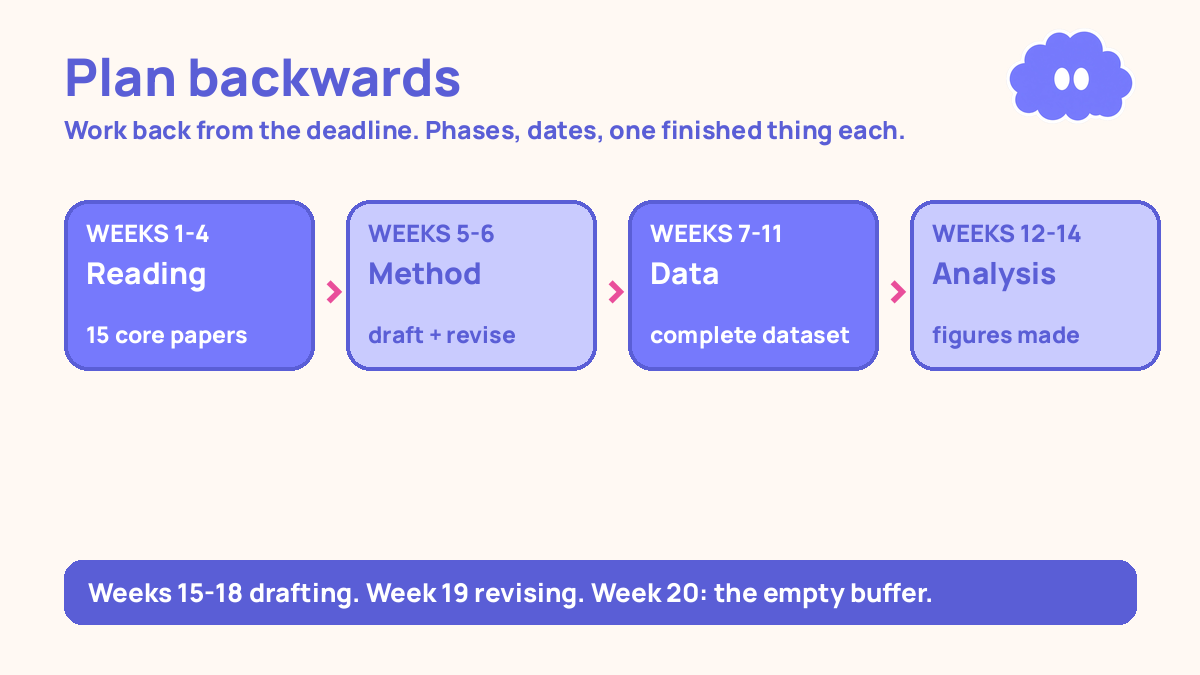
Weeks 1–4 — Reading and question. Finished thing: a one-page question and 15 core papers read, with notes. Weekly tasks: week 1, write the question and search; weeks 2–3, first-pass and second-pass the papers; week 4, write the question page and the outline.
Weeks 5–6 — Method. Finished thing: a method section draft. Week 5, decide the method and write the draft. Week 6, supervisor meeting and revisions.
Weeks 7–11 — Data. Finished thing: a complete dataset. Weeks 7–8, set up and collect. Weeks 9–11, finish collection and clean the data.
Weeks 12–14 — Analysis. Finished thing: analysis done, figures made. Week 12, first analysis. Weeks 13–14, check and finish.
Weeks 15–18 — Drafting. Finished thing: a full draft. One chapter per week, roughly, written badly on purpose and fixed later.
Week 19 — Revising. Finished thing: a full draft read through once, restructured where needed.
Week 20 — Empty. The buffer. Whatever went wrong, this is where it gets fixed. If nothing went wrong, this is a calm final read.
Twenty weeks, six phases, one page. When week 9 arrives, you know exactly what the week is for. When week 9 goes wrong, you know which phase it belongs to, and the plan tells you what to cut or move.
When it goes wrong
You fall two weeks behind and the plan feels ruined. It is not ruined. It is two weeks behind. Replan: cut the smallest thing, move the dates, and keep going. A plan you quietly abandon is worse than a shorter plan you follow.
Your method fails or your data does not work. This is what the buffer week is for, and it is also what your supervisor is for. Take the problem to them with the facts: what you tried, what happened, what you think the options are. A failed method is not a failed project. It needs a smaller question or a different method, and that is a normal part of research.
You keep adding new ideas and the project keeps growing. Write new ideas on a separate list, not in the plan. The plan is what you are doing. The list is what you might do if time allows. At the end of each phase, ask: does this make the project better, or just bigger? A finished project beats a brilliant unfinished one.
The plan is perfect and you still do nothing. Then the problem is not the plan. It is the first step. Shrink it until it fits in 25 minutes: one paragraph, one note, one email. The thesis writing system that keeps moving is built for exactly this — steady small output, every day, instead of waiting for a big day that never comes.
Weekly review checklist
Copy this list and use it each week:
- What is done this week — what exists now that did not exist on Monday?
- Am I on track for this phase, and if not, by how much?
- What is stuck, and is it a decision I need help with?
- What is the one task for next week, small enough to finish?
- What one change will I make to the plan: cut scope, move a date, or shrink the task?
Downloadable infographic spec: one vertical image, title “How to plan a long research project”, with the steps — start from the end, give each phase a finished thing, break the current phase into weeks, keep one page, review and replan every week — and the rule “a plan you quietly abandon is worse than a shorter plan you follow”, in Thynq cream, Cloud Purple, Dark Purple and pink, with the cloud mascot. Text taken word-for-word from this article.
What this system is not
It is not a promise that your project will finish on time, or that the plan will survive contact with reality — it will not, and that is why the weekly review exists. It is not a claim that working backwards is a scientifically proven method. It is a practical way to turn a big project into small dated pieces. And it is not a substitute for the work itself.
Sources
- Dunlosky, J., et al. (2013). Psychological Science in the Public Interest, 14(1), 4-58. Only practice testing and distributed practice received a high utility rating; rereading was rated low.
- Cepeda, N. J., et al. (2006). Psychological Bulletin, 132(3), 354-380. Spaced practice beat massed practice; the optimal gap grows with how long you need to remember.
- Roediger, H. L., & Karpicke, J. D. (2006). Science, 311, 153-160. Students who recalled a passage remembered more a week later than students who restudied it.
For the daily writing this plan protects, read the thesis writing system that keeps moving. For the reading inside your phases, use the research reading system for students.
Questions
How do I start planning a long research project?
Work backwards from the deadline. Write down the finished project, then list the phases that must happen before it — reading, method, data, analysis, writing — and give each phase a start and end date.
How detailed should my plan be?
Detailed enough that next Monday has one clear task, and loose enough that one bad week does not break it. Plan phases in weeks, not days, and leave one empty week before the deadline for the things that go wrong.
What if I fall behind the plan?
Replan, do not panic. Look at what is left, cut the smallest thing first, and move the dates. A plan you quietly abandon is worse than a shorter plan you actually follow.
How do I know if my plan is realistic?
Test it for one week. If you finished what the plan asked for, it is realistic. If you finished half, the plan is twice too big. Adjust the size, not your effort.