
The direct answer
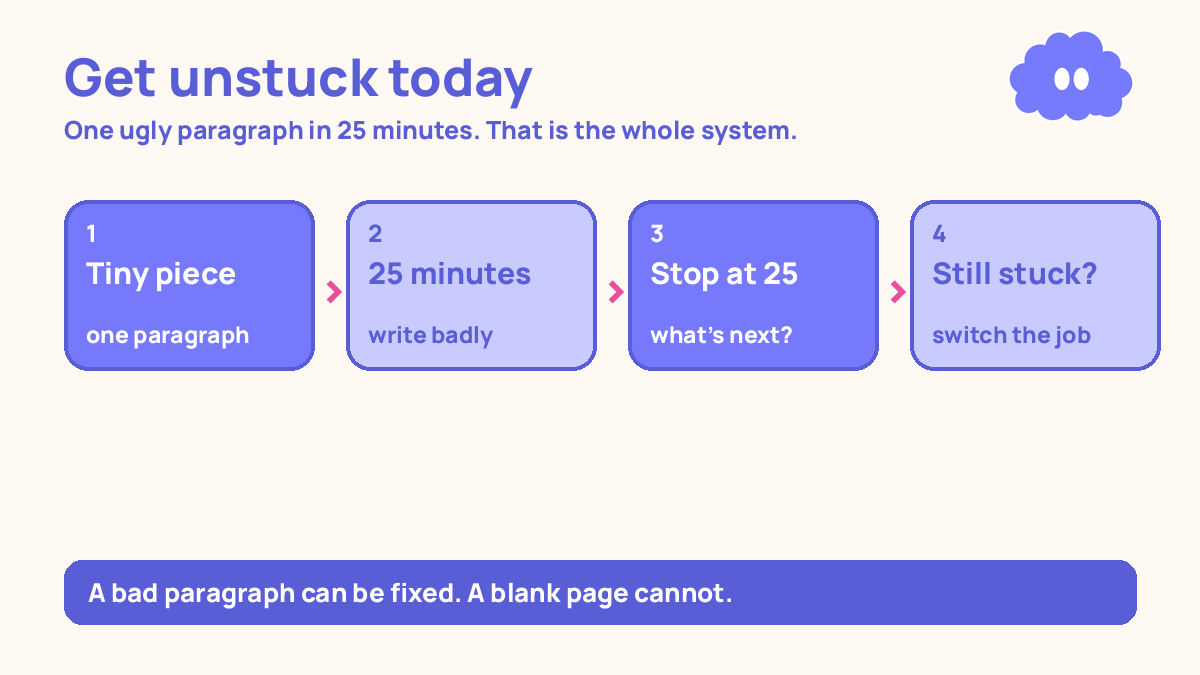
Write one ugly paragraph in 25 minutes, then stop. That is the whole system. You do not need to feel ready, you do not need the perfect opening, and you do not need to fix the whole chapter. You need one rough paragraph that exists, and then you need to do the same thing tomorrow.
Being stuck on a thesis is not usually a knowledge problem. It is a size problem: the thesis is so big in your head that no single piece of work feels worth doing, so you do nothing and the guilt grows. The fix is to shrink the work until it is too small to refuse.
Why theses stall
A thesis stalls in a different way from coursework. An essay has a deadline next week and a clear length. A thesis has a deadline months away and a length that feels endless. There is always a reason to wait: one more paper to read, one more source to check, one more day to think about the structure.
The second trap is the perfect first sentence. You sit down to write the introduction and nothing sounds good enough, so you write nothing. But an introduction is written last, when you know what the thesis actually says. A middle paragraph is what you need now.
The system in short
- Pick one tiny piece of writing: one paragraph, one figure caption, one answer to one question.
- Set a timer for 25 minutes. Write badly on purpose. No editing, no re-reading, no checking sources mid-sentence.
- When the timer rings, stop. Write one line at the top of your notes saying what you did and what is next.
- If you are still stuck after 25 minutes, switch to a different tiny task: sort your references, write the headings, or explain your argument out loud to an empty room.
- Do this every day you can, even on bad days. One paragraph a day is a chapter in a month.
- Once a week, read what you wrote and fix it. Fixing is a separate job from writing, and it happens on a different day.
Step 1: Shrink the task until it fits in 25 minutes
Never sit down to “work on the thesis”. That is not a task, it is a mood. Sit down to write one specific thing: the paragraph that explains why your research question matters, three sentences describing what your method does, the caption for one figure, or what one paper found and why it matters to you.
If you cannot say the task in one line, it is too big. Split it. A thesis is hundreds of these small pieces. You do not write a thesis. You write one paragraph, then another one.
If you genuinely cannot write the paragraph, write the question instead. “I need to explain why I chose interviews instead of a survey, and I am not sure of the reason yet.” A stuck point written down is a problem with a name. A stuck point floating in your head is just dread.
This is the same idea as the thesis writing system that keeps moving: steady small output is the whole method. That one is the daily engine; this one is what you do when the engine will not start.
Step 2: Write badly on purpose
Set a timer for 25 minutes. The 25-minute timer comes from Francesco Cirillo’s Pomodoro Technique, from the late 1980s: 25 minutes of work, a 5-minute break, a longer break after four rounds. The 25-minute length was Cirillo’s practical choice, not a number from cognitive science. If 25 minutes feels too short for writing, try a 50-minute block instead. The rule matters more than the length: a fixed start, a fixed stop, and no editing while the timer runs.
During those 25 minutes, you are not allowed to edit, re-read the last sentence, or open a paper to check one fact. Write as if explaining it to a friend who missed the lecture. Leave gaps in square brackets, like this: [check the year here]. A bracket is a promise to yourself, not a failure.
Bad writing on the page is better than good writing in your head: you can fix the page, your supervisor can read it, and your future self can build on it.
Step 3: When the paragraph will not come, change the job
Sometimes 25 minutes of staring is all you get, and the paragraph still will not come. That does not mean the day is wasted. It means this particular job is blocked, so switch jobs instead of switching off.
Talk it out. Explain your argument out loud, to an empty room or into your phone’s voice recorder. Say what your thesis is about in three sentences. If you cannot say it, you have found the real blockage: the argument is not clear yet, not the writing.
Write the headings. Open a blank page and write only the headings of the chapter, in order, with one line under each saying what that section must do. This turns a shapeless chapter into a list of small jobs.
Sort the mess. Tidy your references. This is the lowest-value work here, so set a timer for it, or it will eat the whole day.
Ask one question. If you are stuck on a real decision — your method, your scope, your argument — write the question down in two sentences and send it to your supervisor. A short, specific question gets a useful answer. “Should I compare three cases or go deep on one, given my word limit?” gets guidance; “I am stuck” gets sympathy. Your weekly review and supervisor meeting system is where these questions get asked properly, but a blocked day is a good day to write one down.
Never end a work session with nothing. The goal of a bad day is contact with the thesis, not output.
Step 4: Separate writing days from fixing days
The fastest way to stay stuck is to write one sentence and fix it, all day. Writing and editing use different parts of your brain, and switching between them every minute is exhausting. It also makes writing feel slow and painful, because every sentence has to be good immediately.
So split them. Writing days are for new words, badly written. Fixing days are for reading what you wrote and improving it. On a fixing day, you are allowed to edit, restructure, cut, and check sources. On a writing day, you are not.
A practical rhythm for a thesis week: three writing days, one fixing day, one planning and reading day. Never make every day a fixing day, or you will polish the same three pages for a month while the rest of the thesis stays empty.
Step 5: Keep a daily log of one line
At the end of each work session, write one line in a notebook or a plain document. Date, what you did, what is next. For example: “Tue 14 Oct — wrote the paragraph on why the question matters. Next: the method paragraph, step by step.”
This log does two jobs. First, it proves to you that you are moving, on the weeks when the thesis still feels enormous. Second, it removes the morning decision. You do not sit down and wonder what to do. You read yesterday’s line, and you know. If you miss a day, write “missed” and move on.
If starting itself is the hardest part, the same shrinking trick works for ordinary study too — see how to start studying when you cannot start.
A worked example: a stuck Tuesday
You have not written anything for nine days. Today you have two hours in the afternoon.
2:00–2:05 — Choose the piece. The task is one paragraph: what your research question is, and why it matters. You write the task on paper and close every other tab.
2:05–2:30 — Timer one. You write badly. The paragraph is clumsy, it repeats itself, and it has two square brackets where you could not remember a detail. It exists. You stop when the timer rings and write one line: “Next: the paragraph on what the method does.”
2:35–3:00 — Timer two. You write the method paragraph, step by step, as if explaining it to a friend. It is rough. It has one bracket. It exists. You log two lines — what you did, what is next — and close the laptop.
Two paragraphs. Two brackets. One log entry. That is not a heroic day. It is a working day, and it is the kind of day a finished thesis is made of.
When it goes wrong
You write for 25 minutes and produce nothing but a sentence you hate. Keep the sentence and stop. Then ask: do I not know what to say, or do I know and I am afraid it sounds stupid? If you do not know, the next job is reading or asking, not writing. If you are afraid it sounds stupid, write it stupidly on purpose and move on. A stupid sentence can be fixed on a fixing day. A missing sentence cannot.
You keep reading “just one more paper” before writing. Set a hard rule: no new reading until you have written today’s paragraph. Reading after writing is fine — it fills gaps you found while writing. Reading before writing, when you already have enough to say one thing, is avoidance in a clever disguise.
You wrote a lot last week and now you cannot face re-reading it. That is normal. Do not re-read it to judge it. Re-read it with a job: underline the sentence in each paragraph that does the work, and cross out the rest. Most rough drafts have a good argument hiding inside extra words.
You miss three days and the guilt makes day four worse. The guilt is the trap, not the missed days. Open the log, write “missed three days”, and write today’s one tiny task. Do not try to make up the lost time in one long session — that is how you miss day five as well. One paragraph today is the whole recovery plan.
Weekly review checklist
Copy this list and use it each week:
- How many writing sessions did I actually do this week, and what exists now that did not exist on Monday?
- What was the smallest task that worked, and can I use it again next week?
- What is the one stuck point I need to ask my supervisor about, as a two-sentence question?
- What did I keep doing instead of writing, and what rule will stop it next week?
- What one change will I make next week: smaller tasks, a different time of day, or writing before reading?
Downloadable infographic spec: one vertical image, title “How to get unstuck on a thesis”, with the steps — pick one tiny piece, write badly for 25 minutes, stop and write what is next, switch jobs if blocked, separate writing days from fixing days, keep a one-line daily log — and the rule “a bad paragraph can be fixed, a blank page cannot”, in Thynq cream, Cloud Purple, Dark Purple and pink, with the cloud mascot. Text taken word-for-word from this article.
What this system is not
It is not a promise that your thesis will be good, or fast, or easy. It is not a claim that 25 minutes is a scientifically proven writing length — it is a practical timer from a student’s kitchen timer, and the honest reason to use it is that it makes starting small. It is a way to keep words appearing on the page while your reading and thinking continue.
Sources
- Dunlosky, J., et al. (2013). Improving students’ learning with effective learning techniques. Psychological Science in the Public Interest, 14(1), 4-58. Only practice testing and distributed practice received a high utility rating; rereading was rated low.
- Cirillo, F. — Pomodoro Technique, late 1980s. 25 minutes work, 5 minutes break, longer break after four. The 25-minute length was Cirillo’s practical choice, not a number derived from cognitive science.
For the daily engine behind this system, read the thesis writing system that keeps moving. For planning the weeks around a stuck chapter, use how to plan a long research project.
Questions
What is the smallest step that actually unblocks a thesis?
Write one ugly paragraph in 25 minutes. Not a good paragraph, not a finished section — one rough paragraph that says what you mean, badly. A bad paragraph can be fixed. A blank page cannot.
Should I keep reading until I feel ready to write?
No. Reading feels like progress, but it can become a way of avoiding the writing. If you have read enough to say one thing about your topic, write that one thing first, then read to fill the gaps.
What if I write something and it is wrong?
Then you have found a real problem to fix, which is progress. Drafts are meant to be wrong in places. Your supervisor can only help you with words that exist — they cannot fix a page you never wrote.
How much should I write on a bad day?
One paragraph, or 25 minutes of trying, whichever comes first. On a bad day the goal is not output, it is contact: you touched the thesis today, so tomorrow does not start from zero.