
The direct answer
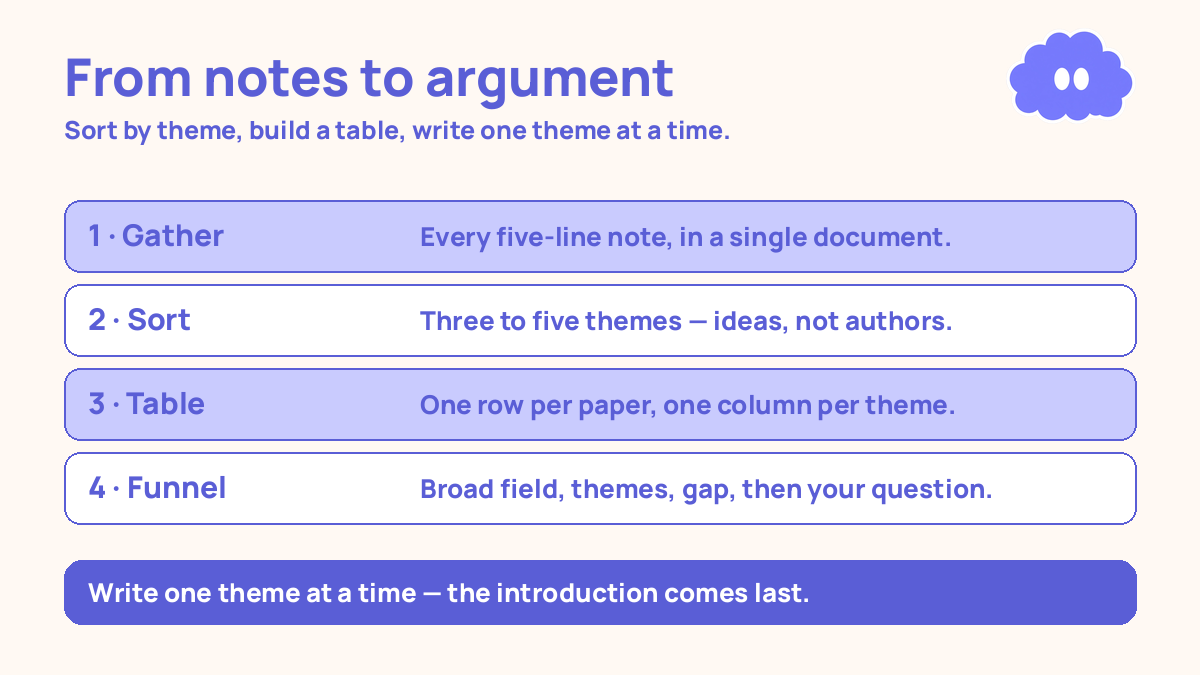
Sort your paper notes into themes, build a small table that compares what the papers say on each theme, and write one theme at a time from your notes — not from the papers. That is the whole system. It turns a pile of reading into an argument: here is what the field knows, here is where it disagrees, and here is the gap your thesis fills.
Most literature reviews fail in the same way. The student writes one paragraph per paper, in the order they read them, and the result is a list, not a review. It reads like a book report. The examiner learns what each paper said and nothing about what the student thinks.
Why the literature review is where theses stall
The first problem is the pile. By the time you start writing, you have read dozens of papers and taken notes on all of them. The pile is too big to hold in your head, so you start with the first paper and write about it, then the second, then the third. That feels like progress. It is not. It is a list with page numbers.
The second problem is the fear of judging. A review asks you to say which papers are strong, which are weak, and where they disagree. But judgement is the job: a review that praises everything equally tells the examiner nothing.
The third problem is starting. The introduction of a literature review is the hardest paragraph to write, because it has to summarise a chapter that does not exist yet. So students stare at it for weeks. Do not start there. Start with the theme you know best, and write the introduction last.
This system assumes you have read the papers and taken notes. If not, start with how to read research papers for a thesis. It sits inside the thesis writing system that keeps moving.
The system in short
- Gather your notes in one place: every five-line note, in a single document.
- Sort the notes into three to five themes — ideas, not authors.
- Build a synthesis table: one row per paper, one column per theme, one line on what it says.
- Outline the review as a funnel: broad field, then themes, then the gap, then your question.
- Write one theme at a time, from your notes, in short daily sessions.
- Once a week, review what you wrote and change exactly one thing.
Step 1: Gather your notes in one place
Before you write a word, collect every note you took while reading. If you used the five-line note — question, method, finding, limitation, connection to your thesis — you already have what you need. If your notes are scattered across apps, PDFs, and loose paper, spend one session gathering them into a single document. You cannot organise what you cannot see.
Work from the notes you have. If a note is missing for a paper that matters, write it now from the abstract and conclusion — ten minutes, not a full re-read. The how to read research papers for a thesis system explains the five-line note in full.
Count your notes before you start. Thirty notes is a chapter. Ten is thin — the fix is more reading, not longer paragraphs. Sixty is a lot — the fix is stricter themes, not a longer review.
Step 2: Sort the notes into three to five themes
Read through your notes once, quickly, and group them by idea. For a thesis on clinic no-shows, the themes might be reminder methods, patient reasons, and the cost of empty slots. The themes come from your notes, not from a textbook.
Aim for three to five themes. Fewer than three, and the review has no shape. More than five, and it becomes a list again. If you have eight themes, merge the small ones. If you have two, split the big one. A theme is a question the papers argue about, not a topic label. “Reminder methods” is a topic. “Do reminders work, and which kind works best?” is a theme.
Write each theme on a line in your document and put the matching notes under it. A note can sit under two themes — but if every note sits under every theme, your themes are not themes yet.
Step 3: Build a synthesis table
For each theme, build a small table. One row per paper, and three columns: what it found, how it found it, and what it missed. Keep each cell to one line. The table is not part of your thesis — it is a tool for thinking, and it does the job that re-reading cannot: it puts the papers side by side so you can see where they agree and where they disagree.
Read down a column to compare all the papers on one point. The disagreements are the interesting part: if three papers say reminders cut no-shows and one says they do not, that disagreement is a paragraph in your review.
Do not skip the “what it missed” column. Limitations are where gaps live: if every paper on a theme used the same kind of clinic or the same method, that sameness is a gap.
Step 4: Outline the review as a funnel
A literature review has a shape: wide at the start, narrow at the end. The funnel is the shape. Start broad — the field and why it matters. Then move through your themes, one at a time, from the most established to the most contested. Then narrow to the gap: what is still unknown or unresolved. Then state your research question, which follows from the gap.
Write the outline as theme headings with one line each: what this theme shows, and what is still missing. If you cannot write the one line, you do not understand that theme yet — go back to the table.
Write the introduction last. Once the themes are written, it says what the chapter covers and where it is going — a paragraph the finished chapter makes obvious.
Step 5: Write one theme at a time, from your notes
Write from your notes and your table, not from the papers. Open the notes for one theme, close everything else, and write one paragraph at a time. A paragraph does one job: it says what the papers agree on, or where they disagree, or what is missing. One idea per paragraph, in your own words, with the citations at the end of the sentence they support.
Start each theme with the point, not the authors. “Reminders cut missed appointments, but the evidence is thin for text messages” is a point. “Smith (2021) studied reminders, and Jones (2022) studied reminders” is a list.
Write in short daily sessions: one theme is two or three sessions of 50 minutes, not one heroic weekend. Count finished paragraphs, not hours. Three honest paragraphs a day is a chapter in two weeks.
When a theme section is drafted, the citation generator formats each source in APA 7, MLA 9 or Harvard and keeps a reference list on your device, so the review and the list grow together.
Step 6: Review what you wrote every week
Once a week, read what you wrote out loud, from the start of the chapter. Reading out loud catches sentences that go nowhere, paragraphs that repeat each other, and places where you summarised instead of synthesising. Ask four questions. Does each paragraph make one point? Does each theme end with what is missing? Is the gap visible yet? And what is the one change I will make next week?
The most common fix is cutting. Cut the paragraph that retells a paper in detail, and the study that belongs to no theme. If a paragraph survives only because you worked hard on it, cut it.
When the themes are written and the gap is visible, write the gap paragraph: what is unknown, then your research question. That paragraph is the hinge of your whole thesis — short, clear, and in your own words.
A worked example: a week of writing the review
You have thirty five-line notes on clinic no-shows, sorted into three themes, and one hour a day.
Monday 9:00–10:00: Gather the notes into one document and sort them under the three themes. Two notes fit nowhere — set them aside.
Tuesday 9:00–10:00: Build the synthesis table for the first theme, reminder methods. The disagreement jumps out: three papers say text reminders work, one says they do not.
Wednesday 9:00–10:00: Write the first theme in three paragraphs: what the papers agree on, the disagreement about text reminders, and what is missing — nobody tested reminders for first-time patients.
Thursday 9:00–10:00: Build the table for the second theme, patient reasons, and write two paragraphs from it.
Friday 9:00–10:00: Build the table for the third theme, cost of empty slots, and write two paragraphs. Weekly review: read the week’s writing out loud. Seven paragraphs done. The gap is forming around first-time patients.
Next week: finish themes two and three, then write the gap paragraph and the research question. Then write the introduction last.
Two weeks, about ten hours. A review organised by theme, with a visible gap, written from notes — not a list of thirty papers.
When it goes wrong
Your review reads like a list of papers. You are writing author by author instead of theme by theme. Sort the notes again, then rewrite one theme with a rule: no paragraph may start with an author’s name. Start with the point; put citations at the end of the sentence.
You have written ten pages and there is no gap. You have summarised, not synthesised. Add one sentence at the end of each theme: what is still unknown here? When those sentences line up, the gap is usually obvious. If not, reframe your themes as questions the papers argue about.
You cannot stop reading and start writing. Reading feels safe and writing feels exposed, so reading wins. Set a rule: for every three papers you read deeply, write one paragraph from your notes. And set a reading freeze date — after it, no new papers unless your supervisor asks for one.
Your supervisor says the review is descriptive, not critical. You reported what the papers say without judging them. Go back to the “what it missed” column and use it: one limitation per paper, stated plainly, turns description into critique.
Weekly review checklist
Copy this list and use it each week:
- How many paragraphs did I actually write this week?
- Does each paragraph make one point, or does it retell a paper?
- Does each finished theme end with what is still missing?
- Is the gap visible yet, or am I still only summarising?
- What is the one change I will make next week?
The one-change rule: pick one change only — stricter themes, a table before writing, or point-first paragraphs.
Downloadable infographic spec: one vertical image, title “How to write a literature review system”, with the six steps and the funnel shape — broad field, themes, gap, research question — in Thynq cream, Cloud Purple, Dark Purple and pink, with the cloud mascot. Text taken word-for-word from this article.
What this system is not
It is not a promise of a grade, and it is not a claim that three to five themes fit every thesis in every field. Some reviews need more themes, and some need a different shape entirely — your supervisor’s advice beats this system when the two disagree. It is a practical system for turning notes into an argument, writing one theme at a time, and ending with a gap your research question can actually follow from.
Sources
- Dunlosky, J., et al. (2013). Improving students’ learning with effective learning techniques. Psychological Science in the Public Interest, 14(1), 4-58. Only practice testing and distributed practice rated high utility; rereading rated low.
- Roediger, H. L., & Karpicke, J. D. (2006). Test-enhanced learning. Science, 311, 1535-1539. Recall beat restudy a week later, though restudiers felt more confident immediately.
- Cirillo, F. — Pomodoro Technique, late 1980s. Classic cycle: 25 minutes work, 5 minutes break, longer break after four. The 25-minute length was Cirillo’s practical choice, not science-derived.
Questions
How is a literature review different from a summary of papers?
A summary retells each paper one by one. A review organises the papers by theme, compares what they agree and disagree on, and shows the gap your thesis fills.
How long should a literature review be?
It depends on your thesis rules, so check them first. As a working rule, it is long enough to cover the main themes and the gap — and short enough that every paragraph earns its place.
What if I have read the papers but cannot start writing?
Start with the theme you know best, not the introduction. Write one paragraph from your notes: what three papers say about this theme, and where they disagree. The introduction comes last.
How do I show the gap my thesis fills?
End each theme with what is still unknown or unresolved. When the themes are laid out, the gap should be visible — then state it plainly in one paragraph before your research question.