
The direct answer
Read each paper in three passes: a five-minute survey to decide if it matters, a focused read of the papers that do, and a short note you can actually use later. That is the whole system. It stops the most common thesis trap — reading endlessly, understanding vaguely, and having nothing written down when the literature review starts.
Most thesis students do not read too little. They read too much, too slowly, with no system for deciding what matters. They open a paper, start at the first line, and three hours later they have finished one paper and understood half of it.
Why reading papers feels endless
The first problem is that a research paper is not written to be read like a book. It is written for other researchers who already know the field. The introduction assumes background you may not have. The methods section is dense. The results section is full of numbers and tables that mean little without the argument around them. Reading it start to finish is the slowest way to find out whether it matters.
The second problem is guilt. Every paper feels like it might be the important one, so skipping feels like cheating. Most papers you find will be background, not building blocks. Your job is to find the papers that change what you think, and understand those properly.
The third problem is notes. Most students take notes that are useless later: long copied paragraphs, or a highlighted PDF with no summary. Three months later those notes say nothing, and you re-read the paper. That is the real cost of bad notes — you pay for every paper twice.
This system fixes all three. It sits inside the wider thesis writing system that keeps moving, and its notes feed into how to write a literature review system.
The system in short
- Keep a reading log: one line per paper, with a verdict — read deeply, skim, or skip.
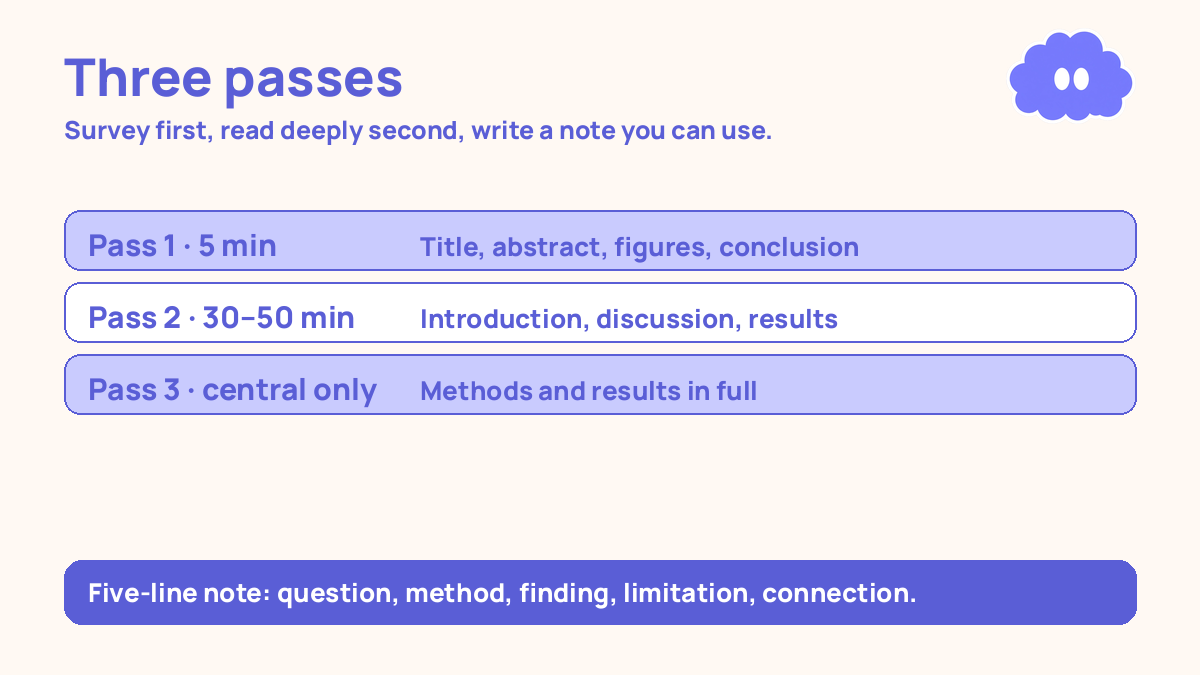
- Pass one, five minutes: title, abstract, figures, conclusion. Decide if it matters.
- Pass two, thirty to fifty minutes: introduction, discussion, and the results that support the claim. Only for papers that passed pass one.
- Pass three, only for central papers: methods and results in full, with a written critique.
- After every paper, write a five-line note: question, method, finding, limitation, connection to your thesis.
- Once a week, review the log and change exactly one thing.
Step 1: Keep a reading log before you read anything
Before you open the first paper, set up a log. A spreadsheet or a notebook page, one line per paper: author and year, title, where you found it, and a verdict column. The verdict has three options only: read deeply, skim, or skip. That is the whole log. It is the most important part of this system, because it is what stops you reading everything.
When you search, add papers to the log first, then decide. Searching and reading are different jobs: search in a batch, log the results, then work through the log in order of relevance.
Set a weekly reading target in papers, not hours. Three papers read deeply and five skimmed is a target you can check. “Read for ten hours” is a target that fills ten hours with re-reading the same introduction. Count finished notes, not hours spent.
Step 2: Pass one — five minutes to decide if it matters
Open the paper and read four things only: the title, the abstract, the figures, and the conclusion. Five minutes, no more. Then ask one question: does this paper change what I think about my topic, or give me evidence I need? If yes, mark it “read deeply”. If it is useful background but not central, mark it “skim”. If no, mark it “skip” and move on.
Figures first: a good figure tells you the result faster than three pages of text, and the caption often states the finding in one sentence.
Do not feel guilty about skipping. A thesis is not a test of how many papers you read. It is an argument, and an argument needs the right papers, not all of them. If you are unsure, mark it skim rather than skip — but do not mark everything “read deeply”. If everything is central, nothing is.
Step 3: Pass two — read the argument, not every line
For the papers that passed pass one, read the introduction and the discussion first, then the results that support the main claim. The introduction tells you the question and why it matters. The discussion tells you what the authors think they found and what it means. The results in between are evidence — read the parts that carry the claim, and skim the rest.
As you read, ask in your own words: what is the claim? What evidence supports it? What would change my mind? Those three questions turn reading into thinking.
If a section confuses you, mark it and keep going. Finish the pass, then go back to it with the full argument in your head.
Keep this pass to thirty to fifty minutes. Use a timer if it helps — 50-minute blocks fit a full pass two nicely. If the paper needs longer than that, it is probably a central paper, and it deserves pass three.
Step 4: Pass three — only for central papers, read it all
A small number of papers — the ones your argument depends on — deserve a full, slow read, including the methods and results in detail. This is pass three, and it is the only pass where you read everything. Before you start, write down why this paper is central: what does your thesis need from it?
Read the methods with one question: could I trust this result? Look at the sample, the measures, and what the authors did about obvious problems. You need to know whether the finding is solid enough to build on.
Read the results slowly and check each claim against the evidence shown. Authors sometimes claim more than their results support. Write down one limitation for every central paper — your examiners will ask, and a limitation you found yourself is a strength.
Pass three should be rare. If you do it on every paper, your pass one is not strict enough.
Step 5: Write the five-line note before you close the paper
Never close a paper without writing a note. Five lines, in your own words:
- The question it asked.
- The method it used.
- The main finding.
- One limitation.
- How it connects to your thesis.
If you cannot write those five lines, you have not understood the paper yet — go back to pass two. If you can, the note is done: it is the paper, for your purposes, from now on.
Write the note in the same place every time — in your reading log, or in a document organised by theme. When the literature review starts, you will work from these notes, not from the PDFs. The how to write a literature review system shows how five-line notes become the sections of your review.
Step 6: Review the log every week
Once a week, open the reading log and ask four questions. How many papers did I finish this week, and how many notes did I write? Which papers turned out to be central, and which were a waste of time? What is the one gap in my reading — the topic, the author, or the method I keep avoiding? And what is the one change I will make next week?
The gap question matters most. Every thesis has a topic the student avoids, usually because it is hard or boring. That avoided topic is often what the examiners ask about. Name it, and schedule one paper on it next week.
Stop reading when the same authors, ideas, and gaps keep appearing. That repetition means you know the field — more reading after that is procrastination with a respectable name.
If the reading list has a deadline, the reading schedule calculator turns the pages left and the days you can read into a daily number, and re-plans the rest when a day slips. For the papers that make the cut, the citation generator formats the reference while you still have the PDF open.
A worked example: a week of reading for a thesis
You are writing a thesis on how small clinics handle missed appointments, and you need the literature on reminders, no-shows, and booking systems.
Monday 9:00–10:30: Search in a batch. Find twelve papers, log them, mark four “read deeply”, five “skim”, three “skip”. Do not read any yet.
Tuesday 9:00–10:30: Pass one on the four “read deeply” papers, five minutes each. One is off-topic; move it to skim. Pass two on the first of the rest.
Wednesday 9:00–10:30: Pass two on the second and third papers, with a five-line note for each. Skim two “skim” papers with one-line notes.
Thursday 9:00–10:30: Pass three on the one paper your argument depends on — the reminder-timing study. Read the methods in full and write a longer note.
Friday 9:00–10:00: Weekly review: four papers read, five notes written, one central paper understood. The gap: nothing on SMS reminders. Schedule two papers on that for next week. Then stop.
One week, about seven hours. Four papers that matter, five-line notes for each, one central paper understood well enough to defend.
When it goes wrong
You have read twenty papers and cannot remember any of them. The notes are missing, not the memory. Go back through the log and write the five-line note for each paper from the abstract and conclusion — ten minutes per paper, and it saves re-reading them all.
You keep reading and never start writing. Reading feels like progress and writing feels like exposure, so reading wins. Set a rule: for every three papers you read deeply, write one paragraph of the literature review from your notes. The how to write a literature review system is built around exactly that rule.
A paper is central but you cannot understand it. Read it in passes: abstract, figures, and conclusion first, then introduction and discussion, then methods and results only if it still matters. Look up the three most confusing terms. Then ask your supervisor about the one point that blocks you — one specific question, not “I don’t understand this paper”.
You cannot tell which papers matter. Ask your supervisor for three papers they consider essential, and read those first. Then look at who those papers cite — the names that appear again and again are the field. If a paper is cited by everything you read, it matters.
Weekly review checklist
Copy this list and use it each week:
- How many papers did I read deeply, skim, and skip this week?
- How many five-line notes did I write, and are they in one place?
- Which papers turned out to be central, and which were a waste of time?
- What is the one gap in my reading that I keep avoiding?
- What is the one change I will make next week?
The one-change rule: pick one change only — a stricter pass one, notes before closing, or one paper on the avoided topic.
Downloadable infographic spec: one vertical image, title “How to read research papers for a thesis”, with the three passes and the five-line note, in Thynq cream, Cloud Purple, Dark Purple and pink, with the cloud mascot. Text taken word-for-word from this article.
What this system is not
It is not a promise of a grade, and it is not a claim that three passes are enough for every paper in every field. Some papers — a new method, a result your whole thesis depends on — will need more than three passes, and that is fine. It is a practical system for deciding what deserves your time, reading the argument instead of every line, and writing notes you can actually use when the literature review starts.
Sources
- Dunlosky, J., et al. (2013). Improving students’ learning with effective learning techniques. Psychological Science in the Public Interest, 14(1), 4-58. Only practice testing and distributed practice rated high utility; rereading rated low.
- Roediger, H. L., & Karpicke, J. D. (2006). Test-enhanced learning. Science, 311, 1535-1539. Recall beat restudy a week later, though restudiers felt more confident immediately.
- Cirillo, F. — Pomodoro Technique, late 1980s. Classic cycle: 25 minutes work, 5 minutes break, longer break after four. The 25-minute length was Cirillo’s practical choice, not science-derived.
Questions
How many papers do I need to read for my thesis?
There is no fixed number. Read until the same authors, ideas, and gaps keep appearing — that repetition means you know the field. A reading log tells you when you get there.
Should I read every paper from start to finish?
No. Most papers deserve one quick pass to decide if they matter. Only the papers central to your argument deserve a slow, full read with notes.
What notes should I take from a paper?
Five things: the question it asked, the method, the main finding, one limitation, and how it connects to your thesis. If you cannot write those five, you have not understood it yet.
What do I do when I cannot understand a paper?
Read it in passes. First the abstract, figures, and conclusion. Then the introduction and discussion. Then, only if it matters, the methods and results in full. Ask your supervisor about the one point that blocks you.