
The direct answer
A thesis that keeps moving is written one ugly paragraph a day, with one clear next action written down before you stop, a stopping point you choose in advance, and a Friday review where you count what actually got written. Do not wait for a perfect day, a perfect chapter, or a reply from your supervisor.
A thesis feels different from normal study because it is long, lonely, and no one tells you what to do today. That is why normal study advice fails here. You do not need more motivation. You need a system that tells you, every day, exactly what the next small action is.
The system in short
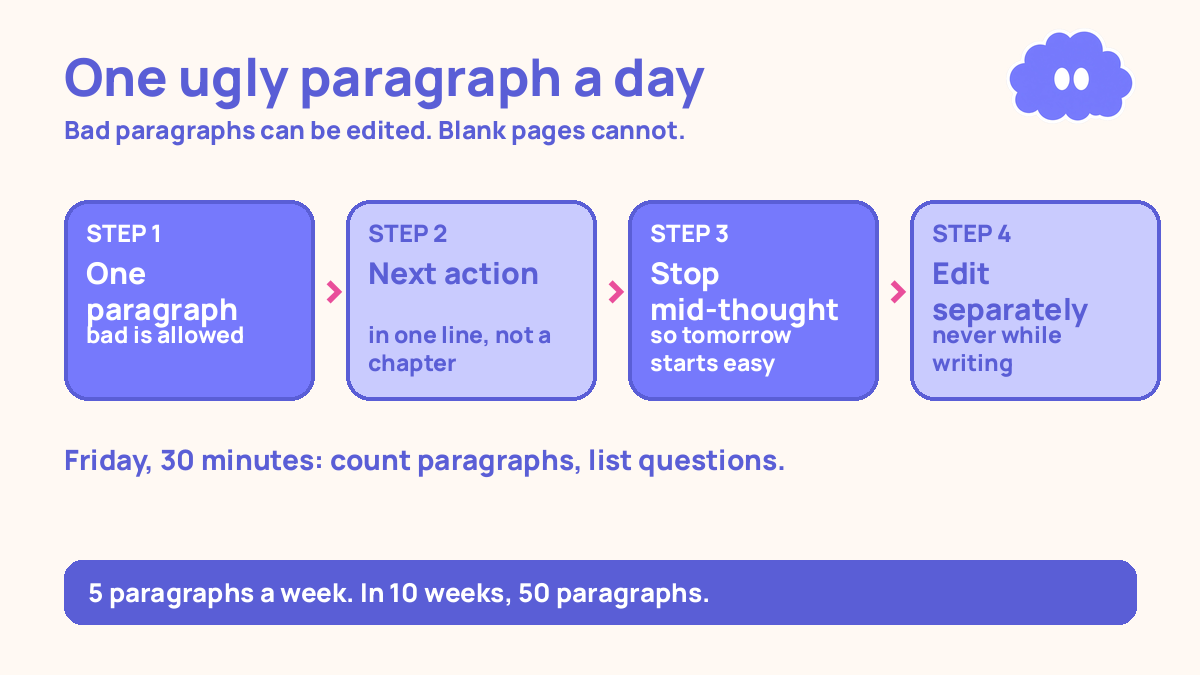
- Write one paragraph a day, even a bad one. Bad paragraphs can be edited. Blank pages cannot.
- Before you stop, write down the next action in one line.
- Stop at a clear stopping point, mid-thought if needed, so tomorrow starts easily.
- Keep a separate editing session. Do not edit while you write.
- Every Friday, count paragraphs written, list questions for your supervisor, and plan next week’s actions.
Step 1: One ugly paragraph a day
Pick a daily target you can keep on a bad day: one paragraph. Not one page, not one section, not “work on the thesis”. One paragraph.
An ugly paragraph is allowed to be unclear, repetitive, and badly worded. Its job is to exist. You will edit it later, in a different session, when you are not also trying to think of what to say next.
If you write more than one paragraph, good. Stop counting after one, and do not raise the target the next day because today went well. A target that grows after good days becomes a target you avoid on bad days. Keep it at one paragraph, every day, until the thesis is done.
Step 2: One next action, not a chapter
“Write chapter 3” is not an action. It is a project, and projects keep you stuck because you do not know where to start.
A next action has a verb and a small finish line:
- Write the method paragraph for the survey sample.
- Summarise the second paper’s findings in three lines.
- List the three limitations of the study design.
Write the next action before you stop for the day, while you still know what you were thinking. Tomorrow, you do not have to decide. You just do the action.
This is the same rule as any study system — one task, not a subject — applied to a project that lasts months. For the full version, see how to build a study system that fits your life.
Step 3: Stop at a clear stopping point
Stop in the middle of a thought, on purpose. Write half a sentence, or a note like “next: explain why this sample was chosen”, and stop there.
Stopping at a clear point does two things. First, it makes tomorrow easy: you already know the first sentence. Second, it stops you from working until you are exhausted, which is how a thesis becomes something you avoid.
If you only stop when you are stuck or tired, you will associate writing with being stuck and tired. Stop while you still know what comes next.
Step 4: Edit separately, never while writing
Writing and editing use different brains, and mixing them is the fastest way to write nothing. When you write, write. When you edit, edit.
Keep two sessions, on different days if you can:
- Writing session: new paragraphs only, no fixing old ones.
- Editing session: fix yesterday’s paragraphs, check references, tighten sentences. No new paragraphs.
If you catch yourself editing a sentence for ten minutes during a writing session, mark it with a note — “fix this later” — and keep writing. The note is your permission to move on.
Three free tools fit this system without taking it over: the essay outline planner for the structure of a section before you write it, the essay word counter to see a chapter against its target, and the citation generator to format a reference the day you use it.
A worked example week
Thesis: a master’s thesis, methods chapter in progress. Time: 9:00-9:45am, Monday to Friday.
- Monday: Write the sample paragraph (ugly, allowed). Next action: write the data collection paragraph.
- Tuesday: Write the data collection paragraph. Next action: summarise the second paper.
- Wednesday: Summarise the second paper in three lines, add them to the literature section. Next action: list three limitations.
- Thursday: List three limitations, one line each. Next action: write the limitations paragraph.
- Friday, 30 minutes: Count: 5 paragraphs written, 3 edited. List 2 questions for the supervisor. Plan next week’s 5 actions, one per day.
That is a thesis moving at 5 paragraphs a week. In 10 weeks, that is 50 paragraphs — more than most chapters — without a single heroic day.
When it goes wrong
You have not written for a week. Do not try to make it up with a marathon day. Write one paragraph today, and one tomorrow. The system restarts with one paragraph, not with guilt.
You do not know what to write. Write what you do know, even if it is “I do not understand this paper yet, because…”. That sentence is a paragraph, and it tells you exactly what to read next.
Your supervisor has not replied. Keep a running list of questions for the meeting, and write the sections you can write without them. Waiting is not a writing plan, and a supervisor meeting goes much better when you bring written work and specific questions instead of “I am stuck”.
You keep rewriting the same paragraph. That is editing disguised as writing. Mark it “fix later”, write the next paragraph, and edit it in the editing session. If a paragraph has been rewritten three times, it is probably good enough for a first draft.
Weekly review checklist
Copy this list and use it every Friday:
- How many paragraphs did I write this week?
- How many did I edit?
- What questions do I have for my supervisor?
- What are next week’s 5 next actions, one per day?
Downloadable infographic spec: one vertical image, title “My thesis week”, with the five steps from “The system in short” and the Friday review questions, in Thynq cream, Cloud Purple, Dark Purple and pink, with the Cloud mascot. Text taken word-for-word from this article.
What this system is not
It is not a promise that your thesis will be accepted, and it is not a substitute for your supervisor, your university’s rules, or good research. It is a way to keep a long project moving on normal days, with a clear record of what got written and what you still need help with. That record is also what makes supervisor meetings useful.
Sources
- This article is a practical system, not a research summary. The only research claim it relies on is the general study-system rule from the Thynq research base: one task at a time, timed work, and a weekly review where you change one thing. See how to build a study system that fits your life for the research base behind that rule.
Questions
How much should I write each day for a thesis?
One paragraph, written badly if needed, is a real daily target. A thesis is finished by daily paragraphs, not by waiting for a day when you feel ready to write a chapter.
What if I do not know what to write next?
Write down the next action, not the next chapter. ‘Write the method paragraph for the survey’ is an action. ‘Write chapter 3’ is not, and it will keep you stuck.
Should I edit as I write?
No, not in the first draft. Write the ugly paragraph, mark it for editing, and edit in a separate session. Editing while writing is the fastest way to write nothing.
What if my supervisor has not replied?
Do not stop. Write the next section you can write without them, and keep a list of questions for the meeting. Waiting for a reply is not a writing plan.