
The direct answer
Once a week, at the same time, review what you did, what is stuck, and what is next — and write it down on one page. Before every supervisor meeting, send a short agenda with your questions. After the meeting, write down what was agreed and the next step.
A thesis is long enough that a bad month can pass without anyone noticing, including you. You are busy, your supervisor is busy, and the next meeting is always a few weeks away. The weekly review stops drift: fifteen minutes that tells you the truth about where the thesis is.
Why theses drift
The first reason is that nobody is watching the week. Coursework has weekly deadlines. A thesis has a deadline months away, so a week with no writing feels harmless. Then another week passes, and another. By the time your supervisor asks how it is going, not much has happened, and the meeting becomes awkward instead of useful.
The second reason is that meetings without an agenda waste the one hour you have. You walk in, describe what you have been doing vaguely, your supervisor asks a few questions, and you leave feeling you should “keep going”. Nothing was decided. Nothing was written down.
The third reason is that stuck points stay private. You are stuck on your method, or your argument, or one chapter, and you do not want to look foolish, so you do not mention it. But supervisors expect stuck points — it is their job to help with them, and they can only help with problems they know about. A problem you name is a problem with a solution. A problem you hide is a delay.
The system in short
- Pick a weekly review time and keep it. Fifteen minutes, same day, same hour.
- Answer three questions in writing: what did I do, what is stuck, what is next?
- Keep a one-page running log: date, what you did, what is next. One line per session.
- Before every supervisor meeting, send a short agenda: what you did, your questions, your plan.
- In the meeting, ask your questions first, before the general chat eats the hour.
- After the meeting, write down what was agreed and the next step, and send it to your supervisor.
Step 1: The fifteen-minute weekly review
Choose a time and protect it — Sunday evening, or Friday afternoon, when the week is still fresh. Fifteen minutes is enough. Longer and you will skip it.
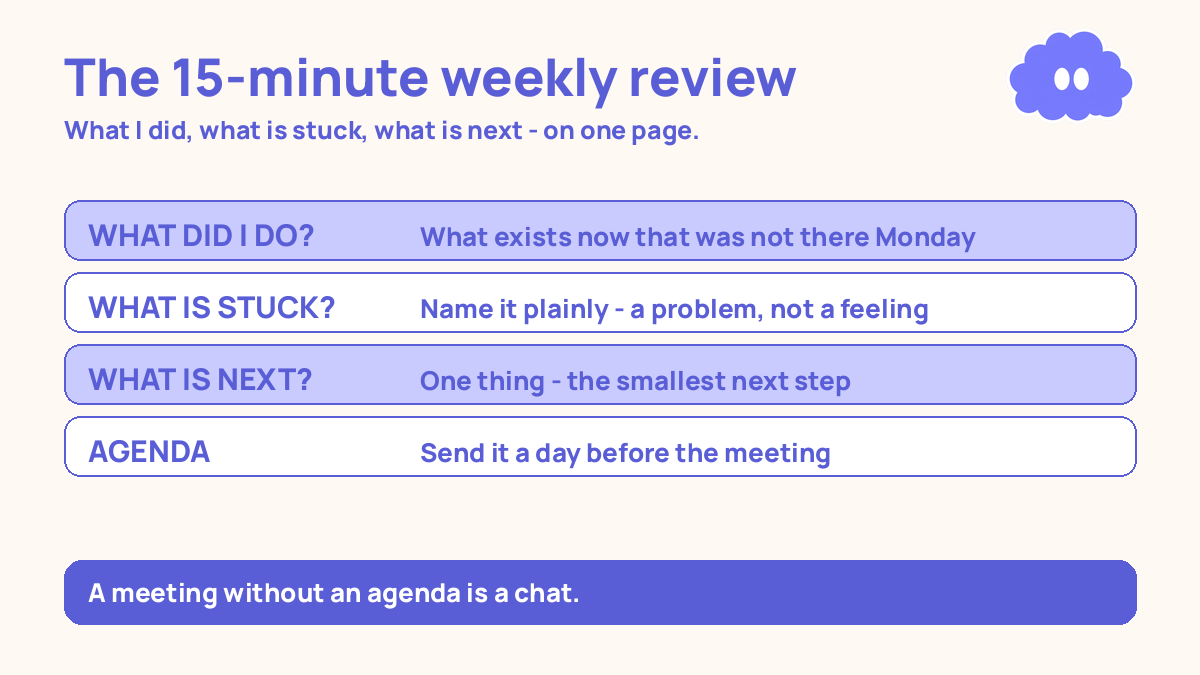
Answer three questions, in writing, on one page:
- What did I do this week? Not what you planned, or what you thought about. What exists now that did not exist on Monday: paragraphs written, papers read, notes made, data collected.
- What is stuck? Name it plainly. “I do not know how to structure chapter 3” is a stuck point. “The thesis is going badly” is a feeling, and feelings cannot be fixed.
- What is next? One thing, the smallest next step. Not five things. One.
That is the review. Done every week, it means your supervisor meetings start from facts instead of feelings. If you already review your study week in general, the weekly study review system is the same habit applied to ordinary study.
Step 2: Keep a one-page running log
The weekly review needs material, and it comes from a daily log of one line per session. Date, what you did, what is next. For example: “Tue 14 Oct — wrote the paragraph on why the question matters. Next: the method paragraph.”
One page holds a month of entries. When review time comes, you read the page instead of trying to remember the week. When your supervisor asks what you have been doing, you have an answer with dates on it.
The log also catches drift early. If the last three entries all say “read papers”, you have not written anything in three sessions, and the review will show it. A week with no log entries is also information: the week got away from you, and the next review should ask why.
Step 3: Write the agenda before the meeting
A meeting without an agenda is a chat, and a chat rarely moves a thesis. A good agenda fits in a short email:
- What I did since last time: three or four lines, from your log.
- My questions: one or two, written as real questions. “Should I compare three cases or go deep on one, given my word limit?” is a question your supervisor can answer. “I am stuck on chapter 3” is not.
- What I plan to do next: two or three lines. This shows you have a plan, and gives them something to correct if it is wrong.
Send it a day before the meeting. Your supervisor is busy, and an agenda sent the morning of the meeting will not be read. A day gives them time to think, which means you get real answers instead of first reactions.
If you are stuck on what to write, start from your weekly review. The stuck point becomes question one. The next step becomes your plan. The agenda writes itself when the review exists.
Step 4: Ask your questions first
Meetings fill up with general chat: how the reading is going, what you thought of a paper, what the department is doing. None of it is useless, but it eats the hour, and your real questions get squeezed into the last five minutes.
So ask your questions first. Open with them: “I have two questions today. First, should I compare three cases or go deep on one?” This is not rude. Supervisors prefer it — it tells them what you need, and it respects their time.
Take notes during the meeting, in your own words. Write down what your supervisor actually said, not what you hoped they said. Notes taken in the meeting beat notes reconstructed from memory the next day.
If the meeting produces a decision, say it back: “So I will go deep on one case and cut the comparison section. Is that right?” Saying it back catches misunderstandings while there is still time to fix them.
Step 5: The follow-up note
Within a day of the meeting, send a follow-up: thank them, say what was agreed, and say what you will do next, and by when.
For example: “Thanks for today. As agreed, I will go deep on one case and cut the comparison section, and I will send you the revised chapter 3 outline by Friday.” That note proves you were listening, creates a written record, and gives your supervisor a chance to correct you if you misunderstood.
The follow-up note is also your next review’s starting point. When review time comes, you read it and ask: did I do what I said I would do? If yes, the thesis is moving. If no, you know exactly where it stopped.
Step 6: When meetings go quiet
Sometimes your supervisor cancels, or does not reply, or the meeting keeps slipping. This is normal — supervisors are busy, and it is rarely personal. A cancelled meeting is not a cancelled week.
Keep working from your plan. Send a short written update anyway: what you did, what is stuck, what you plan next.
If the silence lasts more than two or three weeks, send one polite follow-up asking for a new date. Keep the log going in the meantime — when the meeting finally happens, your agenda will be strong.
If you are stuck and waiting for a meeting to get unstuck, do not wait. Use how to get unstuck on a thesis to keep words appearing on the page while you wait.
A worked example: a Friday review and a Monday meeting
You have a supervisor meeting on Monday at 11am. It is Friday afternoon, your review time.
Friday 4:00–4:15 — Weekly review. You open your log. This week: two writing sessions, three papers read, one methods note. Stuck: compare three cases or go deep on one? Next: decide the case question, then write the method paragraph.
Friday 4:15–4:30 — Agenda. You write a short email. What you did: two sessions, three papers, one note. One question: the case question. Plan: decide it, write the method paragraph, send the revised chapter 3 outline by next Friday. You send it.
Monday 11:00 — Meeting. You open with the question. Your supervisor says go deep on one case, and explains why. You write it down and say it back: “So I will go deep on one case and cut the comparison section.” They agree.
Monday 2:00 — Follow-up. You send three lines: thanks, what was agreed, what you will do by Friday.
One review, one agenda, one meeting, one note. The thesis moved this week.
When it goes wrong
Your review shows three weeks with almost nothing done. Do not hide it, and do not quit the review. The review is doing its job — it found the problem. Ask what got in the way: was the task too big, was the time wrong, or were you waiting for a meeting? Change one thing next week. The review is not a report card. It is a tool for finding the one change that matters.
You send an agenda and your supervisor does not read it. Send it earlier next time, and keep it shorter. If it is still ignored, open the meeting by reading your questions out loud. The agenda is a tool, not a test.
The meeting leaves you with no clear next step. Write down the smallest next step yourself before you leave the room, and put it in your follow-up note. If your supervisor disagrees, they will say so. If this happens every meeting, your questions are too vague — make them smaller and more specific.
You dread the review because it always shows you are behind. Then the review is measuring the wrong thing. Stop counting hours and start counting finished pieces: paragraphs written, notes made, questions answered. A week with two finished paragraphs is a good week. Change what you count, and the review stops feeling like an accusation.
Weekly review checklist
Copy this list and use it each week:
- What did I actually do this week — what exists now that did not exist on Monday?
- What is stuck, named plainly as a problem, not a feeling?
- What is the one next step, small enough for one session?
- Is a meeting coming up, and is the agenda written and sent?
- What one change will I make next week: a different review time, smaller tasks, or earlier agendas?
Downloadable infographic spec: one vertical image, title “Thesis weekly review and supervisor meeting system”, with the steps — fifteen-minute weekly review, one-page log, agenda before the meeting, questions first, follow-up note after — and the rule “a meeting without an agenda is a chat”, in Thynq cream, Cloud Purple, Dark Purple and pink, with the cloud mascot. Text taken word-for-word from this article.
What this system is not
It is not a promise that your supervisor will always reply, or that every meeting will be useful. It is not a claim that fifteen minutes is a scientifically proven review length — it is a practical habit, short enough to keep. It is a way to manage yourself, so the weeks between meetings do not quietly disappear.
Sources
- Dunlosky, J., et al. (2013). Psychological Science in the Public Interest, 14(1), 4-58. Only practice testing and distributed practice received a high utility rating; rereading was rated low.
- Cepeda, N. J., et al. (2006). Psychological Bulletin, 132(3), 354-380. Spaced practice beat massed practice; the optimal gap grows with how long you need to remember.
- Roediger, H. L., & Karpicke, J. D. (2006). Science, 311, 153-160. Students who recalled a passage remembered more a week later than students who restudied it.
For the daily writing this system protects, read the thesis writing system that keeps moving. For the reading that feeds your meetings, use the research reading system for students. For planning the months around your meetings, use how to plan a long research project.
Questions
How often should I review my thesis progress?
Once a week, at the same time each week. A short review — what I did, what is stuck, what is next — keeps small problems from becoming lost months. Daily logs help, but the weekly review is where you decide.
What should I send my supervisor before a meeting?
A short agenda: what you did since last time, the one or two questions you need answered, and what you plan to do next. Send it at least a day before, so they can read it instead of hearing it cold.
What if my supervisor cancels or goes quiet?
Keep working from your plan and send a short written update anyway. A cancelled meeting is not a cancelled week. If the silence lasts more than two or three weeks, send one polite follow-up asking for a new date.
What do I do when a meeting leaves me with no clear next step?
Write down the smallest next step yourself before you leave the room, and send it to your supervisor in your follow-up note. If they disagree, they will say so. A vague meeting only becomes a lost week if nobody writes down what happens next.