The direct answer
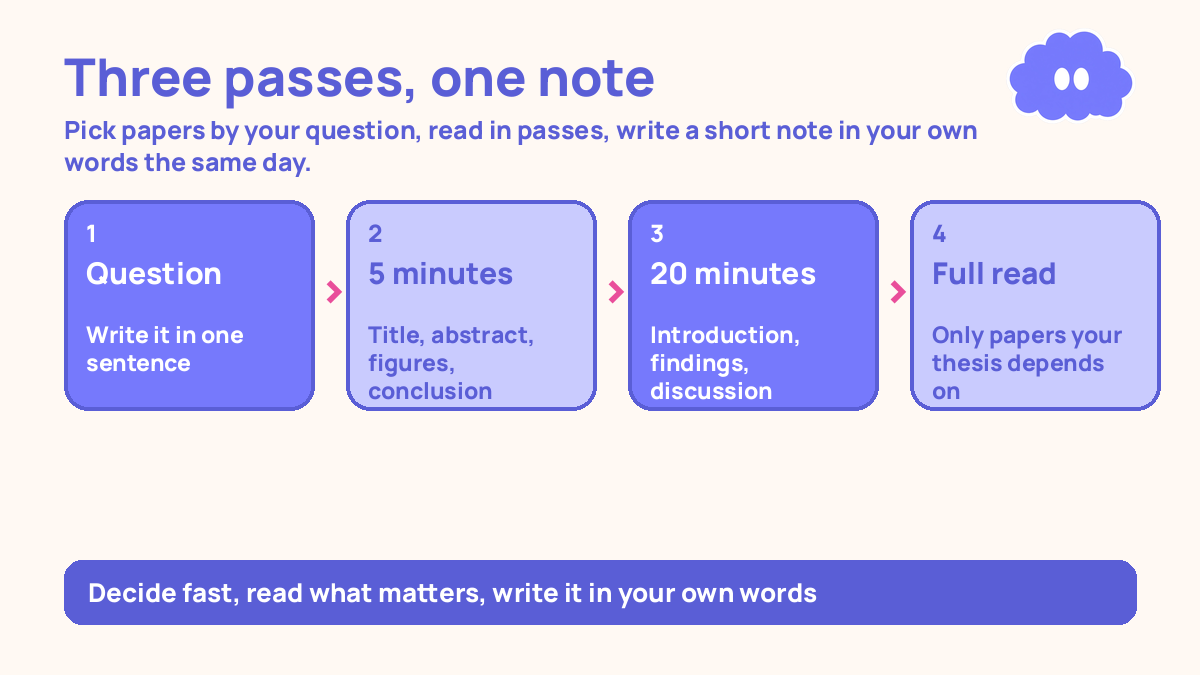
Pick papers by your question, read each one in three passes, and write a short note in your own words the same day. That is the whole system. You do not read everything, you do not highlight everything, and you do not save papers for later.
Most students read research backwards. They open a paper at the top, read every word, highlight half of it, and reach the end with no clear idea of what it said. Then they save it and never look at it again. That is not a reading problem. It is a system problem: no decision before reading, no note after reading, and no plan for remembering.
Why research reading goes wrong
The first problem is volume. A search returns hundreds of papers, and every one looks important. Without a question to filter by, you cannot tell a paper that answers your question from one that is merely about your topic.
The second problem is how you read. Reading a paper like a novel — start to finish, every word — is slow and forgettable. The abstract, the headings, the figures and the conclusion carry most of the meaning.
The third problem is the note you never write. Highlighting feels like taking notes, but it is not — a highlighted sentence is still the author’s words. A note in your own words, written the same day, is the thing that survives. If you cannot explain a paper in three sentences, you have not understood it yet.
The system in short
- Write your question in one sentence before you search. Every paper is judged against it.
- First pass, five minutes: title, abstract, headings, figures, conclusion. Decide: keep, maybe, or drop.
- Second pass, twenty minutes: read the introduction, the findings, and the discussion. Write three sentences in your own words.
- Third pass, full read: only for the few papers your thesis actually depends on.
- Write the note the same day: what it found, why it matters to you, and where it goes in your thesis.
- Review your notes the next day, in three days, and in seven days — a practical starting schedule, not a research rule — by testing yourself, not re-reading.
Step 1: Write the question before you search
Before you open a database, write one sentence: what do I need this reading to answer? That sentence is your filter. A paper that does not speak to it is a “drop”, however famous it is.
Without the question, every paper looks relevant, and you end up with a folder of 80 papers and no argument. With it, the same search gives you 15 papers that matter and 65 you can ignore.
Keep a one-page list of your questions — a thesis usually has three to five. When a new question appears while you read, write it on the list instead of chasing it. Chasing every new question is how a focused session becomes three hours of wandering.
If you are planning a whole project and not sure what your questions even are yet, start with how to plan a long research project.
Step 2: The five-minute first pass
Every paper gets a first pass of five minutes. Read the title and the abstract. Skim the headings. Look at the figures and tables. Read the first paragraph of the discussion and the conclusion. Then decide one of three things:
- Keep: this paper speaks to my question. It gets a second pass.
- Maybe: it might matter, but I cannot tell yet. It goes on a short list with one line saying why.
- Drop: it does not speak to my question. Delete it or move it out of the way.
The decision is the point. Most papers are drops, and dropping is not failure. Dropping a paper in five minutes beats reading it for an hour and then dropping it.
Do the first pass the same day you save a paper. A saved paper with no decision becomes part of a pile, and piles grow until they feel impossible.
Step 3: The twenty-minute second pass
A “keep” paper gets a second pass of about twenty minutes. Read the introduction properly — this is where the author says what the gap is and what they did about it. Read the findings, look at the figures again slowly, and read the discussion.
While you read, write three sentences in your own words: what did this paper find or argue, how did it find it (method, sample, setting), and why does it matter to my question?
Three sentences is enough. If you write more, you are copying, not understanding. If you cannot write them, you have not understood the paper yet: either it needs a full read, or it is not about your question and should have been a drop.
Do not highlight first. If you must highlight, mark one sentence per section at most, and only after you have written your three sentences. Highlighting first is how you end up with a yellow paper and an empty head. In a 2013 review of ten common study techniques, Dunlosky and colleagues rated only two as high utility: practice testing and distributed practice. Highlighting and rereading were rated low.
Step 4: The full read, for the few that earn it
Only a small number of papers deserve a full read — the ones your thesis depends on. These are the papers you will cite, the ones whose method you are building on, or the ones whose findings you disagree with. For most students, that is 10 to 15 papers.
A full read is slow, and that is fine, because you are only doing it for papers that earned it. Read the whole thing, including the method section, and write a longer note: one paragraph on the argument, one on the method and its limits, and one on exactly where it fits in your thesis.
If you are stuck turning reading into words, how to get unstuck on a thesis covers exactly that gap: one ugly paragraph at a time, from notes like these.
Step 5: Notes you can actually use
Your notes are the product of this system, not the papers. A good note fits on half a page: the citation, what it found (your three sentences), why it matters to you (one sentence), and where it goes (the chapter, or “not sure yet”).
Keep all your notes in one place — one document, one notebook, one folder. When you sit down to write a chapter, you should be able to open one document and see every paper that belongs in it. This is the same idea as the notes system that you can actually review.
One rule: never copy a paragraph from a paper into your notes without writing your own version underneath it. A copied paragraph is storage, not understanding.
Step 6: Review by testing yourself, not re-reading
Reading a paper once does not mean you will remember it. Reviewing your notes does. Review each note the next day, in three days, and in seven days — a practical starting schedule, not a research rule. Cepeda and colleagues, in a 2006 synthesis, found that spaced practice beat massed practice, and that the optimal gap is not fixed: it grows with how long you need to remember.
Reviewing means testing yourself. Cover the note, and try to say the three sentences from memory: what the paper found, how, and why it matters to you. Then check. If you get it wrong, that is useful — it tells you which papers you have not really understood. Roediger and Karpicke showed in 2006 that students who recalled a passage remembered more a week later than students who restudied it, even though the restudiers felt more confident immediately.
If a note is easy to recall after a week, let it rest until you need it for writing. If a note keeps failing, rewrite the three sentences in plainer words instead of re-reading the paper. The failure is information: the paper is harder than your note admits.
A worked example: a Tuesday reading session
You have three hours and a question: what methods have researchers used to measure student focus? You searched yesterday and saved 12 papers.
2:00–2:30 — First passes. You do five-minute first passes on six papers. Three are keeps, two are maybes, one is a drop.
2:30–3:10 — Second passes. You do twenty-minute second passes on two of the keeps, writing three sentences for each: what it found, how, and why it matters. One turns out less useful than the abstract suggested — you note that and move it to “maybe”.
3:15–3:55 — Second pass and a full read. You do the third keep’s second pass, then start a full read of the one paper your method will build on, writing a longer note: argument, method and limits, and where it goes.
3:55–4:00 — Log. Three lines: 6 first passes, 3 second passes, 1 full read started. Tomorrow: finish the full read, then first-pass the remaining 6 papers.
By the end of the afternoon you have read three papers properly, decided on six, and started the one that matters most.
When it goes wrong
You read for two hours and cannot remember a single paper. You read without deciding and without writing. Go back and do the first pass properly: five minutes, then a keep/maybe/drop decision in writing.
Your folder has 200 papers and you feel sick every time you open it. Stop adding to it. Work only from your questions list, and first-pass the 10 papers most likely to answer your first question. The other 190 are not a debt you owe.
You highlight everything and your notes are just copied quotes. For your next paper, cover the highlights and write the three sentences from memory first, then check. It will feel slower and worse — that is the feeling of actually learning. The students who felt most confident right after restudying remembered less a week later. Trust the test, not the feeling.
Your supervisor asks about a paper you read three weeks ago and you remember nothing. Do not panic and do not pretend. Say you will check your notes and come back to them — then actually do it, and fix the note so it passes the test next time.
Weekly review checklist
Copy this list and use it each week:
- How many papers did I first-pass, second-pass, and fully read this week?
- How many of my notes can I recall from memory without looking?
- Which notes keep failing — do they need plainer words or a full re-read?
- Is my questions list up to date?
- What one change will I make next week: stricter drops, shorter notes, or a fixed review time?
Downloadable infographic spec: one vertical image, title “Research reading system for students”, with the steps — write your question, five-minute first pass, twenty-minute second pass, full read for the few, note in your own words, review by testing yourself — and the rule “decide fast, read what matters, write it in your own words”, in Thynq cream, Cloud Purple, Dark Purple and pink, with the cloud mascot. Text taken word-for-word from this article.
What this system is not
It is not a promise that you will read faster, or that 10 to 15 core papers is the right number for every thesis — that number is a practical starting point. It is not a claim that three passes are a scientifically proven method. They are a practical way to stop reading everything and start deciding. The argument is still yours to build.
Sources
- Dunlosky, J., et al. (2013). Psychological Science in the Public Interest, 14(1), 4-58. Only practice testing and distributed practice received a high utility rating; rereading and highlighting were rated low.
- Cepeda, N. J., et al. (2006). Psychological Bulletin, 132(3), 354-380. Spaced practice beat massed practice; the optimal gap is not fixed, it grows with how long you need to remember.
- Roediger, H. L., & Karpicke, J. D. (2006). Science, 311, 153-160. Students who recalled a passage remembered more a week later than students who restudied it, though restudiers felt more confident immediately.
For the writing this reading feeds into, read the thesis writing system that keeps moving. For the weekly rhythm behind your reading and meetings, use the thesis weekly review and supervisor meeting system.
Questions
How many papers should I read for a thesis?
Enough to answer your question, not a fixed number. Start with 10 to 15 core papers you read properly, then add more only when a gap in your argument needs one. A long list of half-read papers helps nobody.
Should I read every paper from start to finish?
No. Read in three passes: a five-minute pass to decide if it matters, a twenty-minute pass for the argument and findings, and a full read only for the few papers your thesis actually depends on.
How do I remember what I read?
Write a short note in your own words the same day, then test yourself on it later instead of re-reading. In a 2013 review, Dunlosky and colleagues rated practice testing and distributed practice the only two high-utility techniques; rereading was rated low.
What if I keep saving papers and never reading them?
Stop saving and start deciding. For every paper you save, spend five minutes on the first pass the same day. A saved paper you never open is not research, it is a pile.