
The direct answer
The SQ3R reading method for students is five moves on one chapter: Survey it, turn the headings into Questions, Read one section at a time looking for the answers, Recite each section from memory with the book closed, and Review the questions again after a gap. That is the whole system. It works because you read with a question in mind instead of drifting through pages, and because the recite step tests you before you move on.
Why the SQ3R reading method for students works
You open the textbook at 6pm. Forty pages on cell division. You start at the top and read. The words make sense. You turn the page, then another. At 7pm you close the book and realise you could not say what the chapter was about. You read every word and kept almost none of it.
That is not a memory problem. It is a reading problem. The SQ3R reading system for students fixes the reading, not the memory. It gives you a question before each section, so you know what you are looking for, and it stops you after each section to say what you found, so the reading becomes learning instead of page-turning.
Dunlosky and colleagues rated re-reading as low utility in 2013, and rated practice testing as high. Roediger and Karpicke showed in 2006 that students who recalled a passage remembered more a week later than students who restudied it. SQ3R is built around that finding: the recite step is the test, and the review step is the spacing.
The system in short
- Survey the chapter in five minutes: headings, introduction, summary, diagrams, and any bold terms. Do not read the body text yet.
- Question: turn each heading into a question in your own words. Write the questions down. One question per section.
- Read one section at a time, looking for the answer to its question. Read slowly enough to follow the argument, not to finish the page.
- Recite: close the book and answer the question aloud, in your own words, from memory. Check, fix the gaps, then move to the next section.
- Review after a gap: go through the questions again the next day, then after three days, then after seven. That 1-3-7 pattern is a practical starting schedule, not a research rule.
Step 1: Survey the chapter in five minutes
Before you read a word of body text, spend five minutes looking at the shape of the chapter. Read the introduction and the summary. Read every heading and subheading. Look at the diagrams, tables, and bold terms. Read the questions at the end of the chapter if there are any.
You are not studying yet. You are making a map. After five minutes you should be able to name the chapter’s three or four main sections in one sentence. The survey answers the question students never ask before reading: what is this chapter trying to teach me, and in what order?
Five minutes is a hard limit. Surveying for twenty minutes is procrastination with a respectable name. Those five minutes stop you reading forty pages as one undifferentiated wall.
Step 2: Turn each heading into a question
Take each heading and turn it into a question, in your own words, written down. “Mitosis” becomes “What happens in each stage of mitosis, and what is each stage for?” “The cell cycle” becomes “What controls whether a cell divides, and what goes wrong when the control fails?” One question per section.
Write the questions on paper, in a list, with space under each one. That list is your reading plan and your recite test. A heading is a label. A question is a job.
If a heading is vague — “Introduction” or “Further considerations” — write the question from the survey instead: “What is this section adding that the last one did not?” Vague headings still get questions. The point is that you never start a section without knowing what you are trying to get out of it.
Step 3: Read one section at a time, looking for the answer
Read the first section only, looking for the answer to its question. Read at the speed the material needs, not the speed that gets you to the end. When the text introduces a term, stop and make sure you know what it means before moving on. When it gives an example, check that the example fits the idea.
Do not take notes while you read: notes taken during reading are usually copies of the text, and copying is not thinking. Read the section, then close the book for the recite step, and only then write anything down.
If you catch yourself reading without following the argument — eyes moving, mind elsewhere — stop. Go back to the start of the paragraph, read the question again, and re-read the paragraph with the question in mind. Reading on while lost is how a chapter takes an hour and teaches nothing.
Step 4: Recite the section from memory, with the book closed
Close the book. Answer the section’s question aloud, in your own words, from memory. Say the key terms, the steps, the reason they matter. Do not look at the book while you answer. The recite step is a test, and a test you take with the answers open is not a test.
Then open the book and check. Fix the gaps in one or two lines under the question: the answer, in your own words, with the term you missed.
This is the step that makes SQ3R work, and it is the step most students skip, because it is the uncomfortable one. Reciting feels slow and exposes gaps. That is the point. Roediger and Karpicke’s finding is that the students who felt most confident after restudying did worst a week later, and the students who struggled to recall did best.
Step 5: Review the questions after a gap
When you have recited every section, you have read the chapter once, properly. Now put it away. Come back the next day and go through the question list again, answering each question aloud with the book closed. Then again after three days, then after seven. That 1-3-7 pattern is a practical starting schedule, not a rule from research. Cepeda and colleagues showed in 2006 that spacing beats massing, and that the best gap grows with how long you need to remember the material.
The review takes ten minutes: you re-answer the questions, not re-read the chapter. Any question you cannot answer goes back on the list, and if it fails twice, re-read that one section, not the whole chapter. The question list is the chapter now. The book is the reference you check against, not the thing you re-read.
When a whole textbook is due by a date, the reading schedule calculator tells you how many pages a day that is on the days you can read, and works it out again if you miss one.
A worked example: a cell division chapter, 6:00–7:30pm
Your biology textbook has a 30-page chapter on cell division. The test is in two weeks.
6:00–6:05 — Survey. You read the introduction and the summary, scan the headings, look at the four diagrams. The chapter has four sections: the cell cycle, mitosis, meiosis, and what goes wrong.
6:05–6:10 — Questions. You write four questions, one per section: “What controls whether a cell divides?” “What happens in each stage of mitosis?” “How is meiosis different from mitosis, and why does it matter?” “What goes wrong when cell division is not controlled?”
6:10–6:50 — Read and recite, section by section. You read the cell cycle section, ten minutes, then close the book and answer the question aloud. Two minutes to recite, one minute to check and fix. Same for mitosis, ten minutes to read, three to recite and check. Same for meiosis.
6:50–7:00 — Review the three questions. You answer all three aloud with the book closed. Two of the three are solid. The meiosis answer is shaky: you mix up which division halves the chromosome number. You re-read the one paragraph that explains it, close the book, and answer again. Now it holds.
Wednesday 7:00pm — First review. Ten minutes, four questions, book closed. Three correct. You read the fourth section tonight, fifteen minutes, and recite it.
| Step | Time | What you do |
|---|---|---|
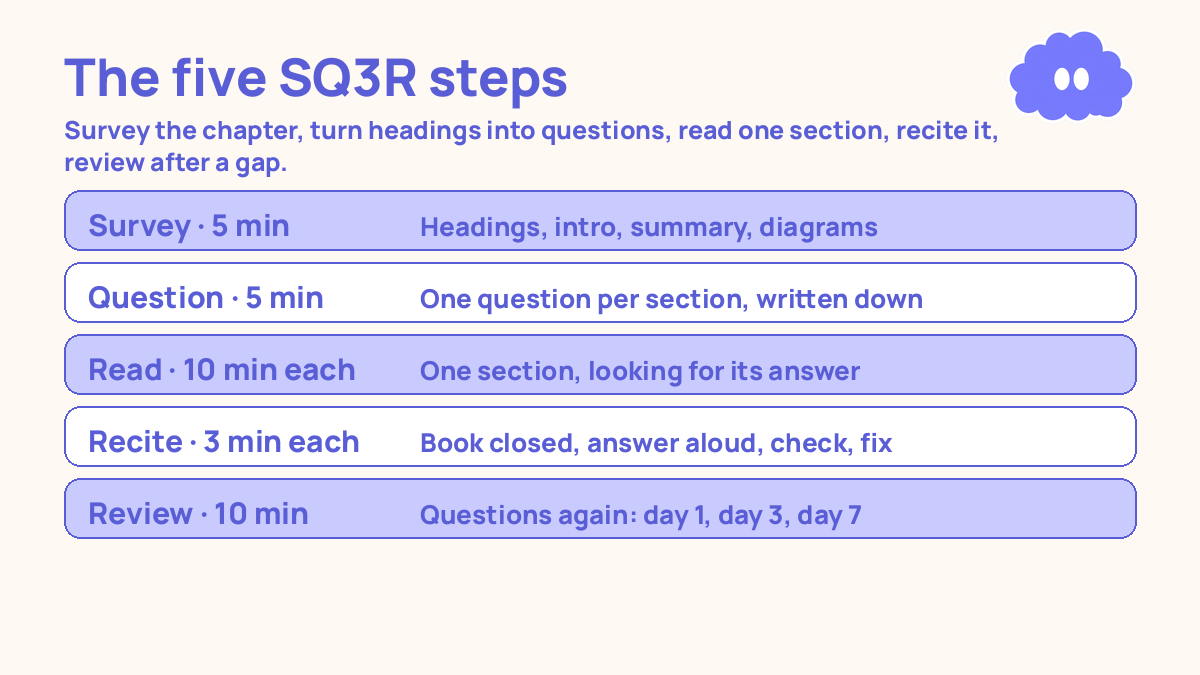
| Survey | 5 minutes | Headings, intro, summary, diagrams |
| Question | 5 minutes | One question per section, written down |
| Read | 10 minutes per section | One section, looking for its answer |
| Recite | 3 minutes per section | Book closed, answer aloud, check, fix |
| Review | 10 minutes | Questions again, next day, day 3, day 7 |
When it goes wrong
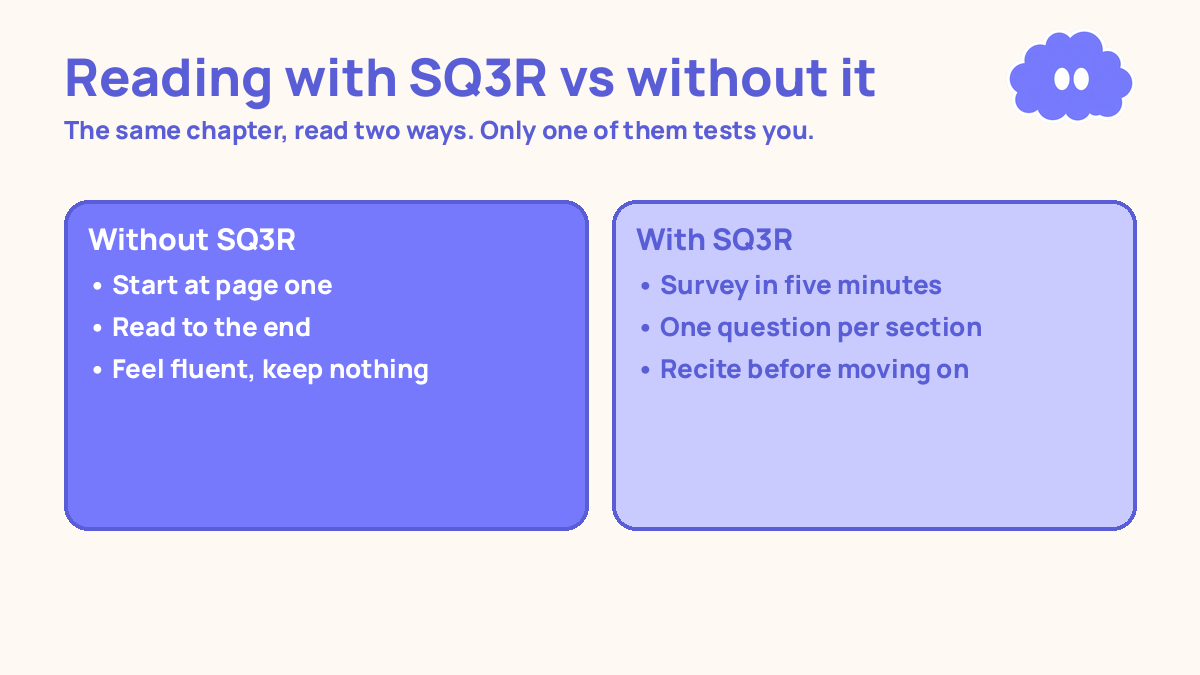
You skip the survey. You open at page one and start reading, because surveying feels like not studying. Fix it with the timer: five minutes, no more, before you read. The survey is what turns forty pages into four sections with four questions.
Your questions are too vague. “What is this chapter about?” is not a question for a section, it is a question for the whole book. Fix it by making each question ask for something specific: a stage, a difference, a reason, a result.
You read without reciting. You read all four sections, then tell yourself you will recite at the end. By the end, the first section is gone. Fix it by reciting after every section, before you read the next one. The recite step is the learning. A chapter read without reciting is a chapter you will have to read again.
The review never happens. You worked through the chapter on Monday, felt good about it, and never opened the question list again. Fix it by writing the review times on the question list itself: “Tue, Fri, next Tue”. The review takes ten minutes. The chapter takes ninety. Skipping the review wastes the ninety.
Weekly review checklist
Copy this list and use it each week:
- How many chapters did I read with SQ3R, and how many did I just read straight through?
- Which recite step did I skip, and what did I lose by skipping it?
- Which questions failed twice, and which section needs a re-read?
- Did I review each chapter’s questions after a gap, or only on the day I read it?
Downloadable infographic spec: one vertical image, title “Read it in five moves”, with the five steps — survey in 5 minutes, question each heading, read one section, recite with the book closed, review after a gap — and the rule “never start a section without a question”, in Thynq cream, Cloud Purple, Dark Purple and pink, with the cloud mascot. Text taken word-for-word from this article.
What this system is not
It is not a speed-reading method, and it is not a promise that one pass through a chapter is enough. SQ3R is slower than reading straight through, on purpose: the recite step after every section costs time, and that time is the learning. It is also not a system for every kind of reading. A research paper for a thesis needs a different approach — see the research reading system for students — and your lecture notes need a notes system that you can actually review. SQ3R is for textbook chapters: bounded, headed, and meant to be learned, not just finished.
Sources
- Dunlosky, J., et al. (2013). Improving students’ learning with effective learning techniques. Psychological Science in the Public Interest, 14(1), 4-58. Re-reading rated low utility; only practice testing and distributed practice rated high.
- Roediger, H. L. & Karpicke, J. D. (2006). Test-enhanced learning. Psychological Science, 17(3), 249-255. Students who recalled a passage remembered more a week later than students who restudied it, even though restudiers felt more confident immediately.
- Cepeda, N. J., et al. (2006). Distributed practice in verbal recall tasks. Psychological Bulletin, 132(3), 354-380. Spaced practice beat massed practice; the best gap grows with how long the material must be remembered.
For the full system behind this method, start with how to build a study system that fits your life.
Questions
How long does SQ3R take for one chapter?
About 60 to 90 minutes for a standard chapter. Roughly 5 minutes to survey, 5 to write questions, 30 to 45 to read in sections, 10 to recite, and 10 to review.
Does SQ3R work for maths or problem chapters?
Partly. Survey and Question still work: turn each worked example into the question “what problem does this solve?” But the Read step becomes doing, not reading — work the example yourself with the book closed, then check. Recite means redoing the problem from memory.
What if the chapter has no headings?
Make your own breaks. Read the first paragraph and the last paragraph, look at the diagrams, and split the chapter into chunks of about five pages. Turn each chunk into one question: “what is this chunk trying to show me?” The headings are a convenience, not the system.
Is SQ3R better than just reading the chapter twice?
Yes, for remembering it later. Reading twice is re-reading, and Dunlosky and colleagues rated re-reading low utility in 2013. SQ3R adds the two moves that matter: questions before you read, and reciting from memory after each section instead of moving on.