The direct answer
The mind mapping system for students is simple: put one idea in the centre of the page, draw four to six main branches for its parts, add sub-branches with single keywords, draw links between branches that connect, and then close the map and rebuild it from memory. That is the whole system. It works because a map shows how ideas connect, which linear notes hide — and because rebuilding it from memory is the test that tells you whether you actually know the connections.
Why the mind mapping system for students starts with connections
Some topics are lists. The causes of the First World War are not a list. They are a tangle: alliances, arms races, nationalism, and a single assassination, each feeding the others. Write them in a line and the connections disappear. You end up memorising four separate facts and missing how they made each other worse.
The mind mapping system for students is for topics like that: topics where the connections are the point. A map puts the idea in the centre and lets the branches show what belongs together and what causes what.
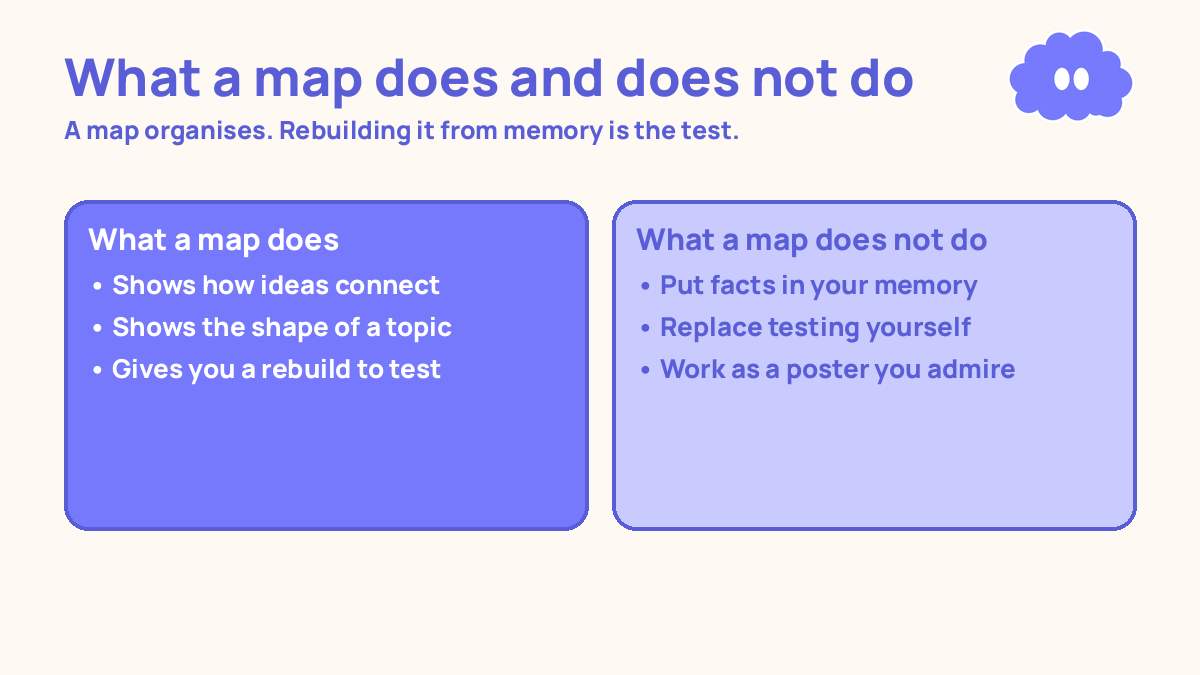
But be honest about what a map does not do. In 2011, Karpicke and Blunt found the retrieval group scored 0.67 a week later against 0.45 for the concept-mapping group. The mappers predicted they would do best. They did not. A map organises material. It does not, by itself, put the material in your memory. This article teaches the map as an organising tool with a test built in, not as a learning method on its own.
The system in short
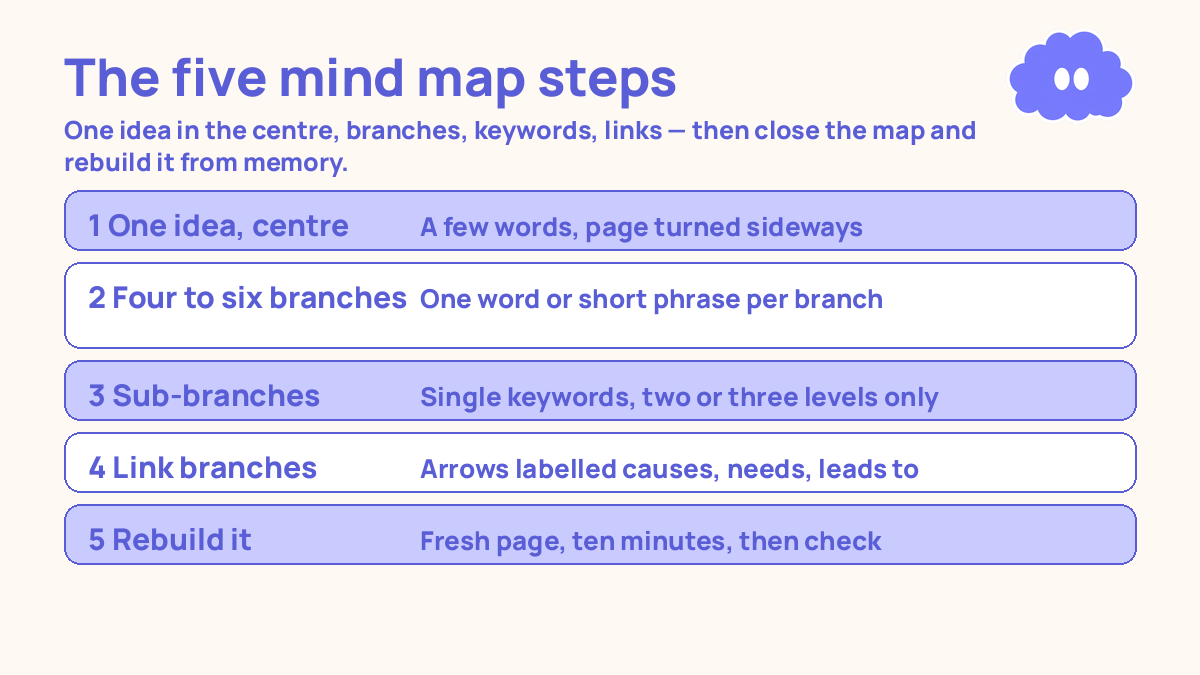
- Centre: write one idea in the middle of a blank page, in a few words. Turn the page sideways — landscape gives the branches room.
- Main branches: draw four to six branches from the centre, one per part of the topic. One word or short phrase per branch.
- Sub-branches: add two or three sub-branches to each main branch, with single keywords. Short phrases only — never sentences.
- Links: draw lines or arrows between branches that connect, and write one word on the line saying how they connect: “causes”, “needs”, “leads to”.
- Rebuild: close the map, take a fresh page, and draw it again from memory. Open the original, check what you missed, and fix the gaps.
Step 1: Put one idea in the centre
Take a blank A4 page and turn it sideways. Landscape gives the branches room to spread. Write the topic in the centre, in a few words: “Causes of WWI”, “The carbon cycle”, “Cell division”. Draw a circle or a box around it. That is the centre, and everything on the page connects back to it.
One idea per map. If the topic is really two topics — “cell division and cancer”, for example — make two maps and draw one link between them, rather than one map with two centres. A map with two centres is a map with no centre.
Do not decorate the centre: the time goes on the branches and the links, not on the middle.
Step 2: Draw four to six main branches
From the centre, draw four to six main branches, one per part of the topic. For the causes of WWI: alliances, militarism, imperialism, nationalism, and the assassination. For the carbon cycle: photosynthesis, respiration, combustion, decomposition, and the oceans. Each branch gets one word or a short phrase, written along the branch, not at the end of it.
Four to six is a real limit, not a suggestion. Fewer than four and you have not split the topic properly. More than six and the map turns into a spiderweb nobody can read. If a topic has eight parts, it is two topics.
One colour per branch can help you see the parts at a glance, but do not spend time choosing colours.
Step 3: Add sub-branches with single keywords
Each main branch gets two or three sub-branches. One keyword each, or a short phrase of two or three words. Under “alliances”: “Triple Alliance”, “Triple Entente”, “secret treaties”. Under “militarism”: “arms race”, “naval rivalry”, “war plans”. Never a sentence. A sentence on a branch is a note, not a map, and the map’s job is to show structure, not to hold text.
Single keywords force a decision: what is this sub-branch really about? If you cannot reduce it to a keyword, you do not understand it well enough yet.
Stop at two or three levels: centre, main branches, sub-branches. More detail belongs in your notes, not on the map.
Step 4: Draw the links between branches
Look at the branches and ask: which ones connect? Draw a line or an arrow between them, and write one word on the line saying how they connect: “causes”, “needs”, “leads to”, “opposes”, “depends on”.
Three links change the map from a set of categories into an argument: arms race to war plans, “forces”; nationalism to assassination, “motivates”; alliances to war plans, “turns local war into general war”. The links are where the understanding lives — and what exam questions ask about.
If you cannot find any links, the branches are wrong: go back to step 2 and re-split the topic. A map with no links is a list drawn in a circle.
Step 5: Close the map and rebuild it from memory
Put the map away. Take a fresh page. Draw the centre, the branches, the sub-branches, and the links from memory. Give yourself ten minutes. Then open the original and check: which branches did you miss, which links did you forget, which keywords came out wrong?
This is the test. Karpicke and Blunt’s mappers felt confident and did worst a week later, because building feels like learning. Rebuilding from memory is the check that catches the feeling. If you can rebuild the map — centre, branches, links — you know the topic’s shape. If you cannot, the gaps are exact: the branch you forgot is the part you do not know.
Rebuild again after a gap: the next day, then after three days, then after seven. When you can rebuild the whole map without looking, move on to testing the detail with retrieval practice.
A worked example: mapping the causes of WWI, Tuesday 6:00–6:45pm
You have a history essay on the causes of the First World War due Friday, and your notes are four pages of linear text.
6:00–6:05 — Centre. You turn an A4 page sideways and write “Causes of WWI” in the middle, circled. One idea, one centre.
6:05–6:15 — Main branches. Five branches: alliances, militarism, imperialism, nationalism, assassination. One word each, written along the branch.
6:15–6:30 — Sub-branches. Two or three keywords under each: alliances gets “Triple Alliance”, “Triple Entente”, “secret treaties”; militarism gets “arms race”, “naval rivalry”, “Schlieffen Plan”; nationalism gets “Alsace-Lorraine”, “Serbian nationalism”, “press and public opinion”.
6:30–6:38 — Links. Three arrows: arms race to war plans, labelled “forces”; nationalism to assassination, labelled “motivates”; alliances to war plans, labelled “turns local war into general war”.
6:38–6:45 — Rebuild. You close the map and draw it again on a fresh page. Four of five branches come back. You forget “imperialism” entirely, and you miss the link from alliances to war plans. You open the original, fix both, and write the two gaps at the bottom of the new page. Tomorrow you will rebuild again, and the two gaps are the test.
| When to use it | What it is for |
|---|---|
| Before learning a topic | Seeing the shape: parts, order, connections |
| After learning a topic | Checking you hold the whole shape, not just pieces |
| Before writing an essay | Finding the argument: which links carry the point |
| Instead of testing yourself | Nothing — a map is not a test, rebuilding it is |
When it goes wrong
The map becomes an art project. You spend forty minutes on colours, icons, and lettering, and ten minutes on the ideas. Fix it with a time limit: twenty minutes to build the map, then the pen goes down.
Every word goes on the map. Branches carry sentences, sub-branches carry paragraphs, and the map is your notes drawn in a circle. Fix it with the keyword rule: one word or a short phrase per branch, never a sentence. If you cannot reduce it to a keyword, that is the gap to fill, not text to copy.
You never rebuild it from memory. You build a beautiful map, feel like you understand the topic, and file the map away. Fix it by making the rebuild part of the system, not optional: ten minutes, fresh page, book closed, the same evening.
The map is too big to review. Twelve branches, five levels, a page you cannot read at arm’s length. Fix it by splitting the topic. Four to six main branches, two or three levels, one page.
Weekly review checklist
Copy this list and use it each week:
- Which topics did I map this week, and which ones did I only read about?
- Which maps did I rebuild from memory, and which ones did I just admire?
- Which branch or link did I forget in the rebuild, and what does that gap mean?
- Did I test the detail inside the map, or stop at the shape?
Downloadable infographic spec: one vertical image, title “Map the topic, then rebuild it”, with the five steps: one idea in the centre, four to six main branches, sub-branches with single keywords, links between branches, rebuild from memory, plus the rule “a map organises, rebuilding tests”, in Thynq cream, Cloud Purple, Dark Purple and pink, with the cloud mascot. Text taken word-for-word from this article.
What this system is not
It is not a learning method on its own, and it is not a claim that drawing is better than writing. Karpicke and Blunt showed that retrieval beat concept mapping a week later, and the mappers were the most confident and the worst performers. A map is an organising tool. Its value is in the shape it shows and the rebuild that tests it. It is also not about being a “visual learner”. Pashler and colleagues found in 2008 that there is no adequate evidence for matching teaching to learning styles. A diagram helps because the material is spatial — the causes connect to each other — not because of what type of learner you are. Use the map where the material has connections. Where it does not, use a notes system that you can actually review instead.
Sources
- Karpicke, J. D. & Blunt, J. R. (2011). Retrieval practice produces more learning than elaborative studying with concept mapping. Science, 331(6018), 772-775. Retrieval group scored 0.67 a week later against 0.45 for concept mapping; mappers predicted best and did worst.
- Dunlosky, J., et al. (2013). Improving students’ learning with effective learning techniques. Psychological Science in the Public Interest, 14(1), 4-58. Only practice testing and distributed practice rated high utility.
- Pashler, H., et al. (2008). Learning styles: concepts and evidence. Psychological Science in the Public Interest, 9(3), 105-119. No adequate evidence for matching teaching to learning styles.
For the full system behind this method, start with how to build a study system that fits your life, and when you need to check whether you really understand a topic, use how to check your own understanding when studying alone.
Questions
Is mind mapping better than normal notes?
Better for seeing connections, worse for learning facts. A map shows how ideas link, which linear notes hide. But in a 2011 study, students who practised retrieval scored 0.67 a week later against 0.45 for students who built concept maps. Use the map to organise, then test yourself from it.
How many branches should a mind map have?
Four to six main branches off the centre. Fewer than four and you have not split the topic properly. More than six and the map turns into a spiderweb nobody can read, including you.
Does mind mapping work for maths?
For choosing between methods, yes. A map of “ways to solve a quadratic” — factorising, completing the square, formula — with the condition for each, helps you pick the right method. But the map does not teach the methods: you still have to practise each one.
Should I draw maps by hand or on a computer?
By hand, on paper. A map you can redraw from memory in five minutes is the point of the system, and redrawing on paper is fast. Software makes prettier maps and slower ones.