The direct answer
How to revise psychology for exams: list the named studies from your specification, rebuild each one from memory under five headings, build evaluation from named follow-up evidence, drill application to scenarios, then plan and write timed essays and retest the studies after a gap.
You read a study summary twice and it feels familiar. Then the exam asks you to use that study in an essay, and you remember the researcher’s name and almost nothing else. The exam asks you to produce the study, judge it, and apply it. Reading never did.
This article is written around the A level shape of that demand, for readers asking how to revise A level psychology: 16-mark essays and the AO1, AO2, and AO3 split. AO1 is knowledge and understanding, AO2 is application to scenarios, and AO3 is analysis and evaluation. Check your own specification for question types, mark allocations, and required studies. Edexcel, OCR, GCSE, IB, and AP arrangements differ and were not verified here. The same loop works if you are working out how to revise psychology GCSE papers, but the essay lengths and required studies will not match. For the wider routine, start with how to build a study system that fits your life.
A level psychology revision fails in one place: students collect summaries and call the collection revision. This system turns each study into one card, tests it from memory in both directions, and finishes by using it in a timed essay. That is how to revise for psychology exams without memorising every detail.
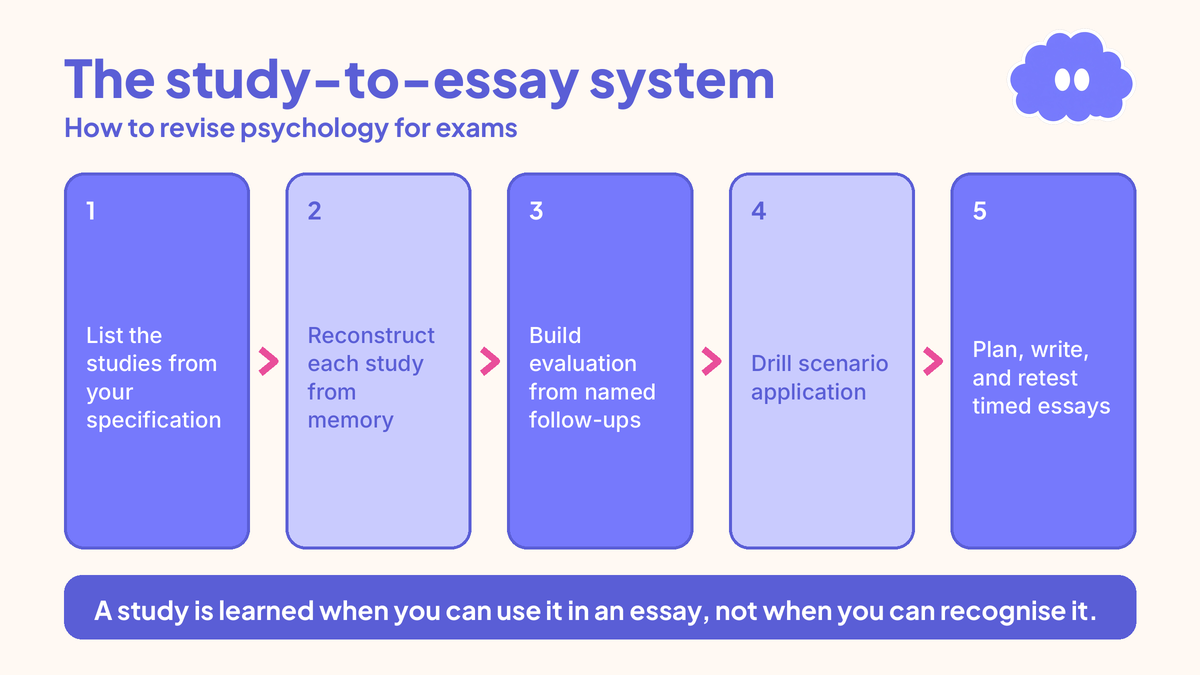
The system in short
- List the studies from your specification. One card per study, five headings each.
- Reconstruct each study from memory. Cover, write, check, correct only what was missing.
- Build evaluation from named follow-ups. Three or four points per study or theory.
- Drill scenario application. Name the person, the exact behaviour, the theory, and the prediction.
- Plan, write, and retest timed essays. Five-minute plan, timed writing, mark scheme check, retest.
Step 1: List the studies from your specification
Open your specification, not your notes. List every topic, and under each one every named study or theory your board lists. Add the key terms for each topic, because examiners reward precise terminology.
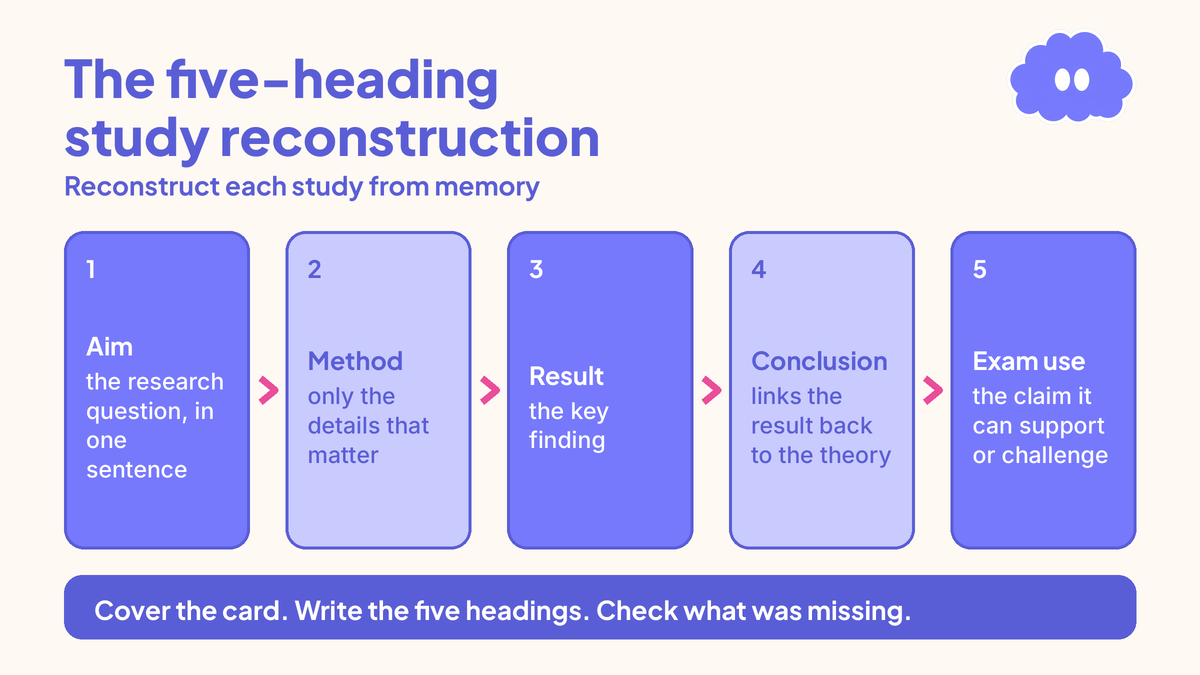
Make one study card per study. Each card has the same five headings, in the same order: aim, method, result, conclusion, exam use. Aim: the research question, in one sentence. Method: only the details that matter, sample, design, task, measures, key controls. Result: the key finding, with a figure only where your specification requires one. Conclusion links the result back to the theory. Exam use: the claim it can support or challenge, in one line.
Work through two or three cards per session. A card leaves the active pile only when you can reconstruct it and use it. Keep two extra sheets: research methods terms with precise definitions, and issues and debates with one example from another topic under each debate. The memorisation system for heavy syllabuses gives the wider routine for a list this long. Do not copy long summaries onto the cards: the card is a test prompt.
Step 2: Reconstruct each study from memory
This is the core of how to revise psychology studies. Pick one card, read the study name, then cover everything else. On blank paper, write the five headings from memory. Uncover the card and check. Correct only what was missing, in a different colour. Cover the card. Write the five headings. Check what was missing.
That check is the revision. Dunlosky and colleagues rated practice testing high utility and re-reading low in 2013. Roediger and Karpicke showed in 2006 that recall beat restudy a week later, though restudiers felt more confident at once.
Example: the rhesus monkey study of attachment by Harlow, in general terms. Aim: to investigate the role of comfort and food in forming attachment bonds. Method: monkeys with two surrogate mothers, a wire mother giving milk and a cloth mother giving comfort; researchers observed which mother each monkey spent time with and turned to when frightened. Result: monkeys spent more time clinging to the cloth mother and sought comfort from her when frightened. Conclusion: contact comfort mattered more than food in forming attachment. Exam use: challenge a learning theory explanation that puts food first. Add figures only if your specification requires them.
Now practise in both directions. Study to details: given the study name, recall the five headings. Claim or scenario to study: given a claim or a short scenario, name the study that answers it. Test both every session.
Precision matters as it does in science: a vague reference earns little, because the examiner cannot tell which study you mean. The how to revise science for exams system makes the same point about evidence. The flashcard system that works gives the sorting routine: missed cards come back tomorrow, known cards wait. If you would rather keep cards on screen, the free flashcard maker runs the same loop.
Step 3: Build evaluation from named follow-ups
Evaluation is where AO3 lives, and generic phrases fail there. “A strength is a large sample” says nothing about this study. Build three or four evaluation points per study or theory, and build each one the same way.
Each point has four parts: name the follow-up evidence, comparison, or methodological point; say what it found, in one sentence; say what that means for the original claim; qualify the claim sensibly.
Research methods give you evaluation material for every study: any detail affecting reliability, validity, ethics, or generalisability is also an evaluation point. Issues and debates give a second source across topics. Keep a grid, one debate per row, with examples from different topics: nature and nurture, free will and determinism, gender bias, culture bias, reductionism, and the ethical implications of research.
The how to revise history for exams system builds essays from chains of causes and consequences. Psychology essays work the same way: a claim, evidence for it, evidence against it, and a judgement. History argues from causes. Psychology argues from named studies and named follow-ups.
Step 4: Drill scenario application
AO2 is application to a scenario the question gives you. The mark is for the application, not for a description you could have written without reading the scenario.
Use this four-part drill. Underline the exact behaviour. Name the person. Link the theory to that behaviour, in the person’s terms. State what the theory predicts for that person. Five minutes per scenario is enough. If your answer would work for any scenario, it has not applied anything.
A question describes a student who gives an answer she knows is wrong because her group gave that answer. A weak answer describes conformity in general. An applied answer names the student, repeats her behaviour, links it to conformity, and says she agrees in public while disagreeing in private. Keep a bank of ten scenarios from past papers. Ten checked five-minute scenarios teach application faster than one long essay.
Step 5: Plan, write, and retest timed essays
In AO1 AO2 AO3 psychology revision, a 16-mark essay needs all three in balance: accurate description, application where the question gives a scenario, and evaluation with named evidence. Plan first: five minutes, three or four main points, each with one line of description and one line of evaluation. Mark where scenario application goes. Write a one-line conclusion.
Then write under time: in practice, allow 25 minutes for planning and writing, and keep that allowance fixed. Write from memory, with notes closed: short introduction, body paragraphs that follow the plan, links between points, brief conclusion.
Mark your essay against the mark scheme, using level-of-response bands. For each weak part, write one fix: rebuild the study card behind a weak description, or the evaluation point behind a weak judgement. Rewrite one paragraph, not the whole essay. The essay exam system for students gives the wider timed-essay routine, and the past-paper system for exams gives the marking and fix-list routine for full papers.
Retest after a gap. Cepeda and colleagues showed in 2006 that spaced practice beat massed practice, and that the best gap grows with how long you need to remember the material. Start with the next day, then three days, then seven days: a practical schedule, not a research rule. Retest by reconstructing the cards from memory, in both directions. A study you reconstructed on Monday and cannot reconstruct on Thursday was recognised, not learned. It goes back to Step 2.
A worked example: a Tuesday evening, two weeks before the exam
Your situation: an A level psychology exam in two weeks, one shaky topic (attachment), and two hours on a Tuesday evening with your specification, study cards, and three past-paper questions.
6:00-6:10, pick the studies. Three study cards for attachment, including Harlow. Put the methods sheet and debates grid beside them.
6:10-6:40, reconstruct from memory. Cover each card in turn. Write the five headings from blank paper, check, and correct only what was missing. Harlow: clean. Second study: the result is vague. Third study: the conclusion is missing. Log both gaps. Reverse direction: read three claims, name the study for each. Two correct, one wrong.
6:40-7:05, build evaluation. Two evaluation points for the second study, one point plus one debates link for the third. One point names no evidence. Rewrite it.
7:05-7:20, break. Walk, water, no phone.
7:20-7:45, scenario drill. Two scenarios from past papers, five minutes each. First scenario: the answer names the person and the exact behaviour. Second scenario: the answer drifts into general description. Rewrite the second answer with the person’s behaviour in every key sentence.
7:45-8:00, plan one essay and set tomorrow. Plan a 16-mark essay in five minutes: three main points, description then evaluation, one-line conclusion. Do not write the full essay tonight. Tomorrow: relearn the third study’s conclusion, retest the second study’s vague result, re-plan the essay from a different question on Thursday. A study is learned when you can use it in an essay, not when you can recognise it.
When it goes wrong
You re-read study summaries and call it revision. Close the summary, reconstruct the five headings from memory, and check.
You memorise every detail and still cannot use the study. Write the exam use line first, then keep only the details that support that claim.
Your evaluation is a list of generic labels. Rebuild each point with the four parts from Step 3. If you cannot name the evidence, you have a label, not a point.
Your scenario answers ignore the scenario. Put the person’s name and exact behaviour in the first sentence. Cut any sentence that does not mention the person or their situation.
You write essays without planning, and they ramble. Five minutes of planning is the structure, not lost time. Practise plans only for a week if planning feels slow: five plans in 25 minutes, checked against mark schemes.
Weekly review checklist
Copy this list and use it each week:
- How many studies can I reconstruct from memory under the five headings, in both directions?
- Which study has the vaguest result, and which evaluation point still has no named evidence?
- Did my scenario answers name the person and the exact behaviour, or drift into general description?
- Did I plan one timed essay, and what one fix came from marking it?
- Which studies failed a retest after a gap, and when will I reconstruct them again?
Downloadable infographic spec: one vertical image, title “How to revise psychology for exams”, with the five steps, list the studies from your specification, reconstruct each study from memory, build evaluation from named follow-ups, drill scenario application, plan, write, and retest timed essays, and the rule, a study is learned when you can use it in an essay, not when you can recognise it, and the five weekly review questions, in Thynq cream, Cloud Purple, Dark Purple and pink, with the cloud mascot. Text taken word-for-word from this article.
What this system is not
It is not a promise of a grade, or a substitute for your specification, textbook, or teacher’s guidance. It does not cover every board, paper, or option topic. It turns studies you must know into answers you can produce, judge, and apply under time.
Detail still matters: inaccurate study references weaken an answer. Learn the detail that identifies the study and supports the claim, by reconstructing it from memory.
Sources
- Dunlosky, J., et al. (2013). Improving students’ learning with effective learning techniques. Psychological Science in the Public Interest, 14(1), 4-58. Only practice testing and distributed practice rated high utility; rereading rated low.
- Roediger, H. L. & Karpicke, J. D. (2006). Test-enhanced learning. Psychological Science, 17(3), 249-255. Students who recalled a passage remembered more a week later than students who restudied it, though restudiers felt more confident immediately.
- Cepeda, N. J., et al. (2006). Distributed practice in verbal recall tasks. Psychological Bulletin, 132(3), 354-380. Spaced practice beat massed practice; the best gap grows with how long the material must be remembered.
- Save My Exams (2025). How to Revise for A Level Psychology: Tactics That Work. Specification checklist, study summary headings, AO definitions, key terms, debates grid; Harlow design in general terms.
- StudyRoom Exams. Psychology Revision Guide: GCSE, A Level and IB. AO split, 16-marker planning, evaluation from named follow-ups, scenario application, research methods, issues and debates.
- Psychology Tutor Online (2026). How to Revise Psychology Studies Without Memorising Every Detail. Five-heading reconstruction, revising in both directions, choosing the key finding.
For the full exam system this sits inside, start with how to revise for exams without cramming.
Questions
How much detail of each study do I need to remember?
Enough to identify the study and use it accurately: the aim in one sentence, the method details that matter, the key result, and the conclusion. Learn a figure only where your specification or a mark scheme clearly requires it. If you can reconstruct the study under the five headings and say what claim it supports, you have enough detail for most questions.
How do I improve my evaluation (AO3)?
Give each evaluation point a named piece of evidence, not a generic label. Name the follow-up study or comparison, say what it found, and say what that means for the original claim. Three or four points built this way, with a short conclusion that weighs them, are stronger than a long list of vague strengths and weaknesses.
How do I apply my knowledge to a scenario (AO2)?
Start from the scenario, not from your notes. Name the person, repeat the exact behaviour the question describes, link it to the theory, and state what the theory predicts for that person. If your answer would work for any scenario, it has not applied anything yet.
How do I revise research methods when it appears in every topic?
Learn the core terms once, on their own cards, with precise definitions you can write from memory. Then practise spotting them inside studies: name the design, the sampling method, and one strength and one weakness of the method for each study you reconstruct. Keep one methods sheet beside your study cards, and use it in every essay plan until the terms come without looking.