The direct answer
How to revise history for exams: build a timeline you can draw from memory, learn every event as a chain of causes, and practise writing essay plans — one-sentence answer, three causes, evidence for each — before you write full essays. History exams reward causation and argument, not memorised pages.
How to revise history for exams starts with argument, not lists
You read the chapter on the war. The causes make sense. The dates are in your head — for now. Then the exam asks “Why did the war start?” and you write down everything you remember, in the order you remember it, hoping the examiner finds the argument in there. They do not. There was no argument. There was a list.
That is the history trap. History is not a list of facts in order. It is an argument about why things happened: causes, triggers, consequences, and the evidence that connects them. Reading the textbook gives you the facts. The exam asks you to build the argument. The only practice that trains that is building arguments — from memory, in your own words, under time.
The research supports the explaining part. Dunlosky’s 2013 review rated elaborative interrogation — asking “why is this true?” about a fact — moderate utility, and self-explanation moderate too. A 2018 meta-analysis found prompting self-explanation gave a moderate average benefit. In history, “why” is not a study technique. It is the subject.
The system in short
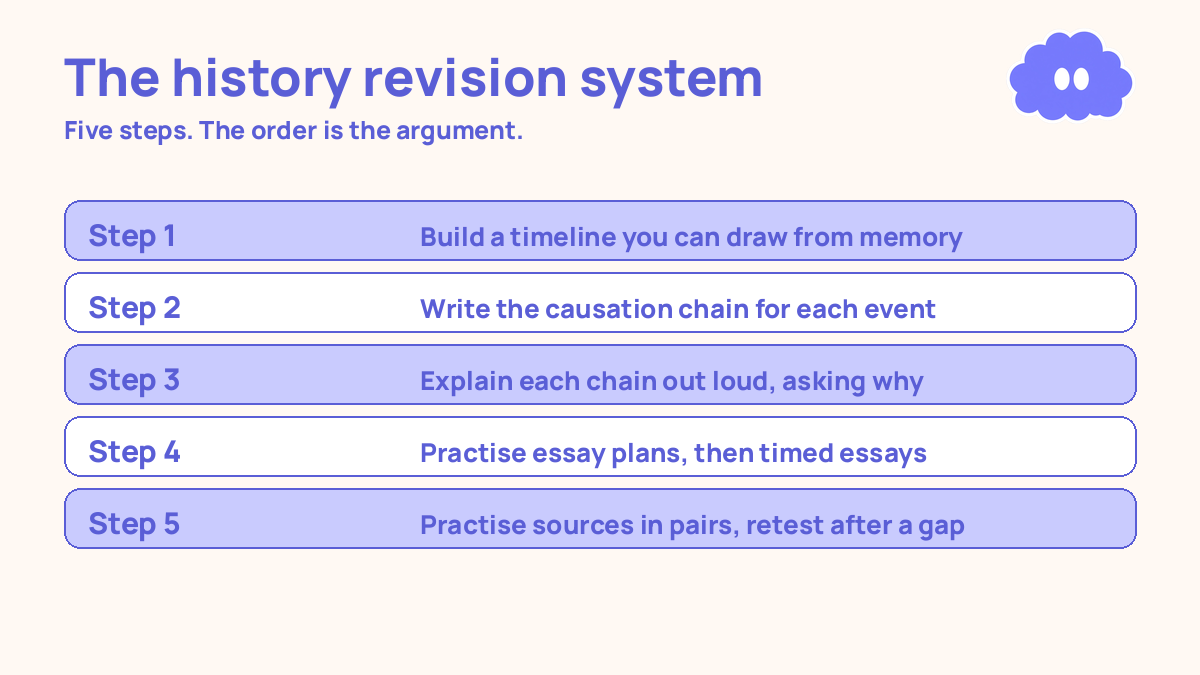
- Build a timeline of the whole topic, on one page, from memory.
- For each big event, write the causation chain: long-term causes, trigger, event, consequences.
- Explain each chain out loud in your own words, asking “why?” at every link.
- Practise essay plans: one-sentence answer, three causes, evidence for each — then write timed essays.
- Practise sources in pairs, and retest every chain after a gap.
Step 1: Build a timeline you can draw from memory
Take one sheet of paper. Draw a line across it. Mark the events of the topic on it, in order, with the dates that anchor them. Not every date — the ones that matter: the start of the war, the treaty, the revolution. Five to ten events is a practical number for one topic.
Draw it from memory first, then check it against the book. Every event in the wrong place, and every missing date, goes on the list to learn. Then draw it again tomorrow, from memory, and the day after. Three correct drawings in a row means the timeline is learned.
The timeline is the skeleton everything else hangs on. If you do not know the order, you cannot build the argument, because the argument is the order.
Step 2: Write the causation chain for each big event
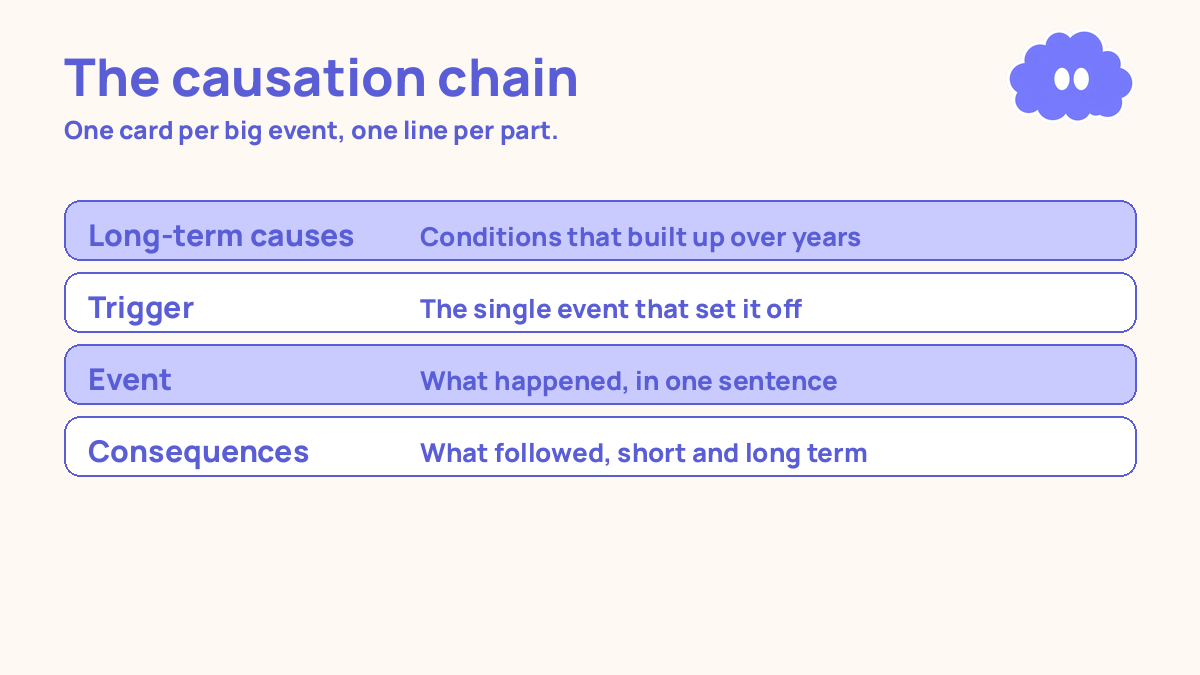
For each big event on the timeline, write the chain in four parts:
- Long-term causes: the conditions that built up over years — alliances, rivalries, economic pressure.
- Short-term trigger: the single event that set it off — an assassination, an invasion, a declaration.
- The event itself: what happened, in one sentence.
- Consequences: what followed, short-term and long-term.
Write the chain on a card, one event per card. Keep each part to one line. “Long-term: the alliance system turned local disputes into general wars.” That is a cause. “Trigger: the assassination in Sarajevo.” That is the trigger. The card is not an essay — it is the skeleton of one, and you will build the essay from it in step 4. The chains are the revision half — the full system for learning history through the term is the study system for history students.
Forgetting is steepest soon after learning, then flattens — Ebbinghaus measured that shape on himself in 1885, with meaningless syllables, so quote the shape, never a percentage as a law. The practical point is the same: a chain you built today will fade by tomorrow unless you rebuild it.
Step 3: Explain each chain out loud, asking “why?” at every link
Pick up a card. Close the book. Explain the chain out loud, in your own words, and ask “why?” at every link. “Why did the alliance system turn a local dispute into a general war? Because each country was bound to defend its ally, so one declaration pulled in the next.” If you cannot answer the “why”, that link is a memorised fact, not an understood cause — and it will break under an examiner’s follow-up.
This is elaborative interrogation: asking why a fact is true, and answering in your own words. Dunlosky rated it moderate utility, and it fits history better than any other subject, because history is made of “why” questions. The examiner’s question is always, in some form, “why did this happen?” — and the student who has asked themselves that question a hundred times in revision is the one who can answer it in the exam.
Do one chain per session at first, then two. Explain it, ask “why” at every link, and mark the links you cannot explain. Those links go back to the book for ten minutes — not the whole chapter, just that link.
Step 4: Practise essay plans, then timed essays
An essay plan is five minutes, on paper: your answer in one sentence, three causes, one piece of evidence per cause. Do not write the essay yet — write the plan, for five different questions, in one session. Planning is the skill the exam tests first: if the plan is wrong, the essay is wrong, however well it is written.
Then write one timed essay a week, from a plan you made that day, closed book. The essay follows the plan: introduction with the one-sentence answer, one paragraph per cause — point, evidence, explanation, link back to the question — and a conclusion that repeats the answer. Mark it yourself against the mark scheme — cause, evidence, link per paragraph — and rewrite the weakest paragraph the next day, from memory.
Step 5: Practise sources in pairs, and retest after a gap
History exams test sources as well as essays. Practise with two sources side by side — a speech and a newspaper, a diary and a treaty. For each one, write three things: what it says, who wrote it, and why they would say that. Then write one sentence comparing them: where they agree, where they disagree, and why.
The comparison is where the marks are. A student who describes two sources separately scores less than a student who compares them in one sentence. “Both sources agree the war was expected, but the speech blames the enemy while the diary blames the generals — because the speech was written to persuade, and the diary was written in private.” That is one sentence, and it is worth more than two paragraphs of description.
Retest every chain after a gap of two to three days: draw the timeline, explain one chain out loud, write one essay plan. A two-to-three-day gap is a practical starting schedule, not a research rule.
A worked example: a Thursday evening, two weeks before the exam
You have a history exam in two weeks. One topic: the First World War. Thursday evening, two hours.
6:00–6:20 — Draw the timeline. One page, from memory: 1871, 1905, 1914, 1918, 1919. Eight events. Checked against the book: two dates wrong, one event missing. Corrected, and the timeline is redrawn.
6:20–6:50 — Two causation chains. “Why did the war start in 1914?” and “Why did the war last four years?” Each chain on a card: long-term causes, trigger, event, consequences. The second chain’s long-term causes are thin — one line instead of three. Logged.
6:50–7:05 — Explain out loud. The first chain, with “why?” at every link. It holds. The second chain breaks at the second link — you cannot say why the war lasted four years beyond “trench warfare”. That link goes back to the book tomorrow.
7:05–7:20 — Break. Walk, water, no phone.
7:20–7:50 — Three essay plans. Three past-paper questions, five minutes each: one-sentence answer, three causes, evidence for each. The third plan is weak — the evidence for cause two is missing. Logged.
7:50–8:00 — Log and plan. Tomorrow: ten minutes on why the war lasted four years, five on the missing evidence. Saturday: retest the timeline and both chains, from memory.
That is two hours, and it produced something re-reading the chapter never does: a timeline you can draw, two chains you can explain, three plans you can write — and a list of exactly two gaps to fix tomorrow.
When it goes wrong
You re-read the chapter and call it revision. Reading a list of facts is not building an argument. Close the book, draw the timeline, explain a chain. If you cannot, you have not learned it yet, whatever the reading felt like.
Your essay is a list, not an argument. Everything you remember, in the order you remember it. The fix is the plan: one-sentence answer first, then three causes. If the plan has no answer sentence, the essay will have no argument.
You memorise dates but not the order. A date without its place in the chain is useless. The timeline fixes this: draw it from memory, check it, draw it again. The order is the argument, and the dates are just the anchors.
You describe sources instead of comparing them. Two paragraphs, one per source, no comparison. The fix is the one-sentence rule: after describing both sources, write one sentence saying where they agree, where they disagree, and why. If you cannot write that sentence, you have not understood the sources yet.
Weekly review checklist
Copy this list and use it each week:
- Can I draw the timeline from memory, with the dates in the right order?
- Which causation chain still breaks when I ask “why?” at every link?
- How many essay plans did I write this week, and how many did I turn into timed essays?
- What one change will I make next week: more chains, more plans, or more source pairs?
Downloadable infographic spec: one vertical image, title “The history revision system in five steps”, with the five steps — build the timeline, write the causation chain, explain it out loud, practise essay plans, practise sources in pairs — and the rule, the order is the argument, in Thynq cream, Cloud Purple, Dark Purple and pink, with the cloud mascot. Text taken word-for-word from this article.
What this system is not
It is not a promise of a grade, and it is not a claim that facts do not matter. They do — an argument with the wrong facts is a wrong argument. But facts without causation are a list, and the exam marks the argument.
Sources
- Dunlosky, J., et al. (2013). Improving students’ learning with effective learning techniques. Psychological Science in the Public Interest, 14(1), 4–58. Only practice testing and distributed practice rated high utility; elaborative interrogation, self-explanation and interleaved practice rated moderate; rereading rated low.
- Rowland, C. A. (2014). The effect of testing versus restudy on retention: a meta-analytic review of the testing effect. Psychological Bulletin, 140(6), 1432–1463. Testing beat restudy (g = 0.50); recall formats beat recognition formats as practice.
- Bisra, K., et al. (2018). Inducing self-explanation: a meta-analysis. Educational Psychology Review, 30(3), 703–725. Prompting self-explanation gave a moderate average benefit (g = 0.55).
- Ebbinghaus, H. (1885). Über das Gedächtnis (On Memory). Forgetting was steep at first and then flattened; he was his own only subject, memorising nonsense syllables — quote the shape, never a percentage as a law.
For the full exam system this sits inside, start with how to revise for exams without cramming.
Questions
Do I need to memorise dates for a history exam?
Memorise the order of events and the handful of dates that anchor it — the start of a war, a treaty, a revolution. The order matters more than the exact day. If you know what caused what, in the right order, you can answer the question even if one date slips.
How do I revise causation for history?
For every big event, write the chain: the long-term causes, the short-term trigger, the event, and the consequences. Then explain the chain out loud in your own words. If you can say why each link follows the last, you understand the causation.
Should I memorise whole essays for history?
No. Memorise the building blocks instead: your one-sentence answer for each question type, three causes per event, and two pieces of evidence per cause. Then assemble them for the question in front of you — the question is never exactly the one you prepared.
How do I revise sources for a history exam?
Practise with two sources side by side. For each one, write what it says, who wrote it, and why they would say that. Then write one sentence comparing them. The comparison — where they agree, where they disagree, and why — is what the marks are for.