The direct answer
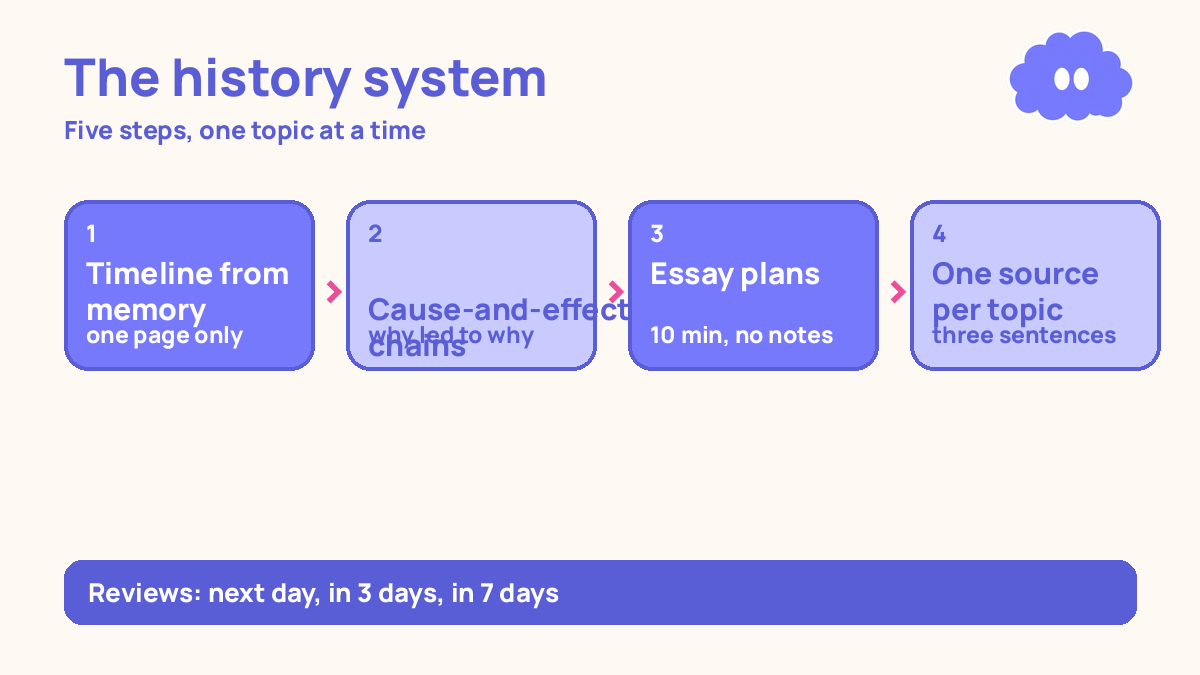
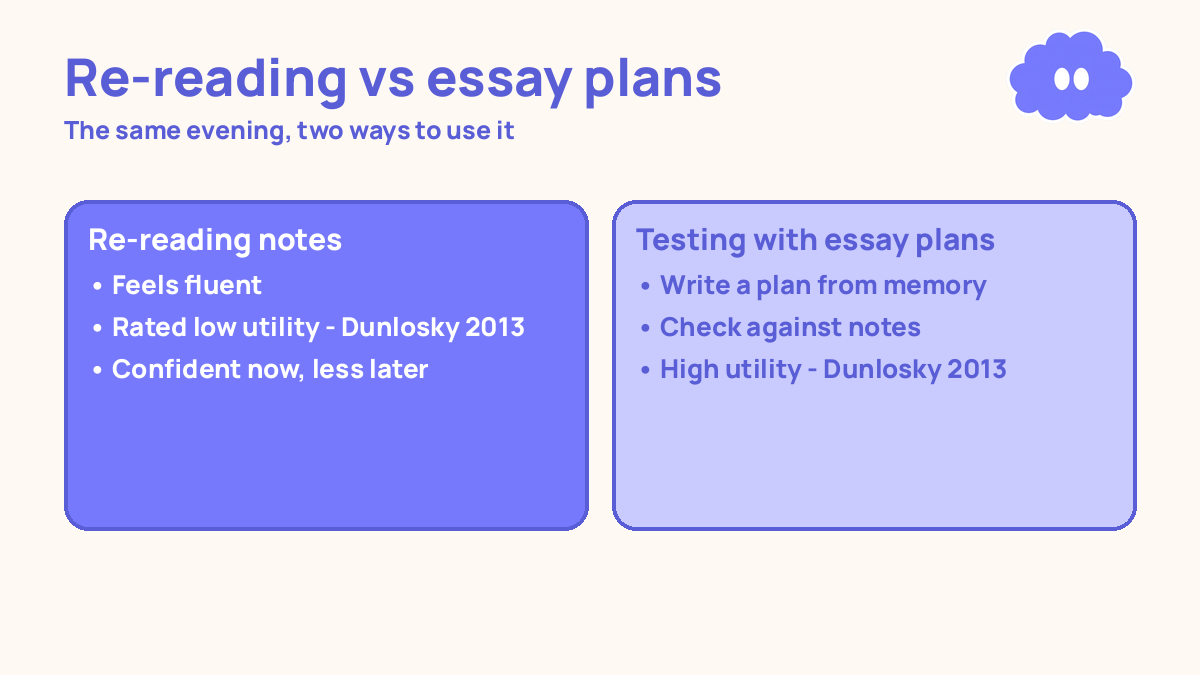
Build the timeline first, learn the story in cause-and-effect chains, then test yourself with essay plans from memory. Read less, test more: in a 2013 review, Dunlosky and colleagues rated practice testing and distributed practice as the only two high-utility techniques, and re-reading as low.
History feels like a lot to remember: dates, names, treaties, battles, causes, consequences. The mistake is treating all of it as equal — some facts hold the story together, and most only make sense once the story is in place. This system starts with the story: a timeline you can draw from memory, the reasons each event led to the next, and practice at the exact thing the exam asks for. The reading supports that work; it does not replace it.
The system in short
- Build a one-page timeline for each topic, from memory, before you open your notes.
- Learn each topic as a chain: this happened, so this happened, so this happened.
- Turn every cause into a question and answer it from memory, then check.
- Work with one primary source per topic — learn what it shows, not what it says.
- Review on a 1-3-7 day schedule: next day, in 3 days, in 7 days. That is a practical starting schedule, not a research rule.
- Once a week, write a timed essay plan for a past question and mark the misses.
Step 1: Build the timeline before you open your notes
Take a blank page, write the topic at the top, and draw a line across it. Add the events you already know, in order, with approximate dates. Do not check anything yet.
Then open your notes and fill in what you missed, in a different colour. Keep it to one page per topic.
The rule: turning points only. A date earns a place if it changes what happens next. If removing an event leaves the story intact, leave it off the timeline.
A timeline you built from memory is worth more than one you copied. In a 2006 study, Roediger and Karpicke found students who recalled a passage remembered more a week later than students who restudied it, though the restudiers felt more confident right after studying. Feeling fluent right after re-reading is not the same as remembering a week later.
Step 2: Learn in cause-and-effect chains, not in lists
History exams rarely ask “list five causes”. They ask “why did this happen” and “how far did this cause that” — a list of causes is hard to remember and harder to use. A chain is both.
Take one event and ask why, four times. The First World War did not start because of one assassination — it started because an assassination happened inside a system of alliances, arms races, and plans that turned a local crisis into a general war. Each link is one sentence: this happened, so this happened. Learn the chain and you can write the essay.
Write each chain as five to seven sentences on one card, then cover it and say it aloud. If you cannot say it, you do not know the topic yet.
Self-explanation helps here too. In a 1989 study, Chi and colleagues watched eight physics students think aloud while studying worked examples: the best solvers — 82% correct against 46% — gave about 15 explanations per example, against fewer than 3 for the weakest. Small and observational, but a 2018 meta-analysis across 64 reports found a moderate average benefit for prompting self-explanation. Asking “why did this step happen” is doing the same work for history.
Step 3: Test yourself with essay plans, not with your notes open
This is the step most history students skip, because it feels slow. It is also the only step that practises what the exam actually asks for.
Take a past paper question and set a timer for 10 minutes. Write an essay plan from memory: a one-sentence argument, three or four paragraph points with evidence, and a conclusion. Then open your notes and mark what you missed — those misses are your next study session.
Do one plan per topic per week. A full essay takes an hour and tells you little more than a plan does.
When you test yourself, use short-answer recall rather than recognition. Rowland’s 2014 meta-analysis of 61 studies found testing beat restudying by a medium amount, recall formats beat recognition as practice, and feedback made the effect larger. Checking your plan against your notes is the feedback — a plan you never check is a guess you never correct.
Step 4: Work with one primary source per topic
Sources are where history students lose marks they did not need to lose. The usual approach is to highlight five sources and remember none of them. Do the opposite: one source per topic, learned properly.
For each topic, choose one primary source — a speech, a letter, a treaty extract, a newspaper report. Learn three things about it, one sentence each: what it says, what it shows, and one limitation. Three sentences is enough to use it in an essay.
Write the three sentences from memory, then check them. If the source is long, learn the two or three lines that matter and the context around them — an examiner would rather read one source used well than five named and dropped. Review a topic’s source with the topic.
Step 5: Space your reviews, and let the gaps do the work
Reviewing a topic three times in one evening feels productive. It mostly is not — the third review feels easy because the first two are still fresh. Spacing works the other way: review after a gap, when you have started to forget, and the effort strengthens the memory.
The schedule is simple and practical: review a topic the next day, then in 3 days, then in 7 days — a practical starting schedule, not a rule from the research. Cepeda and colleagues’ 2006 synthesis found spaced practice beat massed practice, and the best gap grows with how long you need to remember the material. A 2008 study by the same group found the best gap was about 20 to 40% of a one-week delay, and 5 to 10% of a one-year delay. The 1-3-7 schedule is a starting point, not a formula.
A review session is short: 20 minutes — timeline, chains, one essay plan. If you cannot draw the timeline, that topic goes back to step 1.
A worked example: a Tuesday evening after lectures
You have a 7pm to 10pm evening and a test on the Cold War in three weeks.
7:00–7:20 — Timeline: Draw the Cold War timeline from memory on one page — 1945, 1947, 1948, 1949, 1953, 1961, 1962, 1979, 1985, 1989, 1991 — then check against your notes and fill the gaps in a different colour. 7:20–8:00 — Chains: Write the chain for the Cuban Missile Crisis in six sentences — why the missiles were placed, why the US found out, why the blockade, why the deal, what it changed — and say it out loud from memory twice. 8:10–8:40 — Essay plan: Past question: “Why did the Cuban Missile Crisis not lead to war?” Ten minutes, timer on, plan from memory. Then 20 minutes checking it against your notes and adding the points you missed. 8:40–9:00 — Source: One source — Kennedy’s 1962 television address. Three sentences from memory, then check. 9:00–9:30 — Reviews: Two 15-minute reviews of older topics on the 1-3-7 schedule: the First World War timeline, the Treaty of Versailles chain.
Three hours, one topic learned properly, one source learned, two older topics reviewed, and a record of exactly what you missed.
| Time | Block | What you do |
|---|---|---|
| 7:00–7:20 | Timeline | Draw from memory, fill gaps |
| 7:20–8:00 | Chains | One chain, said aloud twice |
| 8:10–8:40 | Essay plan | 10-minute plan, 20-minute check |
| 8:40–9:00 | Source | Three sentences from memory |
| 9:00–9:30 | Reviews | Two older topics, 15 minutes each |
When it goes wrong
You have 40 pages of notes and no timeline. Stop reading and draw the timeline from memory on one blank page. It will be thin — that thinness shows you the shape of the topic. Fill it from your notes, one page only.
You can recite the notes but cannot write an essay plan. You have been re-reading, not testing. Switch to plans: one past question, 10 minutes, no notes. The first plan will be bad; the second will be better.
Your timeline has 60 dates and you remember none of them. You kept every date instead of the turning points. Cut the timeline to 12 dates. Twelve dates you know beat sixty you do not.
You review a topic three times in one night and feel confident, then blank in the exam. That is the fluency trap. Roediger and Karpicke’s students felt confident right after restudying and did worse a week later. Space the reviews: next day, in 3 days, in 7 days. If it feels harder, that is the point.
Weekly review checklist
Copy this list and use it each week:
- Can I draw each topic’s timeline from memory, turning points in order?
- Can I say each chain out loud without looking?
- Did I write one timed essay plan per topic and check it?
- Did I learn one primary source per topic — says, shows, one limitation?
- Did I review older topics on the 1-3-7 schedule, or only study new material?
- What one change will I make next week: fewer dates, more plans, or earlier reviews?
Downloadable infographic spec: one vertical image, title “The history system”, with the five steps — timeline from memory, cause-and-effect chains, essay plans from memory, one source per topic, reviews on a 1-3-7 schedule — and the three source sentences — what it says, what it shows, one limitation — in Thynq cream, Cloud Purple, Dark Purple and pink, with the cloud mascot.
What this system is not
It is not a promise of a grade, and not a claim that timelines and essay plans are the only way to learn history. It is a practical system built on the two techniques researchers rated highest — testing yourself and spacing study out — applied to what a history exam actually asks for. If your course is assessed by source analysis rather than essays, spend more time on step 4 and less on step 3.
Sources
- Dunlosky, J., et al. (2013). Improving students’ learning with effective learning techniques. Psychological Science in the Public Interest, 14(1), 4-58. Only practice testing and distributed practice rated high utility; rereading rated low.
- Roediger, H. L. & Karpicke, J. D. (2006). Test-enhanced learning. Science, 319, 966-968. Recall beat restudy a week later, though restudiers felt more confident right after studying.
- Rowland, C. A. (2014). The effect of testing versus restudy on retention. Psychological Bulletin, 140(6), 1432-1463. Testing beat restudy (g = 0.50) in 81% of comparisons; feedback raised the effect (g = 0.73 with, 0.39 without); recall beat recognition.
- Chi, M. T. H., et al. (1989). Self-explanations. Cognitive Science, 13(2), 145-182. Best solvers gave 15.3 explanations per example against 2.8 for the weakest, in a small study of 8 students.
- Bisra, K., et al. (2018). Inducing self-explanation: a meta-analysis. Educational Psychology Review, 30(3), 703-725. Moderate average benefit (g = 0.55) across 64 reports.
- Cepeda, N. J., et al. (2006). Distributed practice in verbal recall tasks. Psychological Bulletin, 132(3), 354-380. Spaced beat massed; the best gap grows with the retention interval.
- Cepeda, N. J., et al. (2008). Spacing effects in learning. Psychological Science, 19(11), 1095-1102. Best gap about 20-40% of a one-week delay, 5-10% of a one-year delay.
For the full system behind this one, start with how to build a study system that fits your life, and if your notes never get looked at again, fix that with the notes system that you can actually review. For the exam itself, how to revise history for exams covers the essay paper in full.
Questions
How many dates do I actually need to memorise?
Fewer than you think. Memorise the turning points — the dates that change what happens next — and put the rest in order around them. An essay needs a sequence that holds up, not a list of dates.
How do I revise for an essay exam?
Practise writing essay plans from memory, not full essays. Set a past question, spend 10 minutes planning it without notes, then check what you missed. That is the skill the exam tests.
How do I use primary sources in revision?
Pick one source per topic and learn what it shows, not what it says word for word. A source you can explain in two sentences is worth more than five you have only highlighted.
What if I only have a week left before the exam?
Cut the reading and double the testing. Build the timeline, write essay plans for the most likely questions, and review them on a 1-3-7 day schedule. Do not start a new set of notes.