The direct answer
How to revise science for exams: list the processes the exam can ask about, explain each one from memory in four sentences, draw its diagram without looking, and test yourself with short-answer questions. Science exams reward understanding a chain of causes, not memorising pages of facts.
How to revise science for exams starts with rebuilding, not re-reading
You read the chapter on respiration. It makes sense. You read it again, and it makes more sense. Then the exam asks you to explain why oxygen is needed, and the sentences will not come. You know the words — glucose, oxygen, energy — but you cannot put them in order, because reading never asked you to.
That is the science trap. Science is chains: this causes that, which causes the next thing. Reading a chain feels like knowing it, but the exam asks you to rebuild it from nothing. The only practice that trains that is rebuilding it — explaining it from memory, drawing it from memory, writing it from memory.
The research tested exactly this, on science material. In Karpicke and Blunt’s 2011 study, 200 students studied science texts, then either re-read, built a concept map, or practised free recall. A week later the retrieval group scored 0.67, against 0.45 for the concept-mapping group — on verbatim and inference questions alike. The concept-mappers predicted they would do best. They did not.
The system in short
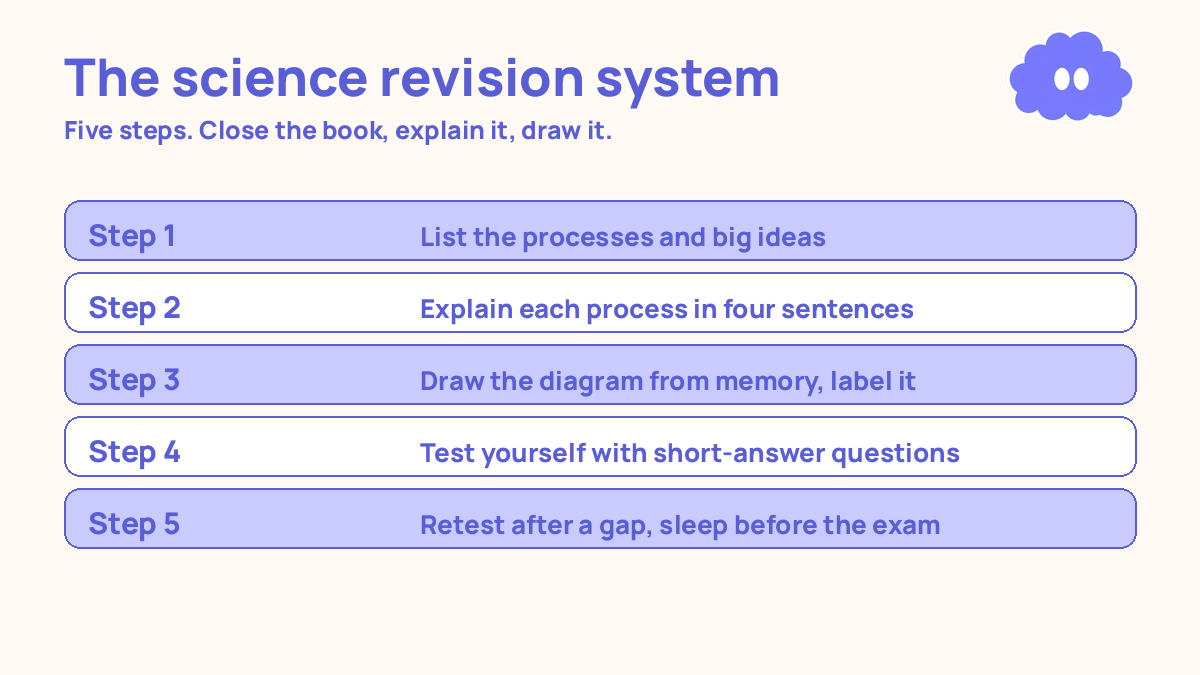
- List the processes and big ideas the exam can ask about. One line each.
- Explain each process from memory in four sentences: what starts it, what happens, why, what results.
- Draw its diagram from memory, label every part, then check it against the book.
- Test yourself with short-answer questions, and mark them with feedback.
- Retest every process after a gap of two to three days, and sleep properly the night before the exam.
Step 1: List the processes, not the chapters
Open the syllabus and the past papers. Write down every process and big idea the exam can ask about, one line each. “Photosynthesis.” “How a reflex arc works.” “The carbon cycle.” “Why metals react with acids.”
A process is something that happens in steps, with causes. A chapter heading is not a process. “Cell biology” is a chapter. “How a cell divides” is a process. If your list is full of chapter headings, break each one into the processes inside it — usually two or three per chapter.
Count the list. Most science exams test between eight and fifteen processes. Every session works through one or two processes from the list, and a process leaves the list only when you can explain it from memory and draw it from memory.
Step 2: Explain each process in four sentences, from memory
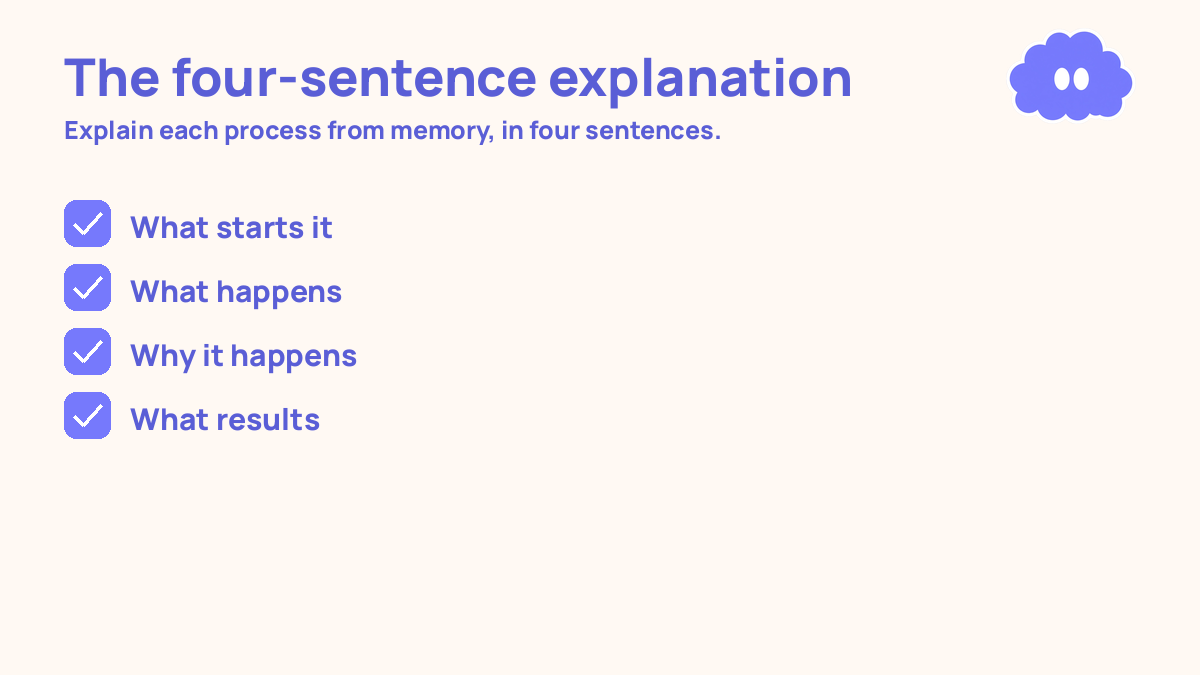
Pick one process. Close the book. Explain it out loud or on paper, in four sentences: what starts it, what happens, why it happens, and what results.
“Photosynthesis starts when light hits chlorophyll in the leaf. The light energy splits water, releasing oxygen. The energy is then used to build sugars from carbon dioxide. The sugars store the energy the plant needs to grow.” Four sentences, one chain, no notes.
If you cannot do it in four sentences, you do not know the chain yet. Either you know the facts but not the order — go back and learn the order — or you know the order but not the reasons. The reasons are what the exam marks: “why” is the question that separates understanding from memorising.
This is self-explanation, and it is also retrieval practice. Dunlosky rated self-explanation moderate utility in 2013, and practice testing was one of only two techniques rated high utility. A 2018 meta-analysis found prompting self-explanation gave a moderate average benefit. This is the revision version — the full system for learning science through the term is the study system for science students.
Step 3: Draw the diagram from memory
Every science process has a diagram: a cell, a cycle, a set-up, a graph. Draw it from memory, on a blank page, and label every part from memory too.
Then open the book and check it. Mark every missing label and every part in the wrong place. Those marks are your revision list for that process — not the whole diagram, just the parts you got wrong.
Drawing from memory is a stricter test than explaining, because a diagram has no hiding places. And labelling is where most marks are lost: students draw the diagram well and label two parts out of eight.
Redraw the diagram the next day, from memory again. Two correct drawings in a row, a day apart, means the process is learned. One correct drawing today means it was learned today — and today is not exam day.
Step 4: Test yourself with short-answer questions
Write five short-answer questions for the process you just learned, or take them from past papers: “Explain why…”, “Describe the steps of…”, “What happens if…?” Answer them from memory, in writing, under time.
Short answer is the right format. Rowland’s 2014 meta-analysis found testing yourself beat restudying, and that recall formats — short answer — beat recognition formats like multiple choice as practice. A multiple-choice question lets you recognise the right answer. A short-answer question makes you produce it, which is what the science exam asks you to do.
Mark your answers with feedback. Feedback matters: Rowland found the testing effect was larger with feedback (g = 0.73) than without it (g = 0.39). For every missing link in the chain, write it down. The missing links are the revision list — one line each, not a rewritten chapter.
| Process | Can I explain it in 4 sentences? | Can I draw and label it? | Short-answer score |
|---|---|---|---|
| Photosynthesis | Yes | 7 of 8 labels | 4 of 5 |
| Respiration | Yes, but the “why” is weak | 5 of 8 labels | 3 of 5 |
| Reflex arc | No — order wrong after step 2 | 4 of 6 labels | 2 of 5 |
This table is from the worked example below. It shows what the system is for: respiration needs its “why” fixed, and the reflex arc needs its order relearned.
Step 5: Retest after a gap, and sleep before the exam
Two to three days later, explain the same processes again from memory — four sentences, diagram, short answers. Same rules, no book open first. A two-to-three-day gap is a practical starting schedule, not a research rule.
The retest tells you what stayed. A process you explained perfectly on Monday and cannot explain on Thursday was never learned — it was recognised. It goes back to step 2, and this time the explanation needs the “why” said out loud, not just thought.
And sleep properly the night before the exam. Sleep is when the day’s learning is consolidated — Diekelmann and Born’s 2010 review describes how patterns of brain activity from learning are re-activated during slow-wave sleep. A short night after a long study day means the work was done but the consolidation was cut short.
A worked example: a Tuesday evening, two weeks before the exam
You have a biology exam in two weeks. Twelve processes on the list. Tuesday evening, two hours.
6:00–6:10 — Pick the processes. Photosynthesis, respiration, reflex arc. Three tonight.
6:10–6:40 — Explain each one in four sentences. Photosynthesis: clean, four sentences. Respiration: the steps are right but the “why” is weak. Reflex arc: the order goes wrong after step 2. All three logged.
6:40–7:05 — Draw the diagrams. Photosynthesis: 7 of 8 labels. Respiration: 5 of 8. Reflex arc: 4 of 6, and two parts in the wrong place. Missing labels logged.
7:05–7:20 — Break. Walk, water, no phone.
7:20–7:50 — Short-answer questions. Five per process, from past papers. Photosynthesis 4 of 5, respiration 3 of 5, reflex arc 2 of 5. The table says: respiration needs its “why”, the reflex arc needs its order.
7:50–8:00 — Plan tomorrow. Ten minutes on the reflex arc order, five on respiration’s “why”. Thursday: retest all three, from memory.
That is two hours, and it produced something re-reading the textbook never does: a table that says exactly which process is ready, which one needs its reasons, and which one needs to be relearned.
When it goes wrong
You re-read the chapter and call it revision. Reading a chain is not rebuilding it. The rule is simple: close the book, explain it in four sentences, draw it. If you cannot, you have not learned it yet, whatever the reading felt like.
Your concept map looks beautiful and you still cannot answer the questions. That is the Karpicke and Blunt result in your own revision: the concept-mappers predicted they would do best and did worst. A map organises material; it does not teach it. Use the map to find the processes, then close it and explain them from memory.
You cram the night before and skip sleep. Sleep is when the day’s learning is consolidated. A short night after a long study day cuts the consolidation short. Stop revising by 9pm, sleep properly, and trust the retests you did during the week.
Weekly review checklist
Copy this list and use it each week:
- How many processes can I explain in four sentences from memory, and draw with labels?
- Which process has the weakest “why”, and which one has the wrong order?
- Did I retest every process after a gap, or only the easy ones?
- What one change will I make next week: more diagrams, more short answers, or relearn one process properly?
Downloadable infographic spec: one vertical image, title “The science revision system in five steps”, with the five steps — list the processes, explain in four sentences, draw the diagram, test with short answers, retest after a gap — and the rule, close the book, explain it, draw it, in Thynq cream, Cloud Purple, Dark Purple and pink, with the cloud mascot. Text taken word-for-word from this article.
What this system is not
It is not a promise of a grade, and it is not a claim that facts do not matter. They do — an explanation with the wrong facts is a wrong explanation. But facts without the chain are a list, and the exam marks the chain.
Sources
- Karpicke, J. D. & Blunt, J. R. (2011). Retrieval practice produces more learning than elaborative studying with concept mapping. Science, 331(6018), 772–775. Retrieval scored 0.67 vs 0.45 for concept mapping a week later, on verbatim and inference questions; mappers predicted best and did worst.
- Rowland, C. A. (2014). The effect of testing versus restudy on retention: a meta-analytic review of the testing effect. Psychological Bulletin, 140(6), 1432–1463. Testing beat restudy (g = 0.50); recall formats beat recognition formats as practice; feedback raised the effect (g = 0.73 with, 0.39 without).
- Dunlosky, J., et al. (2013). Improving students’ learning with effective learning techniques. Psychological Science in the Public Interest, 14(1), 4–58. Only practice testing and distributed practice rated high utility; self-explanation moderate; rereading low.
- Bisra, K., et al. (2018). Inducing self-explanation: a meta-analysis. Educational Psychology Review, 30(3), 703–725. Prompting self-explanation gave a moderate average benefit (g = 0.55).
- Cepeda, N. J., et al. (2006). Distributed practice in verbal recall tasks. Psychological Bulletin, 132(3), 354–380. Spaced practice beat massed practice.
- Diekelmann, S. & Born, J. (2010). The memory function of sleep. Nature Reviews Neuroscience, 11(2), 114–126. Sleep consolidates learning; slow-wave sleep re-activates patterns from learning and moves memories for long-term storage.
For the full exam system this sits inside, start with how to revise for exams without cramming. If you want the recall-first habit in general, the retrieval practice system for students is the same idea applied to any subject.
Questions
Should I memorise science facts or understand the processes?
Understand the processes first, then the facts stick to them. A process is a chain — this causes that, which causes the next thing. If you know the chain, you can rebuild the facts. If you only memorise facts, one forgotten link breaks the whole answer.
How do I revise a diagram for a science exam?
Draw it from memory, then check it against the book. Label every part from memory too. If you can draw it and label it without looking, you know it. If you can only recognise it when you see it, you do not — recognition is not recall.
What is the best way to test myself in science?
Short-answer questions from memory: explain a process in four sentences, or list the steps of a method in order. In a 2014 meta-analysis, recall formats beat recognition formats as practice. Multiple-choice questions are a weaker test of science understanding.
How much should I sleep before a science exam?
Sleep properly the night before. Sleep is when the day’s learning is consolidated — a short night after a long study day means the work was done but the consolidation was cut short. An all-nighter trades tomorrow’s recall for tonight’s reading.