The direct answer
The study system for science students is simple: learn the concept in words by explaining it aloud, draw the diagram or process from memory, practise questions from memory with your notes closed, connect the concepts by asking why each one causes the next, and review the whole topic after a gap. That is the whole system. It works because science asks for three kinds of learning at once — facts, processes you can draw, and problems you can solve — and reading alone only handles the first.
Why the study system for science students has three moves
You read the chapter on photosynthesis twice. You know the words: chlorophyll, thylakoid, Calvin cycle. Then the test asks you to draw the process, explain why the plant needs ATP, and work out what happens if the light is switched off. Reading gave you one of those three skills — the words.
Science is three kinds of learning: knowing the facts, seeing the process, and using the concept on a new situation. A system that only reads covers the facts and leaves the other two to luck.
The research behind it: Rowland’s 2014 meta-analysis found testing yourself beat restudying (g = 0.50), and feedback made the effect larger (g = 0.73 with feedback against 0.39 without it). Karpicke and Blunt found in 2011 that retrieval scored 0.67 a week later, against 0.45 for concept mapping.
The system in short
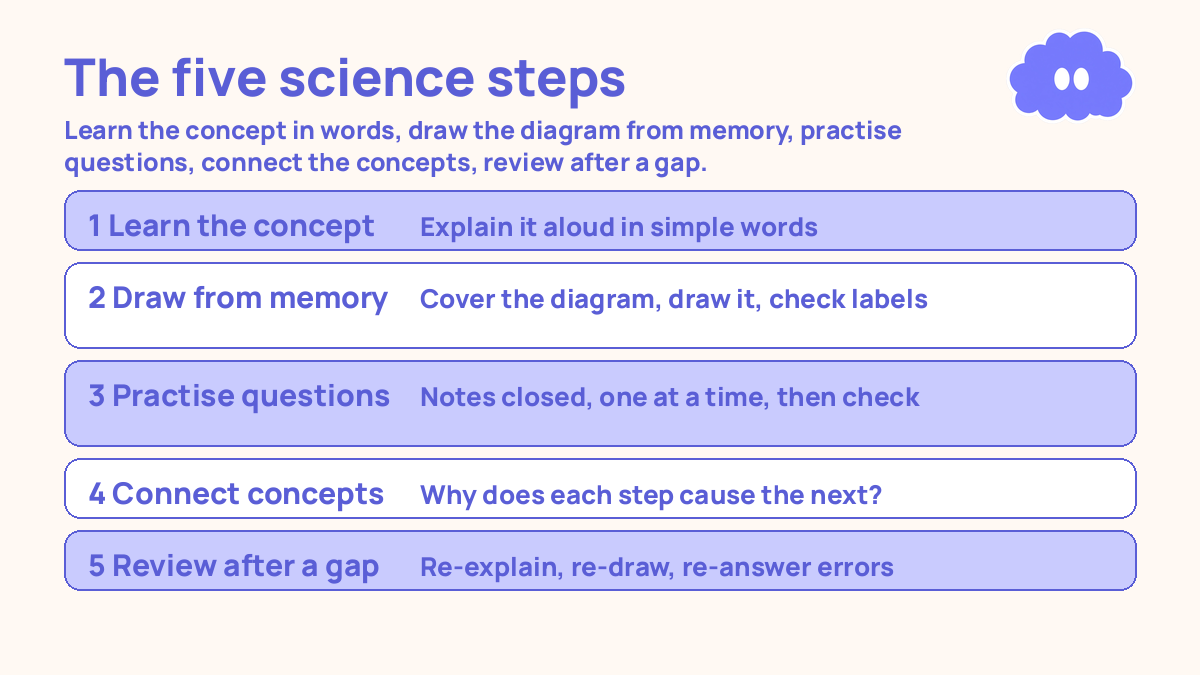
- Learn the concept in words: explain it aloud in simple words, as if to a friend with no background — the Feynman technique. If you cannot explain it, you do not know it yet.
- Draw the diagram or process from memory: look at it once, cover it, draw it on a blank page with the labels, then check.
- Practise questions from memory: past-paper questions and textbook questions, notes closed, one at a time, then check.
- Connect the concepts: ask why each step causes the next, and what would happen if one step stopped. Write the chain down.
- Review after a gap: the next day, then after three days, then after seven.
Step 1: Learn the concept in words
Pick one concept: photosynthesis, osmosis, the carbon cycle, Newton’s laws. Explain it aloud, in simple words, as if to a friend who has never studied the subject. If the concept needs a technical term, say what it means in plain words first.
The stall is the signal: the moment you hesitate, write down where you stopped. That is the gap. Go back to the source, fill that one gap, and explain again. Twenty minutes per concept is enough.
Do not start with the diagram or the questions. The words come first, because the words are the concept. A student who can say what it means can rebuild the diagram from the words.
Step 2: Draw the diagram or process from memory
Now the diagram. Look at it once, then cover it. Draw it on a blank page, with the labels, from memory. Then uncover the original and check: what did you miss, what did you put in the wrong place, what did you label wrong?
A diagram drawn from memory tests something reading cannot: whether you hold the shape of the process, not just the words for it. The first time you draw one from memory, you will miss half of it. That is the point — the missing half is the list of what to learn next.
Draw the same diagram three times across the week: today, tomorrow, and after three days. Each time from memory, each time checked. If a process has steps, draw them as a flow with arrows, and say each step aloud as you draw it.
Step 3: Practise questions from memory
Now the questions. Past-paper questions and textbook questions, one at a time, notes closed. Write the answer properly — full sentences for explanation questions, full working for calculation questions. Then check against the mark scheme or the answers, and mark strictly. “Almost right” is wrong.
Questions are where the concept meets a new situation, and that meeting is the skill the exam measures. The questions build that skill, one at a time.
Mix the questions: photosynthesis with respiration, osmosis, and last month’s topics. Mixing forces you to choose the right concept for each question. If you get one wrong, write down the step where it went wrong — concept, diagram, or application — and that step goes on the list for step 5.
Step 4: Connect the concepts
Science topics are not separate boxes. Photosynthesis connects to respiration: one makes glucose and oxygen, the other uses them. Osmosis connects to cell structure: the membrane decides what crosses. Ask why each step causes the next, and what would happen if one step stopped. Write the chain down in one or two lines.
Why does the plant need ATP in the Calvin cycle? Because building sugars takes energy, and the light reactions are the only source. What happens if the light is switched off? The light reactions stop, ATP runs out, and the Calvin cycle stops too. A chain like that is much harder to forget than a list of facts.
Draw the connections if it helps: boxes with arrows labelled “makes”, “needs”, “causes”. But you still have to be able to say the chain aloud, in order, without looking at it.
Step 5: Review after a gap
Come back the next day and re-do the three moves: explain the concept aloud, draw the diagram from memory, and answer the questions you got wrong. Ten minutes for the explanation, five for the diagram, ten for the questions. Then again after three days, then after seven. That 1-3-7 pattern is a practical starting schedule, not a research rule. Cepeda and colleagues showed in 2006 that spacing beats massing, and the best gap grows with how long you need to remember the material.
The review is not re-reading the chapter. You are re-doing the three moves, and each move is a test. If the explanation stalls in the same place, that concept needs another round of step 1. If the same question fails twice, that application needs another round of step 3.
Sleep matters here too: Diekelmann and Born showed in 2010 that sleep consolidates learning. A review done the evening before, followed by a night’s sleep, is worth more than the same review done at midnight. Do the review, then sleep. As the exam approaches, the same three moves become how to revise science for exams, organised into a revision plan by process rather than by chapter.
A worked example: a week on photosynthesis
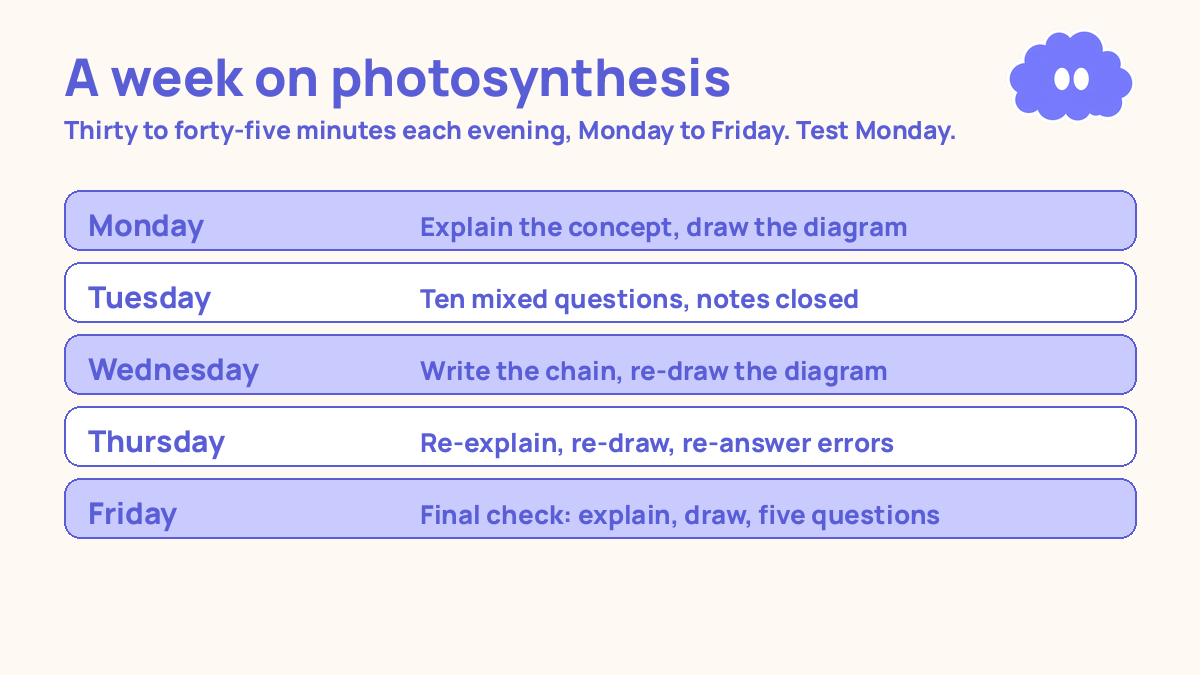
Your biology test is next Monday. Photosynthesis is the biggest topic on it. You have five evenings, Monday to Friday, and thirty to forty-five minutes each evening.
Monday 6:00–6:40 — Learn it. You explain photosynthesis aloud: the plant uses light to make glucose from water and carbon dioxide. You stall on why the plant needs ATP, go back to the book, find the answer, and explain again. Then you draw the chloroplast from memory and fix two missing labels.
Tuesday 6:00–6:30 — Questions. Ten mixed questions: six on photosynthesis, two on respiration, two on osmosis. Notes closed. Seven right. The three wrong ones go on the list.
Wednesday 6:00–6:35 — Connect it. You write the chain: light reactions make ATP and NADPH, the Calvin cycle uses them to build sugars, respiration breaks sugars down again. Then you re-draw the chloroplast from memory. One label still missing.
Thursday 6:00–6:30 — Review. You re-explain photosynthesis, re-draw the diagram, and re-answer Tuesday’s three wrong questions. Two are right now. One is still wrong — the plant in the dark.
Friday 6:00–6:30 — Final check. You explain the topic, draw the diagram, and answer five mixed questions. All five right. The topic is ready.
| Topic part | How you learn it | How you test it |
|---|---|---|
| The concept | Explain it aloud in simple words | Re-explain it after a gap |
| The process | Draw the diagram from memory | Re-draw it, check the labels |
| The application | Practise questions, notes closed | Re-answer the ones you got wrong |
| The connections | Ask why each step causes the next | Ask what happens if a step stops |
When it goes wrong
You memorise definitions without mechanisms. You can repeat “photosynthesis is the process by which plants convert light energy into chemical energy” and you cannot say why the plant needs ATP. Fix it by asking why and how about every definition. A definition you can explain is yours.
You copy diagrams instead of drawing them from memory. You look at the diagram, copy it neatly, and feel like you studied it. Fix it by covering the original before you draw. A diagram drawn from memory is a test, and the missing labels are the list of what to learn.
You only read. You read the chapter three times and never explain, draw, or answer a question. Fix it by making the three moves non-negotiable: every topic gets an explanation, a drawing, and a set of questions.
You leave the questions to the end. You learn the concept and the diagram, then run out of time for questions. Fix it by doing the questions in the same session as the concept, not a week later. A topic learned without questions is a topic half-learned.
Weekly review checklist
Copy this list and use it each week:
- Which topics did I explain aloud, and which ones did I only read?
- Which diagrams can I draw from memory, and which ones do I still need to look at?
- Which questions did I get wrong twice, and which step failed — concept, diagram, or application?
- Did I review each topic after a gap, or only on the day I learned it?
Downloadable infographic spec: one vertical image, title “Explain it, draw it, answer it”, with the five steps: learn the concept in words, draw the diagram from memory, practise questions from memory, connect the concepts, review after a gap, plus the rule “reading is the input, the three moves are the learning”, in Thynq cream, Cloud Purple, Dark Purple and pink, with the cloud mascot. Text taken word-for-word from this article.
What this system is not
It is not a promise of a grade, and it is not a claim that science is only about understanding. Facts matter too — the names, the numbers, the terms — and facts are learned by retrieval practice: testing yourself on them after a gap. This system is for the rest: the concepts, the processes, and the questions. Use both: explain the concept on Monday, test the facts on Tuesday.
Sources
- Rowland, C. A. (2014). The effect of testing versus restudy on retention: a meta-analytic review of the testing effect. Psychological Bulletin, 140(6), 1432-1463. Testing beat restudy (g = 0.50); with feedback g = 0.73, without feedback g = 0.39.
- Karpicke, J. D. & Blunt, J. R. (2011). Retrieval practice produces more learning than elaborative studying with concept mapping. Science, 331(6018), 772-775. Retrieval group scored 0.67 a week later against 0.45 for concept mapping.
- Dunlosky, J., et al. (2013). Improving students’ learning with effective learning techniques. Psychological Science in the Public Interest, 14(1), 4-58. Practice testing rated high utility; self-explanation rated moderate.
- Cepeda, N. J., et al. (2006). Distributed practice in verbal recall tasks. Psychological Bulletin, 132(3), 354-380. Spaced practice beat massed practice; the best gap grows with how long the material must be remembered.
- Diekelmann, S. & Born, J. (2010). The memory function of sleep. Nature Reviews Neuroscience, 11(2), 114-126. Sleep consolidates learning, moving memories from the hippocampus to the cortex for long-term storage.
For the full system behind this method, start with how to build a study system that fits your life.
Questions
How is studying science different from other subjects?
Science asks for three kinds of learning at once: facts, processes you can draw, and problems you can solve. Reading handles only the first. This system gives each kind its own step: explain the concept, draw the process from memory, and practise the questions.
Should I memorise definitions?
Learn what the definition means, not the exact words. Say it in your own words, then check that your version says the same thing. If you can explain why the definition is written that way, you know it. If you can only repeat it, you will lose it under exam pressure.
How do I study diagrams?
Draw them from memory. Look at the diagram, cover it, and draw it on a blank page with the labels. Then check what you missed. A diagram you have drawn from memory three times is yours. A diagram you have only looked at is not.
What if I understand the concept but cannot do the questions?
Then the understanding is incomplete. Questions are where the concept meets a new situation, and that meeting is the skill the exam measures. Practise questions from memory, in mixed sets, and use your errors to find the step that failed.