The direct answer
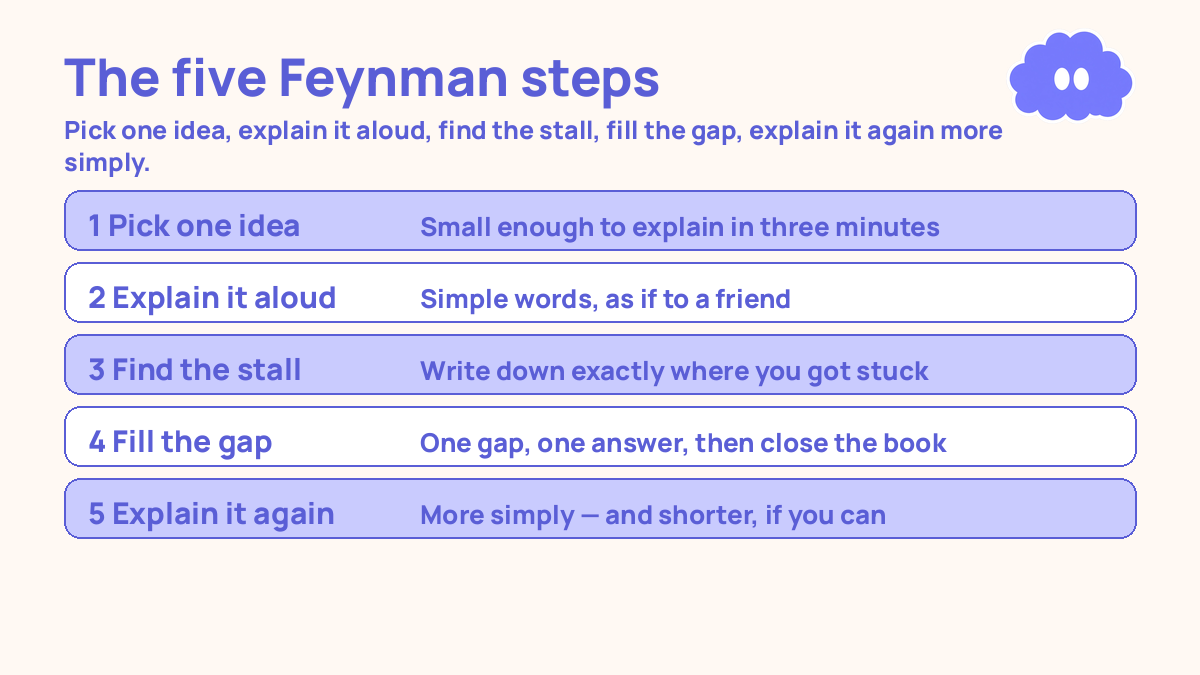
The Feynman technique for students is simple: pick one idea, explain it aloud in simple words as if to a friend who knows nothing about the subject, notice exactly where you stall, go back to the source to fill that one gap, and explain it again more simply. That is the whole technique. It works because explaining forces you to produce the idea from your own understanding, and the places where you cannot explain are the places where you do not understand yet.
Why the Feynman technique for students starts with explaining
You have read the chapter twice. It makes sense while you are reading it. Then someone asks you what it was about, and the words will not come. You know the terms, you recognise the diagrams, but you cannot say the idea in your own words. That is the gap the Feynman technique is built for: the difference between recognising something and understanding it.
Be honest about what this technique is. No peer-reviewed study of the Feynman Technique itself was found in Thynq’s research pass. The evidence behind it is self-explanation. In 1989, Chi and colleagues watched 8 physics students study worked examples while thinking aloud: the 4 who later solved problems best, 82% correct, had given 15.3 explanations per example, while the 4 who did worst, 46% correct, had given 2.8. A 2018 meta-analysis by Bisra and colleagues, across 64 reports, found prompting self-explanation gave a moderate average benefit, g = 0.55.
The system in short
- Pick one idea, small enough to explain in three minutes. One concept, one mechanism, one result — not a whole chapter.
- Explain it aloud, in simple words, as if to a friend with no background in the subject. No jargon, no reading from notes.
- Find the stall. The moment you hesitate, wave your hands, or say “basically, it just sort of…” — stop and write down exactly where you got stuck.
- Go back to the source and fill that one gap only. Read the section, check the example, fix the missing piece.
- Explain it again, more simply. Add an analogy only if it genuinely fits the mechanism. If you still stall in the same place, split the idea and repeat.
Step 1: Pick one idea, small enough to explain in three minutes
Do not start with “photosynthesis” or “supply and demand”. Those are chapters, not ideas. Start with one piece: “why plants need ATP in the Calvin cycle” or “why a price floor creates a surplus”. If you cannot name the idea in one sentence, it is too big.
Write the idea at the top of a blank page, in one line. Then close the book, close the notes, and put them out of reach. The whole technique depends on this: if the source is open, you will read it, not explain it, and you will feel fluent again without learning anything. If you are choosing between ideas, pick the one you are least sure about: explaining what you already know teaches you nothing.
Step 2: Explain it aloud, in simple words
Start talking. Explain the idea as if to a twelve-year-old, or a friend who has never studied the subject. Use short sentences and ordinary words. If the idea needs a technical term, define it in plain words the first time you use it, then use it.
Saying it aloud matters. Thinking it through in your head lets you skip the hard parts without noticing — your thoughts jump over the gap and land on the conclusion, and you believe you understood the middle. Speaking is linear: you have to produce each step in order, out loud, and a missing step leaves a silence you can hear.
Step 3: Find the stall
Sooner or later you will stall. You will hesitate, repeat yourself, say “and then it sort of… happens”, or reach for a word you cannot find. That is the most valuable moment in the whole technique. Stop talking. Write down exactly where you got stuck, in one line: “I cannot say why the plant needs ATP here” or “I do not know what happens to the surplus”.
Be precise about the stall. “I don’t get photosynthesis” is not a gap, it is a feeling. “I cannot say what NADPH does after the light reactions” is a gap, and it tells you exactly what to go back and learn. Asking why and how at each step is the whole point of elaborative interrogation, which turns a stall into a question you can answer.
Step 4: Go back to the source and fill that one gap only
Open the book or the notes and find the answer to the one gap you wrote down. Not the whole chapter — the one gap. Read that section, look at that example, check that definition. Then close the source again.
This is where most students waste the technique. They go back to the source and re-read the whole chapter, because re-reading feels safe. An hour later they have re-read everything and fixed nothing, because they never named the gap. The rule is: one gap, one answer, then the book closes again. If the answer opens a second gap, write that down too, and fill it next. One gap at a time, in order.
Step 5: Explain it again, more simply
Explain the idea again, from the start, aloud, in simple words. This time the stall should be gone, or moved to a new place. If it is gone, try to make the explanation shorter. Cut a sentence. Replace a technical term with a plain one.
An analogy can help here, but only if it fits the mechanism. “ATP is like a rechargeable battery” works because ATP stores energy and is recharged — the analogy matches what ATP does. “The Calvin cycle is like a factory” is weaker, because it does not say what the factory does differently from any other process. If you cannot say why the analogy fits, drop it. If you still stall in the same place after filling the gap, split the idea: explain the first half now, and take the second half as a new idea tomorrow.
A worked example: explaining osmosis on a Tuesday evening
You have a biology test on Friday. Osmosis is on the list, and you have read the chapter twice. It feels clear. You close the book and set a timer for 30 minutes.
6:00–6:05 — First explanation. You explain osmosis aloud to an empty room: “Osmosis is when water moves across a membrane from where there is more water to where there is less water.” Then you stall. Why does the water move? You say “because of concentration, sort of”, and stop. The gap, written down: “I cannot say why water moves across the membrane.”
6:05–6:15 — Fill the gap. You open the book to the osmosis section. The answer: water moves because water molecules move randomly, and more of them cross from the side where there are more water molecules. No force pulls them. It is random movement with uneven numbers. You close the book.
6:15–6:20 — Second explanation. You explain it again: “Water molecules move around randomly all the time. If one side of a membrane has more water molecules than the other, more of them bump across to the other side than bump back. So water ends up moving from the side with more water to the side with less.” No stall. You add the analogy: “It is like a crowded room with a door — more people walk out than walk in, just because there are more people inside.”
6:20–6:30 — Check the edges. You ask yourself two questions the test might ask: what happens to a red blood cell in pure water, and what happens in salty water? You answer both aloud, using the same random-movement explanation. Thirty minutes, one idea, and you now know you understand osmosis instead of hoping you do.
| Attempt | What you said | What it showed |
|---|---|---|
| First explanation | “Water moves because of concentration, sort of” | You knew the direction, not the reason |
| After filling the gap | “More water molecules bump across than bump back” | You can say why it moves |
| Edge check | Red blood cell swells in pure water, shrinks in salty water | The explanation works on new cases |
When it goes wrong
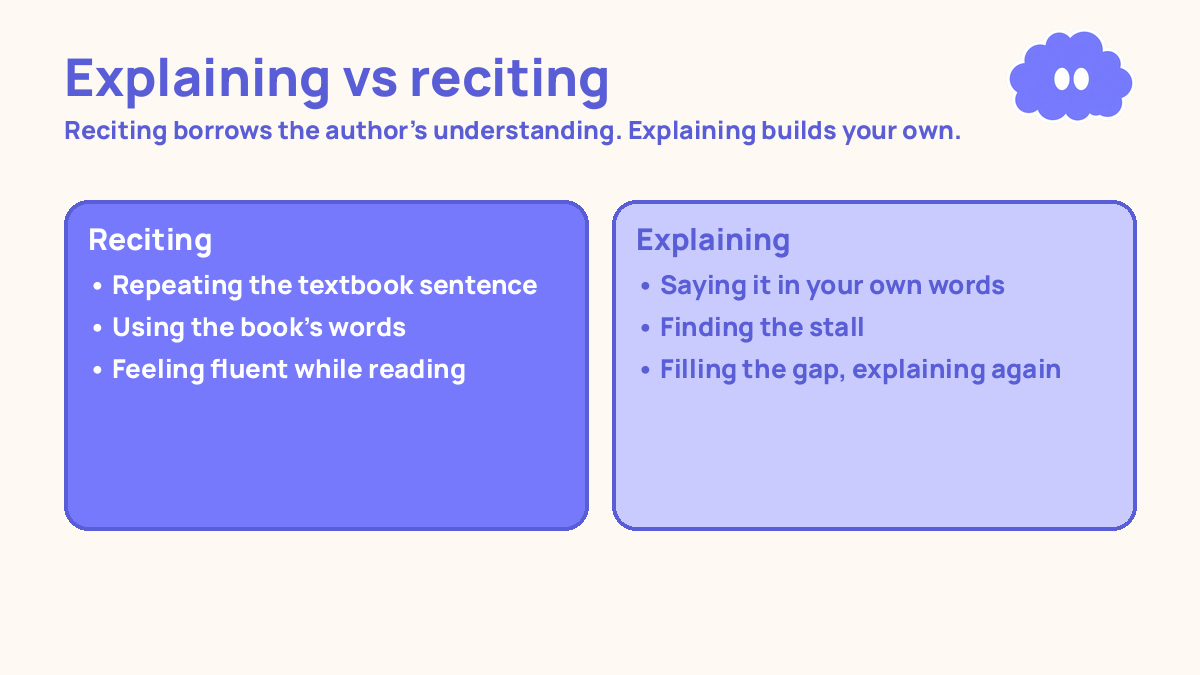
You explain from memory of the wording, not the idea. You recite the textbook sentence in a slightly different order and call it an explanation. Fix it by banning the textbook’s key phrases for the first explanation. If you cannot say it without the phrase “concentration gradient”, you do not understand the gradient yet.
You explain it in your head. Thinking feels like explaining, but it is not. Your thoughts skip the hard step and you never notice. Fix it by speaking aloud, every time, even if it feels strange.
You go back and re-read the whole chapter. The gap was one sentence, and you spent an hour re-reading everything around it. Fix it with the rule: one gap, one answer, book closed. If the answer opens a second gap, write it down and fill it next.
You use jargon to hide the gap. “The system equilibrates due to osmotic pressure” sounds like understanding and says nothing you could explain to a twelve-year-old. Fix it by asking, after every technical term: could I say this in ordinary words? If not, that term is the gap. Look it up, define it plainly, and try again.
Weekly review checklist
Copy this list and use it each week:
- Which ideas did I explain aloud this week, and which ones did I only read?
- Where did I stall, and did I fill that exact gap or just re-read the chapter?
- Which explanation got shorter and simpler on the second try?
- What is the one idea I still cannot explain simply, and when will I take it next?
Downloadable infographic spec: one vertical image, title “Explain it in simple words”, with the five steps: pick one idea, explain it aloud, find the stall, fill the gap, explain it again more simply, plus the rule “if a twelve-year-old could not follow it, you do not understand it yet”, in Thynq cream, Cloud Purple, Dark Purple and pink, with the cloud mascot. Text taken word-for-word from this article.
What this system is not
It is not a research-proven technique, and this article does not pretend it is. No peer-reviewed study of the Feynman Technique itself was found in Thynq’s research pass. What the research supports is the mechanism underneath it: explaining in your own words, tested in Chi’s small 1989 study and in Bisra’s 2018 meta-analysis. It is also not a replacement for testing yourself. Explaining tells you whether you understand an idea; retrieval practice tells you whether you can remember it a week later. Use both.
Sources
- Chi, M. T. H., et al. (1989). Self-explanations: how students study and use examples in learning to solve problems. Cognitive Science, 13(2), 145-182. In 8 physics students, the 4 who solved problems best (82% correct) gave 15.3 explanations per example, against 2.8 for the 4 who did worst (46%).
- Bisra, K., et al. (2018). Inducing self-explanation: a meta-analysis. Educational Psychology Review, 30(3), 703-725. Across 64 reports, prompting self-explanation gave a moderate average benefit (g = 0.55).
- Dunlosky, J., et al. (2013). Improving students’ learning with effective learning techniques. Psychological Science in the Public Interest, 14(1), 4-58. Self-explanation and elaborative interrogation rated moderate utility; only practice testing and distributed practice rated high.
For the full system behind this method, start with how to build a study system that fits your life.
Questions
Do I need a real person to listen to my explanation?
No. Explaining aloud to an empty room works, and so does a voice memo on your phone. The listener is not the point. Speaking forces you to produce the idea in order, and the gaps show up in the speaking.
How long should one Feynman round take?
About 20 to 30 minutes for one idea. Five minutes to explain, five to find the gap, ten to go back to the source and fill it, and five to explain again. If one idea takes an hour, the idea is too big — split it.
Does the Feynman technique work for maths?
Yes, if you explain why each step works, not just what the step is. Saying “then you move the x over” is reciting. Saying “you subtract the same number from both sides so the equation stays balanced” is explaining. If you cannot say why a step works, that is the gap.
Is the Feynman technique proven by research?
No study of the technique itself was found in Thynq’s research pass. The evidence behind it is self-explanation: Chi and colleagues found in 1989 that strong physics students gave far more explanations per example, and a 2018 meta-analysis found a moderate average benefit.