
The direct answer
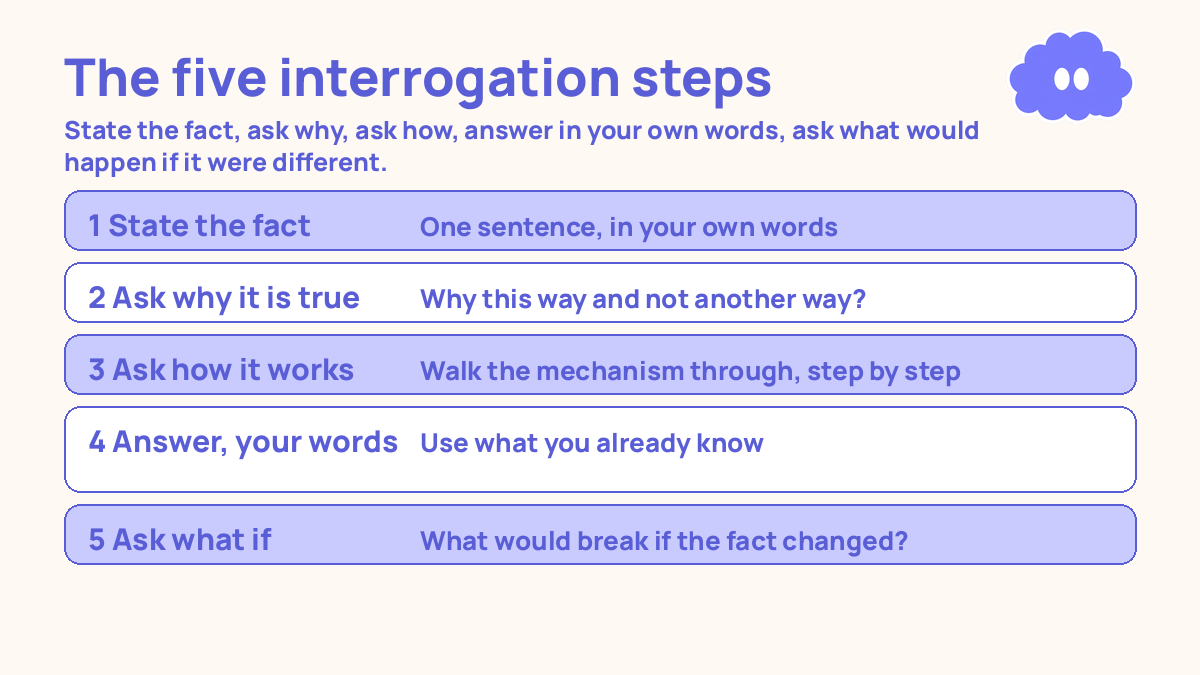
The elaborative interrogation study method is simple: take one fact, ask why it is true, ask how it works, and answer both questions in your own words, using what you already know. Then ask what would happen if it were different. That is the whole method. It works because a fact with a reason attached is easier to remember than a fact on its own — the reason gives your memory something to hold on to.
How the elaborative interrogation study method works
You have read the fact five times. You can repeat it. But it slides off your memory the moment you look away, because it is a fact with nothing attached to it.
Ask why, and you have to think about what the heart does: it pumps blood to the lungs and to the body, two different jobs that need two separate pumps. Now the fact is the end of a short chain of reasoning, and the chain is what you remember.
The research behind it is moderate. Dunlosky and colleagues rated elaborative interrogation as moderate utility in 2013 — not high, like practice testing and distributed practice, but better than re-reading, which was rated low. A 2018 meta-analysis by Bisra and colleagues found prompting self-explanation gave a moderate average benefit, g = 0.55, across 64 reports.
The system in short
- State the fact in one sentence. One fact, in your own words, written down. Not a paragraph — one sentence.
- Ask why it is true. Why does this happen? Why is it this way and not another way?
- Ask how it works. How does the mechanism run, step by step? What does each part do?
- Answer in your own words, using what you already know. Connect the fact to something you learned earlier. No copying from the book.
- Ask what would happen if it were different. If the fact were false, what would break? This is the check that the reason is real.
Step 1: State the fact in one sentence
Pick one fact and write it in one sentence, in your own words. “The heart has four chambers.” “Water moves from high concentration to low concentration.” “A price floor above the market price creates a surplus.” One sentence, one fact.
Writing it in your own words matters: copying the textbook sentence just moves text from one page to another. If you cannot say it in your own words, read the section once and try again.
Interrogation is slow work: five facts interrogated properly beat twenty facts read once. Choose the facts that matter and leave the rest for retrieval practice.
Step 2: Ask why it is true
Ask the fact why it is true. Why does the heart have four chambers? Why does water move from high to low concentration? Why does a price floor create a surplus? Say the question aloud or write it under the fact. The question is the tool. Without it, you are just reading the fact again.
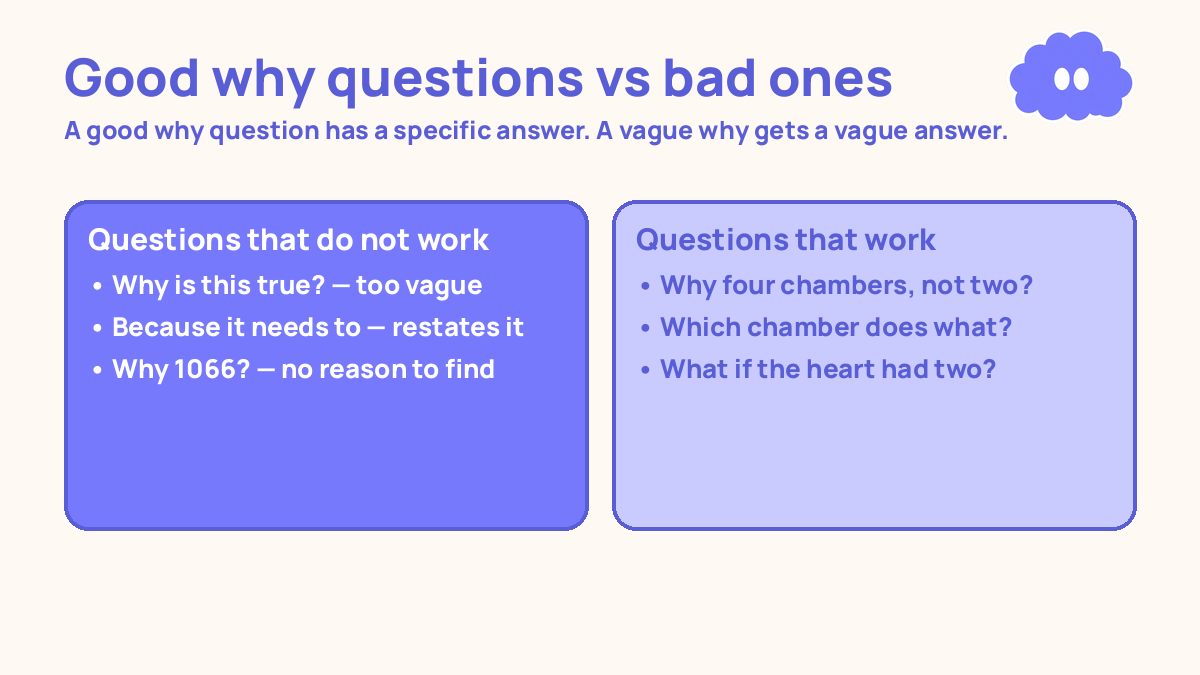
The why has to be specific. “Why four chambers and not two?” is better than “why is this true?”, because it forces a comparison. A vague why gets a vague answer, and a vague answer attaches nothing to the fact.
If the fact is just the way things are, like the value of a constant, stop: not every fact has a why. For facts without reasons, use retrieval practice instead.
Step 3: Ask how it works
Now ask how. For the heart: the right side pumps blood to the lungs, the left side pumps it to the body, and the two sides must not mix. For osmosis: water molecules move randomly, and more cross from the crowded side.
The how is where the understanding lives: a mechanism you can walk through, step by step, is much harder to forget than a claim. If you cannot walk through the how, the step you cannot describe is the step you do not know. Go back to the source and learn that step.
Draw the how if it helps — four boxes with arrows for the blood flow. But you still have to be able to say the steps aloud, in order, without looking at the drawing.
Step 4: Answer in your own words, using what you already know
Answer the why and the how in your own words, using what you already know. The heart’s four chambers connect to something you learned last year: the lungs oxygenate blood, the body uses oxygen, and the two circuits must stay separate. Osmosis connects to random movement, which you already know from diffusion.
This is the step that makes the fact stick: a new fact connected to an old fact is part of a network, and the more connections, the more ways back to the fact when you need it.
Do not copy the book’s answer: it is the author’s understanding, in the author’s words. If your answer is shorter than the book’s, that is usually a good sign — you have found the core of it.
Step 5: Ask what would happen if it were different
Finish with one more question: what would happen if the fact were different? If the heart had two chambers, the oxygenated and deoxygenated blood would mix, and the body would get less oxygen. If the price floor were below the market price, nothing would happen — the floor would not bind.
This is the check that the reason is real. If you cannot say what breaks when the fact changes, the reason you gave in step 4 was probably a restatement of the fact, not a reason for it. “The heart has four chambers because it needs four chambers” is the fact wearing a different sentence.
A worked example: why does the heart have four chambers, 6:00–6:30pm
You have a biology test on Friday. “The heart has four chambers” is on the list, and you have read it five times without it sticking. You sit down at 6pm with a blank page.
6:00–6:03 — The fact. You write: “The heart has four chambers: two atria on top, two ventricles below.”
6:03–6:10 — Why? You ask: why four chambers and not two? The heart does two jobs — lungs and body — and the blood for each must stay separate. You write that down.
6:10–6:18 — How? You walk through it: right atrium collects blood from the body, right ventricle pumps it to the lungs, left atrium collects it back, left ventricle pumps it to the body. Four steps, four chambers.
6:18–6:25 — Connect it. You link it to what you already know: the lungs add oxygen, the body uses oxygen, and mixing the two bloods would deliver less oxygen to the body.
6:25–6:30 — What if? You ask: what if the heart had two chambers, like a fish? The blood would mix, the body would get less oxygen, and the animal could not sustain high activity.
| Question | What you ask | What it gives you |
|---|---|---|
| Why is it true? | Why four chambers, not two? | The reason: two jobs, blood must stay separate |
| How does it work? | Which chamber does what, in order? | The mechanism: four steps, four chambers |
| What if it were different? | What if the heart had two chambers? | The check that the reason is real |
When it goes wrong
You ask why once and stop. “Why does the heart have four chambers? Because it needs to pump blood.” That is not an answer, it is a restatement. Fix it by asking why again: why does pumping blood need four chambers? Two or three whys, not one — the first why usually restates the fact, the second finds the reason.
You answer with the textbook sentence. You ask why, then copy the book’s explanation word for word. Fix it by closing the book before you answer. If you cannot say it without the book open, you have memorised the book’s sentence about it, not understood it.
You ask why about things with no background knowledge. You ask why a fact is true about a topic you have never studied, and the answer is just another fact you do not understand. Fix it by asking a smaller why, or going back to learn the basics first. A difficulty is only desirable if you have the background knowledge to respond to it — if not, it is just hard.
You use it for lists of unrelated facts. Dates, names, terms — you ask why the Battle of Hastings was in 1066, and there is no why to find. Fix it by choosing the right tool: for lists, use retrieval practice — test yourself on them after a gap.
Weekly review checklist
Copy this list and use it each week:
- Which facts did I interrogate this week, and which ones did I only re-read?
- Which why questions got a real reason, and which ones only restated the fact?
- Which facts had no why, and did I move them to retrieval practice?
- What is the one fact I still cannot explain the reason for?
Downloadable infographic spec: one vertical image, title “Ask why and how”, with the five steps: state the fact in one sentence, ask why it is true, ask how it works, answer in your own words, ask what would happen if it were different, plus the rule “two or three whys, not one”, in Thynq cream, Cloud Purple, Dark Purple and pink, with the cloud mascot. Text taken word-for-word from this article.
What this system is not
It is not a high-utility technique, and this article does not claim it is. Dunlosky and colleagues rated it moderate, below practice testing and distributed practice. Use it where it fits — facts with reasons behind them, learned slowly and connected to what you already know — and use retrieval practice for the rest. It is also not the same as the Feynman technique: Feynman asks you to explain a whole idea aloud after learning it. The two pair well: interrogate the facts on Monday, explain the idea on Wednesday, test yourself on Friday.
Sources
- Dunlosky, J., et al. (2013). Improving students’ learning with effective learning techniques. Psychological Science in the Public Interest, 14(1), 4-58. Elaborative interrogation and self-explanation rated moderate utility; only practice testing and distributed practice rated high.
- Bisra, K., et al. (2018). Inducing self-explanation: a meta-analysis. Educational Psychology Review, 30(3), 703-725. Across 64 reports, prompting self-explanation gave a moderate average benefit (g = 0.55).
- Chi, M. T. H., et al. (1989). Self-explanations: how students study and use examples in learning to solve problems. Cognitive Science, 13(2), 145-182. In 8 physics students, the 4 who solved problems best (82% correct) gave 15.3 explanations per example, against 2.8 for the 4 who did worst (46%).
- Bjork, R. A. (1994). Memory and metamemory considerations in the training of human beings. In Metcalfe & Shimamura (eds.), Metacognition: Knowing about knowing, MIT Press. A difficulty is only desirable if the learner has the background knowledge to respond to it.
For the full system behind this method, start with how to build a study system that fits your life, and when you need to check whether you really understand a topic, use how to check your own understanding when studying alone.
Questions
What is the difference between elaborative interrogation and the Feynman technique?
They are close cousins. Elaborative interrogation asks why and how about one fact while you are learning it. Feynman asks you to explain a whole idea aloud in simple words after learning it. Use interrogation while you read, and Feynman when you want to check whether the idea holds together.
How many why questions should I ask about one fact?
Two or three. Why is it true, how does it work, and what would change if it were different. More than three and you are going down a rabbit hole. The goal is to connect the fact to what you already know.
Does elaborative interrogation work for memorising lists?
No, not well. Lists of unrelated facts — dates, names, terms — have no why to ask. For lists, use retrieval practice instead. Interrogation works on facts that have a reason behind them: mechanisms, causes, rules, and results.
What if I do not know enough to answer why?
Then ask a smaller why. If you cannot say why the heart has four chambers, ask why blood needs to go to the lungs at all. If you cannot answer that either, the gap is in your background knowledge — go back and learn the basics first.