The direct answer
Break it into small topics, learn one topic at a time, test yourself on it from memory, and review it again after a gap: next day, in 3 days, in 7 days. Use flashcards for facts, and explain ideas from memory in your own words. That is the whole system.
It works because memory grows from recall, not from reading. Reading a topic once feels like learning, but it is mostly recognition. Testing yourself feels harder, but it is the work that makes the topic stay. A topic recalled after a gap is a topic you will remember longer.
Why a heavy syllabus breaks most study
A heavy syllabus is not hard because any one topic is hard. It is hard because there is so much of it. Students try to read it all, in order, once, and hope it stays. By the time they reach the last chapter, the first chapter is gone.
The other mistake is cramming. You sit for hours, you read everything, and by the end of the night you can repeat it back. Then the exam comes a week later, and it is gone. Cramming works for tomorrow, not for next week.
A heavy syllabus needs a system, not more hours: small topics, testing yourself, and spaced review. Small topics make the work startable. Testing yourself makes the work real. Spaced review makes the work last.
This system sits inside a wider approach to revision. For the full approach, read how to revise for exams without cramming. For spacing, read the spaced repetition system for students. For flashcards, read the flashcard system that works.
The system in short
- List every topic in the syllabus, and split big topics into small ones.
- Sort the topics: what you know, what you half-know, and what you do not know.
- Each day, learn two or three new topics, one at a time.
- After learning a topic, close the book and test yourself on it from memory.
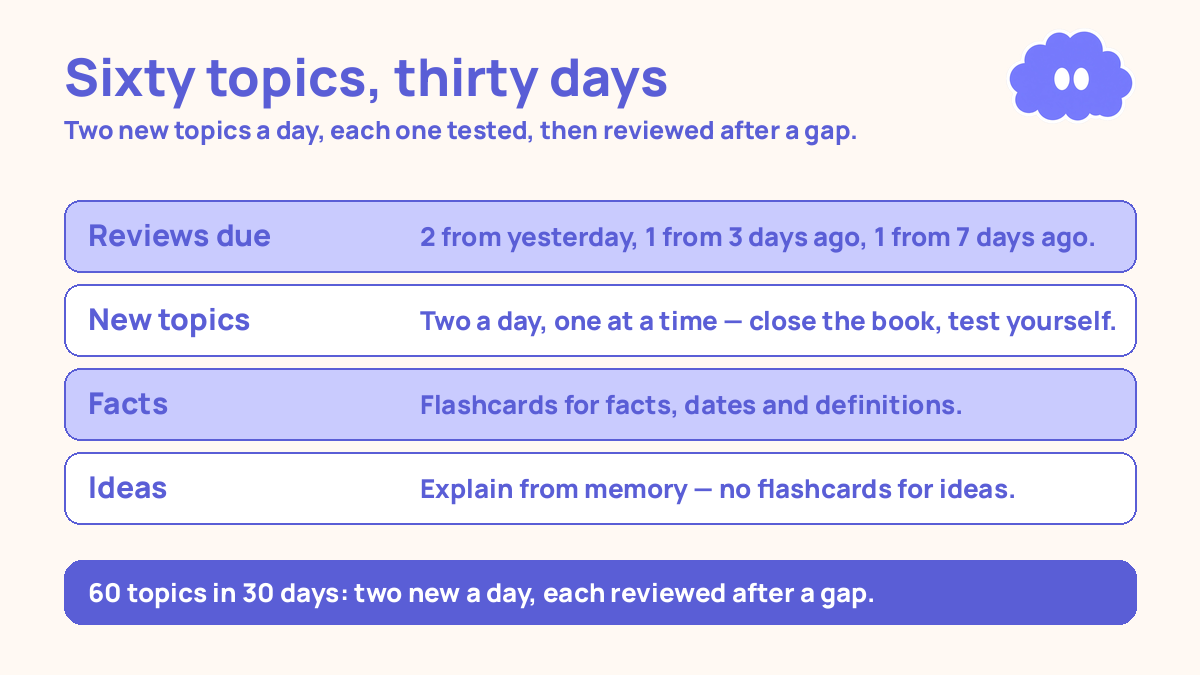
- Review each topic again after a gap: next day, in 3 days, in 7 days.
- Use flashcards for facts, dates, and definitions. Use explaining from memory for ideas.
- Once a week, test yourself on a mix of old topics, and change one thing.
Step 1: List every topic, and split the big ones
Before you start memorising, list every topic in the syllabus, using your course outline, textbook contents, or past papers. Write each topic on its own line. If a topic is big — “the heart”, “the French Revolution” — split it into smaller pieces. “The heart” becomes the chambers, the valves, and the blood flow. Each piece should be small enough to learn and test in one block.
This list is your map. Without it, you will study the topics you like, skip the ones you do not, and discover the gaps on exam day. Count the topics. If there are 60, and you have 30 days, that is two new topics a day. If there are 90, that is three a day.
Sort the list as you go. Mark each topic: know it, half-know it, or do not know it. “Half-know” is the most useful mark: topics you can recognise but cannot explain from memory. They are the ones that will fail you, because the exam asks you to recall, not to recognise.
Step 2: Learn one topic at a time, in a single block
Pick one topic. Learn it in a single block: 25 minutes, or 50 minutes if it needs it. Read it, take short notes, and work one example or question.
While you learn, write questions for yourself. Not summaries. Questions. “What are the four chambers of the heart?” Those questions are your test later. If you only write summaries, you will only re-read them later.
Keep the notes short. One page per topic, at most. A topic with ten pages of notes is a topic you will never review. One page of questions and key facts is a topic you can test in five minutes.
Step 3: Close the book and test yourself
After learning a topic, close the book and test yourself from memory. Answer the questions you wrote. Explain the idea in your own words, out loud or on paper. Then open the book and check.
This is the most important step. In a 2013 review, Dunlosky and colleagues rated ten common study techniques, and only two received a high utility rating: practice testing and distributed practice. Re-reading was rated low.
Testing yourself feels worse than re-reading. It feels slow, and it shows you what you do not know. Roediger and Karpicke found in 2006 that students who recalled a passage remembered more a week later than students who restudied it, even though the restudiers felt more confident right after studying.
Step 4: Review after a gap, not on the same day
Do not review a topic on the same day you learned it and call it done. Review it again after a gap: next day, in 3 days, in 7 days. That is a practical starting schedule, not a research rule.
The gap is what makes the review work. In a 2006 review, Cepeda and colleagues found that spaced practice beat massed practice, and that the best gap grows with how long you need to remember the material. Use the 1-3-7 starting schedule, and stretch it or shrink it as the exam nears.
On each review, test yourself again from memory, before you look at your notes. If you can answer the questions, the topic is holding. If you cannot, learn it again, briefly, and test again.
Step 5: Flashcards for facts, explaining for ideas
Use flashcards for facts: dates, names, definitions, formulas, and lists. One fact per card. Question on the front, answer on the back. Say the answer out loud, then turn the card.
Do not use flashcards for ideas. An idea — why something happens, how a process works — needs explaining, not a card. Close the book and explain it in your own words. If you cannot explain it, you do not know it yet.
For the full flashcard method, read the flashcard system that works. For spacing, read the spaced repetition system for students.
Step 6: Mix old topics in, every day
Every day, your study has two parts: new topics, and review of old topics. Two or three new topics, and the reviews due that day. Do not skip the reviews to learn more new topics. That is how a heavy syllabus collapses.
Mix the old topics up. Do not review them in order. Test yourself on a topic from last week, then one from yesterday, then one from three days ago.
Keep a simple tracker on paper. One line per topic, with the date you learned it, and the dates you reviewed it. A tick for a pass, a cross for a fail.
A worked example: a day with a heavy biology syllabus
Hana has 60 biology topics and 30 days until her exam: two new topics a day, plus reviews. Her day starts with the reviews due today: two topics from yesterday, one from 3 days ago, one from 7 days ago. She tests herself on each from memory, checks, and fixes the gaps.
Then she learns two new topics: the chambers of the heart, and the valves. She reads each one, writes questions for herself, and takes one page of notes per topic. After each, she closes the book and tests herself from memory, then checks.
At the end of the day, she writes the two new topics in her tracker, and marks the reviews: three ticks, one cross. The crossed topic — blood flow — goes back into tomorrow’s list. By day 30, she will have learned all 60 topics, and reviewed each at least three times, after a gap.
When it goes wrong
You read the whole syllabus, but you cannot recall any of it. You did not test yourself. Reading feels like learning, but it is mostly recognition. Close the book after each topic and test yourself from memory, before you move on.
You learn new topics every day, but the old ones vanish. You skipped the reviews. New topics are exciting. Reviews are boring. Put the reviews first in the day, before the new topics.
Your flashcards grow to hundreds, and you never finish them. You made too many, or too detailed. One fact per card. One question, one answer. If a card has a paragraph on it, split it. If you have 200 cards due in one day, split the deck by topic.
You test yourself, fail, and feel like giving up. Failing a test from memory is not a failure. It is the system working. It shows you what you do not know, while there is still time to fix it. Keep the failed topics in the tracker, review them again tomorrow, and watch the crosses turn into ticks.
Weekly review checklist
Copy this list and use it each week:
- How many new topics did I learn this week, and how many are left?
- How many reviews were due, and how many did I actually do?
- Which topics did I fail on review, and what will I do about them?
- Which topics are solid — passed twice after a gap — and which are still shaky?
- What is the one change I will make next week — and only one?
The one-change rule matters. If you try to fix five things at once, you will fix none of them. Pick the single change that would help most: fewer new topics a day, reviews first, or shorter notes. One change, tried for a full week, then judged honestly. If the topics left are more than the days left, drop the least important ones.
Downloadable infographic spec: one vertical image, title “Memorise a heavy syllabus, without cramming”, with the seven steps — list every topic and split big ones, learn one topic at a time, close the book and test yourself, review next day, in 3 days, in 7 days, flashcards for facts and explaining for ideas, mix old topics in every day, test a mix each week — and the checklist question “How many reviews were due, and how many did I actually do?” in Cloud Purple #7679FC, Dark Purple #5A5ED6, Cream Paper #FFF9F3 and Pink #E94E9A, with the Cloud mascot. Text taken word-for-word from this article.
What this system is not
It is not a promise of a grade, and it is not a claim that the 1-3-7 schedule is a research rule. It is a practical starting schedule: review next day, in 3 days, in 7 days, then adjust it to fit your exam date.
It is also not a system for learning everything at the last minute. If the exam is in three days and you have 60 topics left, no system will save you. This system works when you start early, do a little each day, and review after gaps.
Sources
- Dunlosky, J., et al. (2013). Improving students’ learning with effective learning techniques. Psychological Science in the Public Interest, 14(1), 4-58. Only practice testing and distributed practice received a high utility rating; rereading was rated low.
- Cepeda, N. J., et al. (2006). Distributed practice in verbal recall tasks. Psychological Bulletin, 132(3), 354-380. Spaced practice beat massed practice, and the optimal gap grows with how long you need to remember the material.
- Roediger, H. L., & Karpicke, J. D. (2006). Test-enhanced learning. Psychological Science, 17(3), 249-255. Students who recalled a passage remembered more a week later than students who restudied it, though restudiers felt more confident immediately.
For the wider revision approach, read how to revise for exams without cramming, for spacing, read the spaced repetition system for students, and for flashcards, read the flashcard system that works.
Questions
How do I memorise a heavy syllabus without cramming?
Break it into small topics, test yourself on each one from memory, and review each topic again after a gap: next day, in 3 days, in 7 days. That is a practical starting schedule, not a research rule.
Are flashcards enough for a heavy syllabus?
No, not on their own. Flashcards are good for facts, dates, and definitions. For ideas and processes, you need to explain them from memory, in your own words, and to work problems or past questions.
How many topics should I cover in one day?
Fewer than you think. Two or three new topics a day, tested from memory, beats six topics read once. The review of old topics counts too, so leave time for it in the same day.
What if I forget everything by the exam?
Forgetting between reviews is normal, and it is part of how the system works. Each time you recall a topic after a gap, it gets easier to recall next time. If you never test yourself, you will not know what you have forgotten until the exam.