The direct answer
How to revise for your GCSE exams comes down to starting six to eight weeks before your first paper, ranking every topic by weakness and marks, and rotating every subject across the week instead of finishing one before starting the next.
GCSEs are several subjects at once, with papers spread across weeks, and that shape is the whole problem: a plan that works for one exam fails for ten, because the subject you finished in March is forgotten by May.
The system in short
- List every subject, every paper, and every topic from your specifications.
- Rank every topic by weakness and by marks, and put the weak, high-mark topics first.
- Build a rotation that gives every subject a slot each week.
- Revise actively in 45-minute blocks: test yourself, do not reread.
- Do past papers under timed conditions, and learn the command words from the mark scheme.
- Use your mocks to reset the plan, and keep resetting it until the exams.
Step 1: List every subject, every paper, and every topic from your specifications
Start with a list, not a timetable. Write down every subject you take, every paper in each subject, and the topics in each specification. Your exam board publishes the specification for every subject, and your teacher can tell you which board and which tier you are on for each one. The specification is the definitive list of what you can be tested on, and it turns a vague mountain of revision into a finite checklist.
For each subject, note the tier, how many papers it has, and roughly how many topics the specification lists. A subject with two papers and forty topics is a bigger job than one with a single paper and fifteen. Then, for each topic, add a confidence rating: strong, shaky, or weak. Strong means you can answer past-paper questions on it without notes. Weak means you cannot start it without looking. Do not skip the subjects you like least: the list makes avoidance visible.
Step 2: Rank every topic by weakness and by marks, and put the weak, high-mark topics first
Now rank the topics by two measures at once: how weak you are, and how many marks the topic carries. A weak topic that carries a lot of marks is the highest priority in your whole revision. A strong topic that carries few marks is the lowest. The rest sit in the middle, and get their slots after the top of the list.
Work the ranking into a simple order for each subject: the three weakest, highest-mark topics at the top, then the rest in descending order. Then put the subjects in order too: the subject with the most weak, high-mark topics goes first in the day, when you are freshest. Keep the ranking live: update it after every past-paper session.
Step 3: Build a rotation that gives every subject a slot each week
A rotation is the heart of GCSE revision. You have several subjects, and each one needs to stay warm from now until its last paper. Finishing biology in March and not touching it again until May means relearning it in May. A rotation means every subject gets a slot every week, so nothing goes cold.
Build the week like this. Take your workable hours, usually three to five hours a day, and divide them into 45-minute blocks with 10-minute breaks. Give the weakest subject the morning block, when you are freshest, the second subject the midday block, and the third the afternoon block. Then add a short daily review slot of 20 minutes, for yesterday’s topics and last week’s topics. That review slot is the spacing that makes the whole system work.
Rotate the subjects across the days so that every subject appears at least twice a week, and the weakest subject three times. A week with nine subjects and five days means two subjects a day plus the review slot. Write the rotation down and put it where you can see it. Leave one block a week empty, to catch the session that ran long, and keep one day lighter than the rest, because a week with no rest day ends in a skipped day. How to make a revision timetable that works covers the timetable mechanics in detail; the rotation is what you put inside it.
Step 4: Revise actively in 45-minute blocks: test yourself, do not reread
So each 45-minute block has the same shape, whatever the subject. First 5 minutes: test yourself on yesterday’s topic, from memory, with the book closed. Next 25 minutes: work on today’s topic by testing yourself on it. Close the book, write down everything you know, open the book, and fill the gaps. Last 15 minutes: answer past-paper questions on the topic, or drill flashcards for the definitions, formulae, dates, and vocabulary.
The method changes with the subject, but the shape does not. For maths and sciences, practise problems with the book closed, and track which steps you get stuck on. For essay subjects, memorise the key quotes and evidence on flashcards, then practise planning and writing full answers, because structure is half the marks. For languages, put vocabulary on spaced flashcards daily, plus speaking and listening practice, little and often. For content-heavy subjects like biology and geography, use active recall for the facts, then past-paper questions to apply them. How to revise science for exams covers the same habits for science as a whole. Keep the blocks at 45 minutes, and stop when the block ends: a block that runs to 90 minutes steals the next subject’s slot.
Step 5: Do past papers under timed conditions, and learn the command words from the mark scheme
Work through them by topic first, then as full papers under timed conditions. By topic means: after you revise a topic, answer the past-paper questions on it, mark them against the official mark scheme, and log the misses. Full papers mean: sit a whole paper, in the time allowed, without notes, and mark it the same day. Do several before the real thing, so the time pressure is familiar. Past-paper system for exams covers the routine, and How to use mock exams to prepare covers how to treat a timed paper as a rehearsal rather than a test of your worth.
Learn the command words from the mark scheme, because they change the answer. “State” wants one term. “Describe” wants what happens, step by step. “Explain” wants what happens and why. “Compare” wants similarities and differences. “Evaluate” wants strengths, limitations, and a supported conclusion. “Calculate” wants a number, with the working shown. The gap between your answer and the mark scheme is your precise revision to-do list: log every topic where you drop marks, with one line per miss. If you want a second pair of eyes on your answers, Use AI to mark your past paper answers shows how to do that. Do not read the mark scheme before you answer: it is the check, not the lesson.
Step 6: Use your mocks to reset the plan, and keep resetting it until the exams
First, list the topics where you lost the most marks, in each subject, with the reasons: missing knowledge, wrong command word, running out of time, or a method error. A topic lost to missing knowledge gets a revision slot, one lost to the wrong command word gets a practice slot, and a paper lost to time gets a timed-paper slot. Second, update the rotation: the subject that did worst gets an extra slot each week, and the subject that did best loses one, but not its slot entirely, because a strong subject left alone for a month goes cold too.
Third, check the tiers. If a mock result makes you wonder whether you are on the right tier, talk to your teacher, with the mock paper in your hand. Tier decisions are your school’s, based on your mocks and classwork, and the earlier that conversation happens, the more time there is to act on it. Then keep resetting: each set of mocks produces a new ranking and a new rotation. By the last two weeks, the plan should be small: the misses log, the weak topics, and the timed papers.
A worked example: a Year 11 week in March, nine subjects, six weeks to go
Your situation: Year 11 student, nine subjects, first paper in six weeks. Your mocks came back last week: maths and chemistry are weakest, English is strong, and history is shaky. You have three hours after school each day, and three hours on Saturday morning. You are on higher tier for maths and foundation tier for one science, and your teacher has confirmed both.
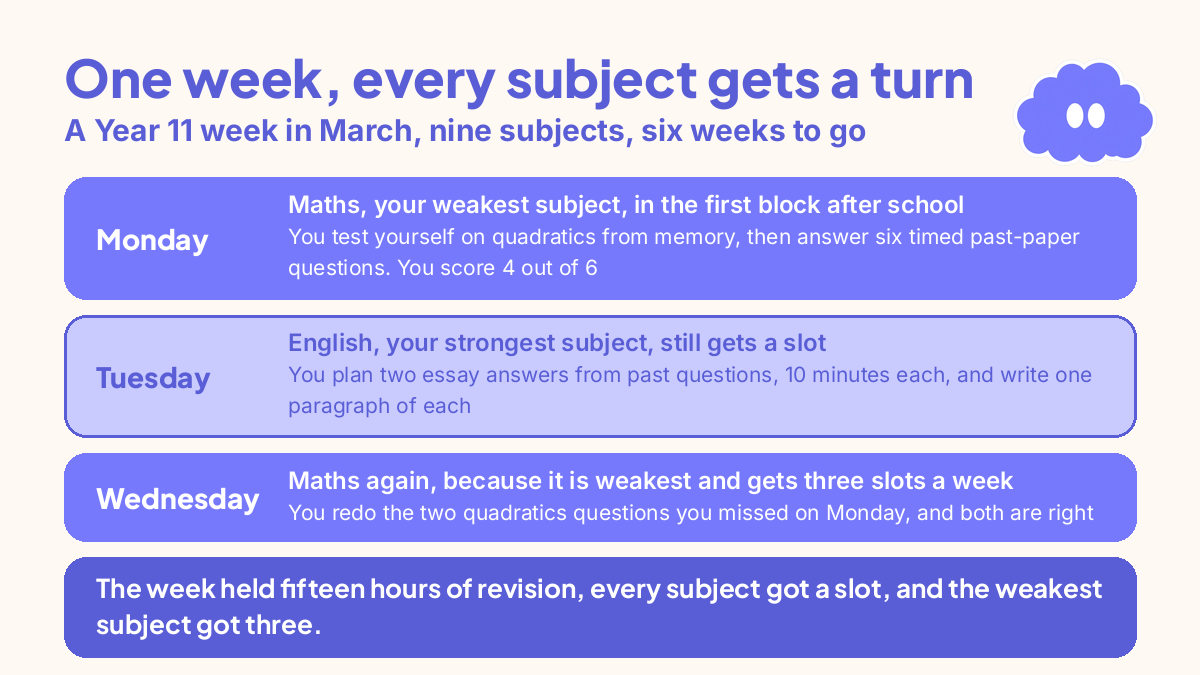
- Monday: Maths, your weakest subject, in the first block after school: you test yourself on quadratics from memory, then answer six timed past-paper questions. You score 4 out of 6, and the two misses go in the log. Then chemistry: you close the book and write out everything you know about bonding, then check and fill the gaps. Then the daily review slot: yesterday’s biology terms, tested from memory.
- Tuesday: English, your strongest subject, still gets a slot: you plan two essay answers from past questions, 10 minutes each, and write one paragraph of each. Then history: you test yourself on the causes of one event from memory, then write a timed paragraph answer and check it against the mark scheme.
- Wednesday: Maths again, because it is weakest and gets three slots a week: you redo the two quadratics questions you missed on Monday, and both are right. Then biology: you draw the heart from memory and label it, then answer four past-paper questions on circulation.
- Thursday: Chemistry again: six timed past-paper questions on bonding, and you score 5 out of 6. The one miss is a command-word error: you described when the question asked you to explain. Then French: vocabulary flashcards, a listening exercise, and five sentences written from memory.
- Friday: Geography: one case study from memory, then three past-paper questions. Then physics: five calculation questions with the book closed, checked against the mark scheme.
- Saturday: A timed chemistry paper, half length, marked the same morning. You score 32 out of 45. The misses log has 9 items, down from 14. Chemistry moves from weak to shaky. Then the weekly review: you update the rankings and write next week’s rotation, with maths still in the first block.
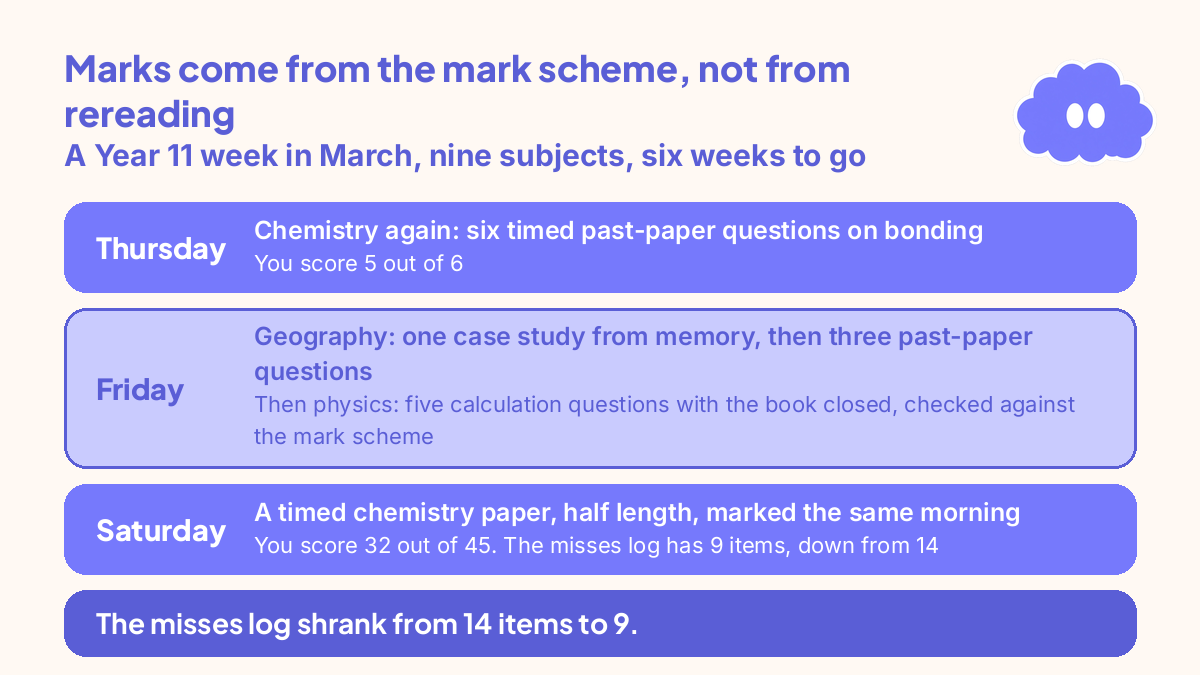
The week held fifteen hours of revision, every subject got a slot, and the weakest subject got three. The misses log shrank from 14 items to 9.
When it goes wrong
You revised one subject for three weeks and the others went cold. Stop, and rebuild the rotation. A subject untouched for a month needs relearning, not reviewing. Every subject gets a slot every week, even the strong ones.
Your mocks were worse than you expected, and you want to start over. Do not start over. A mock is information, not a verdict. List the topics where you lost marks, with the reasons, and rebuild the ranking from that list.
You fail a paper and have to sit it again. That happens, and it is not the end of the story. How to retake an exam: a study system for students who have to sit it again treats the retake as a new plan, with the marks log from the first attempt as the starting point, instead of repeating the same revision that did not work the first time.
Weekly review checklist
- Which topics moved on the ranking this week, and which are still weak?
- Did every subject get its slot, or did one subject take the week?
- Did I test myself from memory in every block, or did I slide back into rereading?
- What does the misses log say, and is it getting shorter?
- Do the timed papers feel familiar yet, or is time pressure still costing marks?
- What do the mocks say about my ranking, and does the rotation need to change?
Downloadable infographic spec: one vertical image, title “How to revise for your GCSE exams”, with the six steps from “The system in short” and the six review questions above, in Thynq cream, Cloud Purple, Dark Purple and pink, with the Cloud mascot. Text taken word-for-word from this article.
What this system is not
It is not a promise of grades, and it does not replace your teachers, your specification, or your exam board’s past papers. It is not a single-subject system stretched across nine subjects; the rotation is the point. It does not cover grade boundaries, exam dates, or board-specific details, because your board’s specification is the only source that counts. And it is not a last-minute plan: if the exam is tomorrow, test the misses log, answer a timed paper, and sleep.
Sources
- Roediger, H. L., & Karpicke, J. D. (2006). Test-enhanced learning. Psychological Science, 17(3), 249-255. Testing from memory beat restudying a week later, which supports testing in every 45-minute block.
- Dunlosky, J., et al. (2013). Improving students’ learning with effective learning techniques. Psychological Science in the Public Interest, 14(1), 4-58. Practice testing and distributed practice rated high; rereading rated low, which is why this system tests from memory and spaces sessions across the week.
- Cepeda, N. J., et al. (2006). Distributed practice in verbal recall tasks. Psychological Bulletin, 132(3), 354-380. Spaced practice beat massed practice, which supports the rotation and the daily review slot instead of one long session.
- Root Tutor. How to Revise for GCSEs: A Step-by-Step Guide. The six-to-eight-week start, the specification as a checklist, and the ranking of topics by weakness and marks.
For the wider exam system behind this one, start with How to build a study system that fits your life.
Questions
When should I start revising for GCSEs?
Start structured revision six to eight weeks before your first paper, usually around the Easter break for a summer exam series. That gives spaced reviews time to work. Light ongoing review through the year makes the final push easier, but six to eight weeks of focused revision is the realistic minimum.
How many hours a day should I revise for GCSEs?
Three to five hours of focused revision a day is realistic and effective for most students during the exam period, split into blocks of 45 minutes with breaks. Consistency matters more than marathon days: a steady daily routine beats occasional eight-hour sessions.
How do I revise for GCSEs when I take nine or ten subjects?
Rotate, do not finish one subject before starting the next. Give every subject a slot each week, put your weakest subject in your freshest morning block, and keep a short daily review slot for yesterday’s topics. A rotation keeps every subject warm at once, which is what several subjects at once demands.
What is the difference between foundation and higher tier at GCSE?
The tier decides which papers you sit and which grades are available to you. Your school and your teacher decide your tier, usually based on your mock results and classwork, so ask your teacher if you are unsure which tier you are on. Revise from the specification for your tier, and practise the papers for that tier.