The direct answer
Use AI to mark your past paper answers: sit the paper timed, notes closed, then paste your answers and the official mark scheme into an AI chat app and ask it to mark strictly against the scheme. Then check every mark yourself, because AI gets marks wrong in both directions. The checked mark is the mark that counts.
You have done the past paper, and nobody is free to mark it. Your teacher has thirty other students, and the mark scheme on its own is hard to read. So the paper stays unmarked, and an unmarked paper is a wasted afternoon. The past-paper system for exams says the same: mark the same day, write the gap list, fix only the gaps, repeat.
This system gives you a marker you already have: any AI chat app on your phone, plus the official mark scheme. The AI marks against the scheme and explains why marks were lost, and you verify every mark yourself. That last part is not optional. AI is a fast marker and an unreliable one — treat its marks as a first draft, not a result.
The system in short
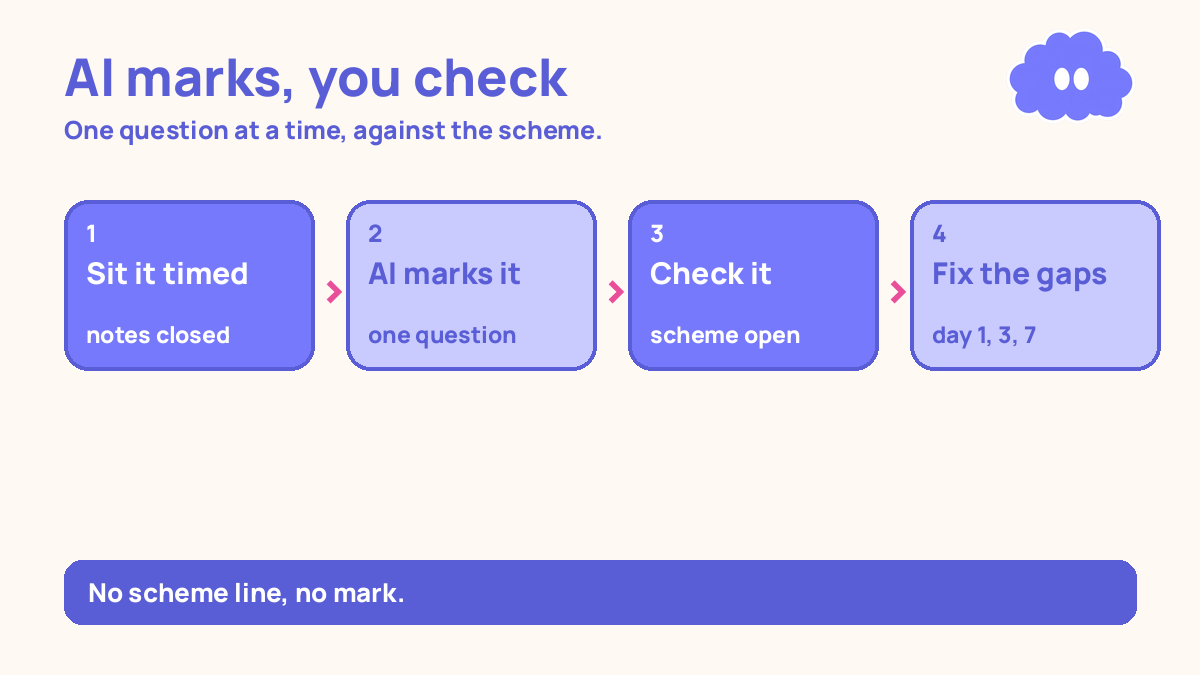
- Sit the past paper timed, notes closed, answering as you would in the exam.
- Get the official mark scheme for that exact paper, from the exam board.
- Paste your answers and the scheme into an AI chat app. Ask it to mark strictly, quoting the scheme line for every mark.
- Check every mark yourself against the scheme — no scheme line, no mark.
- Ask AI to explain every lost mark, then turn the losses into a fix list, topic by topic.
- Re-test the weak topics on day 1, 3, and 7, and sit the next paper the following week.
Step 1: Sit the paper first, properly
Sit the paper the way the exam will run: timed, notes closed, phone away. If the paper is 60 minutes, give yourself 60 minutes, not 90.
Do not look at the mark scheme before you sit the paper. When the time is up, stop, even if a question is half finished.
Step 2: Get the official mark scheme
Get the mark scheme for that exact paper — same subject, same year, same paper number. It is usually a free download from the exam board’s website. A scheme from a different year will mark you against the wrong points.
Read the scheme once yourself. Most schemes list the points that earn marks, one point per mark, and some list alternative answers that also count. Schemes often say “allow” next to an answer that is accepted even though it is not the main one — those are the answers AI most often gets wrong.
Step 3: Ask AI to mark against the scheme
Open any AI chat app you already have on your phone — no paid app or special study app needed. The marking is only as good as your instructions, so give it clear ones.
Paste three things in one message: the question, your answer, and the relevant part of the mark scheme. Do it one question at a time, not the whole paper at once — a whole paper in one message gets sloppy marking, and the AI stops quoting the scheme.
Use a prompt like this:
“Mark my answer strictly against this mark scheme. One mark per scheme point my answer matches, and no mark for anything not in the scheme. Quote the exact scheme line for every mark. If my answer is correct but worded differently, say so and check the ‘allow’ lines. No partial marks unless the scheme allows them.”
AI likes to be generous — half marks for effort, or a mark for an answer that is “close enough”. The scheme does not do that. Ask it to finish with your total and a one-line reason for every mark lost.
Step 4: Check every mark yourself — this is the real work
This is the step that makes the system work, and the one most students skip. AI marks get things wrong in both directions.
First, the generous mistakes. AI gives marks for vague answers that sound right but match no scheme point. “The particles move faster” might earn a mark on a scheme that wants “kinetic energy increases”, or it might not. If AI gives you a mark and cannot quote the scheme line behind it, take the mark away. The scheme is the judge, not the AI.
Second, the strict mistakes. AI takes marks away from correct answers because your wording differs from the scheme. This is the most common error. If you wrote the right idea in different words, check the “allow” lines — if your answer matches an allowed alternative, the mark is yours, whatever the AI said.
Third, the invented mistakes. Sometimes AI quotes a scheme line that is not in the scheme at all — another reason to mark one question at a time.
Check every mark this way, question by question, with the scheme open next to you. It takes about ten minutes for a short paper.
Across 61 studies, testing yourself beat restudying by a medium amount, and the advantage was larger when the test came with feedback than without it (Rowland, 2014). A wrong mark is wrong feedback — it sends your next week of study to the wrong place.
Step 5: Ask why the marks were lost, then fix only those
Once the marks are checked, ask AI to explain the losses: “why did this answer lose the mark, and what would a full-mark answer have said?”
Group the lost marks by topic, not by question number. Three lost marks on three different questions about the same topic is one gap, not three. For each gap, write one fix in plain words: “Learn the definition of kinetic energy, word for word.” “Show working for mole calculations.” “Write the unit every time.”
Then do the fix by testing yourself, not by re-reading. In a 2013 review, Dunlosky and colleagues rated practice testing and distributed practice high utility, and re-reading low. For each gap, close the notes and answer five questions on that topic from memory, then check.
Do not ask AI to write the answers for you during the fix. That is the line this system does not cross. AI marks what you wrote and explains why marks were lost. It does not write your work — if it does, you have tested AI, not yourself.
Step 6: Re-test the weak topics, then sit the next paper
Fixes fade if you do not re-test them. Test each weak topic again on day 1, day 3, and day 7 after the marking session. That 1-3-7 pattern is a practical starting schedule, not a research rule — the research says spacing beats cramming. Keep the re-tests short: five questions, notes closed, five minutes.
Sit the next timed paper the following week, and run the same system on it. One paper a week is a practical starting point — more than that, and the marking eats the time the fixing needs. Use the weekly paper the way the past-paper system for exams describes it: the paper finds the gaps, the fix closes them, the next paper checks whether they stayed closed. If you have mocks coming up, treat them the same way — how to use mock exams to prepare covers how to use a mock as a rehearsal, not a verdict.
A worked example: chemistry, 40 marks, one evening
This is a worked example, with the article’s own numbers — not a real student, and not a promise of a grade.
You sit a chemistry past paper, 40 marks, 60 minutes, notes closed, and download the official mark scheme. You paste one question at a time into the AI app. AI gives you 24 out of 40. That is the AI’s mark, not your mark. Now you check it.
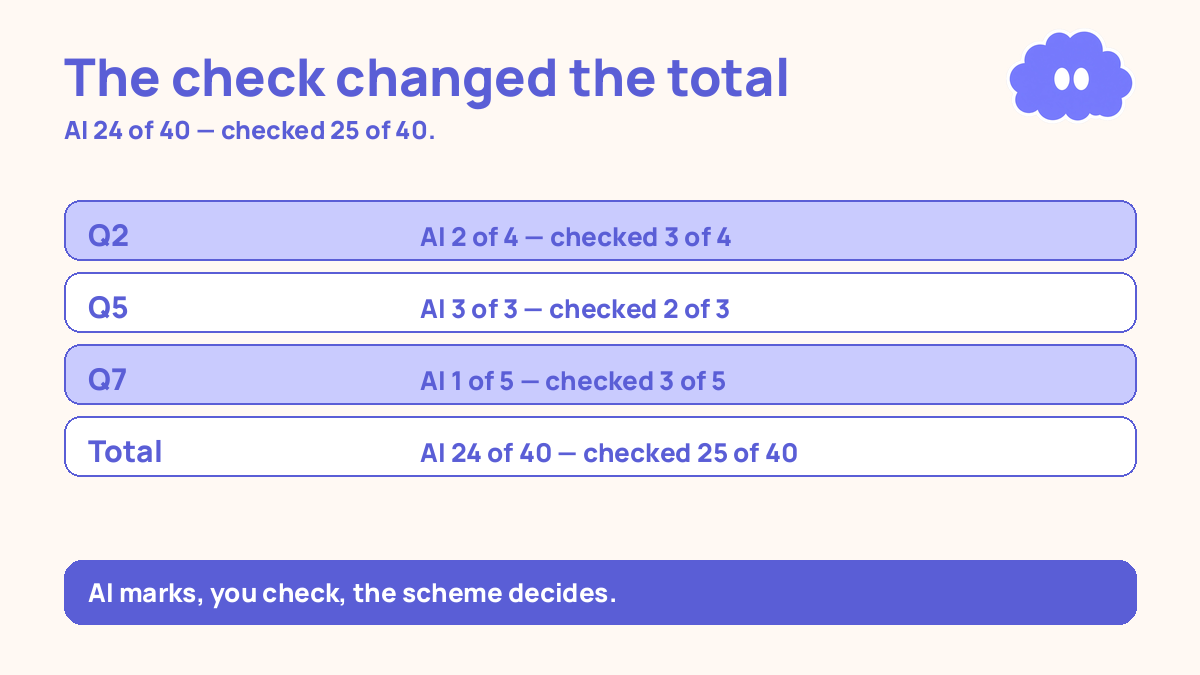
Question 2, AI gave 2 out of 4. The scheme gives one mark per product named, one for the balanced equation, which you wrote, and one for the state symbols, which you missed. That is 3 out of 4. AI missed the equation mark. You add 1.
Question 5, AI gave 3 out of 3. Your answer said “the particles move faster”, but the scheme wants “kinetic energy increases”, with no “allow” for your wording. You take 1 mark away.
Question 7, AI gave 1 out of 5. You wrote the working for a mole calculation but got the final number wrong. The scheme gives marks for the method even when the answer is wrong — formula, substitution, working. AI gave you only the formula mark. You add 2.
Your checked mark is 25 out of 40, not 24: AI under-marked your method and over-marked your vague wording.
The fix list: moles, 5 marks lost across questions 7 and 9 — one gap, one fix. Definitions, 4 marks lost — the wording gap. State symbols, 2 marks. You fix moles first: five questions, notes closed, on day 1, day 3, and day 7. Day 1: 2 right out of 5. Day 7: 5 right.
| Question | AI mark | Checked mark | What changed |
|---|---|---|---|
| Q2: products and equation | 2 / 4 | 3 / 4 | AI missed the equation mark |
| Q5: kinetic energy | 3 / 3 | 2 / 3 | Vague wording, no “allow” in scheme |
| Q7: mole calculation | 1 / 5 | 3 / 5 | Scheme gives marks for method |
| Q9: moles | 0 / 4 | 0 / 4 | No change — real gap |
| Rest of paper | 18 / 24 | 17 / 24 | One vague answer corrected |
| Total | 24 / 40 | 25 / 40 | Net change: +1 mark |
When it goes wrong
You trust the AI mark without checking it. This fails quietly. A generous mark tells you a weak topic is strong, so you stop fixing it. A strict mark tells you a strong topic is weak, so you waste a week on it. The check takes ten minutes. Do it every time.
You mark without the official mark scheme. Without the scheme, AI is guessing what earns a mark, and its guesses sound confident. If you cannot find the scheme, use a different paper — one with a scheme.
You let AI write the answers. If AI writes the answer and then marks it, the mark is meaningless. You write, AI marks, you check. That order never changes.
You mark the paper and never fix the gaps. Marking without fixing is the same as not marking at all. Spend one evening on the biggest gap, not on marking a second paper.
You use this on work that counts. This system is for practice papers only. Do not paste coursework or assessed work into an AI app. Your school’s rules come first.
Weekly review checklist
Copy this list and use it each week:
- Did I sit one timed paper this week and mark it the same day?
- Did I check every AI mark against the scheme, and how many marks did the check move?
- Which topic holds the most lost marks, and did I fix it first?
- Did I re-test the weak topics on day 1, day 3, and day 7, notes closed, and did the score rise?
Downloadable infographic spec: one vertical image, title “Use AI to mark your past paper answers”, with the six steps and the rule “AI marks, you check, the scheme decides” in Thynq cream, Cloud Purple, Dark Purple and pink, with the cloud mascot. Text taken word-for-word from this article.
What this system is not
It is not a promise of a better grade, and it is not a replacement for a teacher. A teacher knows your subject, your syllabus, and your common mistakes in a way no AI app does. This system is for the weeks when no teacher is free — honest feedback on a practice paper from the tools already on your phone, checked against the official mark scheme.
Sources
- Rowland, C. A. (2014). Psychological Bulletin, 140(6), 1432-1463. Across 61 studies, testing beat restudying, and the advantage was larger with feedback than without it.
- Dunlosky, J., et al. (2013). Psychological Science in the Public Interest, 14(1), 4-58. Only practice testing and distributed practice rated high utility; rereading rated low.
For the full system, read the past-paper system for exams, and for mocks, read how to use mock exams to prepare.
Questions
Can AI mark my past paper answers accurately?
Sometimes. AI makes mistakes both ways: it gives marks for vague answers the scheme would reject, and takes marks from correct answers worded differently. Never accept an AI mark you have not checked yourself.
What do I need before I ask AI to mark my paper?
The question paper, your written answers, and the official mark scheme for that exact paper. Without the scheme, AI is guessing what counts as a mark.
Should AI write my answers for me first?
No. You write the answers, notes closed, under timed conditions. AI only marks what you wrote.
How often should I get AI to mark a paper?
One timed paper a week, with a re-test of the weak topics on day 1, 3, and 7. Mark the paper the same day you sit it.