
The direct answer
How to plan your final year at university comes down to one job: turn a year of competing deadlines into a dated map, then protect the dissertation inside a weekly rhythm you can keep. Start from the real deadlines and the grade weightings in your course handbook. Then split the dissertation into milestones and review the plan every week.
The final year is a different job from the first year. In first year, the task was to set up: learn the loop of lectures, seminars, and reading. In the final year, four jobs run at once: a dissertation, coursework, exams, and applications. Without a plan, they take turns becoming urgent, and the dissertation is usually the one that loses.
The system in short
- Build the year map from real deadlines and the grade weightings in your course handbook.
- Split the dissertation into dated milestones, with a weekly word or task target.
- Protect dissertation time with a fixed weekly rhythm.
- Run a supervisor-meeting routine: agenda, notes, and next actions.
- Plan applications and life after in small weekly slots, not in a last-minute rush.
- Build the exam and revision plan backwards from the exam dates.
Step 1: Build the year map from real deadlines and weightings
Start in the first two weeks of term. The year map is one page holding every date that can hurt you: dissertation submission, coursework deadlines, exam dates, and application deadlines. Collect them from your course handbook, module pages, and department emails, and write each one down with the module name next to it.
Next, check the grade weightings in your course handbook. The exact numbers differ between courses, so do not guess them or use a number a friend quoted. Write the weighting next to each item on the map, and use it to decide where your hours go: a dissertation worth a third of the year deserves a third of your study time.
Now count the weeks: from the start of term to the dissertation deadline, and from there to the exams. Mark the crunch weeks on the map: the week two essays are due together, the week the dissertation draft is due, the first week of exams.
Put the map where you will see it every week, and add new deadlines the same day they appear. If it is out of date, it tells you the wrong story with confidence.
The study system for first-year university students built the weekly loop; this system builds the year around it. How to manage multiple assignment deadlines covers term-level triage inside the map.
Step 2: Split the dissertation into dated milestones
A dissertation is too big to plan as one task. Split it into milestones, each with a date and a finished thing you can point to: not “work on the literature review”, but “literature review draft, 3,000 words, sent to supervisor”.
Use these milestones as a starting shape. Move the dates to fit your own deadline, and give the last two weeks to editing and submitting, not to writing new chapters.
- Topic and question agreed, by the end of week 4.
- Proposal and chapter plan, by the end of week 6.
- Literature review draft, by the end of the first term.
- Method and data plan, by the start of the second term.
- First draft of two chapters, by the middle of the second term.
- Full draft, four weeks before submission.
- Edited draft, two weeks before submission.
- Submitted, on the date in the year map.
Set a weekly target inside the milestones: a word count on writing days, or a task on research days. A common shape is 500 new words on each writing day, three days a week: 1,500 words a week, and a 12,000-word dissertation in eight writing weeks.
If you have not chosen a topic yet, use how to choose a thesis topic before you date anything. If the literature review is the part you are dreading, how-to-write-a-literature-review-system breaks it into dated steps. If your deadline is only three months away, how to write a dissertation in three months squeezes them into twelve weeks.
Tell your supervisor the milestone dates at your first meeting, and ask whether they are realistic.
Step 3: Protect dissertation time with a fixed weekly rhythm
Milestones fail without protected hours: dissertation time is fixed, like a lecture, and everything else fits around it.
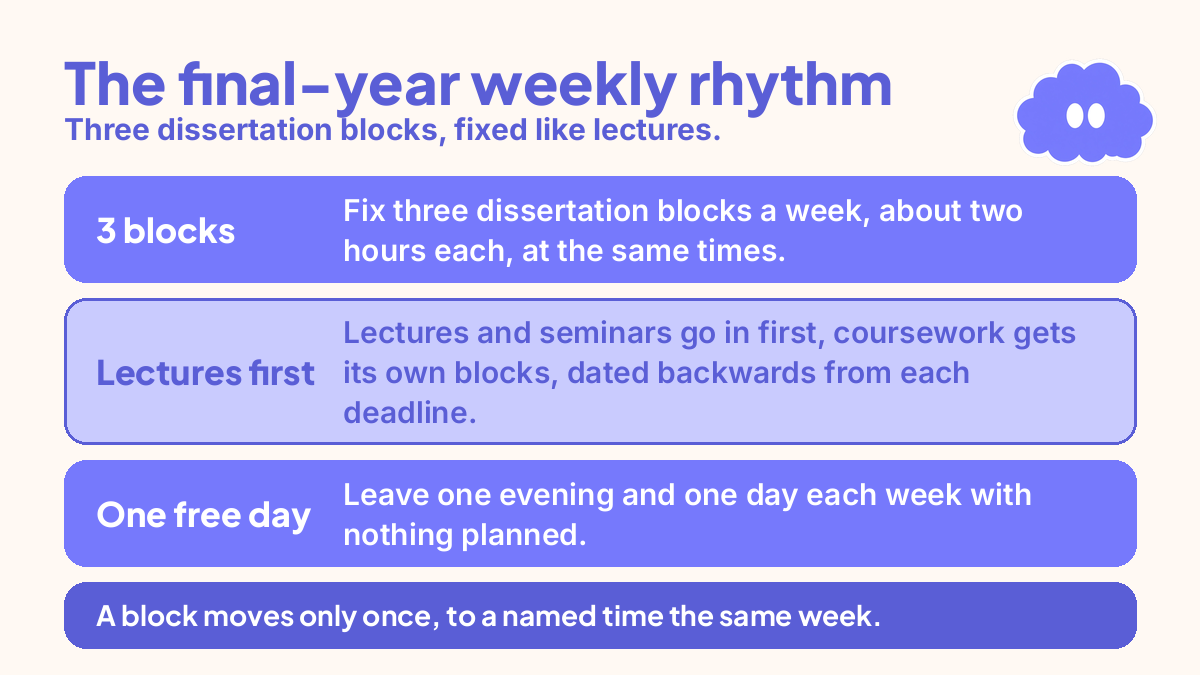
Fix three dissertation blocks a week, about two hours each, at the same times. Put the blocks on your calendar with the task in each one: “Dissertation, literature review, 500 words” is a block, and “Dissertation” is not. Write the task the night before.
Build the rest of the week around those blocks. Lectures and seminars go in first, coursework gets its own blocks, dated backwards from each deadline, and reading fills the gaps of an hour or more. Leave one evening and one day each week with nothing planned.
A block moves only once, to a named time the same week. If it moves twice, it is gone, and you do the next block as planned. The weekly study review system is the check that keeps this honest: fifteen minutes on Sunday, one change only.
Say no to extra commitments in crunch weeks: if the week is a crunch week, the answer is no.
Step 4: Run a supervisor-meeting routine
Your supervisor is the most useful resource in the final year. Students either avoid meetings until there is a problem, or arrive with nothing prepared. A short routine fixes both.
Meet every two to three weeks. Book the next meeting at the end of the current one. Send an agenda 48 hours before each meeting: what you have done, what you are stuck on, and the two or three questions you need answered.
Bring the milestone dates and the weekly target to every meeting. “I wrote 800 words and the argument in chapter two does not work yet” is useful. “It is going fine” is not. Ask directly for what you need: a reading suggestion, a decision on the method, a check that a chapter is on track.
Within 24 hours, write down the actions: what you will do, by when, and what your supervisor will do. Keep a running log, one page per meeting, with the date at the top.
Step 5: Plan applications and life after in small weekly slots
Applications are the part of the final year most students leave until the dissertation is done, and then discover the deadlines were in January. Give them a fixed slot of two hours a week, and keep it out of dissertation blocks.
In the first month, build the base materials: a CV, one covering letter template, and the deadlines that matter, on the year map. Each application after that is an edit, not a fresh start. Track every application in one place: where you applied, when, and what stage it is at.
Use the slot for one thing at a time: one week for the CV, one week for three applications, one week for interview preparation. Do not let applications expand into the dissertation blocks, and do not let the dissertation become an excuse to send nothing.
If applications start eating study time, cut the slot back to one hour and move the rest to the holidays. But do not cut the slot to zero: a final year with no applications sent is a year that ends with a gap.
Step 6: Build the exam and revision plan backwards from the exam dates
When the exam dates are published, build the revision plan backwards from them. The plan has two phases, dissertation then revision, and the switch between them needs a date on the map before the dissertation is submitted.
Divide the revision weeks between subjects, with the weakest subject getting the most time. Then build the timetable with how to make a revision timetable that works, using real hours, not hoped-for hours.
Space the revision, and test yourself instead of re-reading. Cepeda and colleagues (2006) showed spaced practice beat massed practice, and the best gap grows with how long you need to remember the material. Dunlosky and colleagues (2013) found only practice testing and distributed practice received a high utility rating. Test a topic, wait two or three days, test it again, and use the gaps as the study list.
Keep the weekly review running through exam season. The plan that survives is the one that gets checked and changed, not the one that was perfect in October.
A worked example: a final-year plan for one history student
Your situation: Maya, third-year history student. Dissertation 12,000 words, due 15 April (example figure). Three modules, two coursework essays due in November and February (example dates), exams in May. She works one evening shift a week and wants to apply for three graduate jobs. All figures are for one fictional student.
Her year map, built in week one: dissertation 15 April, essay one 14 November, essay two 13 February, exams 11 to 22 May, three job applications due January to March. Her milestones: question by week 4, outline by week 6, literature review by the end of the first term, full draft by 18 March, edited draft by 1 April, submitted 15 April.
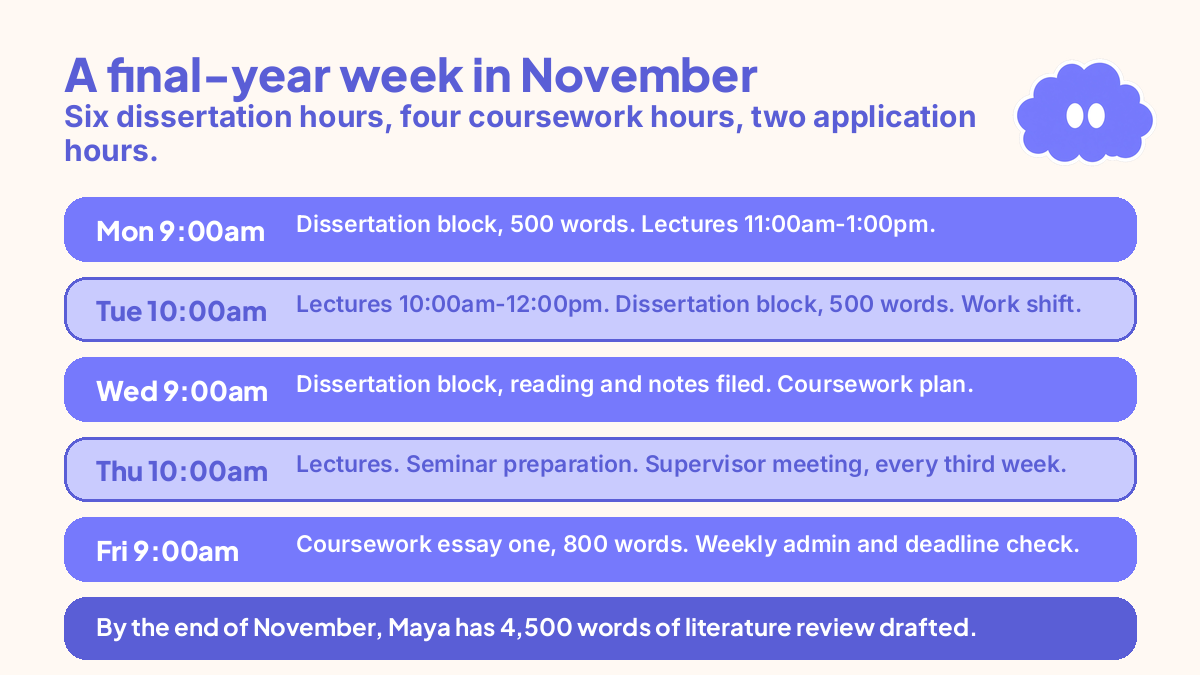
A typical teaching week in November:
- Monday, 9:00-11:00am: dissertation block, 500 words. 11:00am-1:00pm: lectures. 2:00-3:30pm: seminar reading, notes tested from memory.
- Tuesday, 10:00am-12:00pm: lectures. 2:00-4:00pm: dissertation block, 500 words. 7:00-9:00pm: work shift.
- Wednesday, 9:00-11:00am: dissertation block, reading and notes filed. 1:00-3:00pm: coursework essay one, plan and outline. 4:00-5:00pm: applications slot, CV draft.
- Thursday, 10:00am-12:00pm: lectures. 2:00-3:00pm: seminar preparation. 3:00-4:00pm: supervisor meeting, every third week.
- Friday, 9:00-11:00am: coursework essay one, 800 words. 11:00am-12:00pm: weekly admin and deadline check. Afternoon: free.
- Saturday: free, no study planned.
- Sunday, 10:00-10:15am: weekly review, one change only. 7:00-8:00pm: applications slot, one application edited and sent.
That is six dissertation hours, four coursework hours, and two application hours in the week, with Saturday free. By the end of November, Maya has 4,500 words of literature review drafted, essay one submitted, and her CV finished.
When it goes wrong
The dissertation slips by two weeks. Re-date the milestones the same week and tell your supervisor. Cut the scope before you cut the quality, and add one extra dissertation block a week for three weeks.
Your supervisor goes quiet. Send a short email with a specific question and a date by which you need the answer. If there is no reply in a week, send one follow-up, and contact the department office. Do not stop writing while you wait.
You fail a module or an essay. Find out the resit rules from your department, and put the new date on the year map. Ask your tutor what the marker wanted, fix that one thing, and move on.
Applications eat your dissertation time. Cut the applications slot back to one hour, and move the rest to the holidays. If no application deadline falls in the next three weeks, the applications can wait.
Exam season and the dissertation collide. Finish the dissertation first, because its deadline is fixed and its weighting is usually large. Then switch to revision with the weeks that remain.
You burn out in March. Cut back to the minimum for one week: the three dissertation blocks, the lectures, and nothing else. Then add one thing back at a time. Burnout is usually a sign that the rhythm had no rest in it, so fix the rhythm, not just the week.
Weekly review checklist
Use this checklist every Sunday, in writing, in 15 minutes.
- Did each dissertation block happen at its planned time?
- Which milestone is next, and is its date still realistic?
- What coursework or application deadline moved, and is the year map updated?
- Did the supervisor meeting happen, and are the actions written down?
- Which block kept failing, and what one change will fix it next week?
- Is there a crunch week in the next three weeks, and what needs to move now?
Downloadable infographic spec: one vertical image, title “Plan your final year”, with the six steps from “The system in short” and the six review questions above, in Thynq cream, Cloud Purple, Dark Purple and pink, with the Cloud mascot. Text taken word-for-word from this article.
What this system is not
This system does not make the final year easy. It makes it visible, so you can see the crunch weeks coming and the dissertation moving. It does not promise grades.
It is not a dissertation guide on its own, and it is not a revision timetable. This system is the year around them: the map, the rhythm, and the weekly check.
If your final year has no dissertation, use the same system with the largest project in its place.
Sources
- Dunlosky, J., et al. (2013). Improving students’ learning with effective learning techniques. Psychological Science in the Public Interest, 14(1), 4-58. Only practice testing and distributed practice rated high utility; rereading and highlighting rated low.
- Cepeda, N. J., et al. (2006). Distributed practice in verbal recall tasks: a review and quantitative synthesis. Psychological Bulletin, 132(3), 354-380. Spaced practice beat massed practice; the optimal gap grows with the retention interval.
For the full system behind this method, start with how to build a study system that fits your life.
Questions
When should I start planning my final year?
Start in the first two weeks of term, before the work piles up. Build the year map from your real deadlines, split the dissertation into dated milestones, and fix a weekly rhythm. A plan made in week one is a tool. A plan made in March is damage control.
How much time should I spend on my dissertation each week?
Aim for three fixed blocks a week, about two hours each, from the start of term, and protect them like lectures. That steady pace beats long bursts before the deadline, because it leaves time to think, get feedback, and fix problems. If your dissertation is longer or shorter, scale the blocks, but keep them fixed and weekly.
What if my dissertation topic changes halfway through the year?
A small change in focus is normal, and your supervisor can help you judge whether it is small or large. If the question changes, re-date the milestones the same week, and tell your supervisor before you write another chapter. Do not keep writing on the old question while hoping the new one works out.
How do I balance final-year study with job applications?
Give applications a fixed slot of two hours a week, and keep it out of dissertation blocks. Prepare a base CV and one covering letter template early, so each application is an edit, not a fresh start. If applications start eating study time, cut the slot back to one hour and move the rest to the holidays.