
The direct answer
You can write a dissertation in three months if the research is already done: spend two weeks planning and outlining, write the middle in six steady weeks at 500 new words a day, finish the full draft in two more weeks, and keep the last two weeks for editing, checking references, and submitting.
Three months sounds generous on day one and terrifying on day sixty. That is normal. The difference between students who finish in three months and students who do not is rarely talent. It is whether they wrote something every weekday, even on the days when the writing was bad.
This plan assumes your data is collected and your reading is mostly done. If you still have to run experiments or collect interviews, stop here. You need a research plan first. If the research is done and the blank page is the problem, this plan is for you.
The system in short
- Week 1–2: plan. Outline every chapter, decide the word count for each, and set the submission date.
- Weeks 3–8: write the middle. 500 new words a day, five days a week, one chapter at a time.
- Weeks 9–10: finish the draft. Write the introduction and conclusion last, and join the chapters together.
- Weeks 11–12: edit and submit. Structure first, sentences second, proofreading last. Check references and formatting.
- Send each chapter to your supervisor as you finish it. Do not wait until the end.
- Protect sleep and one full rest day a week. A tired writer edits badly and writes slowly.
Step 1: Plan for two weeks, and write nothing yet
The first two weeks are for planning, not writing. That feels slow, and it is the fastest part of the plan. A thesis written without an outline is a thesis you will rewrite.
Start with the structure. List your chapters: introduction, literature review, methodology, results, discussion, conclusion. Under each chapter, list its sections in order, with one line saying what each section does. If you cannot write that line, you do not know what the section is for yet.
Next, give every chapter a word count. A 12,000-word dissertation might split like this: introduction 1,000, literature review 3,000, methodology 2,000, results 3,000, discussion 2,000, conclusion 1,000. What matters is that the total adds up to your required length, and that no chapter is left without a number.
Then set the real dates. Write down the submission date, then work backwards: editing starts two weeks before it, the full draft is due two weeks before that, and writing starts now. Put those dates in your calendar.
If you are planning a longer project from scratch, the long research project plan covers the same backwards planning over a longer stretch. This article is the short version: the same method, squeezed into twelve weeks.
Step 2: Build the daily writing habit
A habit that lasts twelve weeks needs a cue, a place, and a start time. Pick them now. Same desk, same time, same first action: open the document, read yesterday’s last paragraph, and write.
Aim for 500 new words a day, five days a week. That is 2,500 words a week, and 12,000 words over the writing fortnights in this plan — a full dissertation draft. The number is a practical target, not a research rule. Some days you will write 800 words. Some days you will write 200 and fix yesterday’s paragraph instead.
A daily habit takes weeks to feel automatic. In one study of habit formation (Lally et al., 2010), 96 people tracked a new daily behaviour for 12 weeks, and the median time for it to feel automatic was 66 days, with a range of 18 to 254 days. Your writing habit will not feel easy in week two. Missing one day does not reset it — in the same study, a single missed day did not measurably hurt the process. What hurts is missing three days and deciding the habit has failed.
Decide the start in advance with an if-then plan: “When I finish breakfast, I will sit at my desk and open the thesis document.” Research on if-then plans (Gollwitzer & Sheeran, 2006) found that naming the cue and the action in advance raised goal attainment by a medium-to-large amount (d = 0.65) across 94 studies. The plan removes the morning decision, and the morning decision is where most writing days are lost.
Step 3: Write the middle first, one chapter at a time
Do not start with the introduction. Start with the chapter you know best — usually the methodology or the results. You know what you did and what you found. Write that first.
Work on one chapter at a time. Finish it, send it to your supervisor, and move on. Do not jump between three half-written chapters. Every switch costs time: in four experiments on task switching, Rubinstein, Meyer & Evans (2001) found people lost 614 to 1,096 milliseconds on every switch, and lost more as the tasks got more complex. In writing the real cost is larger — you lose your place, your argument, and your momentum. One chapter, one focus, until it is done.
Write badly on purpose. A first draft is not a final draft. If a sentence is clumsy, leave it and keep going. If a paragraph does not work, write “[fix this]” and move on. You cannot edit a blank page. The job of weeks three to eight is words on the page, not perfect words.
Send each chapter to your supervisor as you finish it. Early chapters get feedback while you still have time to use it.
Step 4: Finish the draft in weeks nine and ten
By week nine you have the middle: methodology, results, discussion, and most of the literature review. Now write the two chapters that only make sense at the end — the introduction and the conclusion.
The introduction is easier now because you know what the thesis actually says. You can state the question, say why it matters, and tell the reader what each chapter does, without guessing. The conclusion is easier for the same reason: you can answer the question, state the limits honestly, and say what is left.
Then join everything into one document. Read it from start to finish and mark every place where the argument jumps, repeats itself, or contradicts an earlier chapter. Do not fix the sentences yet. Fix the structure: move a section, cut a repeated paragraph, add a sentence that links one chapter to the next.
Step 5: Edit, check, and submit in weeks eleven and twelve
The last two weeks are not writing weeks. They are checking weeks. Work in this order: structure first, sentences second, proofreading last. Structure first: does each chapter do its job? Cut anything that does not serve the question. Sentences second: shorten long sentences and make sure every paragraph has one clear point. Proofreading last: spelling, punctuation, headings, page numbers, and table numbers.
Then check the references. Every citation in the text must match an entry in your list, and every entry must be cited somewhere. Do it in the morning, when you are fresh, not at midnight before submission.
Finally, check the formatting rules: margins, font, line spacing, and how tables and figures are labelled. Read the rules once, check them off one by one, and submit.
The wider system behind this plan is the thesis writing system that keeps moving: steady weekly writing, a weekly review, and a supervisor meeting with something real to show. This three-month plan is that system with a deadline.
A worked example: twelve weeks, 12,000 words
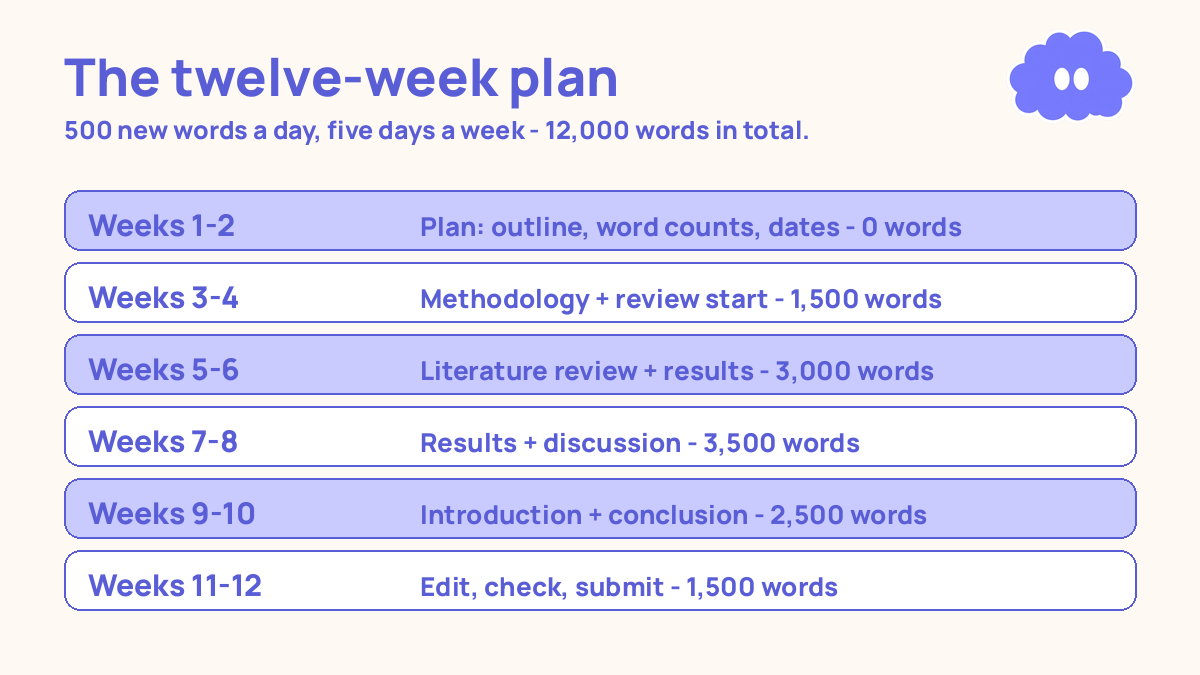
Here is the plan as a timetable. It assumes a 12,000-word dissertation and five writing days a week.
| Weeks | Job | Words written |
|---|---|---|
| 1–2 | Plan: outline, chapter word counts, dates | 0 |
| 3–4 | Methodology + start of literature review | 1,500 |
| 5–6 | Literature review + results | 3,000 |
| 7–8 | Results + discussion | 3,500 |
| 9–10 | Introduction + conclusion, join the draft | 2,500 |
| 11–12 | Edit, check references, format, submit | 1,500 |
One writing day, week five: 9:00–9:15 read yesterday’s last paragraph. 9:15–11:00 write 500 new words. 11:00–11:15 break. 11:15–12:00 fix yesterday’s rough paragraph. Afternoon: reading and admin.
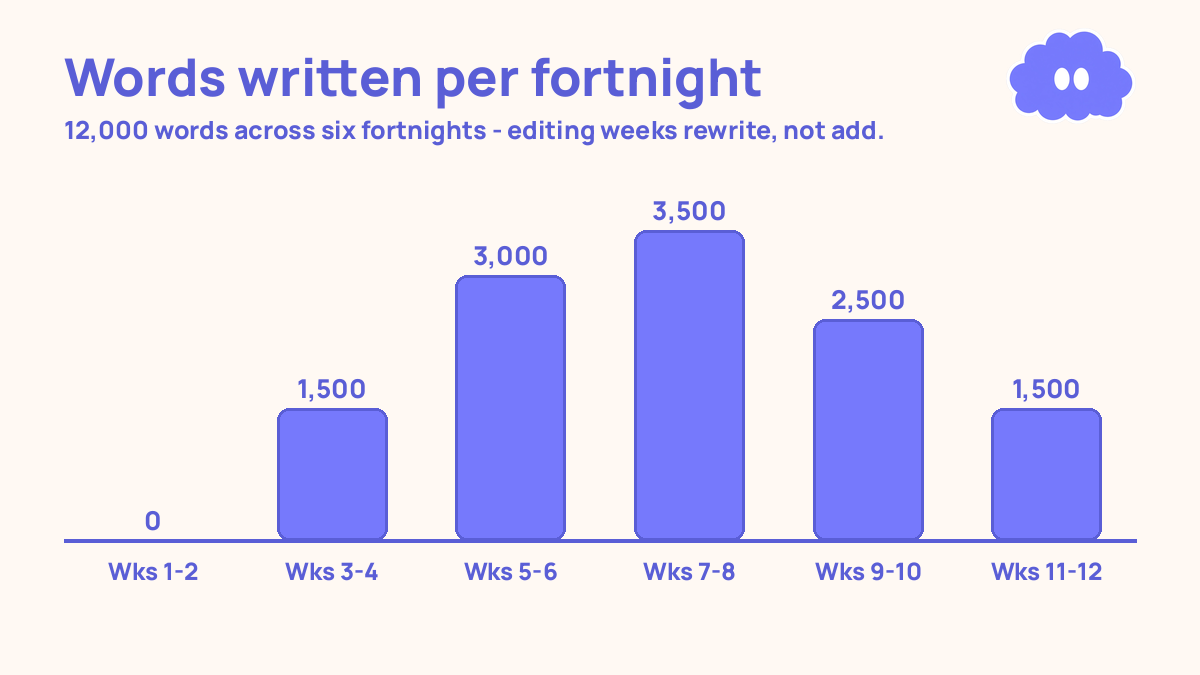
The word counts add up to 12,000. Weeks 11–12 show 1,500 words because editing usually means rewriting a few sections, not writing new ones. If your dissertation is longer, raise the daily target to 600 words instead of adding weeks.
When it goes wrong
Week three arrives and you have written nothing. You spent two weeks planning and never started. Stop planning. Open the document, write the methodology section heading, and write 200 words about what you did. Bad words count. The writing starts with one ugly paragraph.
You fall two weeks behind. Cut scope before you add hours. Drop a sub-section, shrink a chapter, or move a nice-to-have analysis to an appendix. Adding late nights does not buy back two weeks, and it costs you sleep. Sleep is when the day’s learning is consolidated (Diekelmann & Born, 2010), so a short night after a long writing day means the consolidation was cut short.
Your supervisor takes three weeks to return a chapter. Send the next chapter anyway. Do not wait. If feedback on chapter two arrives while you are writing chapter four, use it on chapter four and fix chapter two in the editing weeks. Waiting for feedback is how a three-month plan becomes a five-month plan.
You keep rewriting chapter one instead of moving on. Chapter one is the hardest to write and the easiest to polish forever. Move on. Write the middle, send it, and come back to chapter one in week nine. A finished chapter two beats a perfect chapter one.
Weekly review checklist
Copy this list and use it each week:
- How many new words did I write this week, and on which days?
- Am I on the week’s target, or behind — and by how many words?
- Did I send a finished chapter to my supervisor, or is one sitting unsent?
- What is the one thing blocking me, and who can unblock it?
- Did I protect sleep and one full rest day this week?
- What one change will I make next week: an earlier start, a smaller daily target, or a cut in scope?
Downloadable infographic spec: one vertical image, title “Twelve weeks, one thesis”, with the six fortnights — plan, write, write, write, finish, edit — and the three rules — 500 words a day, one chapter at a time, send each chapter as you finish it — in Thynq cream, Cloud Purple, Dark Purple and pink, with the cloud mascot. Text taken word-for-word from this article.
What this system is not
It is not a promise that three months is enough for every dissertation, and it is not a claim that 500 words a day is a scientific rule. It is a practical plan for a student whose research is done and who needs to write. If your research is not done, this plan will not save you. If your supervisor wants a different structure, follow it.
Sources
- Lally, P., et al. (2010). How are habits formed: modelling habit formation in the real world. European Journal of Social Psychology, 40(6), 998–1009. Median time for a new daily behaviour to feel automatic was 66 days, range 18–254; one missed day did not measurably hurt the process.
- Gollwitzer, P. M. & Sheeran, P. (2006). Implementation intentions and goal achievement: a meta-analysis of effects and processes. Advances in Experimental Social Psychology, 38, 69–119. If-then plans raised goal attainment by a medium-to-large amount (d = 0.65) across 94 studies.
- Rubinstein, J. S., Meyer, D. E. & Evans, J. E. (2001). Executive control of cognitive processes in task switching. Journal of Experimental Psychology: Human Perception and Performance, 27(4), 763–797. Mean switch costs were 614 to 1,096 milliseconds per switch.
- Diekelmann, S. & Born, J. (2010). The memory function of sleep. Nature Reviews Neuroscience, 11(2), 114–126. Sleep improves the consolidation of what was learned.
Questions
Is three months enough to write a dissertation?
It can be, if the research is already done and you write every weekday. Three months is a writing plan, not a research plan. If you still have to collect data, you need a different plan first.
How many words should I write each day?
Aim for 500 new words on each writing day, five days a week. That is 2,500 words a week and 12,000 words in the writing fortnights of this plan. Some days you will write more, some days less. The daily target keeps you moving.
What if I fall behind by two weeks?
Cut scope before you add hours. Drop a sub-section, shrink a chapter, or move a nice-to-have analysis to an appendix. Adding late nights does not buy back two weeks, and it costs you sleep.
When should I send chapters to my supervisor?
Send each chapter as you finish it, not the whole thesis at the end. Early chapters get feedback while you still have time to use it, and your supervisor sees real progress instead of silence.