
The direct answer
A first-year university study system sets up your modules in week 1, turns your handbook and timetable into a weekly study target, and runs the same lecture, seminar and reading loop every week, with testing instead of re-reading. It also works back from your first deadline, so the deadline shapes week 3, not just the night before.
Nobody sets homework, checks it, or warns you before a test. Your timetable may hold only 10 to 15 hours of classes, and the rest is yours to organise. This is the framework from how to build a study system that fits your life applied to a first term.
The study system for high school students assumes homework set by teachers and a fixed school day. A first-year system assumes the reverse: self-directed hours, no homework, and assessments that may not arrive until week 5 or 6. Arriving in week 3? Start at the setup steps and work in order.
The system in short
- Set up weeks 1 to 4 in order, one module at a time.
- Set a weekly study target from your handbook and timetable.
- Run the lecture and seminar loop every week, and test yourself instead of re-reading.
- Read with a question and a triage list.
- Work back from your first deadline in dated phases, and submit a day early.
- Review every week for 15 minutes, and change one thing only.
Step 1: Set up your first-year university study system in weeks 1 to 4
Work through the weeks in order, so the system is built before the first deadline arrives.
In week 1, take one sitting per module, about 30 to 45 minutes each. Read the handbook and note each assessment, its weight, its due date and time, the submission route, the attendance rules, and where the reading list lives. Copy every assessment into one register, with module, item, weight, due date, and estimated hours. Save the reading lists in one place, and add your timetable to your calendar.
Also in week 1, build a support map: your personal tutor, each module tutor, the library help desk, the wellbeing service, and three fellow students you can ask when you miss a class. If you share a room, settle your place to work with the dorm study system. If you are studying in a second language, the study system for international students covers the language and academic culture work in depth. Set a weekly limit for paid work and a weekly money check.
In week 2, run the full loop for the first time, with fixed study blocks in your calendar. In week 3, start work on your first deadline if it falls in week 5 or 6, and recheck your register. In week 4, test week 1 topics without notes, and ask one question in office hours if anything is unclear.
Step 2: Set a weekly study target from your handbook and timetable
Do not guess your hours, or copy a number from another student. Your handbook and course specification are the honest source, because expected study differs by subject and university.
For each module, find its credit value and any statement of expected study. Add those figures across your modules, then subtract your timetabled hours: lectures, seminars, labs, and tutorials. What is left is independent study: reading, notes, testing, and assignment work. If a handbook gives no figure, set a starting target and adjust it after two logged weeks.
Split the target across the days you can keep, with a place and a time for each block. “Library, Tuesday 14:00 to 15:30, set reading for Module 2” will happen more often than “study”. Keep the target flat across teaching weeks. Log your real hours for two weeks, then reset the target to what you kept. A target you keep at 12 hours beats a target you miss at 20.
Step 3: Run the lecture and seminar loop
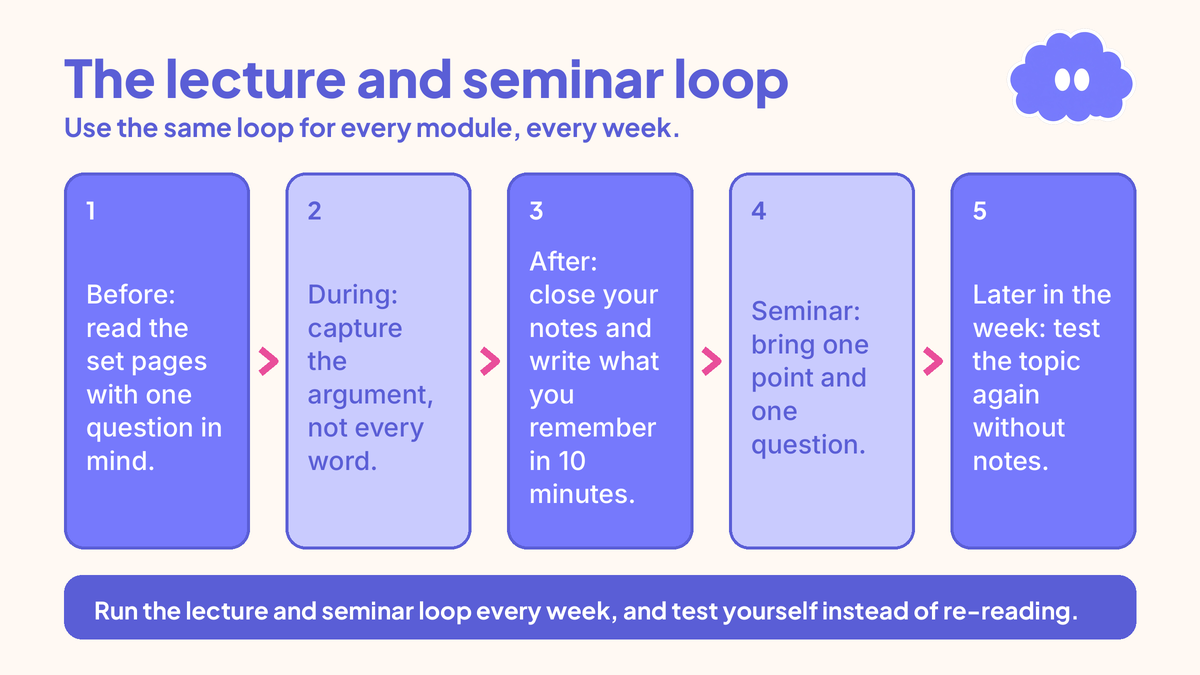
Use the same loop for every module, every week.
- Before: read the set pages with one question in mind.
- During: capture the argument, not every word.
- After: close your notes and write what you remember in 10 minutes.
- Seminar: bring one point and one question.
- Later in the week: test the topic again without notes.
Before the lecture, spend 20 minutes on the set pages: read the headings, turn one into a question, then read for the answer. During the lecture, write the argument in your own words, with headings, key terms, and one open question.
After the lecture, take 10 minutes. Close your notes and write what you remember: the main claim, three key points, and anything you cannot yet explain. Then open your notes, fill the gaps, and turn them into three to five test questions. Keep your notes in a notes system you can actually review, one page per topic, with questions on each page.
For the seminar, write one point you can make and one question you want answered. Speak early if you can. After the seminar, add what the discussion changed to your notes in 10 minutes. Later in the week, test the topic again without notes, then once more the following week. Practice testing and distributed practice were the two techniques rated highest in a 2013 review by Dunlosky and colleagues, while highlighting and re-reading were rated low.
Step 4: Read without drowning
No student can finish a first-year reading list line by line. Decide, before you open a book, what each reading is for.
Sort each reading into three groups. Must-read means set for a seminar or an assessment, and it goes first. Do-if-you-can means useful background, after the must-read work. Skip-for-now means return to it only if a seminar question or an assignment needs it.
Use a 30-minute routine for a chapter: 5 minutes on headings, introduction, and conclusion; 5 minutes writing two questions the chapter should answer; 15 minutes reading for those answers; 5 minutes with the book closed, writing each answer in two sentences. For long chapters, use the SQ3R reading system as the fuller version of this routine. Keep one page of notes per reading: questions, answers, and page numbers.
Work in timed blocks: 25 minutes with a 5-minute break, or 50 minutes with a 10-minute break. The 25-minute version comes from Francesco Cirillo’s Pomodoro Technique, developed in the late 1980s, and that length was his practical choice, not a number from a brain study. Stop at the end of the block, even if the chapter is not finished.
Step 5: Work back from your first deadline
The register from Step 1 tells you the date. This step turns the date into dated work.
Start with the brief, at least two weeks before the due date. Read the task words, length, marking criteria, and submission route in the handbook, and write the brief in one sentence in your own words. If you cannot, ask your tutor one specific question early.
Then work through the phases in order. Gather material from notes and readings you have already tested, and add only the new reading the brief needs. Draft in 50-minute blocks, aiming for a full first draft while days remain. A messy draft you can improve beats a neat pile of notes with nothing written. Check the draft against the criteria, read it aloud once, and fix the format. Submit a day early, and keep the confirmation.
Put each phase in your calendar as a dated block. If two deadlines fall in the same week, start both earlier and stagger the drafting days. This plan is for coursework. When exams approach, build a separate plan with how to make a revision timetable that works, and keep testing at the centre of it.
Step 6: Review every week and change one thing
Set aside 15 minutes on Sunday. Answer the review questions in writing, update your register, and choose one change. This review follows the weekly study review system.
Check deadlines, testing, support, money, work, and the loop step you skipped. If paid work went over your limit, or the money check did not happen, that is the change for next week, not an extra study block. Then change one thing only: the time, the triage, or the preparation block.
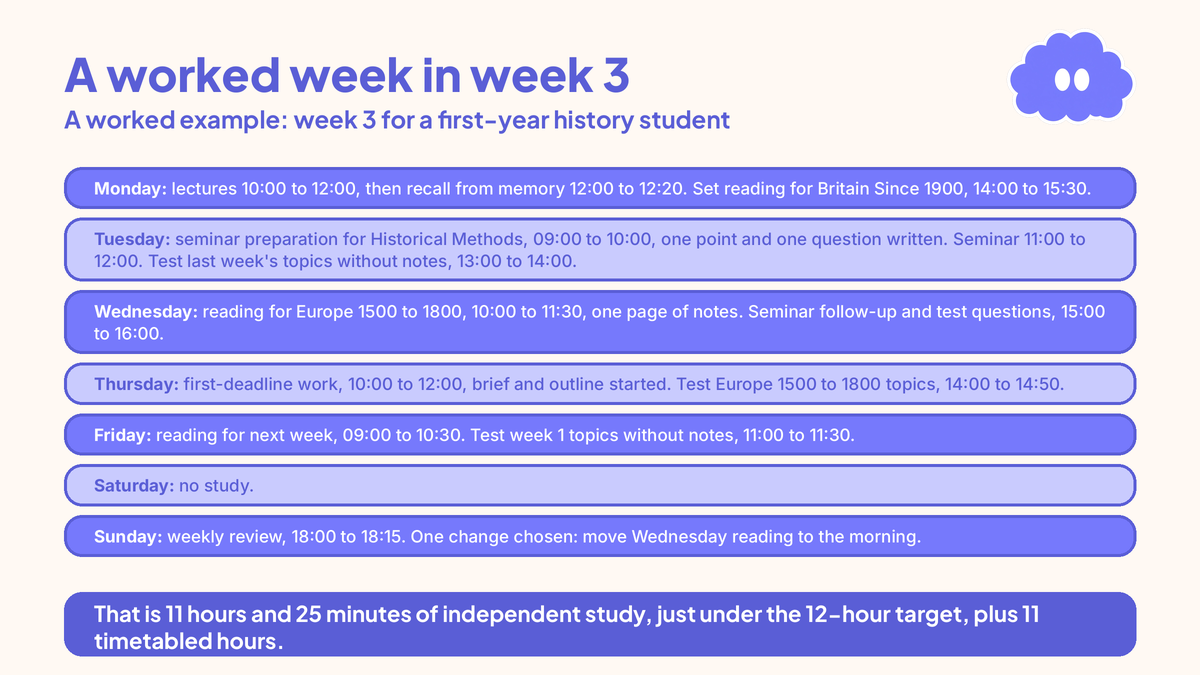
A worked example: week 3 for a first-year history student
Your situation: first-year history student, living in halls, three modules, 11 hours of lectures and seminars, a part-time job of 8 hours a week, and a starting target of 12 hours of independent study. First deadline: a 1,500-word essay for Britain Since 1900, due Friday of week 6 at 14:00.
- Monday: lectures 10:00 to 12:00, then recall from memory 12:00 to 12:20. Set reading for Britain Since 1900, 14:00 to 15:30.
- Tuesday: seminar preparation for Historical Methods, 09:00 to 10:00, one point and one question written. Seminar 11:00 to 12:00. Test last week’s topics without notes, 13:00 to 14:00.
- Wednesday: reading for Europe 1500 to 1800, 10:00 to 11:30, one page of notes. Seminar follow-up and test questions, 15:00 to 16:00.
- Thursday: first-deadline work, 10:00 to 12:00, brief and outline started. Test Europe 1500 to 1800 topics, 14:00 to 14:50.
- Friday: reading for next week, 09:00 to 10:30. Test week 1 topics without notes, 11:00 to 11:30.
- Saturday: no study.
- Sunday: weekly review, 18:00 to 18:15. One change chosen: move Wednesday reading to the morning.
That is 11 hours and 25 minutes of independent study, just under the 12-hour target, plus 11 timetabled hours. The loop ran for all three modules, one seminar was prepared, and the first deadline has an outline in week 3.
When it goes wrong
You miss lectures and they pile up. Pick the missed lecture that feeds the next seminar or assessment, cover it in one 50-minute block, and write test questions from it. Tell your tutor if illness kept you away.
Your reading list is untouched. Triage it today using Step 4, and read only the must-read items for the next seminar, using the 30-minute routine.
You arrive at a seminar with no preparation. Go anyway, and note the one question the seminar keeps returning to. Answer it from the set reading in a 30-minute block the same day.
Your first deadline is a week away and nothing is written. Protect drafting. Spend one block on the brief and criteria, one on a short outline from notes you hold, then draft in 50-minute blocks until a full draft exists. Check it against the criteria, and start the next deadline earlier.
A bad week flattens the whole routine. Shrink the system, do not abandon it: one reliable block a day, one test per topic, and the Sunday review. If bad weeks keep coming, use your support map and speak to your personal tutor or the wellbeing service early.
Your timetable looked light, but the work is not. Go back to Step 2: check the handbook figures, log your real hours for a week, and reset the target to what you kept. A light timetable means self-directed hours, not free hours.
Weekly review checklist
Once a week, answer these in writing. Copy this list and use it as your own:
- Which deadlines changed this week, and is my register up to date?
- Which topics did I test without notes, and which did I only re-read?
- Which lecture, seminar, or reading step did I skip, and why?
- What is the next step for my nearest deadline, and when is it booked?
- Who did I ask for help, and what do I still need to ask?
- What one change will I make next week, and what will stay the same?
Change one step only.
Downloadable infographic spec: one vertical image, title “My first-year study system”, with the six steps from “The system in short” and the six weekly review questions, in Thynq cream, Cloud Purple, Dark Purple and pink, with the Cloud mascot. Text taken word-for-word from this article.
What this system is not
It is not a promise of grades. No system can guarantee a result. First year marks depend on your course rules, your tutors, and work you have not yet done. It is not a budget system or medical advice, and it does not replace your module handbook or your tutor. It is a way to set up the first four weeks, run each teaching week the same way, and meet a first deadline with a plan.
Sources
- Dunlosky, J., Rawson, K. A., Marsh, E. J., Nathan, M. J., & Willingham, D. T. (2013). Improving students’ learning with effective learning techniques. Psychological Science in the Public Interest, 14(1), 4-58. The review that rated practice testing and distributed practice as the only two high-utility techniques out of ten.
- Cirillo, F. The Pomodoro Technique, developed in the late 1980s. Classic cycle: 25 minutes work, 5 minutes break, longer break after four cycles.
Questions
How many hours should I study at university each week?
There is no one number that fits every student, because it depends on your credits, your timetable, and your other commitments. Start with what your module handbook and course specification say about expected study for your credits, subtract your timetabled hours, and set a starting target you can actually keep. Log what you do for two weeks, then adjust the target to match the hours you really kept, not the hours you hoped for.
What should I do in my first week at university?
Read each module handbook, copy every assessment into one register, and save your reading lists and submission routes in one place. Add your timetable to your calendar, find where each class meets, and save the names and contacts of three people you can ask for help. Do those setup jobs first, and start the lecture and seminar loop in week 2, rather than trying to study at full speed before your system exists.
How do I prepare for a seminar?
Do the set reading with one question in mind, then write down one point you can make and one question you want answered. Bring your notes and the set pages, and speak early if you can, even if your point is short. After the seminar, spend 10 minutes writing what you remember without notes, and add anything the discussion changed to your notes.
How do I plan for my first university deadline?
Work back from the due date in phases: understand the brief and marking criteria, gather material, draft, check against the criteria, and submit with time to fix a technical problem. Start the first phase at least two weeks before the deadline for a first piece of work, and put each phase in your calendar as a dated block. If you fall behind, protect the drafting phase first, because a finished draft you can improve beats a pile of notes with nothing written.