
The direct answer
Learn the academic rules of your new country first, study in short sessions, test yourself from memory instead of re-reading, and review each topic again after a gap — next day, in three days, in seven days. That is the whole system. It is built for a student learning a subject, a language, and a new academic culture at once, so it keeps sessions short and the method simple.
You are studying in a second language, in a system with rules nobody explained to you, far from home. The students around you are not smarter — they just know the rules already.
Why studying abroad is a different kind of hard
The first problem is the rules. Every country grades differently. In some places, memorising the textbook earns top marks. In others, the marks go to students who argue, question, and use evidence. Some expect you to speak in seminars; others expect long essays with references in a format you have never used. None of this is written in the course handbook in a way a new student can use.
The second problem is language. Reading in a second language is slower, and that slowness is tiring. A chapter that takes a local student an hour can take you two. The answer is not more reading. It is better reading: read with a question in mind, then test yourself on what you remember.
The third problem is loneliness. Studying far from home is isolating, and isolation makes every setback feel bigger. A system will not fix homesickness, but finished tasks each week are real evidence that you are coping.
For the wider self-study framework, read the self-study system for online learners. To fit study into a real week, start with how to build a study system that fits your life.
The system in short
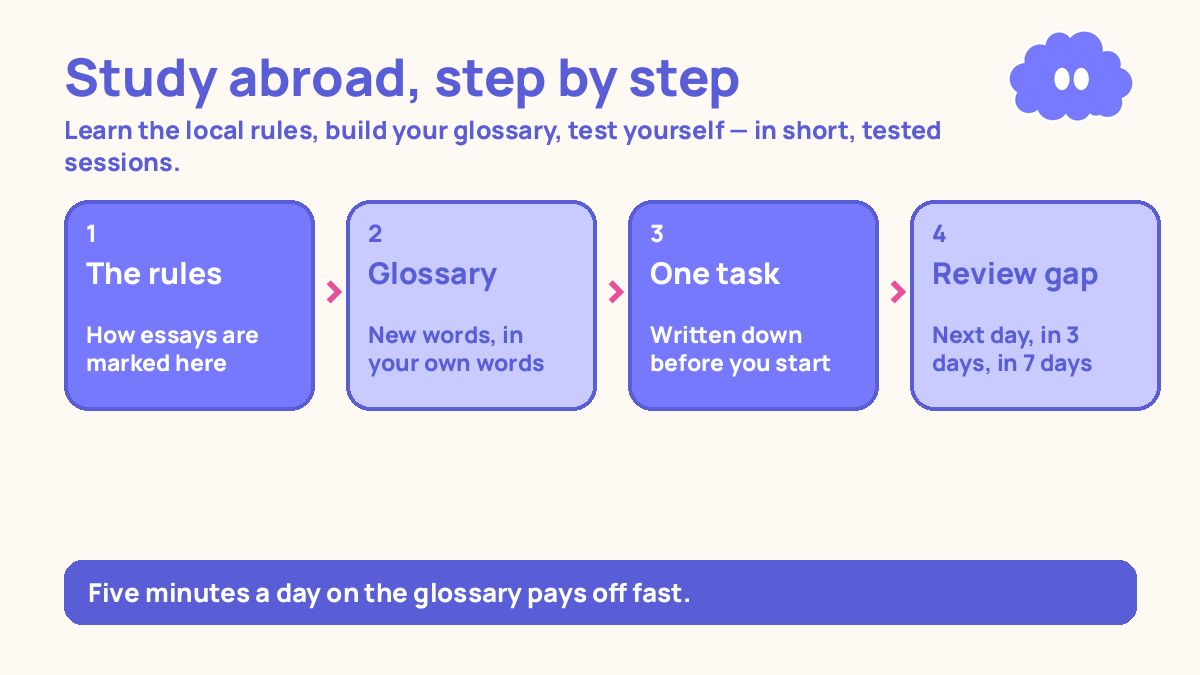
- Learn the local rules first: how essays are marked, what participation means, and how referencing works where you study.
- Build a glossary as you go: every new subject word, in your own words, with an example.
- Each session has one small task written down before you start. Not “study chapter 3” — “answer the five questions at the end of chapter 3 from memory.”
- Study by testing yourself. Close the book, write or say what you remember, then check. Re-read only to fix the gaps you found.
- Review each topic again after a gap: next day, in three days, in seven days. A practical starting schedule, not a research rule.
- Once a week, review the week and change exactly one thing.
Step 1: Learn the local rules before you chase the marks
In your first two weeks, find out how your work is actually judged. Read one marked example essay with its marking guide, and ask a tutor or a senior student: “What do students who get good marks do differently here?” That one answer is worth more than a week of guessing.
Learn the referencing rules early, and write in your own words from the start, even if the words are simple. Simple and yours beats polished and borrowed.
If seminars count, prepare one point before each — one question, one example, one disagreement — and say it early. One prepared point a week builds the habit.
If you are applying to a US university or exchange, you may be asked for a GPA your home system does not use. The GPA calculator works it out on a 4.0 scale from grades you already have, and says plainly that scales vary — check the conversion your target school uses.
Step 2: Build a glossary as you go
Every subject has words that do not exist in everyday English. In your first month, these words are half the difficulty. Keep a glossary in your notebook: the word, what it means in your own words, and one example. Not a dictionary definition — your own words, with an example.
Test yourself on the glossary after a gap: cover the meanings and write each one from memory. Five minutes a day pays off fast, because every new chapter reuses the old words.
Read with a question, not with a dictionary. Before you start a chapter, write down one question you want it to answer. Then read for that answer. When you meet a word you do not know, ask whether you need it to answer the question. If you do, look it up and add it to the glossary. If you do not, keep reading.
Speed comes with vocabulary. A chapter read slowly once, then recalled from memory, beats a chapter skimmed three times.
Step 3: One task per session, written down first
Never start with a vague task. “Study biology” fills an hour with re-reading. “Answer the five questions at the end of chapter 3 from memory” fills it with actual work.
Write the task in one line before you start. If you cannot, the task is too big — split it. A session holds one small, finished piece of work: one set of questions, one short section, one page of a draft. A specific session gives you a finished thing to point at, and that finished thing is what keeps you coming back tomorrow.
Write the next task in your notebook at the end of each session, so you never sit down wondering what to do.
Step 4: Test yourself, do not re-read
This matters even more in a second language, because re-reading feels safe while hiding how little you understood. In a 2013 review of ten common study techniques, Dunlosky and colleagues rated only two as high utility: practice testing and distributed practice. Re-reading was rated low.
Read a short section once. Then close the book and write down everything you can remember, in your own words, in English. Then check. Mark what you missed — those marks are your study list for tomorrow. Writing your recall in English tests your memory and practises the language you will be marked in.
If the subject has problems, do them from memory before looking at the worked example. If it has facts, turn them into questions and answer without looking. Testing yourself will feel worse than re-reading at first. That feeling is normal, and misleading: Roediger and Karpicke (2006) found recall beat restudy a week later, though restudiers felt more confident right after studying.
Step 5: Space it out — review after a gap
Learning that happens in one sitting fades fast. Learning that is revisited after a gap sticks. Cepeda and colleagues showed in a 2006 synthesis that spaced practice beat massed practice across materials, ages, and retention intervals. And the optimal gap is not fixed: it grows with how long you need to remember the material.
In practice, use a simple starting schedule: review a topic the next day, then in three days, then in seven days. A practical starting schedule, not a research rule.
Each review should be short — five to ten minutes is enough. Write the review dates next to each topic, and include your glossary words. The spaced repetition system for students explains the spacing idea in more depth.
Step 6: Use short sessions, and study with other people
The 25-minute Pomodoro cycle — 25 minutes of work, 5 minutes of break, a longer break after four — comes from Francesco Cirillo, a student in the late 1980s who used a tomato-shaped kitchen timer. The 25-minute length was his practical choice, not science-derived. If 25 minutes feels too short, try 50-minute blocks instead.
Study with other people at least once a week. A group from your own background lets you talk through hard ideas in your first language. A mixed group shows you how local students write, speak, and prepare. If you cannot find a group, ask one classmate to test each other for twenty minutes after a lecture.
Protect the session: phone in another room, tabs closed, one task at a time. If a session gets interrupted, do not write the day off — ten minutes of testing yourself keeps the habit alive.
A worked example: a week for an international student
You are in your first term abroad, studying economics in English. You have lectures most mornings and free afternoons.
Monday 2:00–2:55: Read one short section on supply and demand. Close the book, write what you remember in English, check, and add three new words to your glossary.
Tuesday 2:00–2:55: Five-minute test on yesterday’s section and glossary words, then read the next section. Note the review dates: Wednesday, Friday, next Tuesday.
Wednesday 2:00–2:55: New section, same pattern. Prepare one point for Thursday’s seminar — one question about the reading — and write it down.
Thursday 2:00–2:55: Seminar in the morning; say your prepared point early. In the afternoon, review Monday’s topic from memory and work the practice problems.
Friday 2:00–2:55: Study-group session: test each other on the week’s topics for twenty minutes.
Saturday 10:00–11:30: Weekly review: test the week’s three topics and the glossary from memory, note what is shaky, plan next week. Then stop.
Five afternoons, one Saturday morning, about six hours. Three topics, each tested from memory and reviewed after a gap. A glossary that grows every day. One seminar point said out loud.
When it goes wrong
You understand the lecture but cannot write the essay. The gap is usually language, not ideas. Plan the essay in your first language first, then write each paragraph in simple English from the plan. Ask a tutor to read one paragraph early, not the whole essay late.
The reading load is impossible in the time you have. Read with a question and skip what does not answer it. Read the introduction and conclusion first, then decide which sections deserve a slow read. Ask your tutor which readings matter most.
You feel like you do not belong, and it is eating your focus. That feeling is common, and it is not evidence. A bad mark is a bad mark, not a verdict on whether you belong. Keep the system going — the notebook is evidence against the feeling. If it stays heavy for weeks, use the university counselling or international-student office.
You are studying but nothing is sticking. Are you actually testing yourself, or just re-reading with a timer running? And are you reviewing after a gap, or only moving forward? If you never come back to a topic, it fades.
Weekly review checklist
Copy this list and use it each week:
- How many sessions did I actually complete this week, and on which days?
- Which topics did I test myself on, and which did I only re-read?
- How many new glossary words did I add, and can I recall them?
- Did I speak in a seminar or study with someone this week?
- What is the one change I will make next week?
The one-change rule: pick one change only. A smaller session, an earlier slot, phone in another room, or a shorter task. One change, tested for a week, tells you whether it helped.
Downloadable infographic spec: one vertical image, title “Study system for international students”, with the six steps and the weekly review checklist, in Thynq cream, Cloud Purple, Dark Purple and pink, with the cloud mascot. Text taken word-for-word from this article.
What this system is not
It is not a promise of a grade, a visa, or a place at the top of the class. It is not a claim that short sessions fix a language gap on their own — the gap closes over months of steady work, not one good week. It is a practical system for doing steady work, in short sessions, with methods that researchers rated highly, and checking each week whether it actually happened.
Sources
- Dunlosky, J., et al. (2013). Improving students’ learning with effective learning techniques. Psychological Science in the Public Interest, 14(1), 4-58. Only practice testing and distributed practice rated high utility; rereading rated low.
- Cepeda, N. J., et al. (2006). Distributed practice in verbal recall tasks. Psychological Bulletin, 132(3), 354-380. Spaced practice beat massed practice; the optimal gap grows with the retention interval.
- Roediger, H. L., & Karpicke, J. D. (2006). Test-enhanced learning. Science, 311, 1535-1539. Recall beat restudy a week later, though restudiers felt more confident immediately.
- Cirillo, F. — Pomodoro Technique, late 1980s. Classic cycle: 25 minutes work, 5 minutes break, longer break after four. The 25-minute length was Cirillo’s practical choice, not science-derived.
Questions
How do I study well when English is not my first language?
Study in short sessions, test yourself from memory, and build a glossary of subject words as you go. Reading slowly once and then recalling it beats reading fast three times.
What is the hardest part of studying in another country?
Usually it is not the subject. It is the unwritten rules: how essays are judged, what counts as participation, and how much reading is expected each week. Learn those rules early.
Should I study with other international students or local students?
Both. A group from your own background helps you talk through ideas in your first language. A mixed group shows you how local students write, speak, and prepare.
How do I keep up with the reading load?
Read with a question in mind, write down what you remember after each section, and review after a gap. You do not need to understand every word — you need the main idea and the key terms.