The direct answer
A high school study system is one hour after school: homework first in 25-minute blocks, then one block testing yourself on an older topic from memory. Plan the week on Sunday, review each topic again after a gap, and use past papers in the last week before an exam. That is the whole system. It fits around school, homework and a phone, and it does not need a new app or planner.
You do not need to study all evening. You need one hour you actually keep, doing the kind of work that sticks.
Why high school study falls apart
School already fills your day. By the time you get home, homework is waiting, your phone is waiting, and revision is the thing with no deadline — so it waits until the night before the exam. Then you cram, feel like you know it, and forget most of it a week later.
That feeling is the trap. Feeling fluent right after re-reading is not the same as remembering a week later. In a 2006 study, Roediger and Karpicke found that students who recalled a passage remembered more a week later than students who restudied it, even though the restudiers felt more confident immediately after studying. Cramming feels productive because re-reading feels easy. Testing yourself feels harder, and that difficulty is the point.
For the full system behind this one, start with how to build a study system that fits your life. This article is that system, fitted to a school week.
The system in short
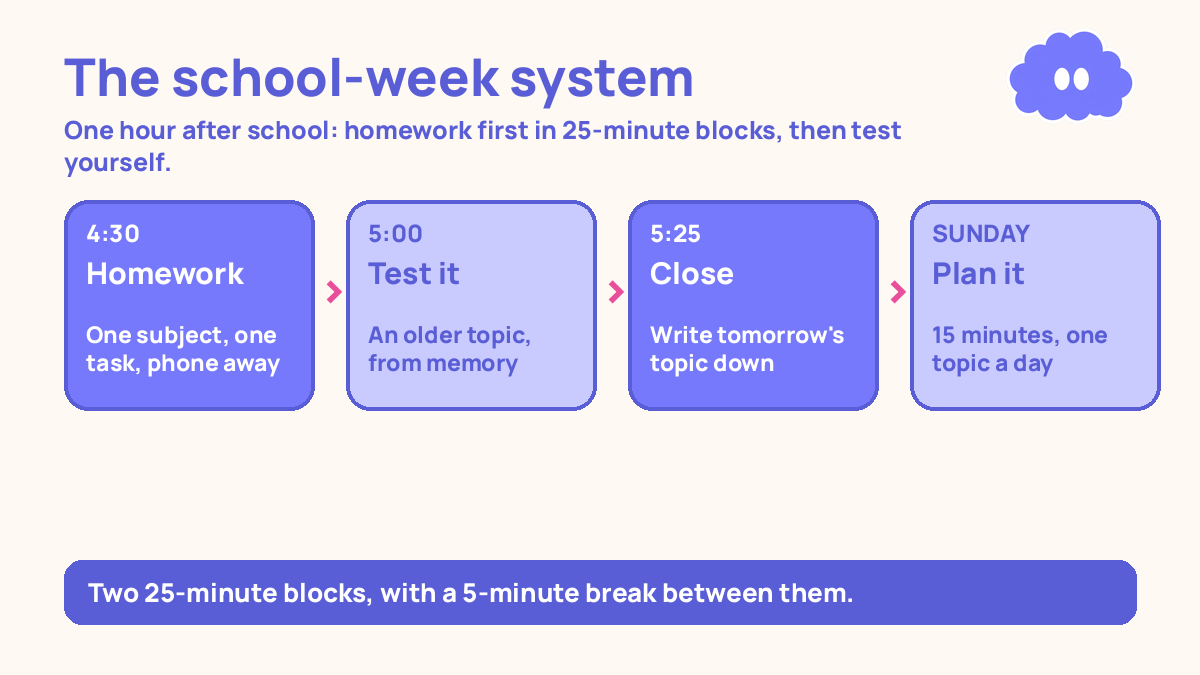
- Pick one hour after school, at the same time every day. Two 25-minute blocks, with a 5-minute break between them.
- Block one is homework: one subject, one task written down, phone in another room.
- Block two is revision: test yourself on an older topic from memory, then check your answers.
- Review each topic again after a gap: the next day, then a few days later. A practical starting schedule, not a research rule.
- On Sunday, plan the week in 15 minutes: which topics, which days, one change from last week.
- In the last week before an exam, swap block two for past papers under timed conditions.
Step 1: Fix the hour, not the amount
“Study more” is not a plan. “4:30 to 5:30, every weekday” is a plan. Pick the hour that survives most days — after a snack and a short break, not the minute you walk in the door, and not 9pm when you are already tired.
Tell your family the hour if you can. Not as a big announcement, just: “I study 4:30 to 5:30, then I am free.” An hour other people know about is an hour that gets protected. An hour nobody knows about gets interrupted.
If a day genuinely has no hour — a match, a family event, a late school day — do one 25-minute block instead of none. One block keeps the habit alive. Zero blocks for three days kills it, and restarting is the hardest part.
Step 2: Homework first, inside a timer
Homework has a deadline, so it goes first. But homework without a timer expands to fill the whole evening. Give it one 25-minute block: one subject, one task written down. “Finish the 8 algebra questions” — not “do maths homework”.
When the timer rings, stop, take five minutes, and ask one question: is the homework done? If yes, block two is revision. If no, and it is genuinely a big piece, give it one more block — but write down why it took two, so you can see whether your homework always takes two blocks. If it does, your hour needs to be ninety minutes, or the homework needs to start earlier. Do not just let it eat revision every day and wonder why exams feel hard.
The 25-minute block comes from the Pomodoro Technique, built by Francesco Cirillo as a university student in the late 1980s: 25 minutes of work, 5 minutes of break, a longer break after four rounds. The 25-minute length was his practical choice, not a number derived from cognitive science — but the structure is what helps: a clear start, a clear stop, and a break you actually take.
Step 3: Test yourself, do not re-read
Block two is the one that decides your exam results. Use it to test yourself on a topic you studied days ago, not the one you studied today. Close the book. Write down everything you remember, answer questions from memory, work problems without looking. Then check your answers against your notes.
In a 2013 review, Dunlosky and colleagues rated ten common study techniques, and only two received a high utility rating: practice testing and distributed practice. Re-reading, highlighting and summarising were all rated low. So an hour spent re-reading notes feels like studying and mostly is not. An hour spent testing yourself feels harder and mostly is studying.
Make the test easy to start. Keep a list of questions per topic — from your textbook, your teacher, or questions you wrote yourself. When block two starts, pick a topic from the list and answer its questions. No decisions, no staring at a pile of notes wondering where to begin.
Step 4: Space the review out
One test is not enough. Review each topic again after a gap — the next day, then a few days later. That is a practical starting schedule to try for a week, not a rule from research. The research direction is clear: in a 2006 synthesis, Cepeda and colleagues found that spaced practice beat massed practice across materials, ages and retention intervals, and that the best gap grows with how long you need to remember the material.
Keep a simple list: topic, date first tested, date to review next. When you test a topic and get it mostly right, the next gap gets longer. When you get it mostly wrong, it goes back to tomorrow. The list is the system. Without it, you will revise the topics you like and avoid the ones you do not — and the exam will ask about the ones you avoided.
Step 5: Plan the week on Sunday
Fifteen minutes on Sunday, with a pen and paper. Write down the week’s tests and deadlines, then pick one topic per day for block two. Not five topics — one. Monday: cell division. Tuesday: mole calculations. Wednesday: essay structure. The rest of the week fills itself in.
Then ask the four weekly review questions: what got finished this week, which session worked best and why, what broke the system and was it fixable, and what one step will I change next week? Change one step only. If the time failed, change the time. If tasks were too big, make them smaller. If the phone broke sessions, fix the phone setup first.
A worked example: a Tuesday after school
School ends at 3:30pm. You get home, eat, rest for half an hour. Your study hour is 4:30 to 5:30pm.
4:30–4:55 — Block 1, homework: Finish the 8 algebra questions. Phone in another room, timer on. 4:55–5:00 — Break: Water, stretch, stand up. No phone. 5:00–5:25 — Block 2, revision: Test yourself on cell division from last week. Write everything you remember, then check against your notes. Three things wrong — they go on tomorrow’s review list. 5:25–5:30 — Close: Write tomorrow’s block-two topic on a slip of paper. Mole calculations. Pack your bag.
One hour, homework done, one old topic tested, tomorrow already decided. That is a good school day. Five of those in a week is a good school week.
When it goes wrong
Homework eats the whole evening, every evening. Homework is not the problem — the missing timer is. Give homework one block, then stop and write down what is left. If it is always unfinished, talk to a teacher about the load, or start homework at school in a free period. Revision cannot be the thing that always loses.
You revise only the night before the exam. That is not a revision system, it is a panic system. The fix is not a bigger panic — it is block two, every day, starting now. Even two weeks of daily testing beats a weekend of cramming, and the earlier you start, the longer the gaps can be.
Your phone breaks every session. The phone is the problem, not your willpower. Put it in another room during the hour. If you need it for homework, put it on silent, face down, and use a laptop timer instead. A timer on the same device as your messages is a timer that loses.
You study for three hours on Sunday and nothing all week. Three hours on Sunday feels like a lot, and it is — but spacing beats massing. One hour a day, five days a week, will beat one big Sunday almost every time. Shrink Sunday to planning and one block, and move the work to weekdays.
Weekly review checklist
Copy this list and use it each Sunday:
- How many days this week did I keep the study hour, and how many blocks were testing rather than re-reading?
- Which topics did I test, and which ones did I get mostly wrong — are they on next week’s list?
- What broke the system this week — homework overload, phone, tiredness, or no plan?
- What one change will I make next week: a different hour, smaller tasks, phone in another room, or one topic per day written down in advance?
Downloadable infographic spec: one vertical image, title “The school-week system”, with the daily hour — homework block, break, test-yourself block — and the Sunday 15-minute plan, in Thynq cream, Cloud Purple, Dark Purple and pink, with the cloud mascot. Text taken word-for-word from this article.
What this system is not
It is not a promise of a grade, and it is not a claim that one hour a day will fix every subject. Some weeks homework really does take the whole evening, some exams really are in two days, and some topics need a teacher’s help, not a timer. This is a practical system for a school week: one hour, two blocks, one test a day, and a Sunday plan. If the week changes, change the system — one step at a time, and check after a week whether the change helped.
Sources
- Dunlosky, J., et al. (2013). Improving students’ learning with effective learning techniques. Psychological Science in the Public Interest, 14(1), 4-58. Only practice testing and distributed practice received a high utility rating; rereading, highlighting and summarising were rated low.
- Cepeda, N., et al. (2006). Distributed practice in verbal recall tasks. Psychological Bulletin, 132(3), 354-380. Spaced practice beat massed practice; the best gap grows with how long you need to remember the material.
- Roediger, H., & Karpicke, J. (2006). Test-enhanced learning. Science. Students who recalled a passage remembered more a week later than students who restudied it.
- Cirillo, F. — Pomodoro Technique, late 1980s. Classic cycle: 25 minutes work, 5 minutes break, longer break after four. The 25-minute length was Cirillo’s practical choice, not a number derived from cognitive science.
For the full system behind this one, start with how to build a study system that fits your life. If you share a room, the dorm study system works on the same rule with one corner and one quiet hour. For exam season, use how to revise for exams without cramming.
Questions
How much should I study each day after school?
Start with one hour: two 25-minute blocks with a break between them. That is enough to finish homework and test one topic from memory. Add a third block only after a week of keeping the first two.
Should homework or revision come first?
Homework first, because it has a deadline. But keep it inside a timer, one subject per block, so it does not eat the whole evening. Revision is the second block, testing yourself on an older topic.
What if I have exams in two weeks and have not started revising?
Start today with the plan in this article, not with a panic timetable. Test yourself on the biggest topics first, review each one again after a gap, and use past papers in the last week. Two weeks of steady testing beats two days of cramming.
Do I need to study every day?
Almost. One short session most days beats a huge session once a week, because spacing works better than cramming. Keep one day lighter, but do not let a missed day turn into a missed week.