
The direct answer
Choose a topic by narrowing it to one question you can answer with data you can actually get, then test it for two weeks before you commit. Read 10 papers, write one page on the question, and check the data exists. If the question survives two weeks of reading and one page of writing, it is a topic. That is the whole system.
You have to choose a thesis topic, and every option looks wrong. The big interesting one is too big. The small safe one is boring. The one your supervisor suggested is not yours. So you read more, think more, and choose nothing — and the weeks pass while the thesis stays at zero words.
Choosing a topic feels like a decision about your whole degree, and that is why it freezes you. It is not. It is a decision about the next few months of work, and it can be tested.
The system in short
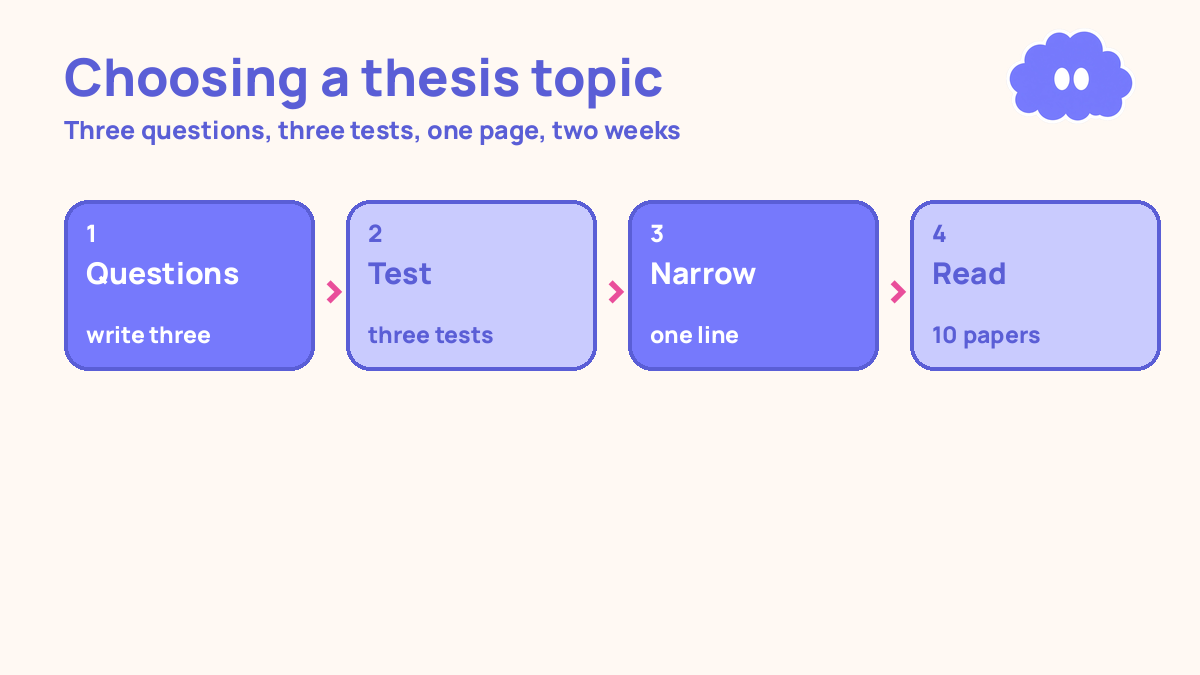
- Write down three questions that interest you — not topics, questions.
- For each question, check the three feasibility tests: data, sources, method.
- Pick the one question that passes all three. Narrow it until it asks one thing.
- Read 10 papers on that question in two weeks. Take one page of notes per paper.
- Write one page: the question, why it matters, and how you would answer it.
- Show the page to your supervisor. If the question survives, it is your topic.
Step 1: Write three questions, not three topics
Start with questions, not topics. A topic is a field: “climate change”, “online learning”, “small businesses”. A field is not a thesis. A question is a thesis: “Does weekly feedback improve completion rates in free online courses?” “How do small clinics in one city handle after-hours messages?”
Write down three questions. Not one — three. One question gives you no choice and no comparison. Three questions let you test them against each other, and the weakest one usually shows itself fast.
Each question should pass two checks. First, it asks one thing, not three. If the question has “and” in it twice, it is two questions hiding in one sentence. Split it. Second, it is a question you can argue with. If you read the question and feel nothing — no curiosity, no disagreement, no “but what about” — drop it.
Step 2: Run the three feasibility tests
A good question is not enough. It also has to be possible. Run each of your three questions through three tests, and be honest about the answers.
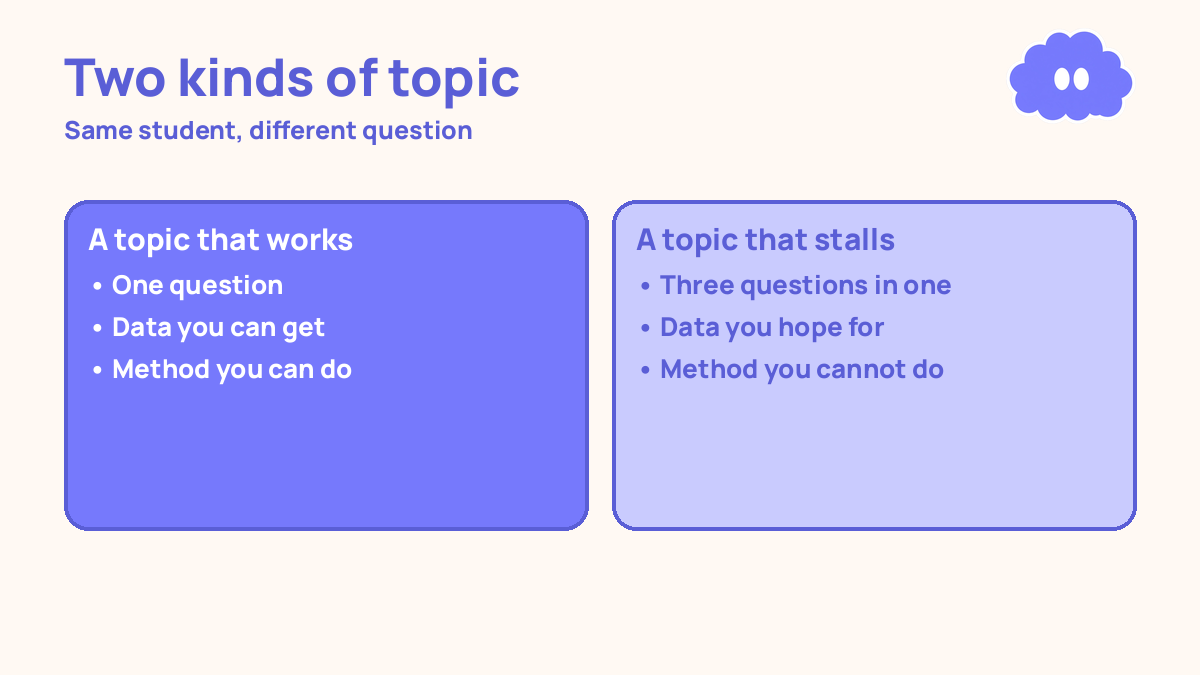
Test one: the data. Can you get the data you would need? If the question needs interviews, can you reach the people? If it needs a dataset, does it exist, and can you access it? If it needs an experiment, can you run it with the time and tools you have? If the answer is “probably” or “I hope so”, the test has failed. “Probably” is not data.
Test two: the sources. Do the papers exist? Search your library for the key terms. If you find fewer than 10 relevant papers, the question is either too new or too strange for a thesis — either way, you will struggle to write the literature review. If you find hundreds, the question is too broad, and you need to narrow it.
Test three: the method. Is the method one you can actually do? If the question needs statistics you have never learned, or fieldwork in a place you cannot reach, or a tool you cannot use, the topic is not yours yet. Either learn the method first, or pick a question whose method you already know.
Step 3: Narrow it until it asks one thing
Take the question that passed and narrow it. Narrowing means cutting the scope until the question asks one thing, about one group, in one place, over one period.
“How do students learn online?” is a field. “How do working students in one university use video lectures?” is closer. “Do weekly practice tests improve completion rates for working students in one online course?” is a thesis question. Each cut makes the question smaller and the answer more reachable.
Three cuts do most of the work: who, where, and when. Who exactly are you studying — all students, or working students, or first-year students? Where — one university, one city, one course? When — one term, one year, one cohort?
Write the narrowed question on one line, at the top of a page. If you cannot write it on one line, it is still too big. Cut it again.
Step 4: Read 10 papers in two weeks
Now test the question by reading. Ten papers, two weeks, one page of notes per paper. Not twenty papers, not a month — ten papers in two weeks is enough to know whether the question has a literature behind it, and short enough that you will actually do it. Decide the cue and the action in advance — “when I finish breakfast, I will read one paper” — instead of deciding again every morning (Gollwitzer & Sheeran, 2006).
For each paper, write one page with four lines: the claim, the method, the result, and what it leaves open. Four lines, not a summary. The claim is what the paper argues. The method is how it argues it. The result is what it found. What it leaves open is the gap — and the gap is where your question lives.
If you cannot find 10 papers, the question is too lonely. Either broaden it slightly, or pick another question from step one. If you find 10 papers easily, read them and look for the pattern: do they agree, do they disagree, is there a question none of them answers?
Step 5: Write one page, then show it to your supervisor
After two weeks of reading, write one page. Not a proposal, not a chapter — one page, with three paragraphs.
Paragraph one: the question, on one line, and why it matters in two sentences. Paragraph two: what the 10 papers say, and what none of them answers. Paragraph three: how you would answer it — the data, the method, and the shape of the answer.
Then show the page to your supervisor. Not a meeting to “discuss ideas” — a page to react to. A page is concrete. Your supervisor can say what is wrong with a page.
If your supervisor says no, ask what exactly they object to — the question, the method, or the scope — and fix that part. A supervisor who says no to the question is different from one who says the scope is too big. Fix the part they named.
If the question survives — your supervisor says yes, or yes with changes — it is your topic. Write it on the wall. From here, the work is the thesis, not the choosing.
A worked example: three questions, one topic
You are a master’s student, and you need a thesis topic in three weeks. You write three questions.
| Question | Data? | Sources? | Method? |
|---|---|---|---|
| Do weekly practice tests improve completion in free online courses? | Yes — course records | Yes — 40+ papers | Yes — survey and records |
| How does social media affect student mental health? | No — cannot reach students | Yes — hundreds | No — needs clinical measures |
| Why do small clinics lose after-hours messages? | Maybe — depends on access | Few — under 10 papers | Yes — interviews |
The first question passes all three tests. The second fails on data and method. The third fails on sources and on data — “maybe” is not a yes. So you pick the first, narrow it to one course and one term, read 10 papers in two weeks, and write the one page.
For the whole thesis system this sits inside, start with the thesis writing system that keeps moving. Once the topic survives the two-week test, the next step is the proposal — how to write a thesis proposal shows how to turn the one page into the document that asks for approval to start.
When it goes wrong
You have been “choosing” for two months. Choosing is not a phase. It is a decision with a deadline. Give yourself two weeks from today: three questions by Friday, the feasibility tests by next Friday, the one page the Friday after. A topic chosen in two weeks and tested is better than a perfect topic that never gets chosen.
Every question you write feels boring. The boredom is usually about the question’s size, not its subject. A big vague question is boring because it asks nothing specific. Narrow it. “How do students learn?” is boring. “Do weekly practice tests improve completion for working students in one course?” is a question with an answer.
Your supervisor rejects the topic twice. Ask what exactly they object to, each time, and write it down. If the objection is the same both times, fix that thing. If the objection changes each time, the problem may be the question itself — go back to step one with the feedback in mind. And if you cannot get a straight answer, ask a second reader: another lecturer, or a student a year ahead of you.
You picked a topic and now you hate it. A topic you hate in week two is a topic to change. A topic you hate in month four is a topic to finish. The difference is how much work is already done. In the first two weeks, changing is cheap — you have 10 papers of notes, not 10 chapters. Change it.
Weekly review checklist
Copy this list and use it during the two-week test:
- How many questions did I write, and which one is still standing?
- Did each question pass the three tests — data, sources, method?
- How many of the 10 papers have I read, and what does each one leave open?
- Is my question on one line yet, or is it still too big?
- What one change will I make next week: a narrower question, different papers, or a meeting with my supervisor?
Downloadable infographic spec: one vertical image, title “Choose a thesis topic”, with three questions, the three tests — data, sources, method — narrow it to one line, read 10 papers in two weeks, write one page, show it to your supervisor, in Thynq cream, Cloud Purple, Dark Purple and pink, with the cloud mascot. Text taken word-for-word from this article.
What this system is not
It is not a promise that the topic you choose will be original, and it is not a claim that two weeks of reading guarantees a good thesis. It is a practical system for making a decision you can test, instead of a decision you have to believe in. And once the topic survives, the work changes: the topic is the decision, and a daily writing habit is what finishes it — a median of 66 days to feel automatic in one study, with a range of 18 to 254 (Lally et al., 2010).
Sources
- Lally, P., et al. (2010). How are habits formed: modelling habit formation in the real world. European Journal of Social Psychology, 40(6), 998–1009. The median time for a behaviour to feel automatic was 66 days, with a range of 18 to 254 days; missing a single day did not measurably hurt the process.
- Gollwitzer, P. M. & Sheeran, P. (2006). Implementation intentions and goal achievement: a meta-analysis of effects and processes. Advances in Experimental Social Psychology, 38, 69–119. Across 94 studies, if-then plans raised goal attainment by a medium-to-large amount (d = 0.65) over holding the goal alone.
Questions
How narrow should my thesis topic be?
Narrow enough to ask one question and answer it with the data you can actually get. If the question needs three studies, three datasets, and a year of fieldwork, it is three topics, not one.
What if I cannot find a topic I care about?
Care about the question, not the field. Pick the question that keeps coming back when you read — the one you argue with in your head. Interest in the question carries you further than interest in the topic area.
How do I know if a topic is possible to finish?
Check three things before you commit: the data exists and you can get it, the sources exist and you can read them, and the method is one you can actually do. If any of the three is missing, the topic is a wish, not a plan.
What if my supervisor does not like my topic?
Ask what exactly they object to — the question, the method, or the scope — and fix that part. A supervisor who says no to the question is different from one who says the scope is too big. Fix the part they named.