
The direct answer
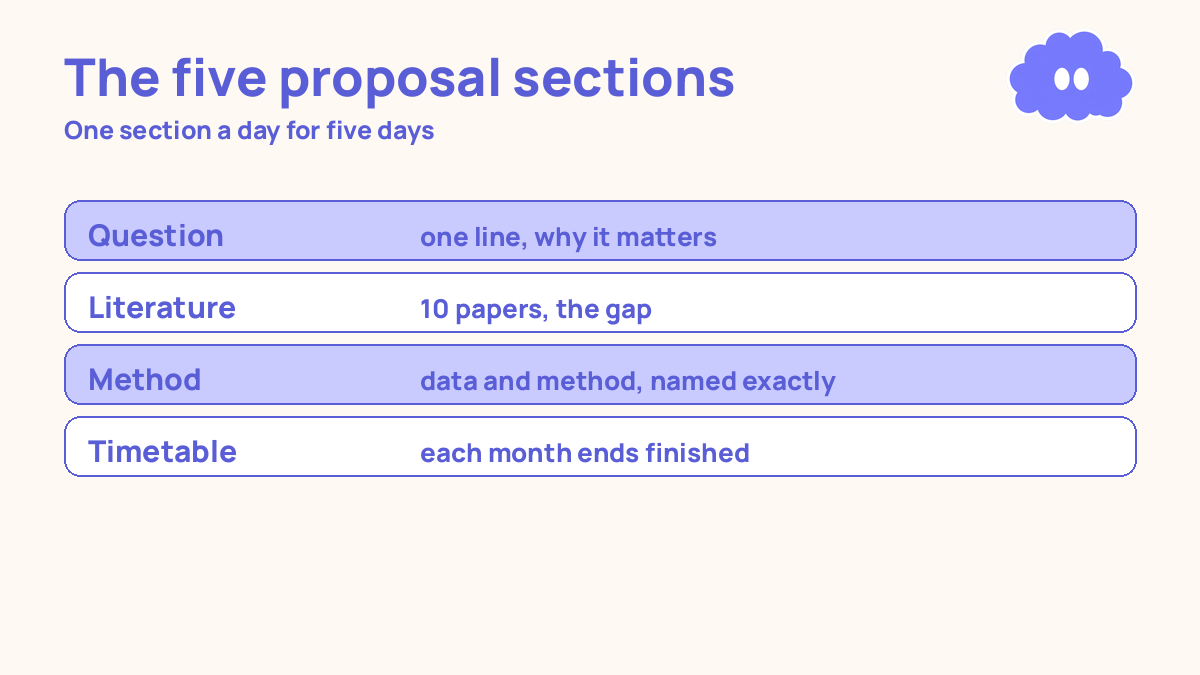
Write your thesis proposal in five sections, one a day for five days: the question, why it matters, what others have already found, how you will answer it, and when you will do it. Each section answers one question and nothing else. Send it only after a checklist check — every section present, every claim sourced, every date real. That is the whole system.
You have a topic. You have read the papers. Now you have to write the proposal — the document that asks your department for permission to start — and the blank page is worse than the topic ever was. A proposal is not a thesis. It is a promise, in writing, that the thesis can be done.
The shape is five sections. Each section answers one question. You write one section a day, and in five days you have a proposal. The system is not about writing well. It is about writing the right things, in the right order.
The system in short
- Get the rules first: page limit, required sections, deadline. Write them down.
- Day 1: write the question — one line, plus two sentences on why it matters.
- Day 2: write what others found — the 10 papers, the pattern, and the gap.
- Day 3: write how you will answer it — data, method, and what the answer will look like.
- Day 4: write the timetable — what happens each month, and what could go wrong.
- Day 5: run the checklist, fix what is missing, and send it.
Step 1: Get the rules before you write a word
Before you write anything, get the rules. Every department has them: a page limit, a list of required sections, a deadline, and a format. Ask your supervisor, or find the handbook. Write the rules on one page and keep it beside you while you write.
The page limit decides how much you can say. Five pages means short sections and no extra material. Ten pages means room for a fuller literature section. Do not write ten pages for a five-page limit and then cut it in half.
The required sections decide the shape. Most proposals need the same five: question, background, literature, method, timetable. Some departments want a budget, an ethics note, or a list of expected outcomes. If yours wants one of those, add it as a section. If it does not, leave it out. A proposal that ignores the format is a proposal that gets sent back unread.
Step 2: Day 1 — the question and why it matters
Day 1 is the shortest section and the most important one. Write the question on one line, at the top of the page. Then write two sentences on why it matters.
The question should be the one you chose and tested — the one that survived the reading and the supervisor’s first look. If you have not chosen a topic yet, you are not ready to write a proposal. Go back and choose one first: how to choose a thesis topic is the system for that decision, and it takes two weeks, not a day.
Why it matters is two sentences, not a page. One sentence on the gap: what nobody has answered yet. One sentence on the use: who needs the answer, and what they will do with it. “Nobody has tested weekly practice tests on working students in free online courses. Course providers need to know whether weekly tests are worth building, because they cost time to make and to mark.”
Step 3: Day 2 — what others have already found
Day 2 is the literature section, and it is built from the notes you already took. You read 10 papers when you chose the topic. Each paper gave you one page of notes: the claim, the method, the result, and what it leaves open. Day 2 turns those notes into three paragraphs.
Paragraph one: what the papers agree on. “The studies agree that practice testing helps retention, and that the benefit grows with feedback.” Paragraph two: where they disagree, or where they differ. “They disagree on how often testing should happen, and most of them studied school students, not working adults.” Paragraph three: the gap — the question none of them answers. “None of them tested weekly practice tests on working students in a free online course. That is the gap this thesis fills.”
Do not summarise each paper one by one. A list of summaries is not a literature section. It is a list. The reader needs the pattern: what the field knows, where it disagrees, and what is missing. Ten papers, three paragraphs, one gap.
Step 4: Day 3 — how you will answer it
Day 3 is the method section, and it answers three questions: what data, what method, and what the answer will look like.
What data: name it exactly. “Course records for one free online course, one term, 200 students. A survey of 60 working students.” Not “data from students”. Exactly which data, from where, how many, over what period. If you cannot name the data exactly, you do not have it yet — and the proposal should say how you will get it, and by when.
What method: name it exactly, too. “A weekly practice test, 10 questions, for 8 weeks, with scores recorded each week.” “Semi-structured interviews, 30 minutes each, with 12 students.” If the method needs a tool you have not used, say so, and say how you will learn it before the data collection starts.
Step 5: Day 4 — the timetable and what could go wrong
Day 4 is the timetable, and it is a table, not a paragraph. One row per month, from now until the thesis is due. Each row says what happens that month, and what is finished by the end of it.
| Month | What happens | Finished by the end |
|---|---|---|
| Month 1 | Ethics approval, survey design | Survey ready to send |
| Month 2 | Data collection, weekly tests | All data collected |
| Month 3 | Analysis, first results | Results chapter draft |
| Month 4 | Writing, revision | Full draft to supervisor |
| Month 5 | Revision, final checks | Thesis submitted |
Five months, five rows, five finished things. Your own timetable will have different months and different tasks, but the shape is the same: each month ends with something finished, not something started.
Step 6: Day 5 — the checklist, then send it
Day 5 is not a writing day. It is a checking day. Run the checklist, fix what is missing, and send it.
Read the proposal once, out loud, from the start. Reading out loud catches the sentences that made sense in your head and not on the page. Fix them. Then check the rules from step one: page limit, required sections, deadline, format. Is every required section present? Is the page count right? Is the deadline met?
Then check the claims. Every sentence that says what someone found needs a citation. Every number needs a source. Every date in the timetable needs to be real — a month you will actually be there, doing that work. A proposal with a fake date is a promise you cannot keep.
Then send it. Do not keep revising. A proposal is not a thesis, and it does not need to be perfect. It needs to be clear, honest, and on time. Send it to your supervisor first, not to the department.
Decide the cue and the action in advance for the writing days — “when I finish breakfast, I will write for 50 minutes” — instead of deciding again every morning. An “if-then” plan names the cue and the action in advance, so starting does not need a fresh decision (Gollwitzer & Sheeran, 2006). And once the proposal is sent, the writing habit is what carries the thesis: a daily writing habit takes weeks to feel automatic — a median of 66 days in one study, with a range of 18 to 254 — and one missed day does not reset it (Lally et al., 2010).
When it goes wrong
You are on day 3 and the method section is blank. The method is blank because the data is not decided. Stop writing and decide the data: exactly what, from where, how many, over what period. Write those four things down. The method section writes itself once the data is named. A blank method section is a data decision you have not made yet.
The literature section is 8 pages and the rest is 2. You wrote a summary of every paper instead of the pattern. Cut it: three paragraphs — what they agree on, where they differ, the gap. Move the paper-by-paper notes to an appendix, or delete them. The notes did their job when you chose the topic. They do not need to be in the proposal.
Your supervisor says the question is too big. Narrow it the same way you narrowed it when you chose it: who, where, when. One group, one place, one period. Change the question on the first page and the timetable on the last page, and send it back. A narrower question is a fix, not a defeat.
The proposal is rejected. Read the feedback and sort it into three piles: the question, the method, and the scope. Fix the pile the feedback names. If the feedback names the method, change the method, not the question. If it names the scope, narrow it. A rejection that names the problem is a revision plan, not a verdict on the topic. Revise once, and send it back.
Weekly review checklist
Copy this list and use it during the five writing days:
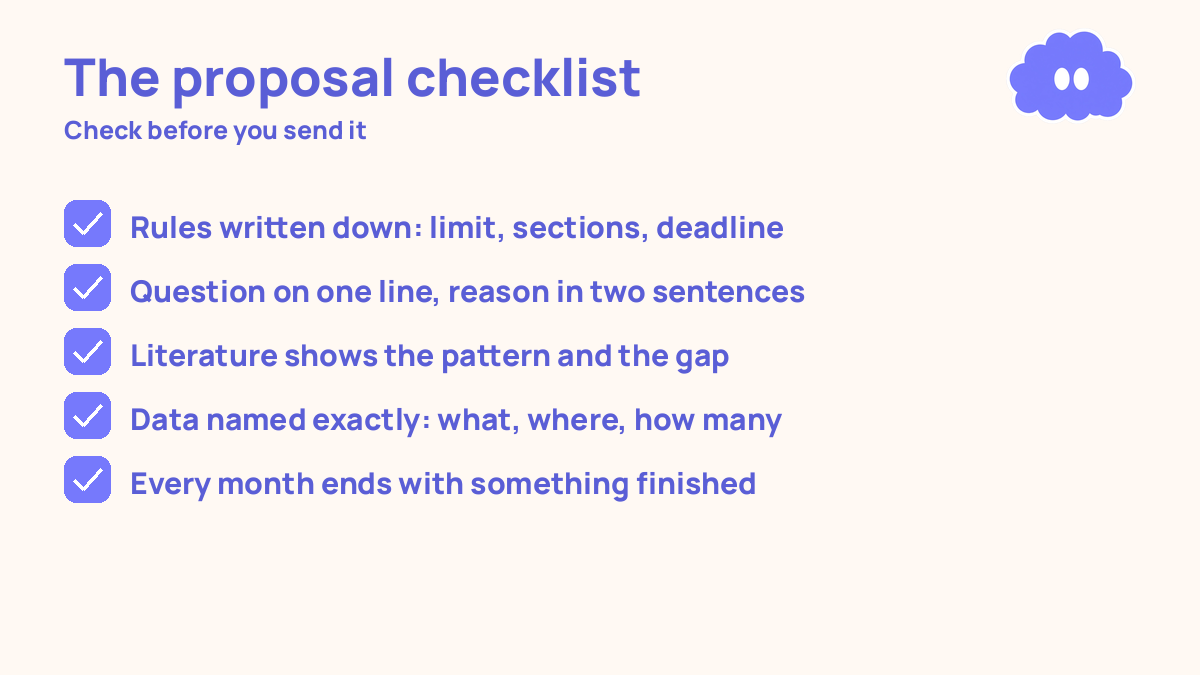
- Do I have the rules — page limit, sections, deadline — written down?
- Is the question on one line, and is the reason in two sentences?
- Does the literature section show the pattern and the gap, not a list of summaries?
- Is the data named exactly — what, from where, how many, over what period?
- Does every month in the timetable end with something finished?
Downloadable infographic spec: one vertical image, title “Your thesis proposal”, with the five sections — question, why it matters, what others found, how you will answer it, when — one section a day for five days, and the rule “checklist before you send it”, in Thynq cream, Cloud Purple, Dark Purple and pink, with the cloud mascot. Text taken word-for-word from this article.
What this system is not
It is not a promise that the proposal will be accepted, and it is not a claim that five days is enough for every proposal. It is a practical system for turning a chosen topic and 10 papers of notes into a document a department can say yes to. If the proposal is rejected, the system has still done its job: the feedback tells you exactly what to fix, and the fix is one section, not the whole document.
Sources
- Gollwitzer, P. M. & Sheeran, P. (2006). Implementation intentions and goal achievement: a meta-analysis of effects and processes. Advances in Experimental Social Psychology, 38, 69–119. Across 94 studies, if-then plans raised goal attainment by a medium-to-large amount (d = 0.65) over holding the goal alone.
- Lally, P., et al. (2010). How are habits formed: modelling habit formation in the real world. European Journal of Social Psychology, 40(6), 998–1009. The median time for a behaviour to feel automatic was 66 days, with a range of 18 to 254 days; missing a single day did not measurably hurt the process.
For the whole thesis system this sits inside, start with the thesis writing system that keeps moving. For the full plan behind the timetable, read how to plan a long research project — it is the plan for a whole research project, while this article is the proposal, the document that asks for approval to start.
Questions
How long should a thesis proposal be?
Five to ten pages is the usual range, but your department’s rules decide. Ask for the page limit and the required sections before you write a word — a proposal that ignores the format is a proposal that gets sent back.
What goes in a thesis proposal?
Five sections: the question, why it matters, what others have already found, how you will answer it, and when you will do it. Every section answers one question, and nothing else goes in.
How long does it take to write a proposal?
Five days of writing, one section a day, after you have chosen the topic and read the papers. The reading takes longer than the writing — if you have not read 10 papers yet, you are not ready to write.
What if my proposal gets rejected?
Read the feedback and sort it into three piles: the question, the method, and the scope. Fix the pile the feedback names. A rejection that names the problem is a revision plan, not a verdict on the topic.