The direct answer
How to manage multiple assignment deadlines: put every deadline on one term map, plan each piece backwards to finish two to three days early, total the hours each week needs, and compare them with your real free hours. When a week needs more hours than you have, pull work into a light week and review the plan every Sunday.
Most students miss deadlines not because one assignment is too hard, but because three coursework deadlines land in one week, each manageable alone, and no one added the hours together. Students call that pile-up deadline stacking.
The dates were visible for weeks, split across handbooks. Treat the term as one portfolio: see collisions early, plan backwards, and prove each week fits.
The system in short
- Capture every coursework deadline on one term map, with the date, time, weighting, and format.
- Sort the list by weight and effort, and protect work that cannot move.
- Plan each assignment backwards to a personal finish date two to three days early.
- Total the hours for each week and compare them with your real free hours.
- Pull work forward into light weeks, and never push it back into a crunch week.
- Start each brief within 48 hours, and review the plan for 15 minutes every Sunday.
Step 1: Capture every deadline on one term map
Start in week one. Go through every module handbook and virtual learning environment, and record every assessed deadline in one place: date, time, weighting, word count or format. Many portals close at midday, not midnight, so copy the time exactly.
Use one sheet of paper, one row per week, listing deadlines, exams, group check-ins, and lab write-ups in date order. A paper list works, and so does the assignment tracker, which keeps every deadline in one sorted list. If you prefer a calendar, follow putting study blocks on your calendar, keeping the term map as the one view showing every deadline together.
Add planned work dates in a different colour: a due date says when work is judged, not when it is done. Mark weeks holding two or more substantial deadlines. Those are your crunch weeks.
Step 2: Sort by weight, effort, and what cannot move
To prioritise assignments by weighting, ask: how much does it count, and how many hours will it take? A 40 percent essay matters more than a 5 percent quiz, even if the quiz is due first.
Sort into three groups. Start early: high weight, high effort, needing weeks. Finish quickly: high weight, low effort, cleared in one or two sessions. Do enough: low weight, where a complete answer meeting the brief is the right standard.
Then protect work that cannot move. Group work comes first, because others depend on your part. Anything depending on someone else, equipment, lab time, or approval joins this group. Start it first, even if it is not due first. Mark each deadline E, Q, or D, with a star for work that cannot move.
Step 3: Plan each assignment backwards to a finish date
Backward planning assignments means starting at the deadline and working back, giving every stage a date. Coursework stages usually run: read the brief and rubric, research, outline, draft, revise, check references and formatting, submit.
Set a personal finish date two to three days before the official deadline: your working deadline. The plan aims earlier, so a failed upload or an extra revision pass does not become a missed submission. Submit on the morning of the due date, at least half an hour before the portal closes.
Write each stage with a finished state: not “Research”, but “Find six sources, read four, and write a one-page outline”. Give each stage an hour estimate for Step 4. This is a practical way to organise work, not a proven technique from a research study. If the work is thesis scale, use the plan for a long research project instead.
Step 4: Count the hours and compare them with real free time
A list of dates can look fine while its hours are impossible. Counting them in week one finds the problem while light weeks are still empty.
Estimate each stage in hours from your own history. If your last 2,000-word essay took 18 hours, that beats a hopeful guess of 10. Estimate stages separately, and include finding sources, formatting, references, uploads, and group coordination time.
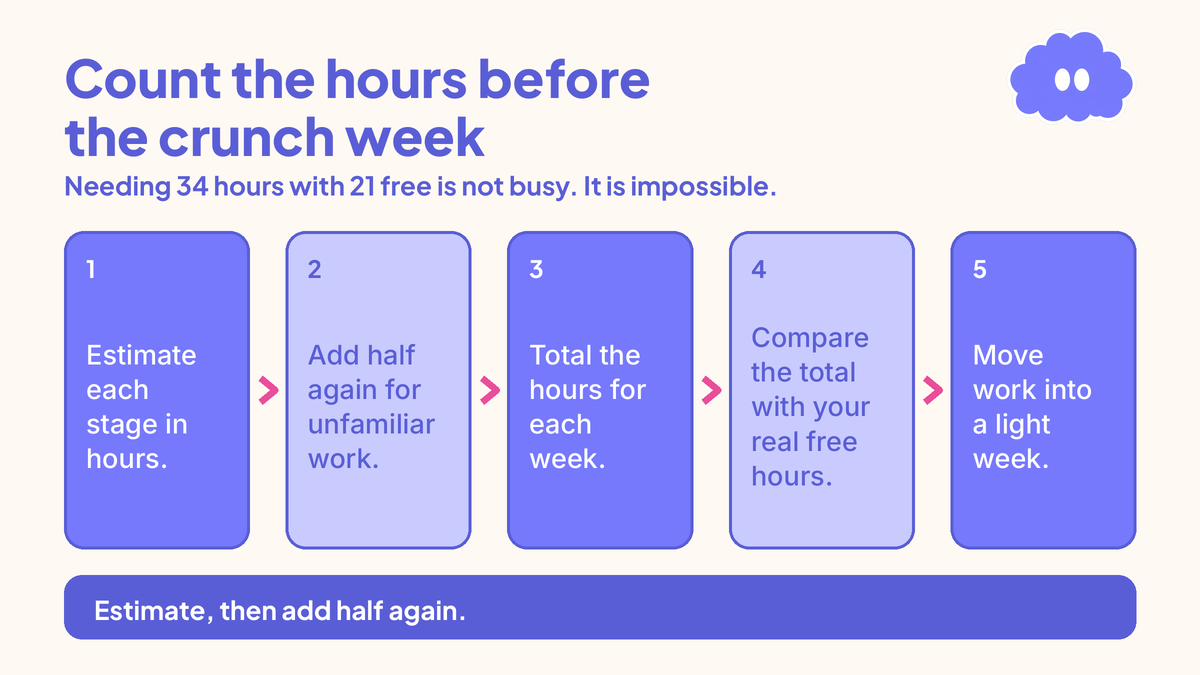
For unfamiliar work, use a simple rule of thumb. Estimate, then add half again. An 8-hour estimate becomes 12 hours. This is a practical rule of thumb, not a research finding. Note actual hours after each submission.
The check takes five moves:
- Estimate each stage in hours.
- Add half again for unfamiliar work.
- Total the hours for each week.
- Compare the total with your real free hours.
- Move work into a light week.
Count real free hours: hours left after lectures, work, travel, sleep, meals, and rest. Total each week’s coursework and revision hours and compare. A week is a crunch week when two or more substantial deadlines fall in it, or when its hours pass your free hours. Needing 34 hours with 21 free is not busy. It is impossible.
Step 5: Pull work forward and share weeks with revision
When a week fails the hour check, pull work forward into a light week. Never push work back: later weeks hold their own deadlines. Pull earliest stages first: reading, research, outlines, then drafts. Keep proofreading close to the deadline.
After every move, re-read the map: a stage pulled forward can create a new collision. Recheck the moved week, and keep moving stages until every week fits. Stagger heavy stages so two assignments never draft in the same week.
Coursework and revision share the same free hours and the same map. Protect revision hours each week as exams approach. Let a revision timetable that starts from your real hours own the exam blocks, while this system owns the coursework stages. If a week cannot hold both, move coursework earlier.
Take this week’s stages from the term map and place them as dated blocks using your weekly study planner. The term map decides what must happen. The weekly planner decides when.
Step 6: Start each brief within 48 hours
A deadline eight weeks away does not feel urgent, so work slips to week seven. Use a first-action rule: within 48 hours of a brief being released, read the brief and rubric, write a one-page outline skeleton, and book a 30-minute session for the earliest stage.
That session surfaces problems early: an unclear question, a missing source, a silent group member. Finding those in week one costs an email. Finding them in the final week costs the assignment. If the brief is unclear, ask your tutor early, naming the module, assessment, and exact question.
Work on one assignment per block, but move between assignments across the week, with each block owned by one stage on the map. If starting keeps slipping, use the small-step method for starting when you keep putting study off.
A worked example: three overlapping assignments and a crunch week in March
Your situation: second-year student, three modules, a part-time job of 12 hours a week, and 21 free study hours in a normal week.
Maya builds her term map in the week beginning Monday 22 February. Three deadlines cluster in the week beginning Monday 15 March: a history essay (2,000 words, 35 percent) due Wednesday 17 March at midday; a sociology group presentation (25 percent) due Thursday 18 March; and a research methods report (1,500 words, 30 percent) due Friday 19 March at midday. Personal finish dates: essay by Sunday 14 March, slides by Monday 15 March, report by Tuesday 16 March.
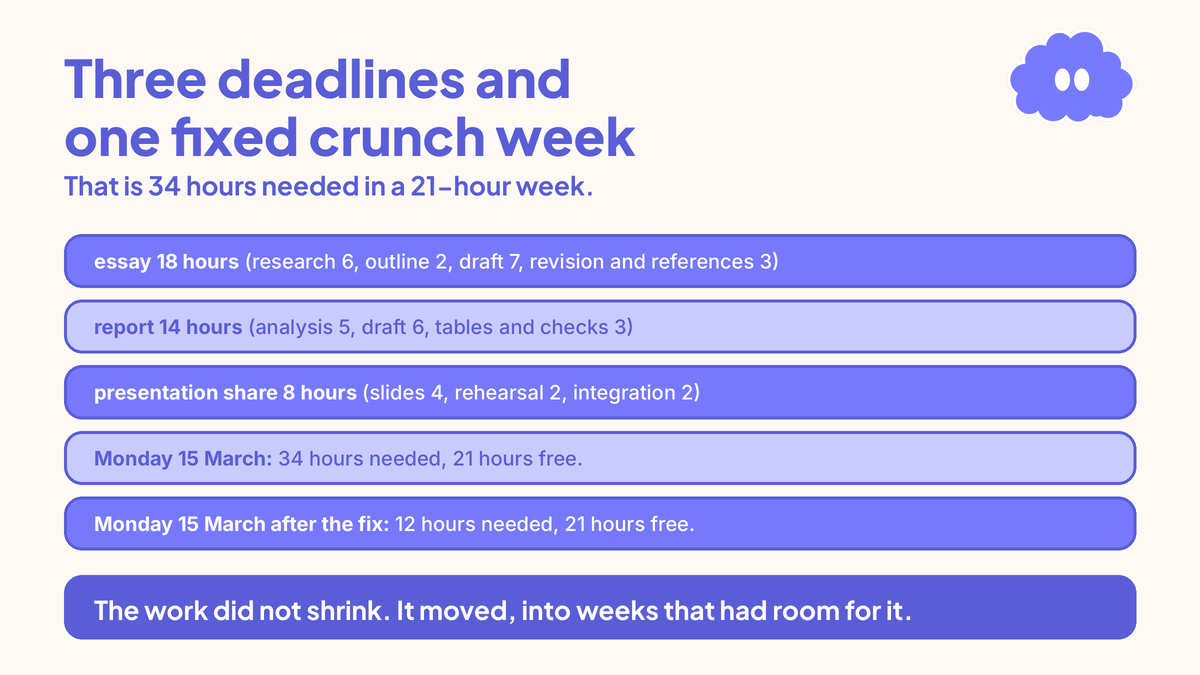
Estimates from last term, with half again for the new report analysis: essay 18 hours (research 6, outline 2, draft 7, revision and references 3); report 14 hours (analysis 5, draft 6, tables and checks 3); presentation share 8 hours (slides 4, rehearsal 2, integration 2). Coursework totals 40 hours, plus 10 hours of revision. The 50 hours fit inside 83 free hours. The problem is where they fall.
| Week beginning | Free hours | Hours needed, left late | Hours needed, after fix |
|---|---|---|---|
| Monday 22 February | 21 | 2 | 10 |
| Monday 1 March | 21 | 4 | 14 |
| Monday 8 March | 20 | 10 | 14 |
| Monday 15 March | 21 | 34 | 12 |
Left late, the crunch week needs 34 hours: essay 12, report 10, presentation 8, revision 4. That is 34 hours needed in a 21-hour week.
The fix pulls work forward: week beginning 22 February, essay research and outline (8 hours); week beginning 1 March, report analysis, first slide draft, and essay draft part one (12 hours); week beginning 8 March, essay draft, report draft, slides finished, and group integration (12 hours). Each week adds 2 hours of revision. The crunch week then holds only essay revision, report checks, and rehearsal: 12 hours.
- Monday 15 March: 34 hours needed, 21 hours free.
- Monday 15 March after the fix: 12 hours needed, 21 hours free.
Every week now fits, with 6 to 11 hours spare. The work did not shrink. It moved, into weeks that had room for it.
When it goes wrong
The plan is dead by week three. Rebuild the map from what is left, re-estimate from hours already spent, and pull one stage forward this week.
Your buffer is eaten before the deadline week. Finish a complete draft now, even if rough: finished and meeting the brief beats a polished half.
A group member is late with their part. Ask in writing, with a clear date for what you need, and keep your own part on schedule. If the deadline is threatened, tell your tutor before it, with dates and messages as evidence.
Your estimate was wrong by half. Note the actual hours beside the estimate and use the real figure next time. If a later week now exceeds its free hours, pull a stage forward or cut a low-weight piece to a complete answer.
You are already behind on several deadlines. List what is due, its worth, and what is done. Triage by the marking rubric: finish complete drafts for every deadline before polishing any one piece. Check your own handbook for late-work and extension rules, which differ between universities. This article states no specific penalty as a general rule. Ask your tutor before the deadline, and keep any evidence. Then restart with getting back on track after a bad study day, one small session, no make-up doubling.
Coursework has swallowed revision, or revision has swallowed coursework. Protect revision hours first near the exam, move coursework earlier, and recheck the weekly total. If no week fits, cut a low-weight piece, not sleep.
Weekly review checklist
Review every Sunday, for 15 minutes, with the term map in front of you. Answer in writing. Make one change only.
- Which stages finished this week, and which did not?
- How many hours did each assignment actually take, compared with the estimate?
- Which week is now the crunch week, and how many hours does it need?
- What moved this week, and did it move forward or back?
- What is stuck, and what is the next small step?
- What one change will I make next week?
Fixed move rules: a slipped stage moves into this coming week, never a later week. If a week exceeds your free hours, pull its earliest stage into the nearest light week today. If a stage has moved three times, shrink it or ask for help.
Downloadable infographic spec: one vertical image, title “How to manage multiple assignment deadlines”, with the six steps from “The system in short”, the rule “Estimate, then add half again.”, and the six weekly review questions, in Thynq cream, Cloud Purple, Dark Purple and pink, with the Cloud mascot. Text taken word-for-word from this article.
What this system is not
It is not a promise of grades. A tidy map is not finished work: the writing still happens in dated blocks, one stage at a time.
It is not a substitute for your university rules: check your own handbook. It is not a thesis plan, a weekly planner, or a revision timetable. It sits above those tools and feeds them.
Sources
- University of Waterloo, Current Students blog. Simple steps to backwards plan for the term. Backward planning, dated stage plans, submitting half an hour early.
- FlowScholar. Semester Planning lesson. Term map, crunch weeks, due dates separate from planned work dates, re-reading the map.
- Mitchell, S., Expert Assignment Writers. How to Manage Multiple Assignment Deadlines at a UK University, 13 October 2026. Sorting by weight and effort, protecting group work, finishing two to three days early.
- Assignment Help Service. How to Manage University Deadlines Without Stress, 30 October 2026. Estimate-then-add-half rule of thumb, checking your own handbook, complete work over perfect work.
For the full system behind this method, start with how to build a study system that fits your life.
Questions
How much buffer time is enough before an assignment deadline?
Aim to finish two to three days before the official deadline, and submit on the morning of the due date rather than at the last minute. That buffer absorbs a failed upload, a late source, or a draft that needs one more revision. If the work depends on other people or on equipment, add an extra day, because those delays are harder to fix at short notice.
Should I work on one assignment until it is finished?
No, not when deadlines overlap. Work on one assignment at a time inside each study block, but move between assignments across the week so no piece is left until its final days. The term map tells you which stage needs the block today, so parallel progress stays planned instead of scattered.
What should I do when I am already behind on several deadlines?
First, list what is due, what each piece is worth, and what is already done, then triage by the marking rubric and finish complete drafts before polishing any one piece. Check your own handbook for late-work and extension rules, and ask your tutor before the deadline if you need help, keeping any evidence you have. Submit something complete for each deadline rather than leaving one blank while perfecting another.
How do coursework deadlines and exam revision share the same weeks?
They share the same free hours, so plan them on the same map and protect a small number of revision hours each week as exams approach. Pull coursework stages forward into light weeks instead of cancelling revision, and let the revision timetable own the exam blocks while this system owns the coursework stages. If a week cannot hold both, move coursework earlier, because revision left until the exam week rarely fits.