
The direct answer
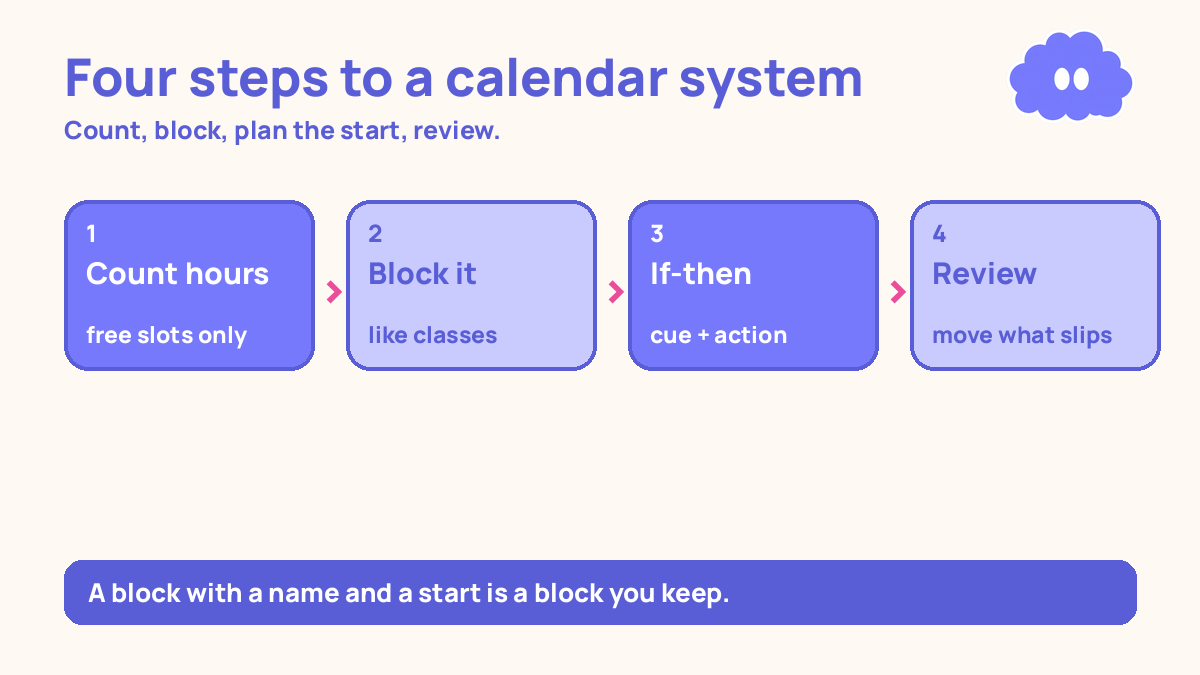
Use your calendar as a study system: count the free hours you actually have, put named study blocks on the calendar app already on your phone, give each block an if-then plan for starting it, and move any block that slips to the next free slot instead of doubling the next day. That is the whole system.
You mean to study tonight. You have meant to study tonight for three weeks. The evening arrives, and something else fills it — a message, a video, a friend, a chore — and you never sit down. By the end of the week, you have studied in the gaps, and the gaps were small.
The problem is not that you do not care about the work. The problem is that study time has no place in your week. Classes have a time. Work has a time. Study is the only thing that is supposed to happen “when I get around to it” — and “when I get around to it” never arrives. A calendar turns a wish into an appointment, with a start time, an end time, and a name. You do not need a new app — the calendar is already on your phone.
The system in short
- Count the free hours you actually have this week, after classes, work, meals and sleep.
- Put study blocks on the calendar like classes: fixed times, one subject and one task per block.
- Give every block an if-then plan: one cue, one first action.
- Protect the start of each block: phone on Do Not Disturb, calendar alerts on, one task only.
- Review the week once: move what slipped, never double a day.
Step 1: Count the hours you actually have
Do not plan from the hours you wish you had. Plan from the hours you have. Look at a normal week — last week, not an ideal week. Mark the fixed things first: classes, work shifts, travel, meals, sleep. What is left is the real space for study, usually smaller than you hoped. A small honest number beats a large invented one: a plan built on hours that do not exist fails on the first day.
Count the free slots in hours. One free hour after lunch on Monday, two free hours on Tuesday evening, an hour on Thursday morning: that is four hours. Fill about two-thirds of the free slots with study blocks and leave the rest empty. The empty slots are where a moved block goes when a day goes wrong. If Friday evening is never free, do not put a block there. A block that is missed every week is not a study block. It is a weekly reminder that the plan does not fit your life.
The weekly study planner for students is the one-page version of this habit, kept on paper instead of the phone.
Step 2: Put study blocks on the calendar like classes
Treat blocks like classes: a fixed time, a fixed length, and a name that says what happens in it. “Study” is not a name. “Study” is a wish with a time attached. “Biology — 10 questions on cells, notes closed” is a block. “Maths — 5 past-paper questions, timed” is a block. The name removes a decision: when the reminder goes off, you only have to start.
A 25-minute block with a 5-minute break is a practical starting timer, not a research rule — the 25-minute length was the inventor’s practical choice, not a number from cognitive science — and a 50-minute block with a 10-minute break works better for longer tasks. Put one subject and one task in each block. A block that says “revise everything” spends the block deciding what “everything” means. If a topic needs more time, give it two blocks on different days: spaced practice beat massed practice, and the right gap grows with how long you need to remember the material (Cepeda et al., 2006).
Step 3: Give every block an if-then plan
A calendar block tells you when to study, not how to start. Starting is the hard part, because it needs a fresh decision every time — what first, where are my notes — and every fresh decision is a chance to put it off. An if-then plan removes that decision in advance. It names the cue and the action: “If it is 4pm and I am home, then I will open yesterday’s questions and answer the first one.” The cue is a time and place you can see; the action is the first small step, not the whole session.
Across 94 studies, if-then plans raised goal attainment by a medium-to-large amount over holding the goal alone (Gollwitzer & Sheeran, 2006). The effect was largest when the plan used the if-then format, the person cared about the goal, and the plan had been rehearsed at least once. Rehearse it once: say it out loud when you write the block. Writing the plan is not the same as doing it, but a plan said out loud is easier to follow than one only thought about. Write the plan in the calendar event itself, so the reminder shows the time and the first action together. One cue, one action. If the cue never happens, the plan is wrong, not you. Change the cue.
Step 4: Protect the start of each block
The first five minutes decide the block. If they go to messages, the block is gone, because the messages do not stop after five minutes. So protect the start before it arrives. When the reminder goes off: phone on Do Not Disturb, calendar alerts left on, one task in front of you. Do Not Disturb keeps the messages quiet while the calendar still reminds you of the next block — the phone is both the tool and the distraction.
Put the phone face down while the block runs. One study found a phone on the desk cost focus even when off, but a later replication did not find the effect, so the evidence is mixed — “phone in another room” is a practical system here, not a proven fact (Ward et al., 2017; Ruiz Pardo & Minda, 2022). If a message is genuinely urgent, answer it, then come back and restart the timer. One interruption does not cancel the block.
Step 5: Review the week once, and move what slipped
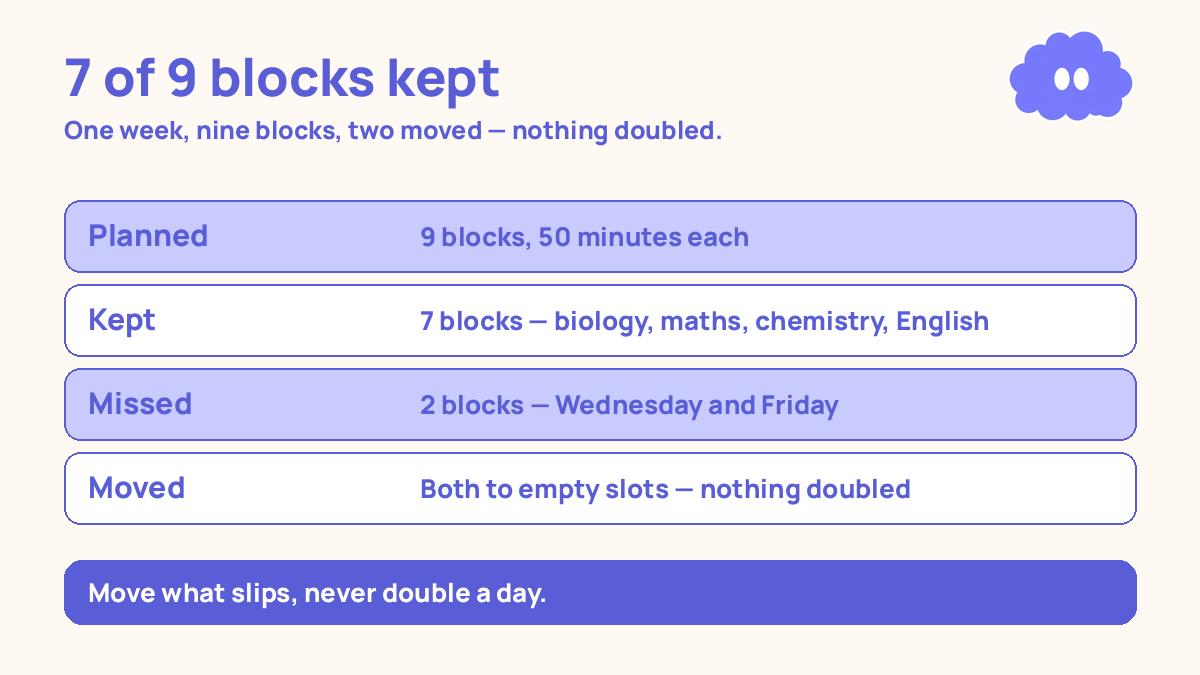
Pick one time each week for the review — Sunday evening works for most, but any time you will actually keep beats the “right” time you will skip. The review takes about fifteen minutes and has three questions. First: which blocks were kept, and which slipped? Count them honestly. Seven of nine blocks kept is a good week, even if the two missed ones feel like the whole story.
Second: why did the slipped blocks slip — wrong time, task too big, or a genuinely full day? Each answer has a different fix. A wrong time means moving the block to a slot that survives. A task too big means splitting it into two blocks. A genuinely full day means the block never belonged there. Third: what is next week’s plan? Keep the blocks that were kept, in the same slots. Move the slipped ones to the next free slot in the same week, not to the next day at double length. A missed day does not get a double day — a double day is a punishment, and nobody keeps a system that punishes them.
The habit is not automatic yet, and that is normal. In one study, the median time for a daily behaviour to feel automatic was 66 days, range 18 to 254, and missing a single day did not measurably hurt the process (Lally et al., 2010). The weekly study review system covers this review in full.
A worked example: one week, nine blocks, seven kept
This is a worked example, with the article’s own numbers — not a real student, and not a promise of a grade.
A student has classes in the morning, a part-time shift on Saturday, and free time on weekday afternoons. They count nine free hours, fill six with study blocks, and leave three empty for moved blocks. Each block is 50 minutes, one subject and one task, with an if-then plan in the notes field.
| Day | Block | What happened |
|---|---|---|
| Monday | 4pm, biology — 10 questions | Kept, 8 of 10 |
| Tuesday | 4pm, maths — 5 timed questions | Kept, 4 of 5 |
| Tuesday | 7pm, English — plan one essay | Kept |
| Wednesday | 4pm, biology — re-test Monday | Missed, class ran over |
| Thursday | 4pm, chemistry — 10 questions | Kept, 6 of 10 |
| Thursday | 7pm, maths — redo missed question | Kept |
| Friday | 4pm, biology — test cells | Missed, friend visited |
| Saturday | 10am, English — write essay draft | Kept |
| Sunday | 11am, review — count the week | Kept, 7 of 9 kept |
Seven kept, two missed. The Wednesday block moves to an empty Thursday slot, the Friday block to Sunday afternoon. Nothing is doubled, nothing is dropped.
When it goes wrong
You fill every free hour and the plan breaks on Tuesday. A calendar with no empty slots cannot absorb a single change. Cut the plan back to two-thirds of the free hours.
You write “study” on the block and spend the block deciding what to study. Rename every block to one subject and one task before the week starts.
You keep ignoring the reminders. A reminder tells you the time; the if-then plan tells you the first action. If the reminders are being ignored, check the cue first. If you are never home at 4pm, no reminder will fix that. Change the cue.
You miss one block and write the whole week off. One missed block is not a failed week. Move it to the next free slot and keep going. The count at the end of the week is usually better than the feeling.
You double the next day to catch up, then miss that too. Do the next block at its normal length, move the missed one to a free slot, and let the rest go.
Weekly review checklist
Copy this list and use it each week:
- How many blocks did I keep, out of how many planned?
- Which blocks slipped, and why — wrong time, task too big, or a genuinely full day?
- What is the one change for next week: a moved slot, a smaller task, or a different cue?
- Did I start each block with its if-then plan?
Downloadable infographic spec: one vertical image, title “Use your calendar as a study system”, with the five steps and the rule “move what slips, never double a day” in Thynq cream, Cloud Purple, Dark Purple and pink, with the cloud mascot. Text taken word-for-word from this article.
What this system is not
It is not a promise of better grades, and it is not a claim that scheduling study time is the same as doing it. A calendar block is a plan, and a plan you ignore is a plan, not a result. The if-then research shows plans raise goal attainment; it does not show that writing a plan is the same as doing the work.
Sources
- Gollwitzer, P. M. & Sheeran, P. (2006). Advances in Experimental Social Psychology, 38, 69-119. Across 94 studies, if-then plans raised goal attainment by a medium-to-large amount (d = 0.65).
- Cepeda, N. J., et al. (2006). Psychological Bulletin, 132(3), 354-380. Spaced practice beat massed practice, and the right gap grows with how long you need to remember the material.
- Lally, P., et al. (2010). European Journal of Social Psychology, 40(6), 998-1009. The median time for a behaviour to feel automatic was 66 days, with a range of 18 to 254 days.
- Ward, A. F., et al. (2017). Journal of the Association for Consumer Research, 2(2). A phone on the desk cost focus even when off — but a later replication (Ruiz Pardo & Minda, 2022) did not find the effect, so the evidence is mixed.
For the one-page plan, read weekly study planner for students, and for the review, read weekly study review system.
Questions
How many study blocks should I put on my calendar each week?
Start with the hours you actually have. Count your free slots after classes, work, meals and sleep, then fill about two-thirds of them. Six kept blocks beat twelve planned blocks and four kept.
What if I keep ignoring the calendar reminders?
The reminder is not the plan — the if-then plan is. A reminder tells you the time; an if-then plan tells you the cue and the first action, such as “if it is 4pm and I am home, then I open yesterday’s questions”. Decide the cue and the action in advance.
Should I schedule study time or free time first?
Schedule the fixed things first, then put study blocks in the gaps that are left. Study time planned around real life holds.
What do I do when a study block gets missed?
Move it to the next free slot in the same week, and let the rest go. Do not double the next day. A plan you can repair is a plan you will keep, and one missed block does not reset anything.