The direct answer
How to analyse qualitative data for your thesis is a system for turning messy interview transcripts into a small set of themes that answer your research question. Choose which thematic analysis you are using, read the whole dataset twice before coding, code systematically, cluster codes into candidate themes, test each theme, and write each one as claim, evidence, and interpretation.
The system in short
- Decide which thematic analysis: reflexive, codebook, or coding reliability, and whether your themes are inductive or deductive, semantic or latent.
- Familiarise: read the whole dataset twice, listen to the recordings if you have them, and note impressions without coding yet.
- Code systematically: label every interesting feature with a short code, work through the whole dataset, and keep a codebook.
- Generate initial themes: cluster codes that share a meaning, not just a topic, and sketch a first thematic map.
- Review and define: test each theme against its extracts and the whole dataset, then write one sentence per theme that says what it is, is not, and answers.
- Write up: each theme as claim, evidence from one or two short quotations, and interpretation that says what the evidence means for the question.
Step 1: Decide which thematic analysis before you start
Braun and Clarke distinguish three broad families of thematic analysis, and much confusion in published work comes from mixing them. Decide which one you are using before you start, and say so in your methods chapter.
Reflexive thematic analysis is the most common choice for a student thesis. The researcher plays an active role in producing the themes, there is no fixed codebook, and themes are not decided in advance. Coding reliability thematic analysis is different: two or more coders code the same data and check agreement, usually with a score. Codebook thematic analysis sits between the two, with a codebook built early and used consistently.
Then make two more decisions. First, will your themes be driven by the data, which is inductive, or by an existing theory or coding frame, which is deductive. Most student theses are inductive: the codes come from the data, and the themes are built bottom-up, with no pre-set codebook. Second, will you code what participants said directly, which is semantic, or the underlying idea beneath what they said, which is latent. Most student theses are semantic, with some latent coding where the meaning is clear. Write all three decisions down in one paragraph, and put it in your methods chapter. The system for writing a thesis methodology shows where that paragraph goes.
Step 2: Familiarise yourself with the data, and do not code yet
Familiarisation is the first phase, and it is the one students skip. Read every transcript, more than once, and listen to the recordings if you have them. Make brief notes on what strikes you, both in each interview and across the set. Do not code yet.
Read the whole dataset twice. The first reading is for the shape of it: what the interviews cover, where the energy is, what surprises you. The second reading is for the detail: the phrases that repeat, the moments that matter, the contradictions. Write margin notes as you go: one line per striking moment, with the participant number and the page. These notes are not codes. They are impressions, and they will guide the coding.
Set aside a week for this phase if you have 8 to 12 interviews. The system for organising your thesis research data covers the file naming and storage that makes the second reading possible.
Step 3: Code systematically, and keep a codebook
Coding is the second phase. Work systematically through the whole dataset, giving each data item equal attention. Label anything relevant to your research question with a short code: a few words, not a sentence. Codes can be semantic, close to what was said, or latent, capturing an underlying idea.
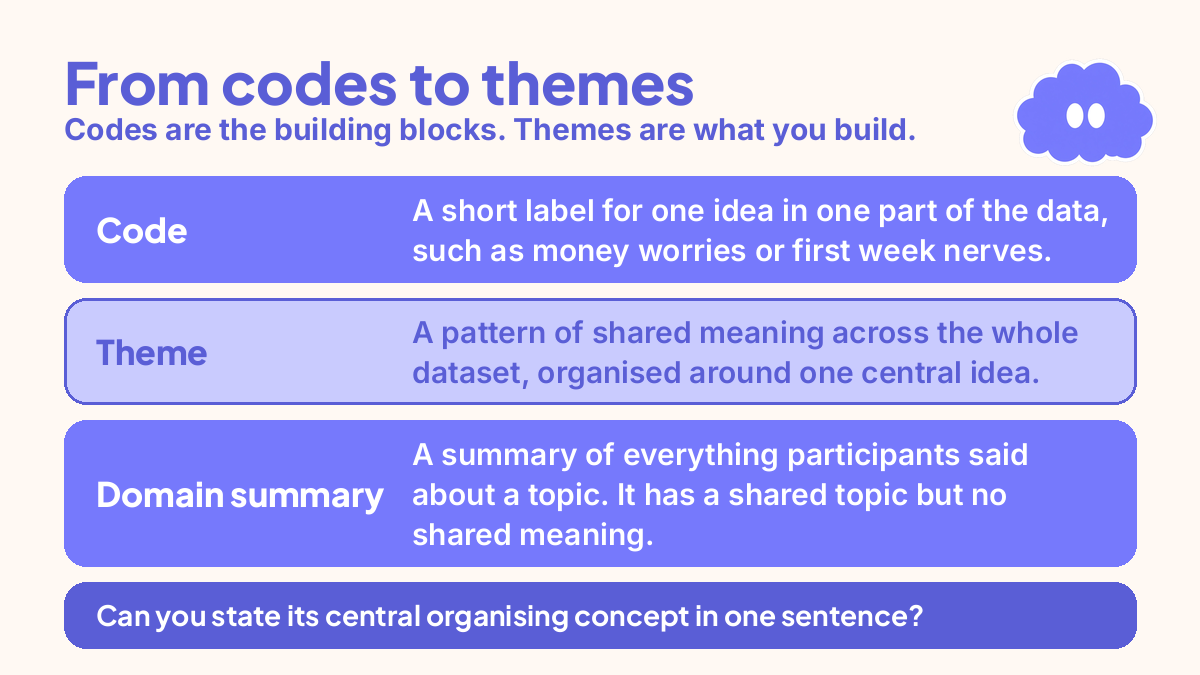
A code is a short label for one idea in one specific part of the data. “Money worries” is a code. “First week nerves” is a code. “Asking for help felt like failing” is a code. A code is not a summary of the whole interview, and it is not a theme. Expect dozens of codes: 40 to 80 for 12 interviews is normal. If you have 12 codes, you are summarising, not coding. If you have 200, you are coding everything, including what does not matter.
Keep a codebook: a table with the code name, one sentence saying what it means, and one example extract. The codebook keeps your coding consistent across the dataset, and it is the evidence the examiner wants that the coding was systematic. When a new code appears in interview nine that overlaps with a code from interview two, merge them and note the merge in the codebook. When a code appears only once and answers nothing, drop it and note the drop.
Code in order, one interview at a time, and do not skip the boring interviews. The interviews that feel dull often hold the codes that matter, because the participant is describing the ordinary reality your question is about.
Step 4: Generate initial themes from shared meaning
The third phase is where the analysis starts to take shape. Collate your codes and look for clusters that share a meaning, not just a topic. A theme is a pattern of shared meaning across the dataset, organised around a central organising concept: the one core idea that ties it together.
A domain summary is not a theme. A domain summary lists everything participants said about a topic: everything about money, everything about time, everything about support. It has a shared topic but no shared meaning, and examiners will call it a list, not an analysis. A theme says something: “Returning to study meant renegotiating who you are at home and at work” is a theme, because it makes a claim about the pattern. “Money” is a topic. “Time” is a topic. Neither is a theme.
Test every candidate theme with one question: can you state its central organising concept in one sentence. If you cannot, the theme is not ready.
Sketch a thematic map: the themes as boxes, the codes inside each one, and the relationships between them as lines. The map is the structure of your analysis chapter, drawn before you write a word of it. A map with three to five themes, each with its own codes and its own central idea, is ready. A map with eight themes and overlapping codes is not. The system for planning research interviews for a thesis is the step before this one, and the map is where its transcripts become an argument.
Step 5: Review and define each theme
The fourth and fifth phases are the quality check. Review each theme against its extracts first, then against the whole dataset. Does every extract fit the theme, or do some belong elsewhere. Does the theme hold across the dataset, or does it rest on one interview. If a theme fails, change it: merge it with another, split it in two, or drop it. Dropping a theme is not failure. It is the analysis working.
Check the counter-cases: the participant who disagrees, the interview that does not fit, the code that contradicts the theme. Name the counter-case in the write-up, do not hide it.
Then define and name each theme. Write one sentence per theme that says what it is, what it is not, and what it answers. The name should carry the claim, not the topic: “Study as a second shift” says more than “Time management”. “Asking for help felt like failing” says more than “Support”. The name is the first thing the examiner reads, and it should tell them what you found.
Most student theses end with three to five themes. Fewer than three usually means the analysis is too thin. More than six usually means the themes are topics, not patterns.
Step 6: Write up each theme as claim, evidence, interpretation
The sixth phase is the report, and writing is part of the analysis, not a report of it. For each theme, build an analytic narrative: say what the pattern is, show it with well-chosen extracts, and say what it means in relation to your question and the literature.
A theme paragraph has three parts, in order. First, the claim: one or two sentences saying what the pattern is. Second, the evidence: one or two short quotations that show the pattern, chosen because they are vivid and typical, not because they are dramatic. Third, the interpretation: what the evidence means for the question, and how it connects to what the literature says. Do not list quotations without interpretation. Do not interpret without evidence. The three parts together are the theme, and a theme without any one of them is incomplete.
Keep quotations short: one or two sentences, not a paragraph. Edit them lightly for readability, and mark every edit with square brackets. Give each quotation a participant number, not a name. The system for writing a thesis results chapter and the system for writing a thesis discussion chapter show how the analysis chapter fits into the thesis as a whole, and the thesis writing system that keeps moving keeps the drafting on schedule.
A worked example: six weeks from transcripts to a draft analysis chapter
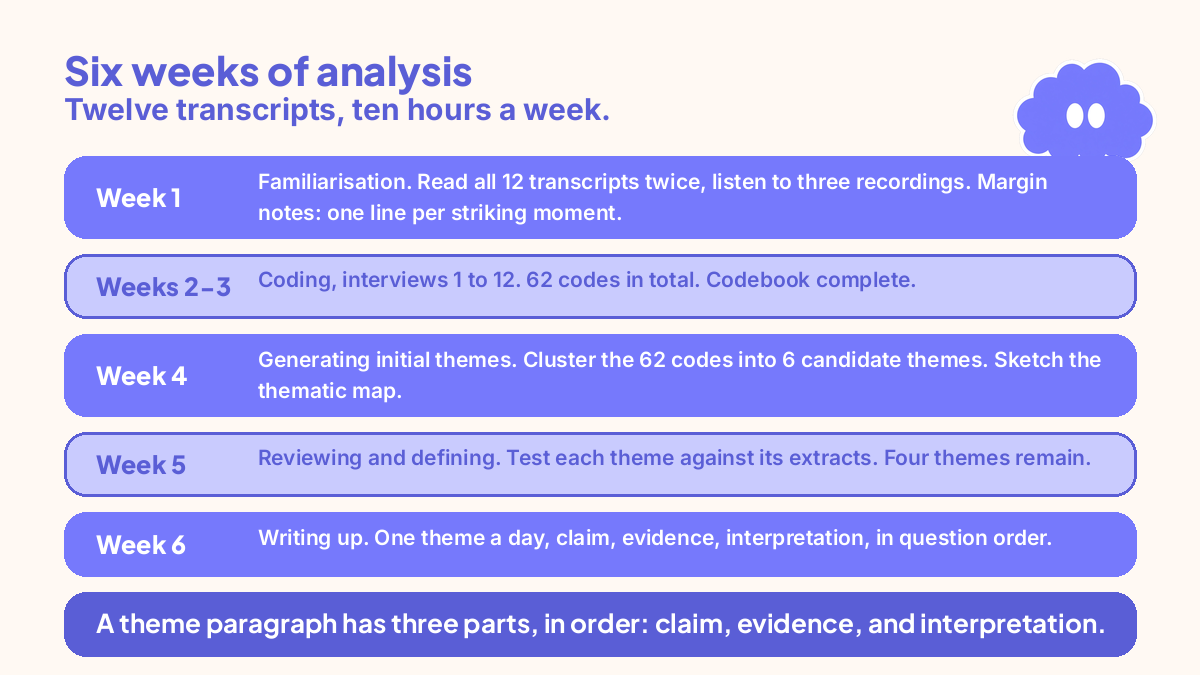
Your situation: Master’s student, 12 interview transcripts on how adult learners experience returning to study after five years or more out of education. Transcripts are clean, named, and stored. Six weeks to a draft analysis chapter, 10 hours a week.
- Week 1: familiarisation. Read all 12 transcripts twice, listen to three recordings. Margin notes: one line per striking moment. Decide: reflexive thematic analysis, inductive, mostly semantic.
- Week 2: coding, interviews 1 to 6. 38 codes so far. Codebook started: code name, one sentence, one example extract. Merge two codes that overlap. Drop three codes that answer nothing.
- Week 3: coding, interviews 7 to 12. 24 more codes, 62 in total. Re-read interviews 1 to 3 and check consistency: two codes applied differently, fixed. Codebook complete.
- Week 4: generating initial themes. Cluster the 62 codes into 6 candidate themes. Sketch the thematic map. One candidate is a domain summary, everything about money, so rework it: the pattern is not money, it is that money decides time, and time decides study. Rename it “Study as a second shift”.
- Week 5: reviewing and defining. Test each theme against its extracts: one theme fails, built on two interviews only, so merge it into the strongest theme. Define each theme in one sentence. Four themes remain.
- Week 6: writing up. One theme a day, claim, evidence, interpretation, in question order. Quotations kept to one or two sentences, participant numbers attached. Friday: read the whole chapter aloud, check the order, and send the draft to the supervisor.
When it goes wrong
You have twelve transcripts and you start coding on day one. Stop, and read the dataset twice first. Coding without familiarisation produces codes that reflect your memory, not the data. The week of reading saves a week of re-coding.
Your themes are topics, not patterns. Ask the one-sentence question: can you state the central organising concept in one sentence. If you cannot, go back to the codes and ask what the pattern is, not what the topic is. A theme makes a claim. A topic makes a list.
You keep summarising instead of analysing. Check each theme paragraph: does it have a claim, evidence, and interpretation. If it has evidence and no interpretation, you are summarising. Add the interpretation: what does this evidence mean for the question, and how does it connect to the literature.
Weekly review checklist
Use this checklist at the end of each analysis week, in writing, in 20 minutes.
- Have I read the whole dataset, or am I coding from memory?
- Is the codebook up to date, with every code defined and every merge noted?
- Do my candidate themes share a meaning, or are they domain summaries?
- Can I state each theme’s central organising concept in one sentence?
- Have I tested each theme against its extracts, the whole dataset, and the counter-cases?
- What one change will I make to next week’s analysis, and what stays the same?
Downloadable infographic spec: one vertical image, title “How to analyse qualitative data for your thesis”, with the six steps from “The system in short” and the six review questions above, in Thynq cream, Cloud Purple, Dark Purple and pink, with the Cloud mascot. Text taken word-for-word from this article.
What this system is not
This system is not a way to skip the reading, and it is not a shortcut to themes. It does not promise that six weeks will produce a finished analysis, and it does not replace your supervisor’s judgement. It turns transcripts into codes, codes into themes, and themes into an argument an examiner can follow.
Sources
- Braun, V., & Clarke, V. (2006). Using thematic analysis in psychology. Qualitative Research in Psychology. The six-phase approach in this article follows this paper: familiarisation, coding, generating themes, reviewing themes, defining and naming themes, and producing the report.
For the full system behind this method, start with how to build a study system that fits your life.
Questions
What is thematic analysis?
Thematic analysis is a method for identifying, analysing, and reporting patterns of meaning, called themes, across a dataset such as interview transcripts. You read the data closely, attach short labels called codes to meaningful parts, cluster related codes into themes, and refine them until they answer your research question.
How many themes should a thesis have?
Most student theses end with three to five themes. Fewer than three usually means the analysis is too thin, and more than six usually means the themes are topics, not patterns of meaning. Each theme must answer the research question, and each one needs a central organising concept you can state in one sentence.
What is the difference between a code and a theme?
A code is a short label for one idea in one part of the data, such as money worries or first week nerves. A theme is a pattern of shared meaning across the whole dataset, organised around one central idea. Codes are the building blocks. Themes are what you build from them.
How long does thematic analysis take?
For a student thesis with 8 to 12 interviews, allow four to six weeks from the first reading to a draft analysis chapter. Coding takes the longest, usually two weeks. Rushing it produces a list of what each participant said, not an analysis, and examiners can tell the difference.