
The direct answer
How to plan research interviews for a thesis is a fieldwork system, not a list of questions. Turn your research question into interview topics, design the guide in five phases, decide who to interview and how many, get ethics approval and consent, run the interviews with a routine, and hand over clean transcripts ready for analysis.
The system in short
- Turn the research question into interview topics: list what participants must talk about, and link every topic to the question.
- Design the guide in five phases: confirm the fit, draw themes from the literature, draft the guide, pilot it, and present the final version.
- Decide who and how many: choose participants on purpose, agree a provisional target with your supervisor, and stop when new interviews add few new ideas.
- Get ethics approval and consent before you recruit: the application, the information sheet, and the consent form come first.
- Run the interviews with a routine: warm-up, open questions, probes, and notes written immediately afterwards.
- Transcribe and hand over to analysis: decide the level of detail, name the files once, store them safely, and write the methods section from the log.
Step 1: Turn the research question into interview topics
Start from the research question, not from a list of questions. Write the question at the top of a page. Under it, list the topics participants must talk about for you to answer it. Each topic is a subject area, not a question: “how they were matched with a mentor”, “what helped”, “what got in the way”, “how it affected their decision to stay”. Each interview question must connect to at least one research question, and each topic must connect to at least one question.
Write the topic map on one page: the research question at the top, three to six topics underneath, and the questions each topic needs beside it. This page is the foundation of the guide, the ethics application, and the methods chapter. The system for choosing a thesis topic and the system for writing a thesis proposal cover the question itself; this system starts where they end.
Step 2: Design the guide in five phases
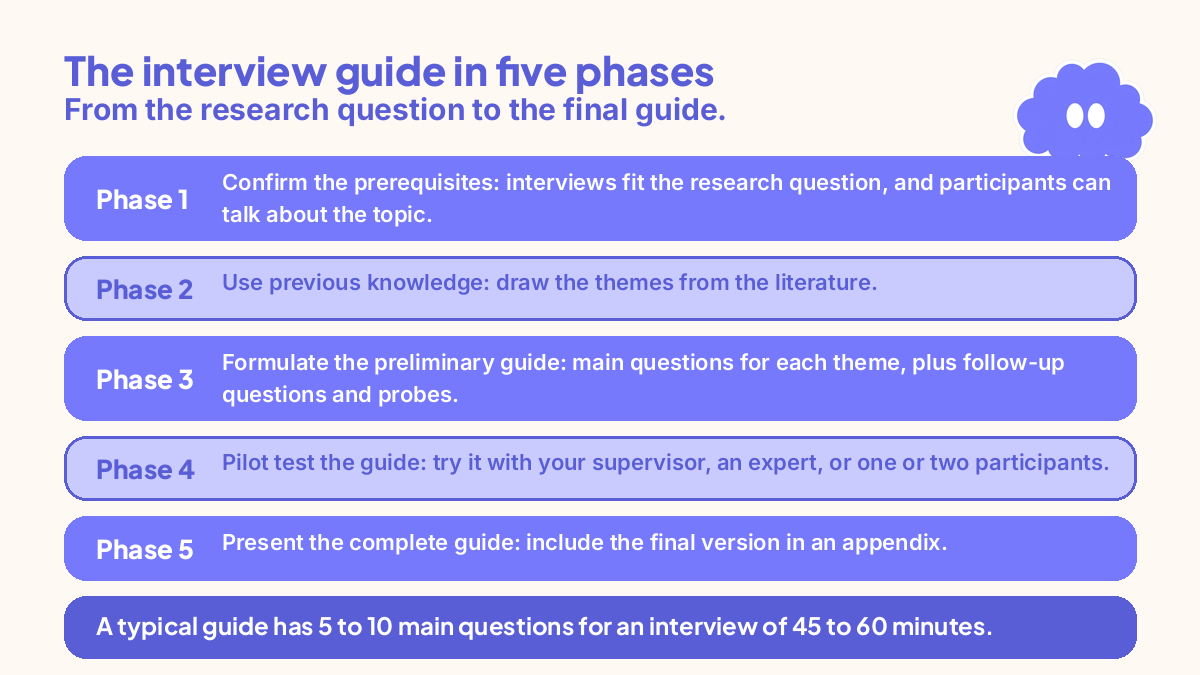
Kallio and colleagues (2016), in a systematic methodological review, describe five phases for developing a semi-structured interview guide. Follow them in order, and do not skip the pilot.
Phase one: confirm the prerequisites. Check that semi-structured interviews fit the research question, and that participants can talk about the topic from experience. If the question needs numbers, or if participants cannot speak freely about it, interviews are the wrong method, and no guide will fix that.
Phase two: use previous knowledge. Draw the themes from the literature and, where relevant, from your own professional understanding of the field. Read the literature first, and let it shape the topics. A guide built from the literature is a guide the examiner can trust. The system for doing a systematic literature search and the system for reading research papers for a thesis cover this step in full.
Phase three: formulate the preliminary guide. Write main questions for each theme, plus follow-up questions and probes. A typical guide has 5 to 10 main questions for an interview of 45 to 60 minutes. More than that turns the conversation into a questionnaire read aloud. Start easy, with a warm-up question about the participant’s role or background. Use open questions that cannot be answered with yes or no. Avoid leading questions that assume an answer.
Phase four: pilot test the guide. Try it with your supervisor, with an expert, or in a field test with one or two participants from the target group. The pilot shows which questions confuse people, which ones produce one-word answers, and which ones take too long. Change the guide after the pilot, and note the changes in your methods chapter: examiners expect to see them.
Step 3: Decide who and how many
Interviews use purposive sampling: you choose people who have relevant experience, not a random sample. Decide who you need, how many, and how to reach them, in line with your sampling plan. Write the criteria down: who counts as a participant, who does not, and why. The criteria are the answer to the examiner’s first question about your method.
There is no fixed number of interviews. Many student projects use roughly 8 to 20, and the aim is enough depth to answer the question. In Guest, Bunce and Johnson’s (2006) analysis of 60 interviews with a fairly homogeneous group, most of the codes they eventually identified had appeared within the first 12 interviews. Agree a provisional target with your supervisor before ethics approval, and stop when new interviews add few new ideas. Justify the number by the study’s aim, the specificity of the sample, and the planned analysis, not by convention alone.
Step 4: Get ethics approval and consent before you recruit
Do not recruit anyone, and do not run a pilot with real participants, before you have ethics approval. The application needs your research question, your guide, your consent form, and your plan for storing data safely. Submit it early: approval can take weeks, and the fieldwork cannot start without it.
Write the information sheet before you write the consent form. The sheet explains, in plain language: what the study is about, why the participant is being asked, what the interview involves, how long it takes, how the data will be used, who will see it, and that the participant can withdraw at any time without giving a reason. The consent form is the participant’s agreement to those terms. Get written or recorded consent, and confirm it again at the start of the interview.
Protect confidentiality from the first contact. Use participant numbers, not names, in your files. Store recordings and transcripts in the place your university requires, usually a password-protected university drive, not a personal phone or a shared cloud folder.
Step 5: Run the interviews with a routine
An interview is a conversation with a purpose, and the purpose is the guide. The routine keeps it on track without turning it into an interrogation.
Before the interview, check the logistics: the room is quiet and private, the recording device works, the spare battery is charged, the guide is printed, and the consent form is ready. If the interview is online, test the platform, the microphone, and the recording on the same device you will use. Arrive early.
Start with the warm-up question, and let the participant settle. Then work through the guide in order, but follow the participant when they raise something important: the guide is a list of topics, not a script. Probe for depth and clarity. Useful probes are: “Can you tell me more about that?”, “What happened next?”, “Can you give me an example?”, and “How did that feel at the time?” Do not fill silences. A silence after a good question is the participant thinking, and the answer that follows is usually the best one in the interview.
End with the closing question, thank the participant, and stop the recording. Then, immediately, write short notes: the setting, the mood, the key impressions, the ideas for analysis, and what you might change in the next interview.
Step 6: Transcribe and hand over to analysis
Transcribing gives you text to analyse. Decide the level of detail you need before you start. A verbatim transcript captures words as spoken, including pauses and false starts. A cleaned transcript removes fillers and fixes grammar. Most student theses use a cleaned verbatim transcript: every word, but without the ums and the repeated false starts. Decide once, write it in the methods chapter, and do it the same way for every interview.
Transcribe soon after each interview, while the notes are fresh. Transcribing takes roughly four hours for one hour of recording, so plan it into the fieldwork schedule: an interview a day leaves no time to transcribe, and a backlog of six recordings is a week of work. Name the files once, with one rule: participant number, date, and version, such as P03_2026-11-20_v1. Never keep two files called final. The system for organising your thesis research data covers file naming and storage in full.
Write the methods section from the log, not from memory. The recruitment log, the pilot notes, the interview notes, and the transcription decisions are the evidence the methods chapter needs: who you interviewed, how many, how the guide was built, how the interviews were run, and how the data was prepared.
A worked example: twelve interviews in four weeks
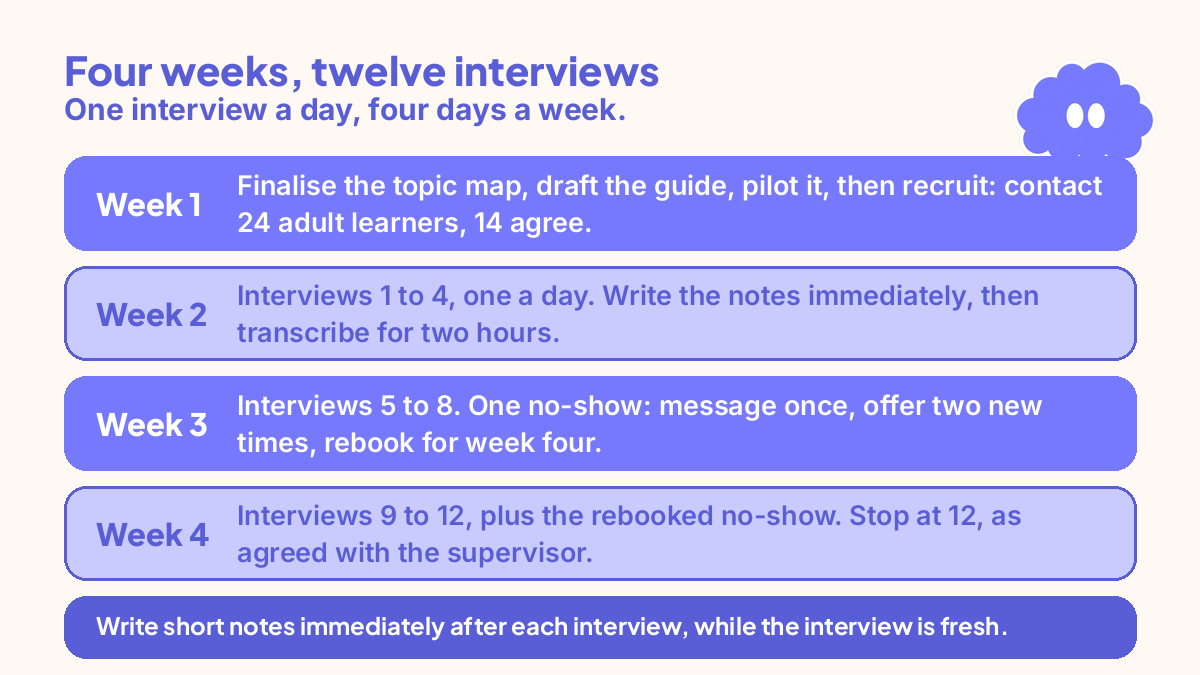
Your situation: Master’s student, thesis on how adult learners experience returning to study after five years or more out of education. Twelve interviews planned, semi-structured, 45 to 60 minutes each. Ethics approval in hand. Four weeks for fieldwork, one interview a day, four days a week.
- Week 1, Monday: finalise the topic map with the supervisor: returning to study, the decision to return, the first term, support, and what changed. Draft the preliminary guide: 8 main questions, 45 minutes planned.
- Week 1, Tuesday: pilot the guide with a colleague who returned to study. Two questions confuse her, one produces a one-word answer. Rewrite three questions, add two probes, cut one question. Note the changes.
- Week 1, Wednesday to Friday: recruit. Contact 24 adult learners through the university’s mature student society and two course tutors. 14 agree. Book 12 interviews across weeks two to four, with two reserves. Send information sheets and consent forms.
- Week 2, Monday to Thursday: interviews 1 to 4, one a day. Each morning: check the recorder, print the guide, confirm the consent form. Each afternoon: write the notes immediately, then transcribe for two hours.
- Week 3, Monday to Thursday: interviews 5 to 8. One no-show on Wednesday: message once, offer two new times, rebook for week four. Transcription keeps pace: four transcripts done, four to go.
- Week 4, Monday to Thursday: interviews 9 to 12, plus the rebooked no-show. After interview 10, the notes show few new ideas: the same themes are repeating. Stop at 12, as agreed with the supervisor.
- Week 4, Friday: finish transcription. 13 transcripts, named P01 to P13, stored on the university drive, consent forms in a separate folder. Hand over to analysis.
When it goes wrong
Your questions produce one-word answers. The questions are closed, not open. Rewrite them so they cannot be answered with yes or no: “Tell me about the day you decided to return” instead of “Did you find it hard to decide?” Add a probe after each question, and pilot the new version.
Nobody will agree to be interviewed. Change the approach, not the topic. Ask a participant to suggest someone else, ask a tutor to pass on the invitation, or move the interviews online so the time cost is lower. If recruitment stalls for two weeks, talk to your supervisor about widening the criteria.
Your recording fails. This is why you check the device before every interview and keep a spare. If it fails anyway, write up the interview from your notes immediately, while you remember it, and note in the methods chapter that one interview was recorded in notes only. Then fix the device before the next one.
Weekly review checklist
Use this checklist at the end of each fieldwork week, in writing, in 20 minutes.
- Is the topic map still right, or has the fieldwork shown a topic I missed?
- Did the pilot changes work, or do the questions still need fixing?
- How many interviews are done, how many are booked, and is recruitment on track?
- Did every interview have consent confirmed, and are the files named and stored correctly?
- Are the interview notes written the same day, and what do they show so far?
- What one change will I make to next week’s fieldwork, and what stays the same?
Downloadable infographic spec: one vertical image, title “How to plan research interviews for a thesis”, with the six steps from “The system in short” and the six review questions above, in Thynq cream, Cloud Purple, Dark Purple and pink, with the Cloud mascot. Text taken word-for-word from this article.
What this system is not
This system is not a way to skip ethics approval, and it is not a shortcut to good data. It does not promise that twelve interviews will answer your question, and it does not replace the analysis that comes after. It turns a research question into a guide, a guide into interviews, and interviews into transcripts an examiner can trust.
Sources
- Kallio, H., et al. (2016). Systematic methodological review: developing a framework for a qualitative semi-structured interview guide. Journal of Advanced Nursing. The five phases for developing a semi-structured interview guide in this article follow this review.
- Guest, G., Bunce, A., & Johnson, L. (2006). How many interviews are enough? An experiment with data saturation and variability. Field Methods. Most codes appeared within the first 12 interviews in a fairly homogeneous group, which supports stopping when new interviews add few new ideas.
For the full system behind this method, start with how to build a study system that fits your life.
Questions
How many interviews do I need for a thesis?
There is no fixed number. Many student projects use roughly 8 to 20 interviews, and the aim is enough depth to answer the question, not a magic total. Agree a provisional target with your supervisor before ethics approval, and stop when new interviews add few new ideas.
What is a semi-structured interview?
A semi-structured interview follows a prepared guide of open-ended questions on set themes, while letting you change the order, ask follow-up questions, and probe for detail. It is the usual choice for a thesis, because it gives you coverage and flexibility at the same time.
How long should a thesis interview last?
A typical guide has 5 to 10 main questions for an interview of 45 to 60 minutes. More questions than that turns the conversation into a questionnaire read aloud. Plan the time per question before the interview, and pilot the guide to check the timing.
Do I need ethics approval before interviewing for my thesis?
Yes, in almost every university. Get ethics approval before you recruit anyone or run a pilot with real participants. The application needs your research question, your guide, your consent form, and your plan for storing data safely.