
The direct answer
A systematic literature search turns your research question into search terms, runs those terms through two or three databases, screens every result against written rules, and records each step — how many papers you found, how many you screened, and how many you kept. It is slower than a normal search, and that is the point: at the end you can show your work.
You have probably done the other version. You searched a few keywords, opened the papers that looked good, and stopped when you had enough for the chapter. That works for a short essay. For a thesis it leaves a question your supervisor will ask, and you will not be able to answer: how do you know you found everything that matters?
A systematic search answers that question before it is asked. You write the rules first, follow them for every paper, and keep the numbers.
The system in short
- Write your research question in one sentence, then pull out its key parts.
- Turn each part into search terms, including synonyms and different spellings.
- Pick two or three databases that cover your field, and search them all with the same terms.
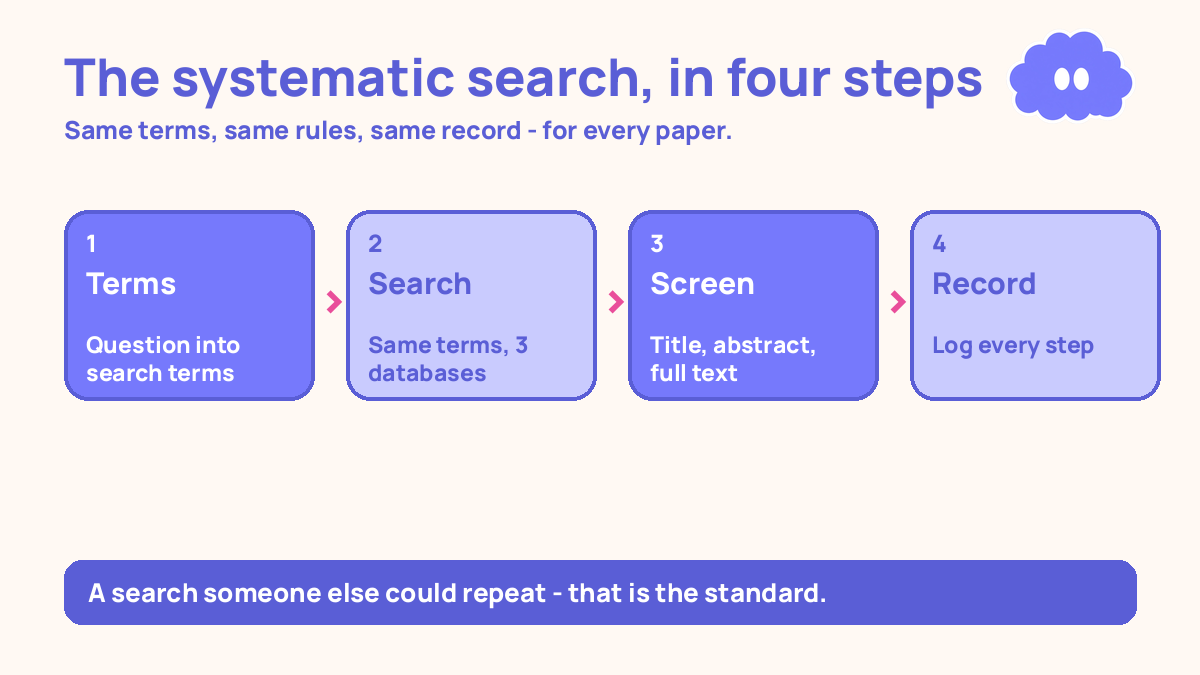
- Screen every result the same way: title first, then abstract, then full text.
- Apply your inclusion rules to every paper, and record how many pass each stage.
- Read the included papers properly, and file them with a one-line claim each.
Step 1: Turn your question into search terms
Start with your question in one sentence. “Does spaced practice help university students remember more than massed practice?” The key parts are: spaced practice, university students, remembering. Each part becomes a group of search terms.
For each part, list the synonyms. Spaced practice is also called distributed practice, spacing, and spaced repetition. University students are also undergraduates and higher education students. Remembering is also retention, recall, and long-term memory. Different papers use different words for the same idea.
Write the terms down in a table before you search. One column per part, one term per row. This table is your search plan, and you will reuse it in every database. If your supervisor asks how you searched, this table is the answer.
Set a date range and a language before you start. A thesis on current practice might cover the last ten years. A thesis on the history of an idea might cover fifty. Either is fine, as long as you decide it now and write it down.
Step 2: Pick your databases and record the search
Pick two or three databases that cover your field, plus your university library catalogue. In education and psychology, that might be ERIC, PsycINFO, and Web of Science. In health, it might be PubMed, CINAHL, and Web of Science. Your field will have its own list, and your librarian can confirm it in ten minutes. Ask them.
Search every database with the same terms. Do not change the terms halfway through. If a database gives you 2,000 results, narrow the terms and note the change. If it gives you 12, results, widen them. What matters is that every change is written down, with the date.
Keep a search log. One row per search: the database, the date, the exact terms, and how many results it returned. This log is the record that makes your search systematic. Without it, you have a search. With it, you have a search someone else could repeat.
Step 3: Screen titles and abstracts, in order
Screening has three stages, and you do them in order: title, abstract, full text. Do not read the full text of a paper whose title already tells you it is about something else. That is how a search of 400 papers takes a week instead of a month.
First, screen titles. Read each title and ask one question: could this paper be about my question? If yes, keep it. If no, exclude it. If you are not sure, keep it — doubt goes forward, not out. This stage is fast. You can screen 100 titles in an hour.
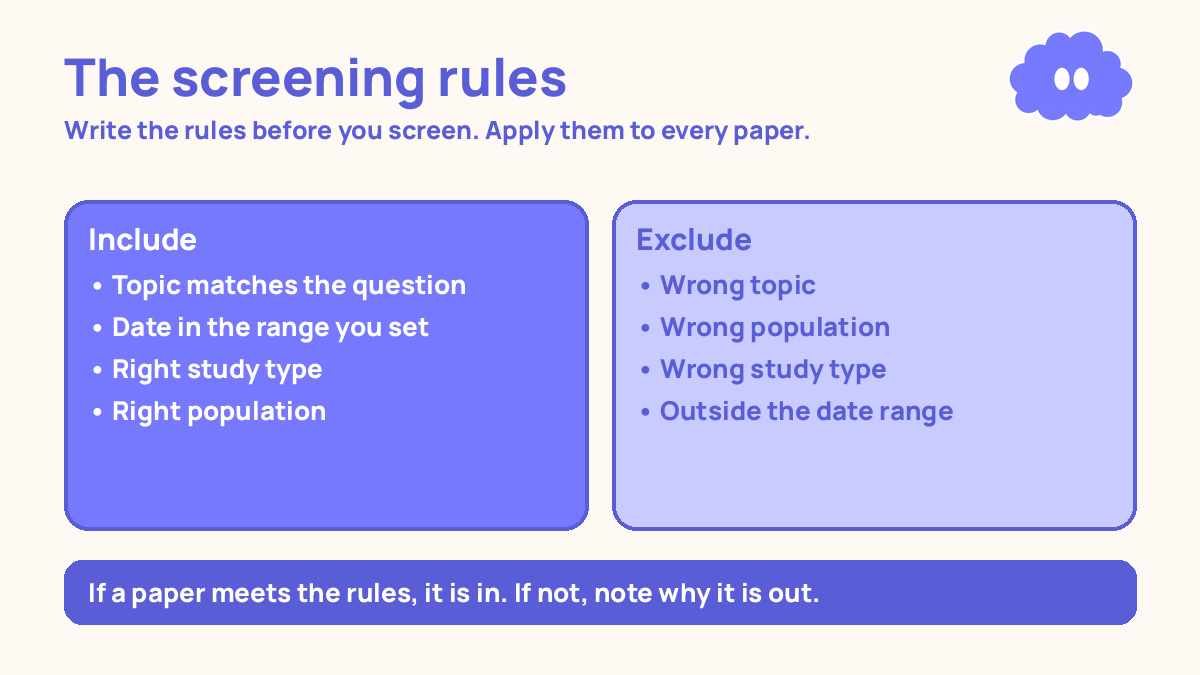
Then screen abstracts. Read the abstract of every paper that survived the title screen, and apply your inclusion rules: topic, date range, study type, language. If a paper meets the rules, it goes to full-text reading. If it does not, exclude it and note the reason — wrong topic, wrong population, wrong study type. The reason matters, because your final count needs to say why papers went out.
Do the screening in short sessions, not one long day. Decide the start in advance with an if-then plan: “When I finish lunch, I will screen 30 titles before I do anything else.” Research on if-then plans (Gollwitzer & Sheeran, 2006) found that naming the cue and the action in advance raised goal attainment by a medium-to-large amount (d = 0.65) across 94 studies.
Step 4: Read the full texts and decide
Now read the full text of every paper that survived the abstract screen. This is the slowest stage, and it is the stage where your reading system matters most. Read for the claim and the method: what did the authors find, and how did they show it? The research reading system covers how to read a paper so you leave with its claim and its method, not just a highlighted PDF.
Apply the same inclusion rules again, to the full text. Some papers look right in the abstract and wrong in the method section — the sample is not your population, or the study did not measure what you need. Those papers are excluded now, with the reason noted. That is not a failure. It is the screen working.
For each included paper, write one line in your own words: the claim, and how the authors showed it. Then test yourself on that claim a week later, from memory, before you open the paper again. In a 2013 review, Dunlosky and colleagues rated ten common study techniques, and only practice testing and distributed practice received a high utility rating. Rereading was rated low. If you can state a paper’s claim without looking, you understand it well enough to use it. If you cannot, open it and fix the note.
Step 5: Record the flow, and keep the numbers honest
At the end, you need four numbers: how many papers you found, how many survived the title screen, how many survived the abstract screen, and how many you included. Draw them as a simple flow, one box per stage, with the count in each box and the reasons for exclusion beside it. This flow goes in your thesis, usually in the methodology or the literature review chapter.
Keep the numbers honest. If you found 412 papers and kept 18, say so. A small number of included papers is not a failure — it means your question is narrow, or the field is small, or your rules were strict. What fails is a search with no numbers.
File the included papers the same way you file everything else: one folder, one name format, one list. The literature review system shows how those included papers and their one-line claims turn into a chapter. The search finds the papers. The review chapter argues with them. Keep the two jobs separate, and both get easier.
A worked example: one question, 412 papers, 18 kept
Here is a real-shaped example. Your question is about spaced practice and university students. You search three databases and your library catalogue on the same day, with the same terms.
| Stage | Papers | What happened |
|---|---|---|
| Found in all databases | 412 | Search terms run in 3 databases + catalogue |
| After removing duplicates | 338 | 74 duplicates removed |
| After title screening | 96 | 242 excluded: wrong topic |
| After abstract screening | 41 | 55 excluded: wrong population or study type |
| After full-text reading | 18 | 23 excluded: method did not fit |
| Included in the review | 18 | Filed with a one-line claim each |
A sample screening day, Tuesday: 9:00–10:00, screen 60 titles. 10:00–10:15, break. 10:15–11:30, screen 40 abstracts and note the reasons for exclusion. 11:30–12:00, update the search log and the flow counts. Afternoon: read two full texts from the included pile. One day, 100 titles screened, and the numbers are up to date.
When it goes wrong
You found 2,000 papers and cannot face screening them. Your terms are too broad. Add one more concept to the search — a population, a setting, a study type — and run it again. Narrowing the search is not cheating. Note the change in your log and move on.
You found 12 papers and your supervisor says it is not enough. Your terms are too narrow, or your date range is too short. Add synonyms you left out, widen the date range by five years, and search one more database. If the field is genuinely small, say so in your thesis and show the numbers.
You keep changing the rules while you screen. You excluded a paper on Monday for a reason, then included a similar paper on Wednesday. Stop. Re-read your inclusion rules, write them on a card beside your desk, and re-screen the last 20 papers against the written rules. Rules that change halfway through are not rules.
You cannot remember why you excluded a paper. You did not note the reason at the time. Go back to the abstract, apply the rules again, and write the reason now. From today, note the reason the moment you exclude a paper. A count without reasons is a number your supervisor cannot trust.
Weekly review checklist
Copy this list and use it each week:
- Did I run this week’s searches with the same terms in every database?
- Did I record each search in the log — database, date, terms, results?
- How many titles and abstracts did I screen, and how many survived?
- Did I apply the same inclusion rules to every paper?
- Did I note the reason for every paper I excluded?
- Does every included paper have a one-line claim in my own words?
- What one change will I make next week: narrower terms, another database, or faster screening?
Downloadable infographic spec: one vertical image, title “Search once, show your work”, with the six steps — question to terms, pick databases, search and log, screen titles and abstracts, read full texts, record the flow — and the funnel 412 found, 338 after duplicates, 96 after titles, 41 after abstracts, 18 included — in Thynq cream, Cloud Purple, Dark Purple and pink, with the cloud mascot. Text taken word-for-word from this article.
What this system is not
It is not a promise that you will find every paper ever written, and it is not a claim that a systematic search is the only honest way to read. It is a practical method for a thesis: a written plan, the same rules for every paper, and a record you can show. If your department wants a particular reporting format, follow it. If your field uses a named checklist for reporting searches, use that one. The system survives either choice, because the system is a plan, a log, and honest numbers — not a brand name.
Sources
- Gollwitzer, P. M. & Sheeran, P. (2006). Implementation intentions and goal achievement: a meta-analysis of effects and processes. Advances in Experimental Social Psychology, 38, 69–119. If-then plans raised goal attainment by a medium-to-large amount (d = 0.65) across 94 studies.
- Dunlosky, J., et al. (2013). Improving students’ learning with effective learning techniques. Psychological Science in the Public Interest, 14(1), 4–58. Only practice testing and distributed practice received a high utility rating; rereading was rated low.
For the wider system this search sits inside, see the thesis writing system that keeps moving, and for turning the included papers into a chapter, see the literature review system.
Questions
How is a systematic search different from normal searching?
A normal search stops when you have enough papers. A systematic search follows a written plan: the same terms, the same databases, the same screening rules for every result, and a record of each step so someone else could repeat it.
How many databases should I search?
Two or three that cover your field, plus your university library catalogue. One database is not enough, because no single database holds everything. More than four usually adds duplicates, not new papers.
How do I decide which papers to include?
Write your inclusion rules before you start screening: topic, date range, study type, and language. Apply the same rules to every paper. If a paper meets the rules, it is in. If it does not, it is out, and you note why.
What do I do with the papers I exclude?
Keep the count and the reason. You do not need to keep every excluded paper, but you do need to be able to say how many you found, how many you screened, and how many you kept — and why the rest went out.