
The direct answer
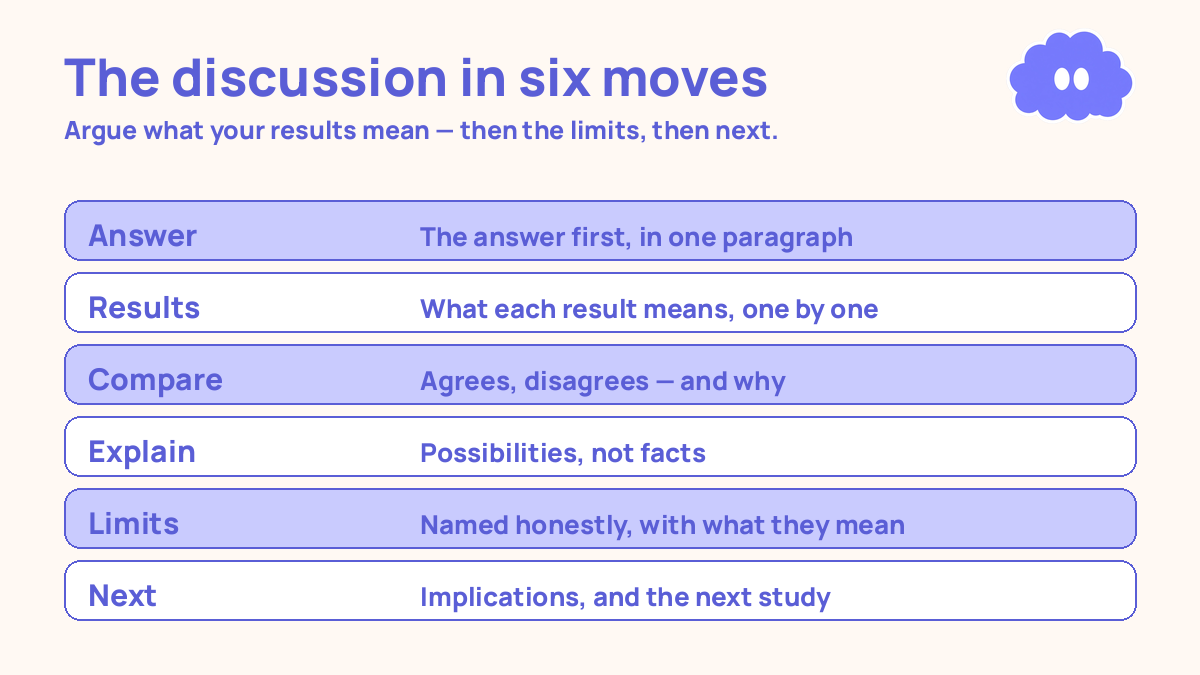
A thesis discussion chapter argues what your results mean. It answers your research question in one paragraph, then works through the results one by one: what each one means, how it compares with earlier work, and what could explain it. Then it names the limits honestly and says what should happen next. No new numbers, no new results — only the argument built on the findings you already reported.
You have reported the results. Now you have to say what they mean, and this is the chapter most students find hardest. Reporting is safe: the numbers are what they are. Arguing is exposed: you have to take a position, compare your work with other people’s, and admit where your study falls short.
Your examiner reads the discussion to judge your thinking, not your data. If the answer is clear, the comparisons are fair, and the limits are honest, they trust the thesis even when the results are modest.
The system in short
- Answer your research question in one paragraph, at the start of the chapter.
- Work through the results one by one, in the same order as the results chapter.
- Compare each result with earlier work: where it agrees, where it disagrees, and why.
- Offer explanations for the unexpected results, as possibilities, not as facts.
- Name the limits of the study honestly, and say what each limit means for the findings.
- End with what should happen next: the implications, and the next study.
The discussion leads straight into the ending: How to write a thesis conclusion shows how to close without repeating it.
Step 1: Answer the question first
Open the discussion with the answer. One paragraph. Restate the research question, then answer it in plain words, using the results you reported. “Small clinics in Peshawar answer most patient messages the next morning, not the same evening — and an automated reply did not change that” is an answer. “This study investigated communication in clinics” is not.
The reader should know the answer within the first minute. Everything after that is the argument for it.
Test yourself on the answer the way you would test yourself on study material. Close the document and write the answer from memory, in two sentences. Dunlosky and colleagues rated practice testing as one of only two high-utility learning techniques in their 2013 review. If you cannot produce the answer from memory, you do not know it yet.
Step 2: Work through the results one by one
Take the results in the same order as the results chapter, and say what each one means. One result, one short section. Start with the most important result — the one that answers the question — then work through the rest.
For each result, do three things. Say what the result was, in one sentence, with the number. Say what it means, in one or two sentences. Then say why it might have happened, as a possibility. Keep the three apart. The result is a fact from the last chapter. The meaning is your argument. The explanation is a guess, and it must sound like one.
Step 3: Compare each result with earlier work
For each important result, ask what earlier work found. Where your result agrees, say so and name the study. Where it disagrees, say so too — and then work through the possible reasons. A different setting, a different method, a smaller sample, a different year. The reasons are the interesting part. A disagreement with no explanation is a loose end. A disagreement with two honest possible reasons is a contribution.
Be fair to the earlier work. Do not dismiss a study because its result differs from yours. Read what it actually did, and compare the methods before comparing the findings. If the earlier study used large hospitals and yours used small clinics, the difference in setting may explain the difference in result.
Step 4: Explain the unexpected results as possibilities
Every thesis has a result that does not fit. The clinic with automated replies was no faster. The group you expected to do best did worst. Do not hide these results — you already reported them — and do not explain them away with a single confident cause. Offer two or three possible reasons, and say which one you find most likely and why.
An explanation offered as a possibility is honest. An explanation offered as a fact is a claim without evidence. “One possible reason is that staff checked the automated replies once a day, so the reply went out late anyway” is a possibility. “Staff checked the replies once a day” is a fact you would need evidence for.
If no explanation fits, say so. “This result is hard to explain with the data collected, and the next study should test whether…” is a better sentence than a confident explanation invented to fill the gap. Examiners respect a gap that is named.
Step 5: Name the limits honestly
Name the limits of the study, and say what each limit means for the findings. The sample was small, so the findings may not hold in other clinics. The study ran for one month, so it cannot show what happens over a year. The interviews were with staff, not patients, so the patient’s side is missing. One limit, one sentence about what it means.
Be specific. “This study has limitations” says nothing. “Twelve staff from three clinics cannot show what happens in every clinic in the city” says something. The examiner already knows the limits. Naming them shows you know them too, and that is what they are checking.
Do not apologise for the limits. A limits section that ends with “therefore the findings mean nothing” has gone too far. The limits qualify the findings. They do not erase them.
Step 6: End with what should happen next
Close the chapter with two things: what your findings mean for practice, and what the next study should do. Keep both short and concrete.
The implications follow from the findings, not from your hopes. If clinics answer messages the next morning, the implication is about staffing the evening, not about buying new software. If the automated reply made no difference, the implication is that the reply is not the bottleneck. Say what follows, in one or two sentences, and no more.
The next study follows from your limits. What would settle the question your study could not? A longer study, more clinics, patients as well as staff. One or two concrete suggestions, tied to your findings, are enough. A long wish list of future research is not a plan. It is a way of avoiding a decision about what matters most.
Get feedback on this chapter from someone outside your project before you call it done. Rowland found in a 2014 meta-analysis of 61 studies that testing beat restudying by a medium amount (g = 0.50), and that feedback mattered: with feedback the effect was larger (g = 0.73) than without it (g = 0.39). A reader who does not know your study will spot the claim you have not supported and the limit you have not named.
A worked example: one week, a first draft
You have a week and a blank discussion chapter. Your study found that three clinics answered most messages the next morning, and the automated reply made no difference. Your target is a first draft of about 1,300 words — the chapter is argument, and argument is written slowly.
| Day | Block | Job | Words |
|---|---|---|---|
| Monday | 50 minutes | Write the answer from memory, in two sentences | 0 new, outline only |
| Tuesday | 2 × 50 minutes | Draft the answer paragraph and the first two results | 300 |
| Wednesday | 2 × 50 minutes | Draft the remaining results and the comparisons | 400 |
| Thursday | 2 × 50 minutes | Draft the limits and what should happen next | 400 |
| Friday | 1 × 50 minutes | Read it aloud, mark every sentence you do not believe | 200 cut or fixed |
Monday is an answer day. Close the results chapter and write the answer from memory, in two sentences. If you cannot, you do not know the answer yet, and the week is spent finding it, not writing around it.
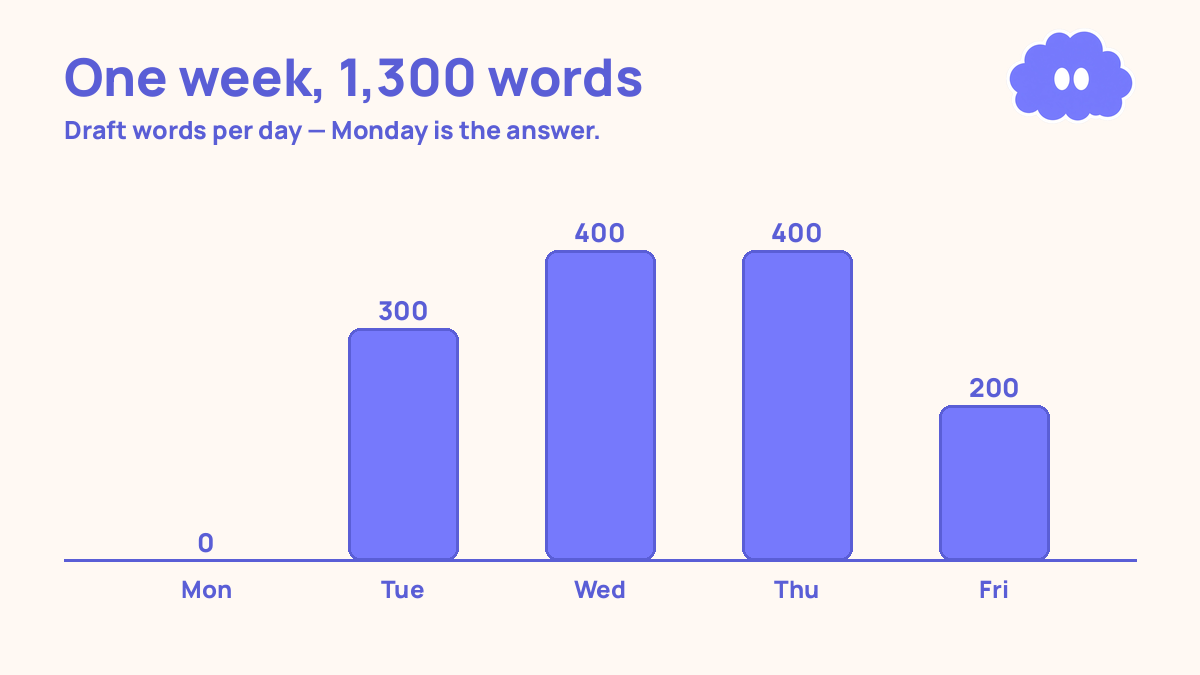
Tuesday and Wednesday are drafting days. Two 50-minute blocks each, with a real break between them — a practical timer, not a prescription. The 25-minute Pomodoro length was Francesco Cirillo’s practical choice, not a number from cognitive science. One result at a time: what it was, what it means, how it compares.
Thursday is for limits and next steps. Write the limits as plain sentences, one per limit, with what each one means. Then write the next study in two sentences: what it would test, and why that question matters.
When it goes wrong
Your discussion repeats the results. Every paragraph restates a table in different words. Cut the repetition. The discussion adds meaning: what each result means, how it compares, and what could explain it. If a paragraph adds no meaning, it belongs in the results chapter, not here.
Your discussion hides the hard results. The unexpected finding gets one vague sentence, or none. Give it a full section: what it was, what it could mean, and two or three possible reasons. A hard result discussed honestly is a strength. A hard result hidden is a reason not to trust the chapter.
Your limits erase your findings. The limits section ends with “therefore the findings mean nothing”. Rewrite it. The limits qualify the findings. Say what the findings still show, within the limits, and stop. An honest limit makes the findings more believable, not less.
Your discussion introduces new numbers. A new count, a new percentage, appears here for the first time. Move it to the results chapter, or cut it. The discussion argues from the findings already reported. A new number here is a finding the reader has not seen, and an examiner will ask where it came from.
Weekly review checklist
Copy this list and use it each week while you write the discussion:
- Can I state the answer to my research question from memory, in two sentences?
- Does each result have a meaning, a comparison, and a possible explanation?
- Are the disagreements with earlier work explained, not hidden?
- Is each limit named specifically, with what it means for the findings?
- Is there a new number anywhere in the chapter? If yes, move it to the results.
Downloadable infographic spec: one vertical image, title “The discussion in six moves”, with the six moves — answer, results one by one, compare, explain the unexpected, limits, next steps — and the rule “no new numbers”, in Thynq cream, Cloud Purple, Dark Purple and pink, with the cloud mascot. Text taken word-for-word from this article.
What this system is not
It is not a way to make modest results sound large, and it is not a promise that a good discussion guarantees a good grade. It is a way to argue what your results mean, fairly and honestly, without hiding the hard parts. A clear discussion shows the examiner how you think. It cannot make findings appear that are not in the data.
Sources
- Dunlosky, J., et al. (2013). Psychological Science in the Public Interest, 14(1), 4-58. Only practice testing and distributed practice received a high utility rating.
- Rowland, C. A. (2014). Psychological Bulletin, 140(6), 1432-1463. Testing beat restudying (g = 0.50); with feedback the effect was larger (g = 0.73) than without it (g = 0.39).
- Cirillo, F. — Pomodoro Technique, late 1980s. The 25-minute length was Cirillo’s practical choice, not a number derived from cognitive science.
For the whole thesis, start with the thesis writing system that keeps moving. For the findings this chapter argues about, see how to write a thesis results chapter.
Questions
How is the discussion different from the results chapter?
The results chapter reports what you found. The discussion argues what it means. If a sentence states a number, it belongs in the results. If a sentence says what the number means, or why it happened, it belongs in the discussion.
What if my results disagree with earlier work?
Say so, plainly, and then work through the possible reasons: a different setting, a different method, a smaller sample. A disagreement you explain is a contribution. A disagreement you hide is a problem an examiner will find.
How honest should I be about the limits?
Completely honest, and specific. Name the limits that matter for your findings: the sample size, the setting, the method. A limit stated plainly shows you understand your own work. A limit hidden looks like a limit you did not notice.
Can I suggest future research I will not do myself?
Yes, and you should. The next study follows from your limits: what would settle the question your study could not? One or two concrete suggestions, tied to your findings, are enough. A long wish list is not.