
The direct answer
A thesis conclusion answers your research question, states the main findings in three or four sentences, names the contribution and the limits, and says what is left. It is the shortest chapter in the thesis — usually 800 to 1,500 words — and it adds nothing new. No new numbers, no new argument, no new ideas. It closes the thesis by saying what was asked, what was found, and what remains.
You are nearly done. The results are written, the discussion is argued, and the conclusion is the last chapter standing between you and submission. That is exactly why it goes wrong so often. Tired writers either repeat the whole thesis in ten pages, or write three vague paragraphs and stop. Both fail the chapter’s one job: to give the reader a clear, honest ending.
Your examiner reads the conclusion to check that the thesis kept its promises. The introduction promised an answer to a question. The conclusion must deliver it, in the same plain words, and say what the answer is worth.
The system in short
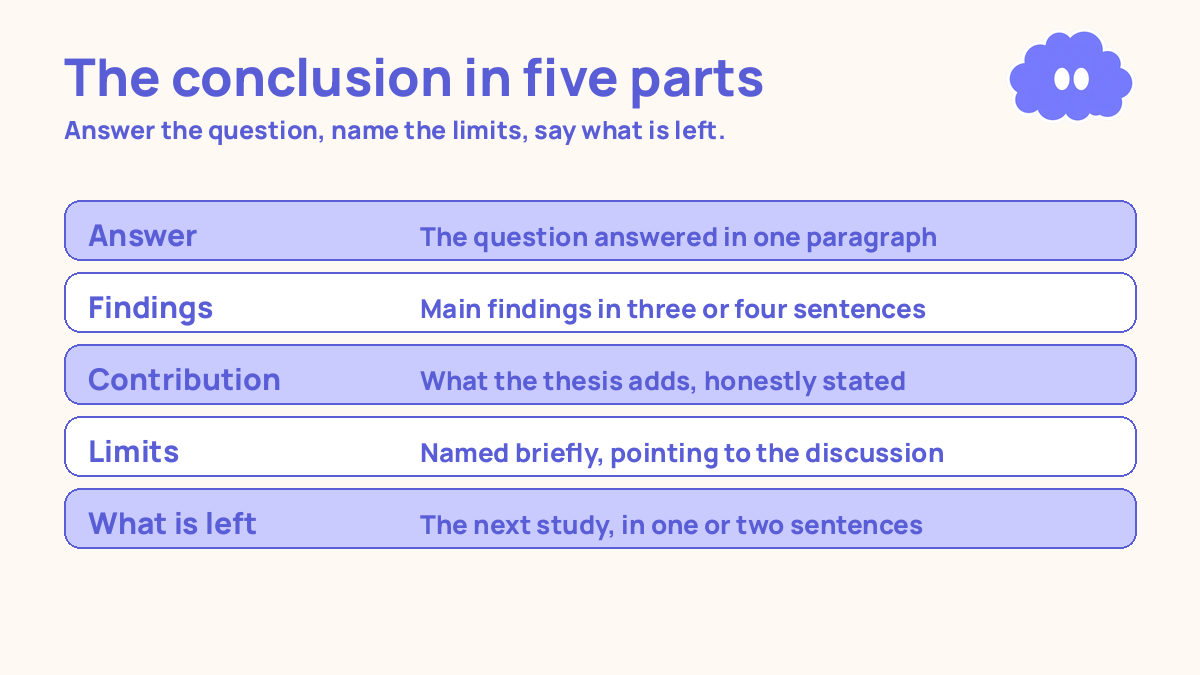
- Restate the research question, then answer it in one paragraph, in plain words.
- Summarise the main findings in three or four sentences — no numbers, no tables.
- State the contribution: what this thesis adds, in one short paragraph.
- Name the limits briefly — one or two sentences, pointing back to the discussion.
- Say what is left: the next study, in one or two sentences.
- Stop. Read it aloud. If a sentence adds something new, cut it.
Step 1: Answer the question in one paragraph
Open with the question, then the answer. Restate the research question in one sentence, exactly as it appears in the introduction. Then answer it in two or three sentences, using the findings from the results chapter.
The answer must match the question. If the introduction asked how small clinics handle patient messages after hours, the conclusion must say how they handle them — not how they should handle them, and not what the literature says about hospitals. A conclusion that answers a different question from the one the introduction asked is the most common failure in this chapter, and the easiest for an examiner to spot.
Test yourself before you write it. Close the document and write the answer from memory, in two sentences. Dunlosky and colleagues rated practice testing as one of only two high-utility learning techniques in their 2013 review. If you cannot produce the answer from memory, you do not know it yet, and the conclusion will wander.
Step 2: Summarise the findings in three or four sentences
After the answer, summarise the main findings. Three or four sentences, covering the two or three findings that matter most. No numbers, no tables, no detail. The reader has already read the results and the discussion. The conclusion reminds them of what mattered, it does not repeat the evidence.
Pick the findings that answer the question. Leave out the rest. A finding that was interesting but did not change the answer does not belong in the summary. If you are unsure whether a finding belongs, ask whether the answer would change without it. If the answer stays the same, the finding stays out.
Write the summary as plain statements. “Clinics answered most messages the next morning, the automated reply made no difference, and staff decided what to reply based on how urgent the message looked” is a summary.
Step 3: State the contribution, honestly
Say what the thesis adds. One short paragraph. Name the contribution in the same plain words you used in the introduction — and check that the two match. If the introduction promised a contribution the results do not support, the conclusion is where that gap shows. Do not widen it by repeating the promise. Narrow it by stating what the thesis actually adds.
Keep the paragraph short. Two or three sentences. If the contribution needs a page of explanation, it is probably two contributions, or one contribution and one hope. Split them, keep the real one, and move the hope to the next study.
Step 4: Name the limits briefly
Name the limits in one or two sentences. Do not repeat the full limits section from the discussion chapter — point back to it. “The study ran for one month in three clinics, so the findings may not hold elsewhere; the limits are discussed in full in the previous chapter” is enough.
The limits belong in the conclusion because a conclusion without them overclaims. A reader who finishes the thesis should know what the answer is worth, and the limits are part of that. But the conclusion is not the place to argue the limits. That argument is in the discussion.
If a limit changes the answer, say so plainly. “Because the study covered only three clinics, the answer applies to small clinics of this kind, not to clinics in general” is honest and specific. A limit that is named and bounded makes the answer more believable, not less.
Step 5: Say what is left
End with what is left: the next study, in one or two sentences. The next study follows from your limits and your unexpected results. What would settle the question your study could not? A longer study, more clinics, patients as well as staff. Pick the one that matters most, and say what it would test.
One next study is enough. Two at most. A conclusion that ends with a long list of future research has not decided what matters most, and the reader leaves with a list instead of an ending.
Do not introduce a new idea here. It has no evidence behind it in the thesis. If the idea matters, it belongs in the discussion, where it can be argued and checked. The conclusion closes the thesis. It does not open a new one.
Step 6: Stop, read it aloud, cut what is new
When the draft is done, read it aloud from start to finish. Mark every sentence that adds something new: a number that appears for the first time, a claim with no evidence in the earlier chapters, an idea that was never discussed. Cut each one, or move it to the chapter where it belongs.
Then check the chapter against the introduction: does the answer match the question, and the contribution match the one promised? A thesis that promises one thing and concludes another has a gap, and the conclusion is the last chance to close it honestly — by narrowing the claim, not by hiding the gap.
Make the final check a scheduled job. Decide the cue and the action in advance, instead of deciding again every morning. Gollwitzer and Sheeran found across 94 studies that if-then plans raised goal attainment by a medium-to-large amount (d = 0.65) over holding the goal alone. Write the plan as a sentence: “When the discussion is finished, I will write the conclusion the next morning, starting with the answer from memory.”
A worked example: one week, a short chapter
You have a week and a blank conclusion. Your thesis found that three clinics answered most messages the next morning, and the automated reply made no difference. Your target is a first draft of about 900 words — the shortest chapter, written last, when you are tiredest.
| Day | Block | Job | Words |
|---|---|---|---|
| Monday | 50 minutes | Write the answer from memory, in two sentences | 0 new, outline only |
| Tuesday | 1 × 50 minutes | Draft the answer paragraph and the findings summary | 300 |
| Wednesday | 1 × 50 minutes | Draft the contribution and the limits | 300 |
| Thursday | 1 × 50 minutes | Draft what is left, then read the whole chapter aloud | 300 |
| Friday | 1 × 50 minutes | Check the conclusion against the introduction, line by line | 0 new, fixes only |
Monday is an answer day. Close the thesis and write the answer from memory, in two sentences. If you cannot, the conclusion is not ready to write, and the week is spent finding the answer in the discussion, not writing around it.
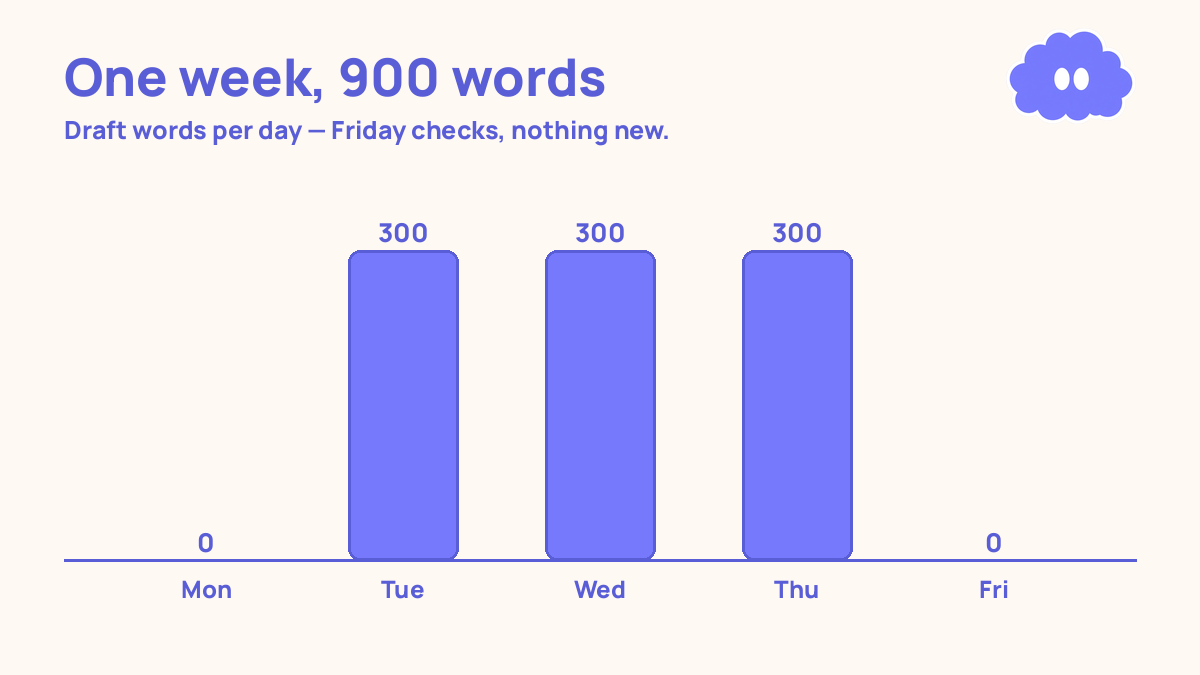
Tuesday to Thursday are drafting days, one 50-minute block each. The conclusion is short, and short chapters are written in short blocks. Do not book a full day for it. A full day invites padding, and padding is the conclusion’s worst enemy.
Friday is a matching day. Read the introduction and the conclusion side by side. Question against answer, contribution against contribution. If they do not match, narrow the claim in the conclusion until they do. Then leave the chapter alone for a day if you can. Cepeda and colleagues found in 2006 that spaced practice beat massed practice — a chapter checked after a gap is a chapter you actually see.
When it goes wrong
Your conclusion repeats the whole thesis. It runs for ten pages, restating every chapter. Cut it to the five parts: answer, findings, contribution, limits, what is left. If a paragraph does not serve one of those five, it belongs in an earlier chapter, not here.
Your conclusion answers a different question. The introduction asked one thing, the conclusion answers another. Read the two side by side and narrow the claim until they match. A thesis that promises one thing and concludes another has a gap, and hiding it is worse than naming it.
Your conclusion overclaims. It says the thesis “proves” or “solves” something the results do not support. Rewrite the contribution in the same plain words you would use to tell a friend what you actually found. A small honest contribution beats a large unsupported one.
Your conclusion introduces a new idea. A new finding, a new argument, or a new recommendation appears here for the first time. Cut it, or move it to the discussion, where it can be argued. The conclusion closes the thesis. It does not open a new one.
Weekly review checklist
Copy this list and use it each week while you write the conclusion:
- Can I state the answer to my research question from memory, in two sentences?
- Does the answer in the conclusion match the question in the introduction?
- Are the findings summarised in three or four sentences, with no numbers?
- Does the contribution match the one promised in the introduction?
- Is there a new number, claim, or idea anywhere in the chapter? If yes, cut it.
Downloadable infographic spec: one vertical image, title “The conclusion in five parts”, with the five parts — answer, findings, contribution, limits, what is left — and the rule “nothing new in the last chapter”, in Thynq cream, Cloud Purple, Dark Purple and pink, with the cloud mascot. Text taken word-for-word from this article.
What this system is not
It is not a way to make a weak thesis sound strong in the last pages, and it is not a promise that a tidy conclusion guarantees a good grade. It is a way to end the thesis clearly and honestly: what was asked, what was found, what it is worth, and what is left. A clear conclusion lets the examiner leave with the right answer in mind. It cannot rescue a thesis whose earlier chapters do not support it.
Sources
- Dunlosky, J., et al. (2013). Psychological Science in the Public Interest, 14(1), 4-58. Only practice testing and distributed practice received a high utility rating.
- Gollwitzer, P. M., & Sheeran, P. (2006). Advances in Experimental Social Psychology, 38, 69-119. If-then plans raised goal attainment (d = 0.65) across 94 studies.
- Cepeda, N. J., et al. (2006). Psychological Bulletin, 132(3), 354-380. Spaced practice beat massed practice, and the optimal gap grows with how long you need to remember the material.
For the whole thesis, start with the thesis writing system that keeps moving. For the argument this chapter summarises, see how to write a thesis discussion chapter.
Questions
How long should a thesis conclusion be?
Short. Most conclusions run 800 to 1,500 words: the answer, the findings in brief, the contribution, the limits, and what is left. If your conclusion is longer than your discussion, you are writing a second discussion.
Does the conclusion repeat the discussion?
It summarises it, it does not repeat it. The discussion argues result by result. The conclusion states the answer, the main findings in three or four sentences, and what is left. No new argument, no new numbers.
Can I add a new idea in the conclusion?
No. A new idea in the conclusion is an idea with no evidence behind it in the thesis. If the idea matters, it belongs in the discussion, where it can be argued. The conclusion closes the thesis; it does not open a new one.
What if my answer is ‘it depends’?
Then say what it depends on, plainly. ‘It depends on the size of the clinic and the hours staff work’ is an answer. ‘It depends’ on its own is not. Name the conditions, with the findings behind each one.