
The direct answer
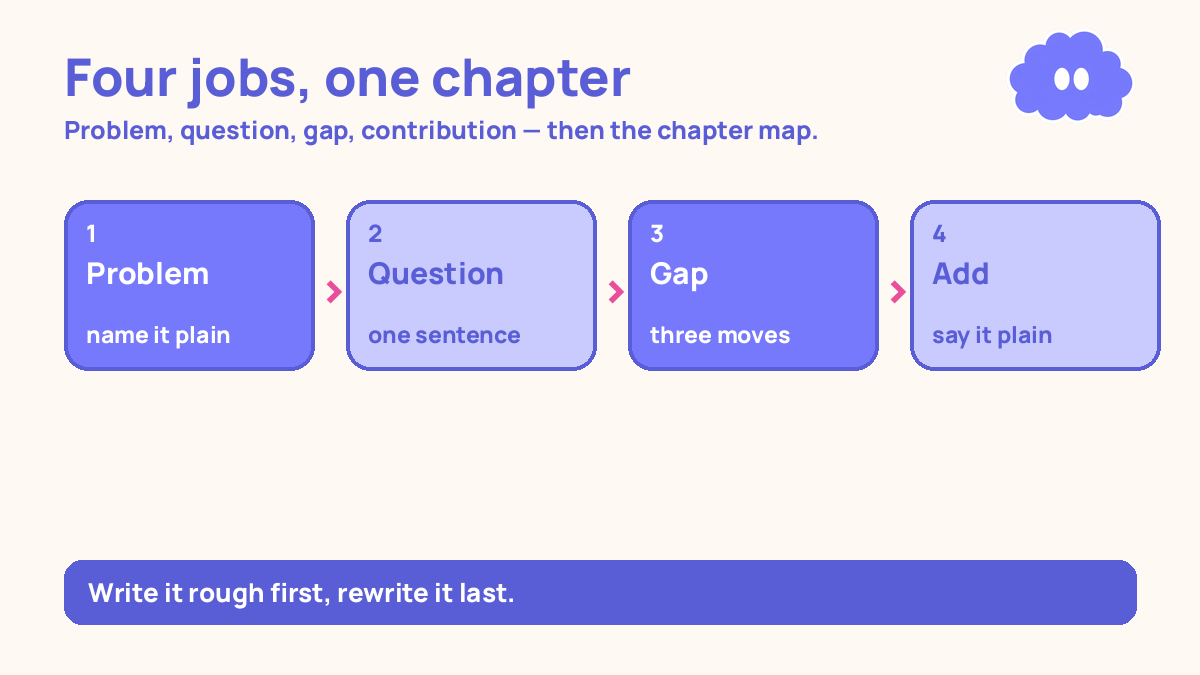
A thesis introduction does four jobs: it names a problem your reader can see, states your research question in one sentence, shows the gap in earlier work that your thesis fills, and says what your thesis adds. Then it gives a short map of the chapters that follow. Write it in that order, keep it short, and rewrite it last, once you know what the thesis actually found.
You are probably staring at a blank first page. The rest of the thesis feels like real work. The introduction feels like writing about writing, so most students either leave it until the night before the deadline or write ten pages of background and call it done. Both are mistakes. The introduction is not a warm-up. It is the chapter that tells your examiner whether the rest is worth reading.
Your examiner reads it first and judges fast. If the problem is clear, the question is sharp, and the gap is real, they read the rest looking for the answer.
The system in short
- Write one paragraph that names the problem in plain words — what is wrong, who it affects, and why it matters now.
- State your research question in a single sentence, and put it where the reader cannot miss it.
- Show the gap in three moves: what earlier work did, what it did not do, and why that missing piece matters.
- Say what your thesis adds, in one short paragraph, without claiming more than your results support.
- Give the reader a map: one or two sentences per chapter, saying what each chapter does.
- Draft it fast, then rewrite it last, after the results and discussion are written.
The introduction and the ending answer each other — How to write a thesis conclusion closes what the introduction opened.
Step 1: Name the problem in plain words
Open with the situation, not a definition. Your reader does not need to be told what your field is. They need to see the problem.
A good opening paragraph answers three questions: what is happening, who does it affect, and why does it matter. Keep it to five or six sentences and use concrete words. If you are writing about clinic booking, say that patients message a clinic after hours and nobody answers until morning. The reader should be able to picture the problem before you mention a single study.
Do not open with history. “Since the beginning of time, humans have…” is a stall, not an opening. Your examiner knows what the key terms mean. What they do not know is why your particular problem deserves a thesis.
Step 2: State the research question in one sentence
Your research question is the spine of the whole thesis. Every chapter hangs off it. Write it as one sentence, in plain words, and put it early — in the first two pages, not buried at the end of the chapter.
A workable question has three parts: the thing, the angle, and the setting. “How do small clinics in Peshawar handle patient messages after hours?” has all three.
Test yourself. Close the document and write your question from memory, in one sentence. Dunlosky and colleagues rated practice testing as one of only two high-utility learning techniques in their 2013 review. Roediger and Karpicke found in 2006 that students who recalled material remembered more a week later than students who restudied it.
Step 3: Show the gap in three moves
The gap is the reason your thesis exists. It is also the part students get wrong most often, because they write it as a list of papers instead of an argument. Use three moves, in order.
First, what earlier work did: two or three sentences naming the strongest work on your question, with names and findings. Second, what it did not do: the specific piece that is missing — a setting nobody studied, a method nobody tried, a contradiction nobody resolved. Third, why that missing piece matters: what we cannot know, or cannot do, until somebody fills it.
The second move is where most introductions fail. “Nobody has studied this” is not a gap on its own. “Earlier work tested this in large hospitals, but not in small clinics, where most patients in this city actually go” is a gap.
Keep the gap short — three or four paragraphs. The full survey of earlier work belongs in the literature review chapter. The thesis writing system that keeps moving treats the introduction as one chapter with one job, not as a second literature review.
Step 4: Say what your thesis adds
After the gap, say what your thesis does about it. One short paragraph. Name the study you ran, the data you collected, or the analysis you did — in general terms, not in detail. The methodology chapter holds the detail.
The rule is honesty about scope. Say what your thesis adds, not what you wish it added. “This thesis reports what happened when three small clinics used an automated reply system for one month” is a real contribution. “This thesis solves the problem of missed patient messages” is a claim your results almost certainly do not support.
Write the contribution paragraph after you have written the results. You cannot honestly say what the thesis adds until you know what it found. A contribution paragraph written before the results is a promise. The same paragraph written after the results is a summary.
Step 5: Give the reader a map
End the introduction with a short map of the thesis. One or two sentences per chapter, saying what each chapter does. Not what it is about — what it does. “Chapter 3 describes the method and why it was chosen” tells the reader something. “Chapter 3 is about methodology” does not.
Keep the map short. Half a page is plenty. A map that runs for two pages is a second introduction hiding at the end of the first one. The reader needs to know where they are going, not to read the journey twice.
Write the map as sentences, in the order the reader will meet the chapters, and make sure the order matches the document. If you reorder chapters later, update the map.
Step 6: Draft fast, then rewrite last
Write the first draft early, when you have your question and your gap. It does not need to be good. It needs to exist, because it forces you to state the question and the gap in writing — the fastest way to find out whether they are clear.
Then leave it. Write the rest of the thesis. Come back when the results and discussion are done, and rewrite the introduction from scratch, using the first draft only as a note of what you meant to do.
Make the rewriting a scheduled job, not a hope. Decide the cue and the action in advance, instead of deciding again every morning. Gollwitzer and Sheeran found across 94 studies that if-then plans raised goal attainment by a medium-to-large amount (d = 0.65) over holding the goal alone. Write the plan as a sentence: “When I finish the results chapter, I will spend the next morning rewriting the introduction, starting with the question.” Use 50-minute writing blocks with a 10-minute break — a practical timer, not a prescription. The 25-minute Pomodoro length was Francesco Cirillo’s practical choice, not a number from cognitive science.
For a shorter essay with the same shape, the essay outline planner gives you an introduction slot for the hook and the thesis line, then one section per argument, so the map you promise in the introduction is already written down.
A worked example: one week, a first draft
You have a week and a blank introduction. Your thesis is about how small clinics handle patient messages after hours. Your target is a first draft of about 1,400 words.
| Day | Block | Job | Words |
|---|---|---|---|
| Monday | 50 minutes | Write the problem paragraph and the question, from memory | 0 new, outline only |
| Tuesday | 2 × 50 minutes | Draft the problem section and the question | 300 |
| Wednesday | 2 × 50 minutes | Draft the gap in three moves, key papers named | 400 |
| Thursday | 2 × 50 minutes | Draft the contribution paragraph and the chapter map | 400 |
| Friday | 1 × 50 minutes | Read the draft aloud, cut what repeats the literature review | 300 cut or fixed |
Monday has no word target on purpose. The job is thinking, not typing: write the question from memory, write the gap in three sentences on paper, and check that the two match.
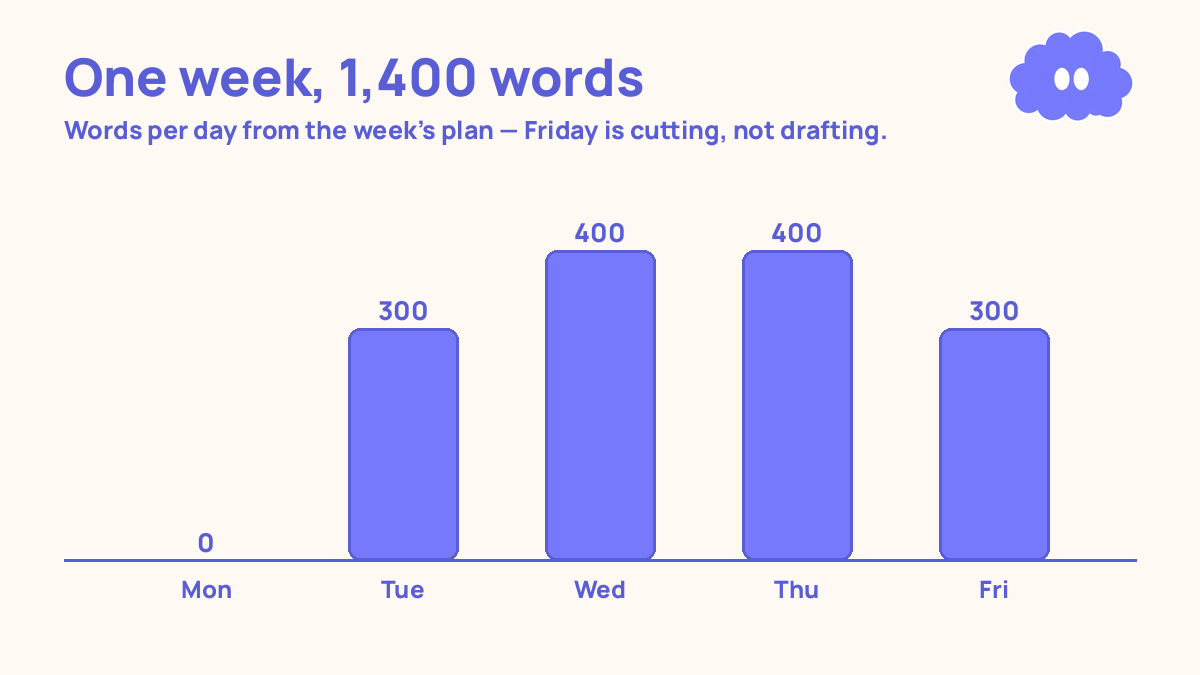
Tuesday to Thursday are drafting days: two 50-minute blocks, with a real break between them. Write fast and do not edit sentences as you go. Editing while drafting is how a 300-word day becomes a 40-word day. Friday is a cutting day: read the draft aloud, and move every paragraph that summarises a paper one by one to the literature review. The draft usually loses 200 to 300 words on Friday, and what is left is the introduction.
When it goes wrong
Your introduction is a history essay. It starts with the background of the field and reaches your question on page six. Cut everything before the problem paragraph. Move the history to the literature review.
Your question is buried or missing. You have written five pages and the reader still cannot say what your thesis asks. Write the question as one sentence, on its own line, in the first two pages. Then check that every paragraph serves that question.
Your gap is invented. You wrote “no previous study has looked at this” and your supervisor found three that did. Go back to the papers and find the real gap: a different setting, a different method, a contradiction between two findings. A small honest gap beats a large invented one, because an examiner will check.
Your introduction promises more than the results deliver. You wrote that the thesis “solves” the problem, but the results show a small effect in three clinics. Rewrite the contribution paragraph after the results are written. Say what the thesis found, in the same plain words you would use to tell a friend.
Weekly review checklist
Copy this list and use it each week while you write the introduction:
- Can I write my research question from memory, in one sentence?
- Does the first paragraph name the problem, who it affects, and why it matters?
- Is the gap stated in three moves — what was done, what was missed, why it matters?
- Does the contribution paragraph say only what the results support?
- Is the chapter map one or two sentences per chapter, in the right order?
Downloadable infographic spec: one vertical image, title “The introduction in four jobs”, with the four jobs — problem, question, gap, contribution — plus the chapter map, and the rule “write it rough first, rewrite it last”, in Thynq cream, Cloud Purple, Dark Purple and pink, with the cloud mascot. Text taken word-for-word from this article.
What this system is not
It is not a template that writes the introduction for you, and it is not a promise of a good grade. It is a way to make sure the chapter does its four jobs in order, in plain words.
Sources
- Dunlosky, J., et al. (2013). Psychological Science in the Public Interest, 14(1), 4-58. Only practice testing and distributed practice received a high utility rating.
- Roediger, H. L., & Karpicke, J. D. (2006). Science. Students who recalled a passage remembered more a week later than students who restudied it.
- Gollwitzer, P. M., & Sheeran, P. (2006). Advances in Experimental Social Psychology, 38, 69-119. If-then plans raised goal attainment (d = 0.65) across 94 studies.
- Cirillo, F. — Pomodoro Technique, late 1980s. The 25-minute length was Cirillo’s practical choice, not a number from cognitive science.
For the whole thesis, start with the thesis writing system that keeps moving, which treats the introduction as one chapter with one job inside a larger plan.
Questions
How long should a thesis introduction be?
Long enough to do its four jobs — problem, question, gap, contribution — and no longer. For most theses that is about 8 to 10 percent of the total word count. Longer than that, and you are probably writing the literature review inside it.
Should I write the introduction first or last?
Write a rough one first to fix your question, then rewrite it last. The first draft is a plan for yourself. The final draft is written when you know what the thesis actually found, so it promises only what the later chapters deliver.
What is the difference between the introduction and the literature review?
The introduction names the gap in a few paragraphs. The literature review shows the work behind that claim, study by study. If your introduction summarises papers one by one, that material belongs in the literature review chapter.
Can the introduction mention the results?
Yes, briefly. One or two sentences saying what you found helps the reader. Do not argue the results here — that is the discussion chapter’s job. The introduction points at the answer; the discussion defends it.