
The direct answer
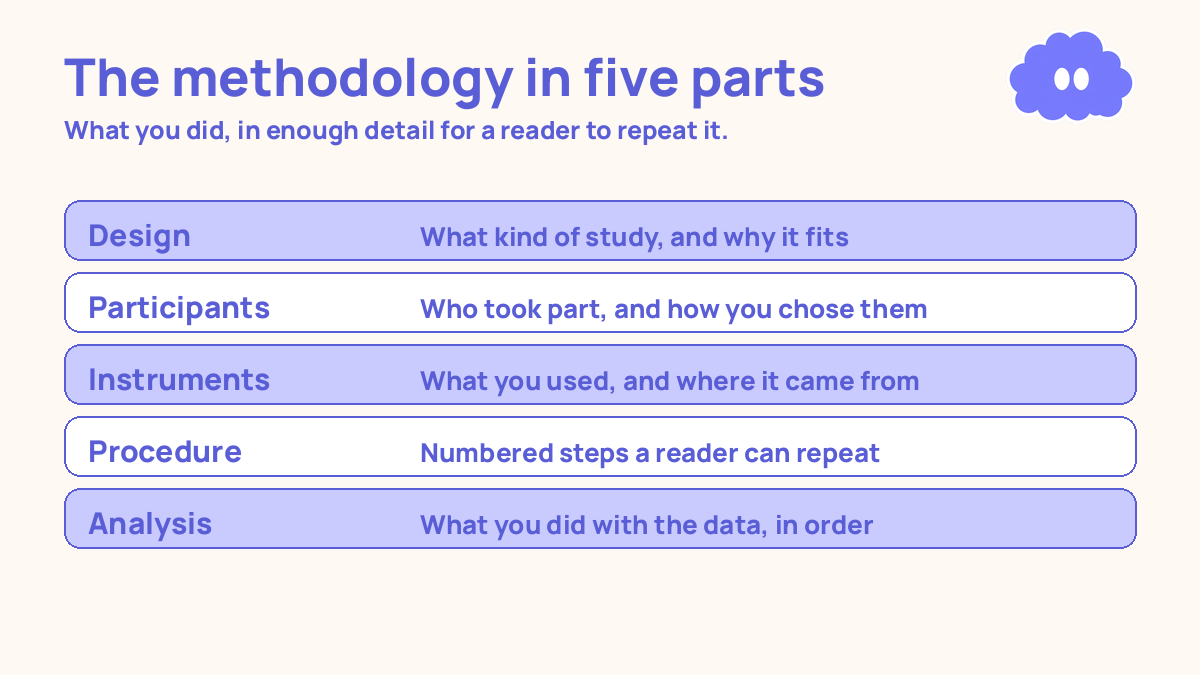
A thesis methodology reports what you did, in enough detail for a reader to repeat it, and says why each choice was the right one for your question. It covers five things, in order: the design, the participants or data, the instruments or materials, the procedure step by step, and the analysis. Write it in the past tense, in plain words, and report what you actually did — not what you planned to do.
You have done the work. You collected the data, ran the interviews, or built the thing. Now you have to describe it, and the description feels harder than the work itself. That is normal. Doing is guided by habit and by the situation in front of you. Describing means turning all of that into words a stranger can follow, in order, without you in the room to explain.
Your examiner reads the methodology to answer one question: can I trust what comes next? If the method is clear and the choices are justified, they read the results as findings. If the method is vague, they read the results as claims they cannot check.
The system in short
- State the design in one paragraph: what kind of study this is, and why that design fits your question.
- Describe the participants or the data: who or what you studied, how many, and how you chose them.
- Describe the instruments or materials: what you used to collect the data, and where it came from.
- Write the procedure as numbered steps, in order, so a reader could repeat it.
- Describe the analysis: what you did with the data, in the order you did it, and why.
- End with ethics and limits: what approval you had, and what the method cannot show.
What you write in the results depends on the method: How to write a thesis results chapter shows how to report what the method produced.
Step 1: State the design and why it fits
Open with the design in one paragraph. Name it in plain words: a survey, an experiment, a case study, interviews, an analysis of existing records. Then say why that design fits your question, in one or two sentences.
The reason matters more than the label. “I used interviews because the question is about how clinic staff decide what to reply” is a justification. “This study used a qualitative design” is a label with no reason attached.
Keep this section short. One paragraph for the design, one for the reason. If you need more, you are probably defending the design against objections nobody has raised yet. Save the defence for the discussion chapter.
Step 2: Describe the participants or the data
Say who or what you studied. How many people, or how many records, messages, or cases. How you chose them, and who you left out. Give the numbers exactly — not “about thirty”, but 34, or 12, or 214.
Choosing matters as much as counting. If you interviewed clinic staff, say how you found them: through the clinic manager, by invitation, from a list. If you used messages, say which messages and from which dates. A reader who cannot tell how the sample was chosen cannot tell whether it is biased.
Describe the participants in general terms, never in a way that identifies them. Give the facts that matter for the study — role, experience, setting — and leave out the rest. If your university required approval, name it here: the committee, the date, the reference number.
Step 3: Describe the instruments or materials
Say what you used to collect the data. A questionnaire, an interview guide, a set of clinic messages, a piece of software. For each one, say where it came from: did you write it, adapt it from an earlier study, or use a standard tool?
If you wrote your own questions, include them in an appendix and point to it from this chapter. The reader needs to see the exact words you asked, because the words shape the answers.
If you adapted an instrument from earlier work, say what you changed and why. If you used a standard tool, name it and cite it. And if you tested the instrument first — a pilot interview, a trial run — say what the test changed.
Step 4: Write the procedure as numbered steps
The procedure is the heart of the chapter. Write it as numbered steps, in the order things happened. Step 1, step 2, step 3. A reader should be able to follow the steps and repeat the study without asking you anything.
Be specific about time and order. “Interviews took place in March, lasted 30 to 45 minutes, and were recorded with the participant’s permission” is a procedure. “Data was collected” is not. Give the dates, the place, the length of each session, and what happened first, second, and last.
Write the procedure from your notes, not from memory. Your notes from the time are the honest record. Memory smooths over the awkward parts — the interview that was cut short, the questionnaire that was reworded halfway through, the week the clinic was closed. Those awkward parts belong in the chapter.
Step 5: Describe the analysis, in order
Say what you did with the data, in the order you did it. If you counted things, say what you counted and how. If you coded interviews, say how the codes were made: from the data, from earlier work, or both. If you used software, name it. If you did the analysis by hand, say so.
The most common failure here is a jump: the data goes in, the findings come out, and nothing in between is described. Fill the gap. “Interview transcripts were read twice, then coded for the three decisions staff described — reply now, reply later, or ignore — and the codes were checked against the original messages” is an analysis a reader can follow.
Get feedback on this section from someone outside your project. Rowland found in a 2014 meta-analysis of 61 studies that testing yourself beat restudying by a medium amount (g = 0.50), and that feedback mattered: with feedback the effect was larger (g = 0.73) than without it (g = 0.39). A reader who does not know your study will spot the missing step you can no longer see.
Step 6: End with ethics and limits of the method
Close the chapter with two short paragraphs. The first covers ethics: the approval you had, how consent was given, and how you protected the people or the data. The second covers the limits of the method itself: what this design cannot show, and what you did to reduce the risk.
Do not hide the limits. Every method has them. A survey cannot show why people answered the way they did. Interviews with twelve people cannot show what happens in every clinic. Saying so does not weaken the thesis. It shows you understand what your method can and cannot do.
Keep the limits to the method. The limits of the findings belong in the discussion chapter. Here, the question is narrow: what could this design not show, even done perfectly? Answer it in three or four sentences, then stop.
A worked example: one week, a first draft
You have a week and a blank methodology chapter. Your study interviewed 12 clinic staff about how they handle patient messages after hours. Your target is a first draft of about 1,200 words — the chapter is mostly description, and description is written in short blocks.
| Day | Block | Job | Words |
|---|---|---|---|
| Monday | 50 minutes | List the five sections and the numbers: 12 staff, 3 clinics, March dates | 0 new, outline only |
| Tuesday | 2 × 50 minutes | Draft the design and the participants sections | 250 |
| Wednesday | 2 × 50 minutes | Draft the instruments and the procedure steps | 350 |
| Thursday | 2 × 50 minutes | Draft the analysis and the ethics and limits | 350 |
| Friday | 1 × 50 minutes | Read it aloud, check every number against your notes | 250 fixed |
Monday is an outline day. Write the five section headings, then fill in the numbers from your notes: how many people, which dates, how long each interview lasted. If a number is missing from your notes, find it now, not on Friday.
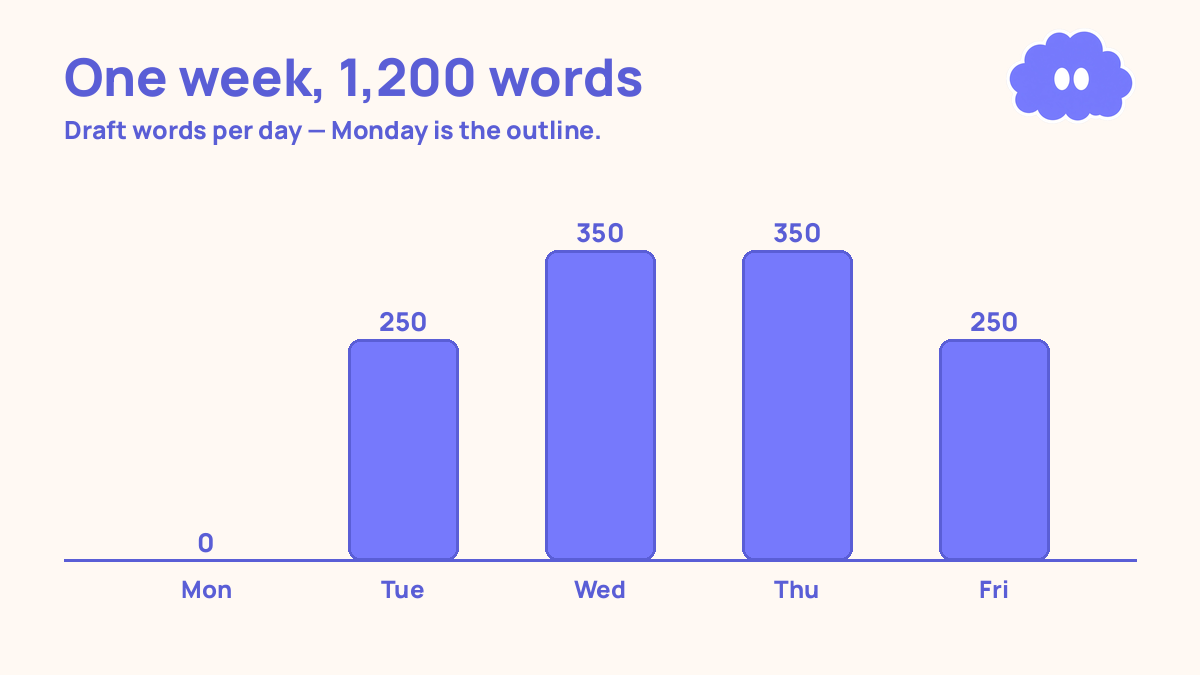
Tuesday to Thursday are drafting days. Two 50-minute blocks, with a real break between them. Write the procedure from your notes, step by step, and do not tidy the steps as you go. Tidying comes on Friday.
Friday is a checking day. Read the chapter aloud and check every number against your notes: the count of participants, the dates, the length of the interviews. Then hand the analysis section to someone outside the project and ask where they lose the thread.
When it goes wrong
Your methodology reads like a textbook. It explains what a survey is, or what interviews are, for three pages. Cut the textbook. Your examiner knows what the methods are. They want to know what you did, with what, and why.
The sample appears from nowhere. You say “34 people took part” but never say how you found them. Add the choosing: who you asked, how you asked, who said no, and who you left out. A sample with no choosing described is a sample the reader cannot trust.
The analysis is a black box. The data goes in and the findings come out, with one sentence in between. Write the analysis as steps, in order, with the same care as the procedure. Name what you counted or coded, how the codes were made, and what you checked them against.
You report the plan, not what happened. The method changed — an interview was cut short, a question was reworded — but the chapter describes the original plan. Rewrite the chapter from your notes. Report what you actually did, including the change and the reason. A method that changed for a good reason is honest research. A hidden change is a problem.
Weekly review checklist
Copy this list and use it each week while you write the methodology:
- Could a reader repeat the study from the procedure steps alone?
- Is every number exact — participants, dates, lengths — and checked against my notes?
- Does each choice have a reason: design, sample, instrument, analysis?
- Are the interview questions or questionnaire in an appendix, pointed to from the chapter?
- Are the limits of the method stated, in three or four sentences?
Downloadable infographic spec: one vertical image, title “The methodology in five parts”, with the five parts — design, participants, instruments, procedure, analysis — plus the rule “report what you actually did, not what you planned”, in Thynq cream, Cloud Purple, Dark Purple and pink, with the cloud mascot. Text taken word-for-word from this article.
What this system is not
It is not a defence of your method against every objection, and it is not a promise of good results. It is a way to describe what you did so plainly that a reader could repeat it.
Sources
- Rowland, C. A. (2014). Psychological Bulletin, 140(6), 1432-1463. Testing beat restudying (g = 0.50) across 61 studies; with feedback the effect was larger (g = 0.73) than without it (g = 0.39).
- Dunlosky, J., et al. (2013). Psychological Science in the Public Interest, 14(1), 4-58. Only practice testing and distributed practice received a high utility rating.
- Cirillo, F. — Pomodoro Technique, late 1980s. The 25-minute length was Cirillo’s practical choice, not a number derived from cognitive science.
For the whole thesis, start with the thesis writing system that keeps moving. For reading other people’s methods before you write your own, see how to read research papers for a thesis.
Questions
How much detail does a methodology chapter need?
Enough for a reader to repeat what you did: who took part, what you used, the steps in order, and how you analysed the results. If a step is missing, the reader cannot repeat the study, and the chapter has failed its job.
What if my method changed during the project?
Say so, plainly, and say why. A method that changed for a good reason is honest research. A method that changed and was hidden is a problem. Report what you actually did, not what you planned to do.
Do I have to justify every choice?
Yes, briefly, for the choices that matter: why this design, why these participants, why this analysis. One or two sentences per choice is enough. A choice with no reason given looks like a choice made by accident.
Where do I write about what went wrong with the method?
In the methodology, briefly, and in the discussion, fully. The methodology reports the problem and what you did about it. The discussion argues what the problem means for your findings.