The direct answer
To write a thesis acknowledgements page, list everyone who genuinely helped, order the thanks from most formal to most personal, and give each person one specific reason. Keep it to about one page, check your institution template first, and write in a warm professional voice.
The acknowledgements page looks easy and then stops people for days. You worry about forgetting someone. You worry about sounding too warm or too cold. You worry that a supervisor will read a short thank you as criticism, or that a family member will read a long one as favouritism. Those worries are normal because the page is personal and public at the same time.
This system removes the guesswork. You will build the list from evidence rather than memory, sort it by a clear order, write one specific sentence per person or group, and check the result against your institution requirements. The aim is a page that is complete, fair, and calm to read. Nobody should finish it wondering why they were left out or what they actually did.
The system in short
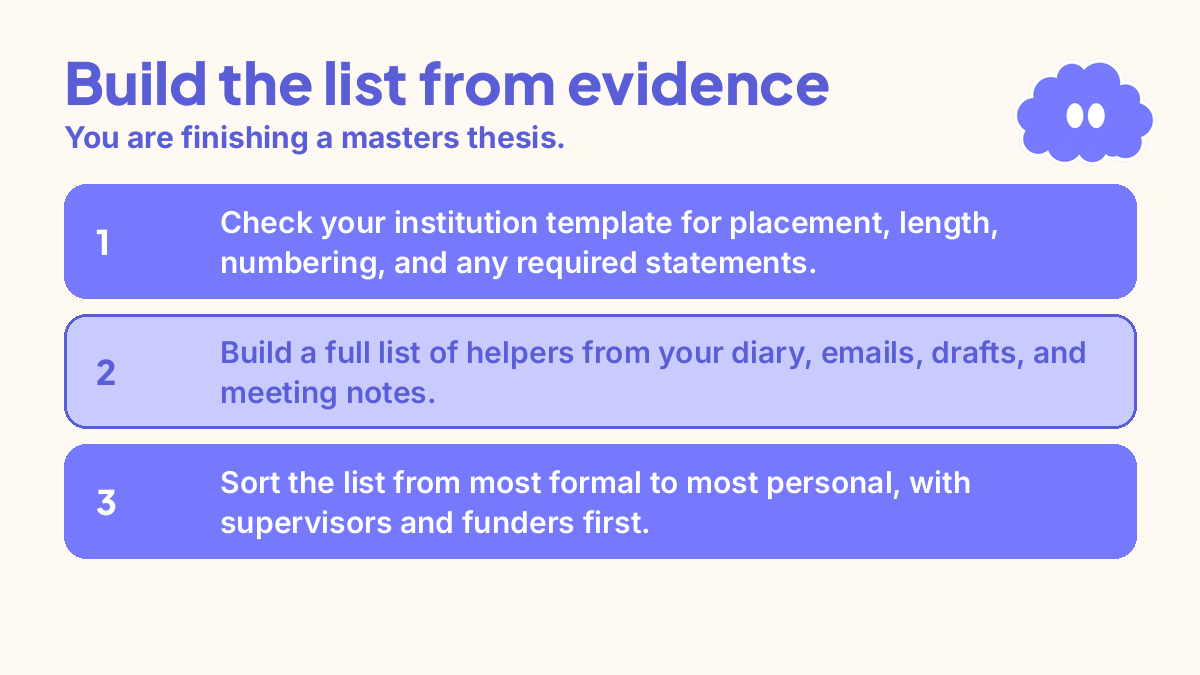
- Check your institution template for placement, length, numbering, and any required statements.
- Build a full list of helpers from your diary, emails, drafts, and meeting notes.
- Sort the list from most formal to most personal, with supervisors and funders first.
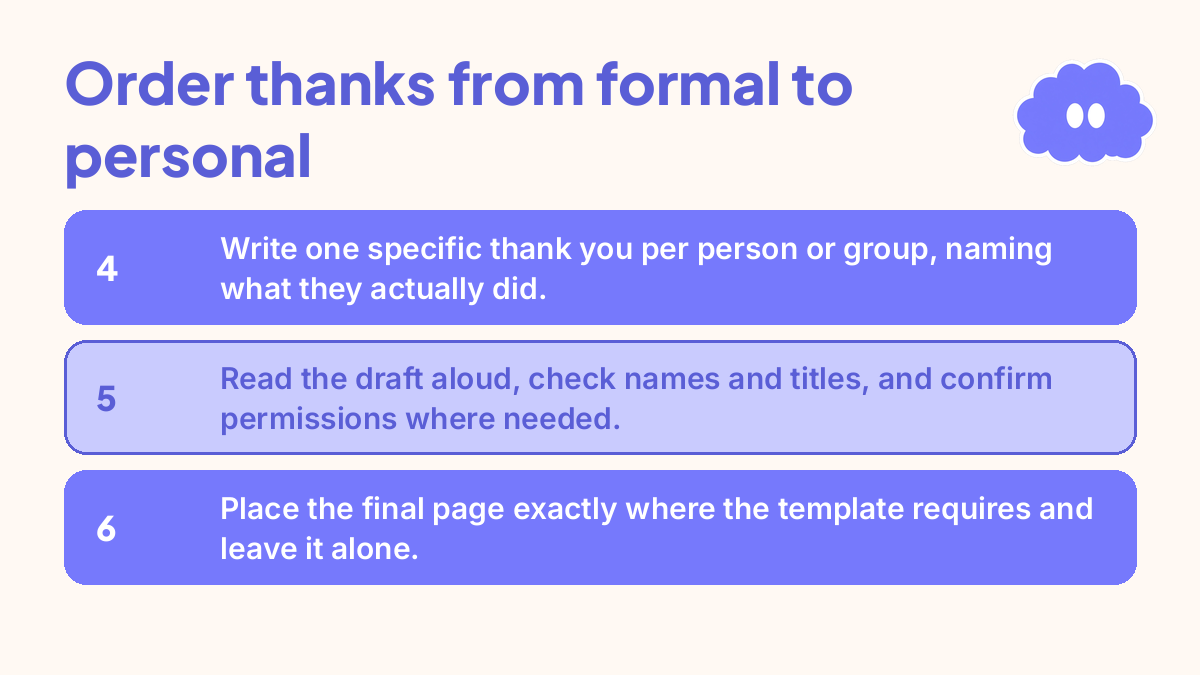
- Write one specific thank you per person or group, naming what they actually did.
- Read the draft aloud, check names and titles, and confirm permissions where needed.
- Place the final page exactly where the template requires and leave it alone.
Step 1: Check your institution template first
Before you write a word, open your university thesis template or submission guide and find the front matter requirements. Note where acknowledgements sit, whether the page is numbered, what heading to use, and whether there is a length limit. Some institutions keep acknowledgements strictly professional. Others welcome personal thanks. The template settles questions that no general guide can settle for you.
Check for required statements. The same care helps with the rest of the front matter in how to format your thesis for submission. Funding bodies sometimes need an exact acknowledgement wording or a grant reference. Professional editing, proofreading help, or use of certain tools may need a declaration under your institution rules. If a statement is required, copy the required form exactly and place it where the guide directs. Do not paraphrase a compulsory statement into friendlier language.
Step 2: Build the list from evidence
Do not rely on memory alone. Open your research diary, your supervisor meeting notes, your email threads, and your draft files with comments. List every person or group who contributed in a real way, from shaping the topic to checking the final proof. Memory favours recent and dramatic help. Evidence catches the steady help that made the thesis possible.
Use four prompts to build the list. First, academic guidance: supervisors, committee members, examiners where appropriate, and other academics who gave feedback or advice. Second, research support: librarians, lab staff, research assistants, archivists, technical staff, and participants who gave time or data. Third, material support: funders, employers who gave study time, and organisations that provided access, equipment, or data. Fourth, personal support: family, partners, friends, and others who sustained you through the work.
Beside each name, write what the person actually did in a few plain words. A diary kept as in how to keep a research diary for your thesis makes this step easier. Feedback on chapter three. Access to the archive. Help with transcription. Childcare during writing weekends. Those notes become your sentences later, and they stop the page from filling with vague gratitude. Specific thanks are kinder than grand thanks because the person can recognise their real contribution.
Be careful with privacy. Participants who were promised anonymity should be thanked as a group, such as the interviewees or the survey respondents, without names or details that could identify them. For professional contacts, use full names and titles where your institution expects them. For personal thanks, first names are usually fine, but check the names people actually use. A misspelled name on a thank you page undoes the goodwill the page exists to create.
Step 3: Sort the thanks from formal to personal
Order the list from most formal to most personal. Supervisors and committee members usually come first, because they guided the work and may examine it. Funders come next, with any required wording. Then other academics, editors or proofreaders where relevant, librarians, assistants, and participants. Family and friends usually come last, however much they carried you. That order is convention, not a ranking of love, and readers understand it.
Within each group, order by closeness to the project. A primary supervisor before a secondary supervisor. A collaborator who worked on your data before a colleague who gave one helpful conversation. If two people contributed equally, alphabetical order is a calm solution that avoids any appearance of ranking.
Think in three bands to keep the page balanced. Major thanks go to people without whom the project would not exist, usually supervisors, committee members, and funders. Big thanks go to people who helped you grow or progress, such as colleagues, cohort members, librarians, and participants. Minor thanks cover moral support and encouragement, usually family and friends. The bands guide length as well as order. Major thanks can carry a full sentence each. Minor thanks can often share a sentence as a group.
Step 4: Write one specific sentence per person
Write the page in the first person. Acknowledgements are not academic argument, so a warmer and more direct voice is appropriate. Keep the language professional. Avoid slang, private jokes, and remarks that only two people will understand. Your examiners, your family, and future readers will all read this page, sometimes years later.
Give each person or group one sentence with three parts: a thank you phrase, the name, and the specific contribution. Thank you for detailed feedback on the methods chapter. Thank you for teaching me the analysis software during my second year. Thank you for reading every draft at short notice. Specific sentences are shorter, warmer, and more credible than long declarations of eternal gratitude.
Vary the opening phrases so the page does not read like a stamped form. I am grateful to. Special thanks go to. I also thank. Lastly, I thank. A small set of varied openings keeps the rhythm natural without drawing attention to the writing. End with your final thank you. Acknowledgements do not need a conclusion or a summary sentence.
Keep the tone honest. If a supervisor relationship was difficult, a brief professional thank you for guidance and feedback is truthful and sufficient. Do not use the acknowledgements page to settle scores or to praise beyond what you believe. Examiners read tone closely, and calm honesty always reads better than either bitterness or flattery. The same restraint helps when you later write How to write a thesis conclusion and need to close the argument without overstating it.
Step 5: Check names, permissions, and tone
Read the draft aloud slowly. Listening catches repeated phrases, awkward rhythm, and sentences that sound colder than you intended. Then check every name spelling, title, and role against a reliable source such as an email signature, a department page, or the person directly. Do not guess at titles. A wrong title is a small error that the person will notice immediately.
Check permissions where your institution or good practice requires them. Professional editors sometimes prefer to be named in a particular way, or not named at all, and some guidelines ask you to confirm wording with them. Funders may require exact wording. Participants must stay anonymous where anonymity was promised. If in doubt, ask the person or your supervisor before submission rather than after.
Finally, proofread the page with the same care as any other chapter. Acknowledgements sit at the front of the thesis, so errors there are unusually visible. The checks in how to edit and proofread a thesis apply fully here. Names, titles, punctuation, and consistent spelling of acknowledgements itself all deserve one slow pass.
Step 6: Place the page and stop revising
Insert the final page exactly where your template requires, with the required heading and numbering. Then stop. Acknowledgements invite endless small revisions because every sentence feels personal. Set a limit of two full checks after placement, one for accuracy and one for tone, and then leave the page alone while you finish the thesis.
The finished page should feel settled. Complete, specific, correctly placed, and fair to everyone who helped. That is the whole job. A good acknowledgements page does not try to be memorable. It tries to be accurate, and accuracy is what makes it warm.
A worked example: a masters thesis with nine helpers
Your situation: You are finishing a masters thesis. Your institution template places acknowledgements after the title page and before the abstract, with a guide length of one page. Your diary and emails list nine helpers. You have one evening to draft the page and a submission deadline in five days.
You list the nine helpers with their contributions. Your supervisor gave feedback on every chapter. Your second reader advised on the literature review. A funding body paid your fieldwork travel. A librarian located two out of print sources. Three interview participants gave their time. Your partner covered childcare during writing weekends. Your parents encouraged you throughout. That is nine names or groups when the three participants count as one anonymous group.
You sort them into order. Supervisor first. Second reader second. Funding body third, using the exact wording from your award letter. Librarian fourth. Interview participants fifth, thanked as a group to protect anonymity. Partner sixth. Parents last. The order moves from formal to personal, and each entry sits in the right band.
You write one sentence each. Seven sentences in total, because the participants share one sentence and the parents share one sentence. The draft runs to about 180 words, which fits comfortably on one page with the required heading. You read it aloud, correct one title, confirm the funder wording against the award letter, and ask a cohort colleague to check for omissions. She spots that your employer gave you two study days, so you add a brief group thank you for your workplace in the material support band. The page now has eight sentences and still fits one page.
You place the page in the template position, check the numbering, and stop. Total time spent is about ninety minutes across one evening. The page is complete because it was built from evidence, not from a worried memory at midnight.
When it goes wrong
You cannot remember everyone who helped. Return to evidence. Search your emails, your diary, your draft comments, and your meeting notes for names. Check your reference list for librarians or archivists who supplied sources. Ask your supervisor who they remember contributing. A systematic search beats anxious guessing.
Your supervisor relationship was difficult. Write a brief, truthful thank you for guidance and feedback and move on. Do not omit your supervisor, and do not write praise you do not believe. Calm brevity is professional and examiners respect it.
The page runs over one page. Group minor thanks, shorten major thanks to one sentence each, and cut repeated phrases. Protect completeness over detail. A short specific page reads better than a long vague one, and your template limit comes first in any case.
You are unsure whether to name someone. Ask whether the person contributed directly to the thesis or supported you personally during it. If yes, include them in the right band. If the help was peripheral, a group thank you or no mention is fairer than a prominent individual line.
Weekly review checklist
- Have you checked your institution template for placement, heading, numbering, and length?
- Did you build your list from diary, email, and draft evidence rather than memory alone?
- Is every helper thanked for one specific contribution rather than general support?
- Does the order move from supervisors and funders to colleagues, participants, then family?
- Have you protected participant anonymity and confirmed any required funder wording?
- Are all names, titles, and spellings checked against a reliable source?
- Has one trusted reader checked the draft for omissions before you placed the page?
Downloadable infographic spec: A vertical 1000x1500 image in Thynq colours, cream background with cloud purple and dark purple cards and the cloud mascot at the top, titled How to write a thesis acknowledgements page, showing the six steps word for word from the system in short and the seven weekly review questions word for word from the checklist above.
What this system is not
This system is not a substitute for your institution rules. Templates vary on placement, length, numbering, and required statements, and those rules always win over general guidance. If this article and your template disagree, follow your template and note the difference for your records.
It is also not a place for academic claims. Acknowledgements thank people. They do not present findings, argue a position, or preview conclusions. Keep the page personal and factual, and let the thesis chapters carry the argument. The discipline of separating thanks from claims also helps in how to write a thesis introduction, where the opening must set up the work rather than thank the people behind it.
Sources
- George, T. Thesis and Dissertation Acknowledgements: Tips and Examples. Scribbr, revised 2023. Supports checking university guidelines, professional thanks before personal thanks, first person voice, full names and titles, anonymity for participants, and keeping the page to about one page.
- Compilatio. Thesis and Dissertation Acknowledgements: Guide and Examples. Supports front matter placement near the title page and the usual order from advisor and committee to family and friends.
For the closing pages that balance the opening thanks, see how to write a thesis appendix.
Questions
How long should a thesis acknowledgements page be?
Aim for half a page to one page for most theses. A longer doctorate with many contributors may need a little more, but check your institution template first because some universities set a limit or expect a short formal page. Specific thanks read better than long thanks.
Do I have to thank my supervisor in the acknowledgements?
Yes, thank your supervisor first, even if the help felt limited. Supervisors guide the work and may examine it, and leaving them out can look like a deliberate snub. A brief, honest thank you for guidance and feedback is enough if a warmer message would not be true.
Can I write acknowledgements in the first person?
Yes. Acknowledgements are personal rather than academic argument, so first person and a slightly warmer tone are normal. Keep the language professional, avoid slang and private jokes, and use full names and titles for professional thanks where your institution expects them.
Where does the acknowledgements page go in a thesis?
It usually sits in the front matter near the title page and before the abstract or table of contents, but the exact order varies. Check your institution template and follow it exactly, including page numbering, headings, and any required statements about funding or editing help.