
The direct answer
How to write a thesis appendix comes down to one decision: what your reader needs to follow your argument, and the rest goes in the appendix. The main text must stand on its own. An appendix holds the material that supports the argument without being part of it: survey questions, transcripts, raw data, extra tables, ethics letters, and code.
If you remove an appendix and the argument breaks, that material was in the wrong place. Most students write the appendix last, in a rush, as a dumping ground for everything they could not fit elsewhere. That is how a thesis ends up with an appendix nobody reads, or with the one table the examiner actually needed buried at the back.
The system in short
- List everything you considered putting in an appendix, in one place.
- Run the stay-or-go test on every item: if the argument breaks without it, it stays in the main text.
- Sort what is left into one appendix per job, not one per item.
- Label and title each appendix so a stranger can find it in ten seconds.
- Refer to every appendix from the main text, at the point where the reader needs it.
- Check the whole set against your university’s regulations and your contents list.
Step 1: List everything you considered putting in an appendix, in one place
Before you write a single appendix page, make the list. Open a blank document and write down every item you think might belong there: the questionnaire, the interview guide, the transcripts, the raw data file, the extra regression tables, the ethics approval letter, the consent form, the code, the fieldwork diary, the extra figures. Do not sort or judge yet: a list you can see is a list you can decide about.
This matters because most appendix problems are invisible until the end. A student who never lists the candidates ends up with three appendices for the same material, or with a transcript that exists only as a file on a laptop. The list takes twenty minutes and prevents both. Go through your thesis chapter by chapter: your How to write a thesis methodology chapter will point to the questionnaire and the interview guide, and your How to write a thesis results chapter will point to the extra tables and the raw data.
Step 2: Run the stay-or-go test on every item
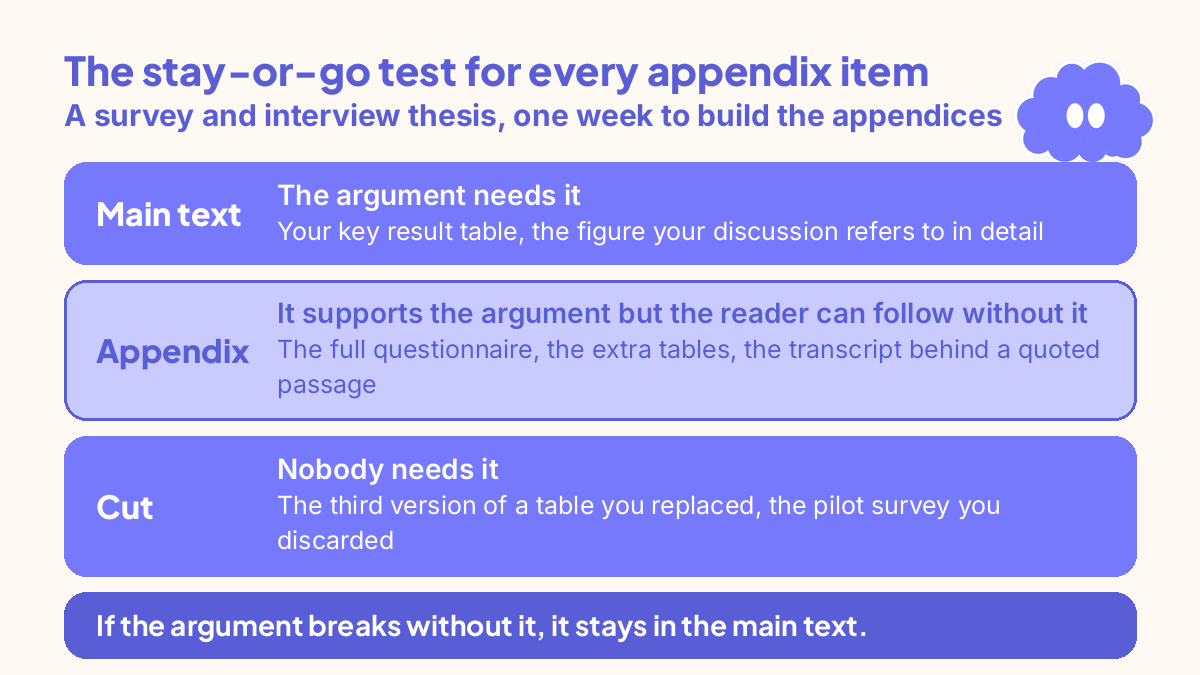
Now test each item with one question: if I remove this, can the reader still follow my argument? If no, it stays in the main text, however long it is. If yes, it can go in an appendix. Scribbr puts it as a rule of thumb: any detailed information not immediately needed to make your point can go in an appendix, and the reader must be able to understand the argument without the appendices.
Work through the list with three labels. “Main text” means the argument needs it: your key result table, the figure your discussion refers to in detail, the definition your analysis depends on. “Appendix” means it supports the argument but the reader can follow without it: the full questionnaire, the extra tables, the transcript behind a quoted passage. “Cut” means nobody needs it: the third version of a table you replaced, the pilot survey you discarded, the raw data for an analysis you dropped. Be strict with the cut label: an appendix stuffed with material nobody asked for does not make a thesis look thorough, it makes it look unfinished.
Step 3: Sort what is left into one appendix per job
Group the surviving items by the job they do, and give each job one appendix. A questionnaire and an interview guide are two jobs: one shows what you asked on paper, the other shows what you asked in conversation. Twenty interview transcripts are one job: they are the evidence behind the quoted passages, and they belong together in one appendix, numbered inside it.
The common mistake is one appendix per item: a thesis with Appendix A for one transcript, Appendix B for the next, and Appendix C for the next has twenty appendices doing one job. The other mistake is one giant appendix for everything. One appendix per job sits between the two. Write a one-line purpose for each appendix before you build it: “Appendix A: the questionnaire, so the reader can see exactly what respondents were asked.” If you cannot write the purpose in one line, the appendix is doing two jobs and should be split. Keep the items inside each appendix in the order the reader will meet them, and number them from 1, restarting in each new appendix.
Step 4: Label and title each appendix so a stranger can find it in ten seconds
Every appendix starts on a new page. At the top, give it a letter and a clear title, in the same style as your chapter headings: Appendix A, then the title on the next line, for example “Appendix A: Survey questionnaire”. Use letters, not numbers, so appendix numbering is never confused with chapter numbering. If you have only one appendix, call it “Appendix”, with no letter.
The title must say what is inside it. “Appendix B: Interview transcripts” is a good title. “Appendix B: Additional material” is not, because it tells the reader nothing. Check your titles by reading the contents list on its own: if a stranger cannot tell what each appendix holds from the title alone, rewrite the title. Format each appendix the same way as the main text, with the same font, spacing, and heading style. Tables and figures inside an appendix get their own numbers, restarted at 1, with the appendix letter in front where your style guide asks for it, for example Table A1. If your university’s regulations specify the appendix format, they win, so check before you format, not after.
Step 5: Refer to every appendix from the main text, at the point where the reader needs it
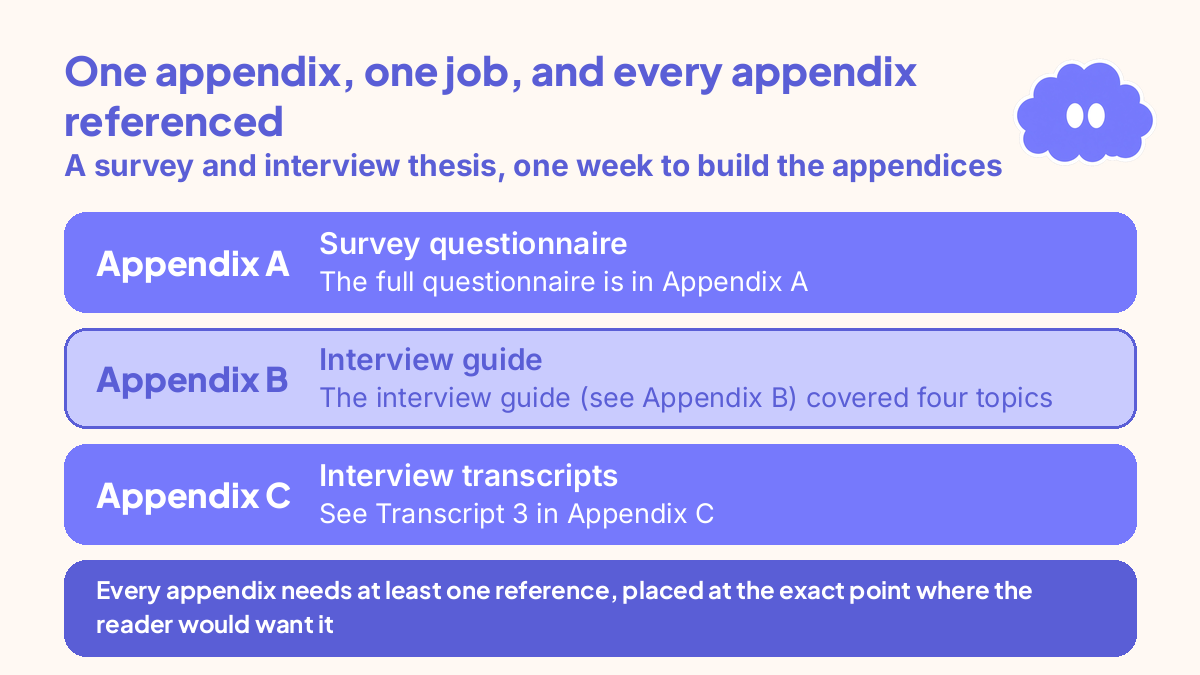
An appendix with no reference from the main text is an appendix nobody will open. Every appendix needs at least one reference, placed at the exact point where the reader would want it, in the sentence where the material is first mentioned. “The full questionnaire is in Appendix A” works. “The interview guide (see Appendix B) covered four topics” works. “For the full regression output, see Appendix C, Table 2” works, and points the reader to the exact table. The pattern is the same each time: name the appendix, and name the item inside it when there is more than one.
Check the references in both directions. First, read through the main text and list every appendix reference. Then check that every appendix appears on it. If an appendix has no reference, either add one where the material is first used, or cut the appendix. If a reference points to an appendix that does not exist, fix the letter. This two-direction check takes fifteen minutes and catches the most common appendix error: a reference to Appendix D in a thesis that only has three appendices.
Step 6: Check the whole set against your university’s regulations and your contents list
The last step is a compliance check, in three parts. First, the regulations: read your university’s thesis regulations on appendices and check four things: where appendices go, whether they count towards the word limit, whether there is a length cap, and whether any material must go elsewhere, such as data in a separate repository. Write the answers down.
Second, the contents list: every appendix must appear in your table of contents, with its letter, its title, and its starting page number. Update it after the appendices are final, not before, because page numbers shift. Third, the supervisor check: send your supervisor the appendix list, with the one-line purpose of each appendix, before you write the appendices in full. Supervisors know what examiners in your field expect to see, and they can spot in five minutes what you would spend a week building wrongly. How to handle supervisor feedback on a thesis works here too: bring the list, not the finished pages, so the feedback comes while changes are still cheap.
A worked example: a survey and interview thesis, one week to build the appendices
Your situation: Second-year masters student, thesis on how new teachers plan their first term. You ran a survey with 60 teachers and interviewed 8 of them. The main text is written. You have one week before you send the full draft to your supervisor, and the appendix does not exist yet.
- Monday: Make the list, then run the stay-or-go test. The questionnaire, the interview guide, the transcripts, the extra tables, and the ethics letter go to the appendix. The pilot questionnaire is cut, and the raw survey data goes to your university’s data repository instead.
- Tuesday: Sort into jobs. Appendix A: survey questionnaire. Appendix B: interview guide. Appendix C: interview transcripts. Appendix D: extra tables. Appendix E: ethics approval letter, with the consent form inside it.
- Wednesday: Build Appendix A and B. Each starts on a new page, letter and title at the top, same font and spacing as the main text. The questionnaire is reproduced exactly as respondents saw it.
- Thursday: Build Appendix C. The 8 transcripts go in interview order, numbered Transcript 1 to Transcript 8, each starting with the date, the length, and the pseudonym used in the main text.
- Friday: Build Appendix D and E. The 4 extra tables are numbered Table D1 to D4, each with a title. The ethics letter and consent form go in Appendix E.
- Saturday: Write the references into the main text. “The full questionnaire is in Appendix A.” “The interview guide (see Appendix B) covered four topics.” “See Transcript 3 in Appendix C.” “The full output is in Appendix D, Table D2.”
- Sunday: Run the compliance check. Your regulations put appendices after the references and exclude them from the word count. You regenerate the contents list, check all five appendices appear, and send your supervisor the list. She replies that Appendix D should be two tables, not four, because two of them duplicate the main text. You cut them on Monday morning.
The week produced five appendices, each with one job, each referenced from the main text, and one cut that saved the examiner wading through two duplicate tables. The supervisor check caught the duplication before the draft went to the examiner, which is exactly when it is cheapest to fix.
When it goes wrong
Your appendix is longer than your main text. This usually means the argument is in the wrong place. Go back to the stay-or-go test: if a table is discussed for three pages in the results chapter, it belongs in the main text.
You hid a key result in the appendix to dodge the word limit. Do not do this. Examiners read the appendix, and they notice when the main text gestures at a result it never shows. If the result matters, it belongs in the main text. How to write a thesis conclusion makes the same point from the other end: a conclusion cannot claim what the main text never showed.
Every appendix is called “Additional material”. Retitle them by what they hold: a contents list is a map, and “Additional material” five times is a map with no labels.
You referenced Appendix D, but there are only three appendices. This happens when an appendix is cut late and the references are not updated. After any cut, search the whole document for “Appendix” and check every reference against the current list. It takes five minutes with a find function.
Weekly review checklist
- Is my appendix list complete, with every candidate item on it?
- Has every item passed the stay-or-go test, with the argument surviving without the appendix?
- Does each appendix do one job, with a one-line purpose I can state?
- Does each appendix have a letter and a title that says what it holds?
- Is every appendix referenced from the main text at the point where the reader needs it?
- Does the contents list show every appendix with the right page number, and do the regulations agree with where I put them?
Downloadable infographic spec: one vertical image, title “How to write a thesis appendix”, with the six steps from “The system in short” and the six review questions above, in Thynq cream, Cloud Purple, Dark Purple and pink, with the Cloud mascot. Text taken word-for-word from this article.
What this system is not
It is not a way to hide weak material where the examiner will not look, because examiners do look, and a weak appendix damages a thesis just as a weak chapter does. It is not a substitute for the word limit: moving argument into an appendix to dodge the count is the kind of trick that gets noticed, and in some universities it breaks the regulations. It does not replace your university’s rules, which override every general guide including this one. And it is not a formatting system: the layout of your thesis is a separate job from deciding what goes in the appendix.
Sources
- George, T., & Dingemanse, K. (2023, July 18). Research Paper Appendix: Example and Templates. Scribbr. The rule that the reader must be able to understand the argument without the appendices, and the practice of labelling each appendix with a letter and a clear title.
- University of Nebraska at Omaha, Office of Graduate Studies. Thesis and Dissertation Support. The placement of appendices after the references, starting each appendix on a new page, and the alphabetical labelling of appendices.
- Roediger, H. L., & Karpicke, J. D. (2006). Test-enhanced learning. Psychological Science, 17(3), 249-255. Testing from memory beats rereading, which supports checking references by reading the main text without the appendices open.
For the wider thesis system behind this one, start with How to build a study system that fits your life.
Questions
What belongs in a thesis appendix?
Anything that supports your argument but is not needed to follow it: the survey questions, interview transcripts, raw data, extra tables, ethics approval, and code. If the reader must see it to understand your claim, it belongs in the main text, not in an appendix.
How many appendices should a thesis have?
One per job, not one per item. A questionnaire and its interview transcripts are two jobs, so they get two appendices. Twenty separate appendices for twenty interview transcripts is one job split into twenty pieces, and that is harder to navigate than one appendix with twenty transcripts inside it.
Do appendices count towards the word limit?
It depends on your university, and you must check. Some universities exclude appendices from the word count, some include them, and some cap how long they may be. Never assume appendices are free words, and never move main-text argument into an appendix to dodge the limit.
Does every appendix need to be mentioned in the main text?
Yes. Every appendix needs at least one reference from the main text, at the exact point where the reader would want it. An appendix nobody is pointed to will not be read, and an examiner may reasonably ask why it is there at all.