
The direct answer
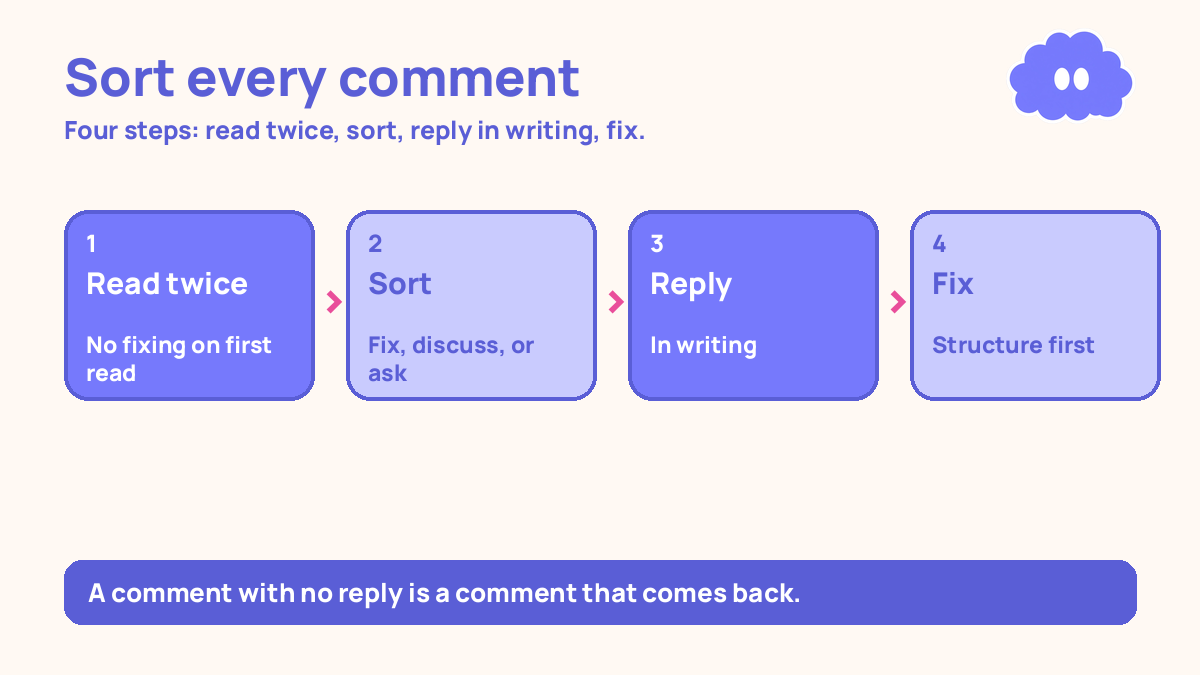
Handle supervisor feedback in four steps: read it twice without fixing anything, sort every comment into fix, discuss, or ask, reply to each comment in writing so your supervisor can see what you did, and fix the work before your next meeting. Feedback is not a verdict on you. It is a list of jobs.
You send a chapter you worked on for three weeks. The reply comes back covered in comments, and your stomach drops. The first read feels like a rejection. It is not. It is your supervisor doing their job: reading closely, and telling you what to change before an examiner does.
Many students do one of two things: they fix nothing for two weeks because the comments feel too big, or they fix everything in a panic without understanding what was asked. Both waste the feedback.
The system in short
- Read the feedback once, without fixing anything. Then read it again.
- Sort every comment into three piles: fix, discuss, or ask.
- Reply to each comment in writing, saying what you did or will do.
- Fix the “fix” pile first, starting with the biggest structural comments.
- Bring the “discuss” and “ask” piles to your next meeting, with your reasons ready.
- Send the revised chapter back with a short note saying what changed.
Step 1: Read it twice before you fix anything
Do not open the document and start fixing on the first read. The first read is emotional. You will see the red marks before you see the meaning, and you will either agree with everything or disagree with everything. Neither is useful.
Read the feedback once, all the way through, without touching the thesis. Then close it and do something else for an hour. Then read it a second time, slowly, with a notebook beside you. On the second read, the comments stop feeling personal and start looking like jobs.
Write down, in your own words, what your supervisor is asking for overall. Not each comment — the overall message. “The argument is there, but the structure hides it” is an overall message. If you cannot state the overall message in one sentence, read the feedback a third time. The overall message tells you which comments matter most.
Step 2: Sort every comment into fix, discuss, or ask
Go through the comments one by one, and put each into one of three piles.
Fix. The comment is clear, and you agree. “This paragraph repeats the last one.” “This citation is wrong.” “Move this section to chapter three.” These are jobs. Write them on a list and do them. Most comments belong here, and most of them are small.
Discuss. The comment is clear, but you disagree, or you think there is a better fix. “Cut this section” when you think the section is needed. Do not fix these yet. Write down your reason, with evidence, and bring it to the meeting. Supervisors expect disagreement on some points. What they do not accept is a comment left unanswered.
Ask. The comment is unclear. “Unclear.” “Why?” “Expand.” You cannot fix what you do not understand, and guessing wastes a week. Write down exactly what confuses you, and ask at the meeting. Asking is not a weakness.
Count the piles when you are done. If the “fix” pile is twenty items, the work is a few days. If the “discuss” pile is twenty items, the chapter needs a conversation before it needs fixing.
Step 3: Reply to every comment in writing
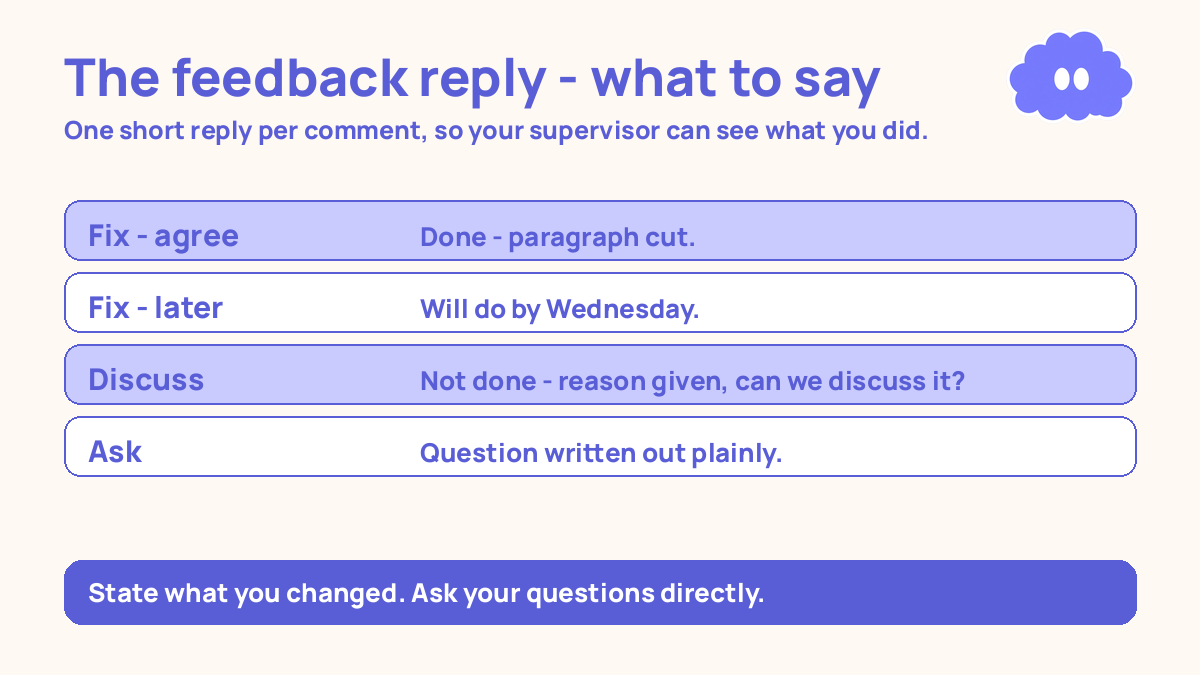
Your supervisor cannot tell what you did unless you say so. Reply to the feedback in writing, comment by comment. A short reply is enough: “Done — paragraph cut.” “Done — citation fixed.” “Not done — this section answers the second research question. Can we discuss it?”
This written reply does three things. First, it shows your supervisor you read every comment, including the ones you disagreed with. Second, it creates a record, so neither of you has to remember what was agreed. Third, it forces you to decide on every comment instead of quietly skipping the hard ones.
Keep the tone plain and professional. State what you changed, and ask your questions directly. Do not apologise for the draft, and do not defend every choice.
Feedback matters, and not just as a judgement. In a 2014 meta-analysis of the testing effect, Rowland found that testing yourself beat restudying by a medium amount (g = 0.50), and that feedback mattered: with feedback the effect was larger (g = 0.73) than without it (g = 0.39). Feedback is the part that makes the work better — but only if you use it and show that you used it.
Step 4: Fix the structural comments first
Start with the biggest comments, not the smallest. If your supervisor says the chapter’s structure is wrong, fix the structure before you fix the sentences. Rewriting a paragraph that is about to be moved is wasted work.
Work in this order: structure, then argument, then sentences, then small fixes. Move sections, cut repeated paragraphs, and add the linking sentences that make the argument flow. Then fix the argument: does each claim have evidence? Then fix the sentences, then the small things — citations, spelling, formatting.
Set a deadline for the fixes and tell your supervisor what it is. “I will send the revised chapter back on Friday” is a promise you can keep. Decide the start in advance with an if-then plan: “When I finish breakfast, I will fix the first three comments before I open anything else.” Research on if-then plans (Gollwitzer & Sheeran, 2006) found that naming the cue and the action in advance raised goal attainment by a medium-to-large amount (d = 0.65) across 94 studies.
Step 5: Bring questions to the meeting, and send the revision back
Prepare for the meeting with the supervisor meeting system: a short agenda, the fixed work, and your questions. The weekly review and supervisor meeting system covers how to prepare — what to send in advance, what to ask, and what to write down afterwards.
At the meeting, go through the “discuss” pile first. State your reason briefly, with evidence, and listen to the answer. If your supervisor agrees, the comment is closed. If they do not, fix it their way and note why. The thesis is yours, but the supervisor’s job is to make sure it passes, and their experience counts. Pick your battles: disagree where the evidence is on your side, and accept the rest.
Then go through the “ask” pile. Ask each question directly, write down the answer, and fix the comment that day, while the answer is fresh. A question answered in a meeting and fixed the same day never comes back.
After the meeting, send the revised chapter back with a short note: what changed, what you discussed, and what is still open. Then start the next chapter. Do not wait for a reply before you write again. Waiting for approval is how a thesis stalls.
If you are stuck on a chapter and the feedback is part of the block, the guide to getting unstuck on a thesis covers what to do when the work will not move. Feedback that sits unanswered for weeks is one of the most common ways students get stuck.
A worked example: one chapter, 14 comments, one week
Your supervisor returns chapter two with 14 comments. Here is the week.
Monday, 10:00–11:00: You read the feedback twice and write the overall message in one sentence: “The evidence is there, but the structure hides the argument.” You sort the comments: 9 fix, 3 discuss, 2 ask.
Monday, 11:00–12:00: You reply in writing to all 14 comments. The 9 fix comments get “Done” or “Will do by Wednesday”. The 3 discuss comments get your reason and a request to talk. The 2 ask comments get your question.
Tuesday–Wednesday: You fix the 9. Biggest first: you move one section to chapter three, cut two repeated paragraphs, and add three linking sentences. Then you fix the citations and the spelling. By Wednesday evening, the “fix” pile is empty.
Thursday, 2:00–3:00: Meeting. You discuss the 3 disagreements. Your supervisor agrees with one and disagrees with two. You fix them that evening. You ask the 2 unclear questions, write down the answers, and fix those comments the same day.
Friday, 10:00: You send the revised chapter back with a short note: what changed, what you discussed, and what is still open. The chapter is done, and you start chapter three on Monday.
When it goes wrong
You have not replied for three weeks. The feedback feels too big, so you avoid it. Open it, read it twice, and sort the comments. Sorting takes an hour, and after an hour you have a list of jobs instead of a feeling. Start with the smallest fix on the list. One fixed comment breaks the avoidance.
Every comment feels like an attack. Read it a third time, and read only the verbs: cut, move, add, explain, fix. Verbs are jobs, not judgements. If a comment is genuinely harsh, it is still a job. Do the job, and judge the tone later — or never. The thesis is what gets examined, not the tone of the feedback.
You fixed everything, and the next draft comes back with new comments. That is normal. A thesis goes through rounds, and each round finds smaller problems. The first round is structure. The second is argument. The third is sentences. If the comments are getting smaller, the thesis is getting better.
You disagreed with everything and fixed nothing. Your supervisor will notice, and the next meeting will be harder. Go back through the comments and sort them honestly. Some of them are right. Fix those first, and bring the rest to the meeting with reasons. Disagreement with evidence is respected. Silence is not.
Weekly review checklist
Copy this list and use it each week you receive feedback:
- Did I read the feedback twice before fixing anything?
- Can I state the overall message in one sentence?
- Did I sort every comment into fix, discuss, or ask?
- Did I reply to every comment in writing?
- Did I fix the structural comments before the sentences?
- Did I bring the discuss and ask piles to the meeting, with reasons ready?
- Did I send the revised chapter back with a short note on what changed?
Downloadable infographic spec: one vertical image, title “Read, sort, reply, fix”, with the four steps — read twice, sort into fix, discuss, ask, reply in writing, fix before the next meeting — in Thynq cream, Cloud Purple, Dark Purple and pink, with the cloud mascot. Text taken word-for-word from this article.
What this system is not
It is not a promise that your supervisor will always be right, and it is not a claim that you must agree with every comment. It is a practical routine for turning feedback into work: read twice, sort, reply, fix. If your supervisor wants feedback handled differently — a meeting first, or a tracked-changes document — follow their way. The system survives either change, because the system is sorting every comment and answering each one, not a particular format.
Sources
- Rowland, C. A. (2014). The effect of testing versus restudy on retention: a meta-analytic review of the testing effect. Psychological Bulletin, 140(6), 1432–1463. Testing beat restudy by a medium amount (g = 0.50); with feedback the effect was larger (g = 0.73) than without it (g = 0.39).
- Gollwitzer, P. M. & Sheeran, P. (2006). Implementation intentions and goal achievement: a meta-analysis of effects and processes. Advances in Experimental Social Psychology, 38, 69–119. If-then plans raised goal attainment by a medium-to-large amount (d = 0.65) across 94 studies.
For the wider system this routine sits inside, see the thesis writing system that keeps moving, for preparing the meeting itself, see the weekly review and supervisor meeting system, and if the feedback has left you stuck, see how to get unstuck on a thesis.
Questions
How soon should I reply to supervisor feedback?
Within a week, even if the reply is only to say you have read it and when the fixes will be done. Silence looks like you ignored it. A short reply keeps the work moving.
What if I disagree with a comment?
Say so, with a reason and evidence, not with silence. Supervisors expect disagreement on some points. What they do not accept is a comment left unanswered, because then they cannot tell if you saw it.
What if the feedback is only negative?
Read it twice. The first read feels personal; the second read shows what to fix. Most feedback is about the work, not about you. Sort it into fix, discuss, or ask, and start with the fixes.
Should I fix everything before the next meeting?
Fix what you can, and bring a list of what you could not fix and why. A meeting where you show fixed work and honest questions is far better than a meeting where you say you have not started.