
The direct answer
Keep a research diary in ten minutes a day: five lines per entry, written at the end of each work session, in one place, dated, and reviewed every week. The diary holds the thinking behind your thesis, so you can find it again when you write.
A thesis takes months, and months are long enough to forget. You will forget why you chose one method over another, what your supervisor said in March, why you dropped an idea that now looks good again, and where the question that became your third chapter first appeared. The diary is the fix: a daily record of decisions, questions, and next steps, written while they are fresh, in one place you can search. The system below gives you the five-line entry, the weekly review that turns notes into chapters, and the rules that keep the diary useful instead of becoming another pile of notes.
The system in short
- Keep the diary in one place, paper or digital, and use it every work session without exception.
- Write five lines per entry: date, what you did, one decision, one question, and the next step.
- Write at the end of the session, for ten minutes, before you close the books.
- Tag each entry with its chapter and one keyword, so you can find it again in seconds.
- Review the diary for 30 minutes every week, and turn the week’s entries into chapter notes.
- Review monthly for 15 minutes: what the diary says about your progress, and what it says about your argument.
Step 1: Keep the diary in one place, paper or digital
Pick one place and stay with it for the whole thesis. A bound notebook, a single document, or a notes app with one note per entry, it does not matter which, as long as it is one place and you can search it. A diary spread across loose sheets, chat messages, and three apps is not a diary. It is a pile, and a pile cannot be searched when you need it.
If you choose paper, number the pages and keep an index at the front: date, one-line summary, page number. If you choose digital, keep every entry in one document, with the date at the top of each entry. Ask your supervisor first if your field has a rule: some labs require a bound notebook. If the choice is yours, test both for one week and keep the one you reached for without thinking.
Never keep the diary in a chat app or on loose sheets. Messages get deleted, loose sheets get lost, and an entry you cannot find when you write the chapter is an entry that never existed. For the files behind the diary, How to organise your thesis research data covers folders, naming, versions, and backups. The diary is different: it explains the decisions, and the files hold the evidence.
Step 2: Write five lines per entry
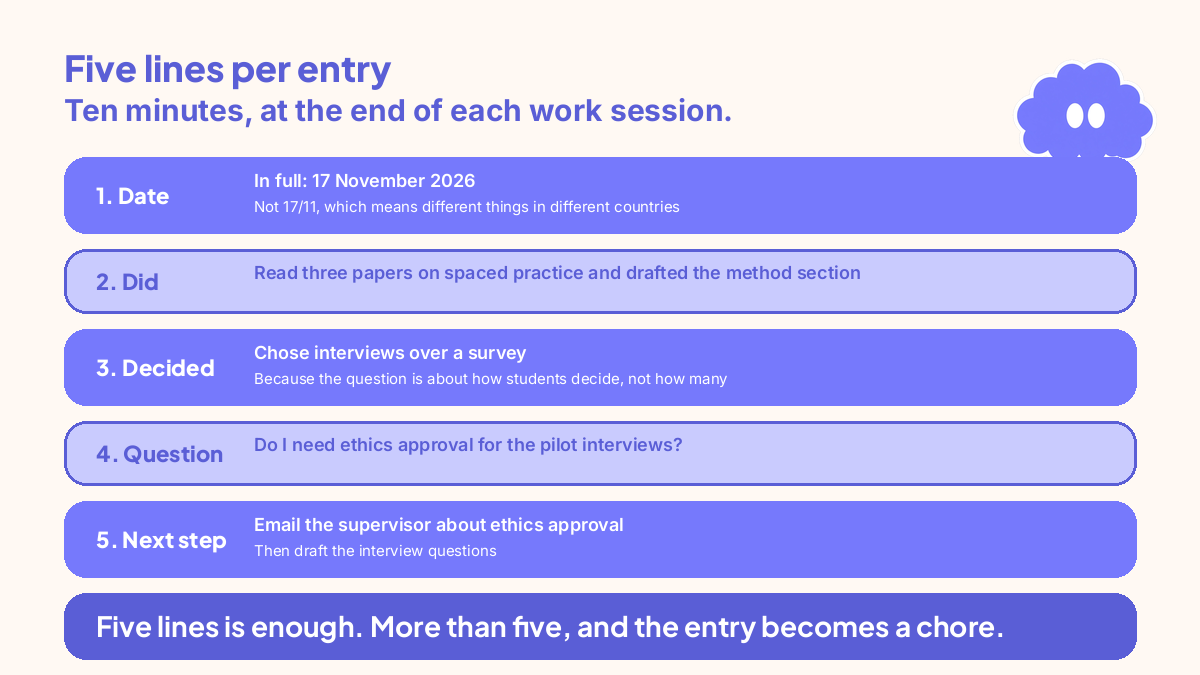
Every entry has five lines, in the same order, every time. First, the date, in full: 17 November 2026, not 17/11, which means different things in different countries. Second, what you did, in one line: “Read three papers on spaced practice and drafted the method section.” Third, one decision, and why: “Chose interviews over a survey, because the question is about how students decide, not how many.” Fourth, one question you could not answer: “Do I need ethics approval for the pilot interviews?” Fifth, the next step: “Email the supervisor about ethics approval, then draft the interview questions.”
Five lines is enough. More than five, and the entry becomes a chore. Less than five, and the diary loses the parts that matter: the decision and the question are the lines you will need in six months. Write in short sentences, in your own words. The diary is for you, not for an examiner.
Write down dead ends too. “Tried the Smith framework, does not fit the data, dropping it” is one of the most useful entries a diary can hold, because it stops you trying the same framework again in three months. A diary that only records successes is a diary that lies by omission.
Step 3: Write at the end of the session, for ten minutes
Write the entry at the end of each work session, before you close the books, and take ten minutes over it. Not the next morning, when the decision has faded, and not at the end of the week, when five sessions have blurred into one. Ten minutes, at the end of the session, while the thinking is still fresh.
On days when you did no thesis work, write one line: the date, and “No thesis work today, work deadline.” That line matters, because it tells the future you that the gap was a decision, not a mystery. A diary with gaps and no explanation is a diary that cannot be trusted, and a diary you cannot trust is a diary you stop reading.
Step 4: Tag each entry with its chapter and one keyword
At the end of each entry, add two tags: the chapter it belongs to, and one keyword. “Methodology, interviews” or “Literature review, spaced practice” or “Results, survey data”. Two tags, no more, because a tagging system with ten tags per entry is a system nobody maintains.
The tags are what make the diary useful when you write. When you sit down to write the methodology chapter, you search for “Methodology” and you have every decision, question, and dead end about the method, in date order, in one place. Without tags, you would have to read the whole diary, and nobody reads a whole diary when a chapter is due. With tags, the diary becomes a set of chapter notes that wrote themselves over months.
If you use paper, write the tags in the margin, and keep a running list of the keywords you have used, so you do not invent a new keyword for the same idea every week. “Interviews” and “interview” are the same tag, and a diary that uses both will split your notes in two. Pick one spelling and stick to it.
Step 5: Review the diary for 30 minutes every week
Once a week, spend 30 minutes reading the week’s entries and turning them into chapter notes. Read the five or six entries, then write a short summary for each chapter the week touched: what changed, what was decided, what is still open, and what the next week must do. Move the open questions into a single list, and cross off the ones you answered.
This weekly review is where the diary pays for itself. The daily entries capture the thinking. The weekly review organises it. Without the review, the diary is a pile of dated notes. With it, the diary becomes the outline of the thesis, built week by week, in your own words. When you sit down to write a chapter, you do not start from a blank page. You start from the weekly summaries, which already hold the decisions and the order they were made in.
Bring the week’s open questions to your supervisor meeting, or to your next progress report. A question that has sat in the diary for three weeks is a question that needs asking, and the diary is what stops it from sitting there for three months. When the feedback comes back, How to handle supervisor feedback on a thesis shows how to turn it into a revision plan. If you need the meeting rhythm to go with it, the thesis weekly review and supervisor meeting system pairs the weekly review with the supervisor meeting in one routine.
Step 6: Review monthly for 15 minutes
Once a month, spend 15 minutes reading the month’s weekly summaries and asking three questions. First, what does the diary say about your progress: are the chapters moving, or are the entries mostly reading and planning? Second, what does it say about your argument: is the question getting sharper, or is it drifting? Third, what patterns do you see: the same question appearing three times, the same dead end tried twice, the same decision postponed?
Write the answers in a few lines at the front of the diary. That monthly note is the record of how the thesis is really going. If the diary says you have spent a month reading without writing, that is a fact, and the fix is a writing week, not more reading.
A worked example: a diary that writes the methodology chapter
Your situation: Master’s student, thesis on study habits, interviews as the method. You start the diary on 17 November, when the method is still undecided.
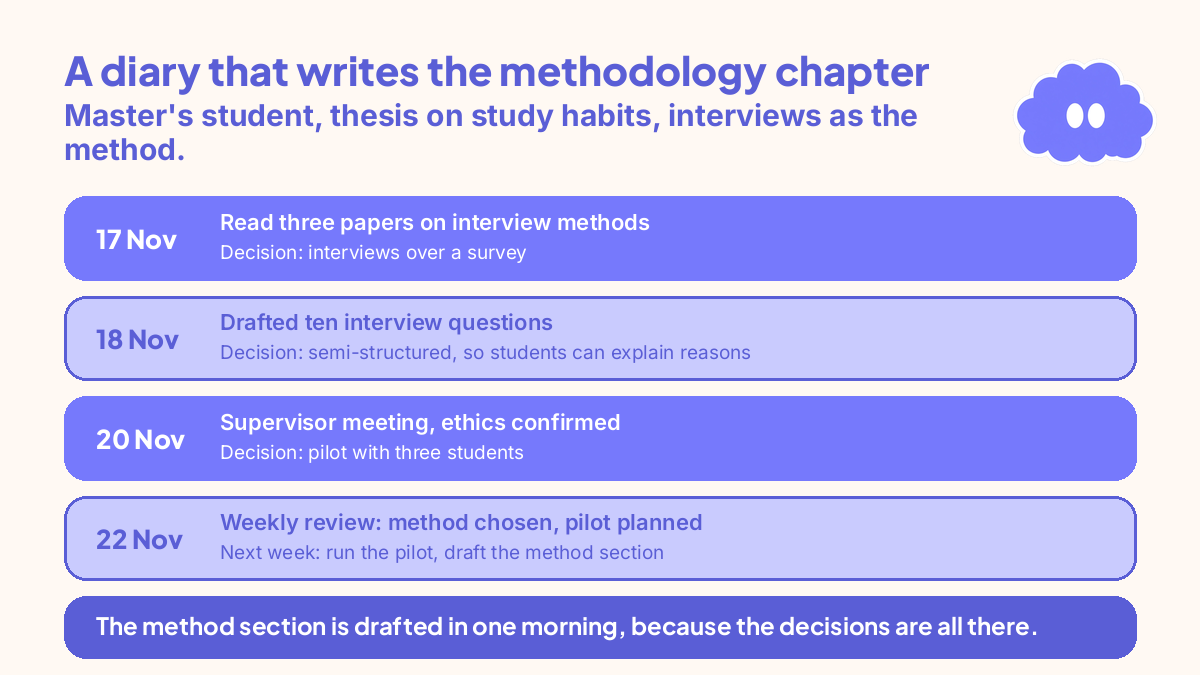
- 17 November: Did: read three papers on interview methods. Decision: interviews over a survey, because the question is about how students decide, not how many. Question: do I need ethics approval for pilot interviews? Next step: email the supervisor about ethics. Tags: Methodology, interviews.
- 18 November: Did: drafted ten interview questions. Decision: semi-structured, not structured, so students can explain their reasons. Question: how many students is enough? Next step: read the sampling section of one paper. Tags: Methodology, interviews.
- 20 November: Did: supervisor meeting, ethics confirmed for the pilot. Decision: pilot with three students, then revise the questions. Question: none. Next step: recruit three pilot students. Tags: Methodology, ethics.
- Weekly review, 22 November: Summary for the methodology chapter: method chosen, pilot planned, ethics confirmed. Open questions: sample size. Next week: run the pilot and draft the method section from the diary entries.
- A month later: The diary holds 14 entries tagged Methodology. The method section is drafted in one morning, because the decisions are all there: why interviews, why semi-structured, why three pilot students, and what changed after the pilot. No re-reading, no guessing, no lost reasons.
When it goes wrong
You keep forgetting to write the entry. Tie it to the end of the session: the entry is the last thing you do before you close the books, like putting the books away. If you still forget, set a daily alarm for the time your session usually ends. A diary with gaps is still useful, but a diary with a gap every day is not a diary.
The entries get longer and longer until writing them feels like work. Cut back to the five lines. The diary is not a second thesis. If an entry needs more than five lines, write the five lines, then write the extra thinking on a separate page and tag it. The entry stays short, and the thinking still gets kept.
You cannot find an entry when you need it. That means the tags failed, not the diary. Check the tags: are you using the same keyword every time, and the same chapter names? Fix the tags going forward, and add a one-line index at the front of the diary for the entries that matter most. Do not rewrite the whole diary. Fix the system and move on.
The diary says the same question has appeared four times and you still have no answer. That is the diary doing its job. The question is stuck, and the fix is to ask someone: your supervisor, a fellow student, or a librarian. A question that has been in the diary for a month is a question that needs a conversation, not another week of thinking alone.
Weekly review checklist
- Did you write an entry at the end of every work session this week?
- Does each entry have all five lines, especially the decision and the question?
- Are the entries tagged with a chapter and one keyword, using the same spellings?
- Did the 30-minute weekly review happen, and did it produce chapter notes?
- Which open questions have been in the diary for more than two weeks, and who will you ask?
- What does the diary say about your argument: sharper, drifting, or stuck?
Downloadable infographic spec: one vertical image, title “How to keep a research diary for your thesis”, with the six steps from “The system in short” and the six review questions above, in Thynq cream, Cloud Purple, Dark Purple and pink, with the Cloud mascot. Text taken word-for-word from this article.
What this system is not
It is not a lab notebook, and it does not replace one if your field requires it. A lab notebook records what happened in the lab, with dates and corrections, so the work can be checked. A diary records what you thought about the work, so the argument can be found again. It is not a folder system, and it does not replace organising your files. It is not a thesis draft, and copying whole paragraphs into it will only make the diary harder to search. What it is, is smaller and more useful: ten minutes a day, five lines, and a weekly review that turns scattered thinking into chapters.
Sources
- OCAD University Library. Using research diaries. Read November 2026. Research diaries track progress, organise findings, and record reflection, with date, source, summary, reflection, and next steps for each entry.
- University of Toledo Libraries. Keeping a research log for your scholarly project. Read November 2026. A research log keeps thoughts, ideas, and questions in one place, dated, and used often, so nothing is lost across a long project.
- American Mathematical Society Blogs. Do you have a research journal? Read November 2026. A journal holds open questions, ideas, and references, and reading it every few weeks reveals connections between entries.
For the files behind the diary, read How to organise your thesis research data. For the references the diary points to, read How to manage references for a thesis.
Questions
What is a research diary for a thesis?
A research diary is a dated, daily log of what you did, what you decided, and what you are still unsure about. It is not a lab notebook and not a folder of files. It is the thinking behind the thesis, written down while it is fresh, so you can find it again when you write.
How much time does a research diary take each day?
Ten minutes, at the end of each work session. Five lines are enough: the date, what you did, one decision, one question, and the next step. A diary that takes ten minutes gets kept. A diary that takes an hour gets abandoned in the first month.
What should I write in a thesis research diary?
Write what you did, the decision you made and why, the question you could not answer, and the next step. Add ideas, dead ends, and supervisor comments. Do not copy in whole paragraphs from papers or your thesis draft; the diary holds thinking, not text.
How is a research diary different from organising my research data?
Organising data is about files: folders, names, versions, and backups. A diary is about thinking: why you chose this method, why you dropped that idea, what your supervisor said, and what confused you. The diary explains the decisions; the files hold the evidence.