The direct answer
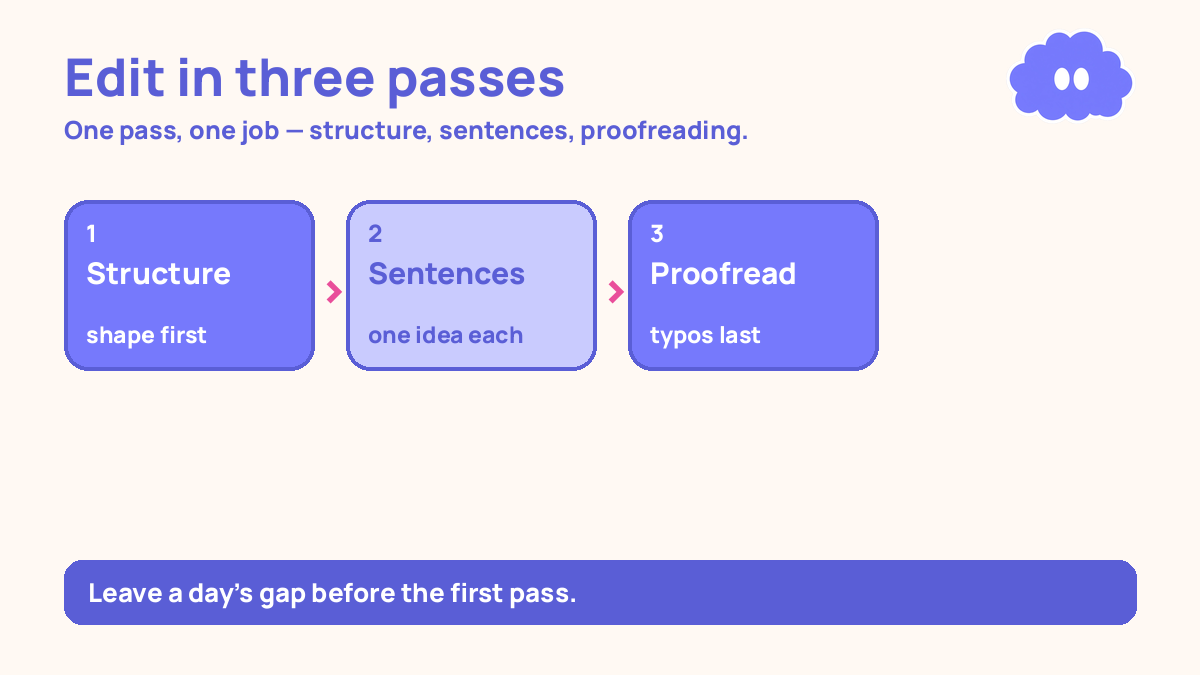
Edit a thesis in three separate passes: structure first, sentences second, proofreading last. The structure pass asks whether each chapter does its job, in the right order. The sentence pass cuts and clarifies. The proofreading pass catches typos, numbers, and references. Leave a gap between passes — a day if you can — and never try to do all three at once. A pass that looks for everything finds nothing well.
You have written the thesis. Every chapter exists, the words are on the page, and now you have to make it good. The temptation is to start at page one and fix everything as you go: the argument, the sentences, the commas, all in one read. That is how most students edit, and it is why most theses still have structural problems on submission day.
Editing works when each pass has one job. You read the whole thesis three times, and each time you look for one kind of problem only. It feels slower. It is faster, because you stop fixing sentences in paragraphs you later cut.
The system in short
- Leave the draft alone for at least a day before the first pass.
- Pass one, structure: does each chapter do its job, in the right order, with nothing missing?
- Pass two, sentences: one idea per paragraph, plain words, cut every sentence the chapter does not need.
- Pass three, proofreading: typos, numbers, references, figures, and formatting — read aloud.
- Get a reader for the structure pass and the proofreading pass, not just for the sentences.
- Stop when a full pass finds only tiny changes.
Step 1: Leave the draft alone first
Do not edit the day you finish writing. Leave the draft alone for at least a day — two if you can. You need the gap, because you cannot see the problems in a text you wrote yesterday. You remember what you meant to say, so you read what you meant instead of what is on the page.
The gap is not wasted time. Cepeda and colleagues found in 2006 that spaced practice beat massed practice, and the optimal gap grows with how long you need to remember the material. The same is true of seeing your own writing: a chapter read after a gap is a chapter you actually see. A chapter read the morning after you wrote it is a chapter you glide past, filling in the gaps from memory.
Use the gap for something else: sleep, rest, or the practical jobs — printing, checking the submission rules, or the reference list. Diekelmann and Born found in a 2010 review that sleep improves the consolidation of what was learned. A night’s sleep before the first editing pass is part of the system, not a luxury.
Step 2: Pass one — structure
Read the whole thesis once, looking only at structure. Does each chapter do its job? Does the introduction state the question and the gap? Does the methodology describe what you did? Do the results report what you found? Does the discussion argue what it means? Does the conclusion answer the question?
Work from the chapter headings. Write one line per chapter saying what it does. Then check the lines against the thesis: does the chapter do what the line says? If a chapter does two jobs, split it. If two chapters do the same job, merge them. If a section serves no question, cut it or move it to an appendix.
Step 3: Pass two — sentences
Now read for sentences. One idea per paragraph. If a paragraph holds two ideas, split it. If a paragraph holds no idea — if it only repeats the last one — cut it. Read the first sentence of each paragraph in order, down the page. They should tell the story of the chapter.
Cut plainly. A sentence the chapter does not need is a sentence to remove, however well written it is. Cut the throat-clearing at the start of paragraphs. Say the thing, and stop.
Use plain words. If a simpler word says the same thing, use it. If a sentence runs longer than three lines, split it. Long sentences hide unclear thinking.
Get a reader for this pass if you can. Rowland found in a 2014 meta-analysis of 61 studies that testing beat restudying by a medium amount (g = 0.50), and that feedback mattered: with feedback the effect was larger (g = 0.73) than without it (g = 0.39). A reader who does not know your thesis will trip over the sentences you glide past.
Step 4: Pass three — proofreading
Proofread last, when the structure and the sentences are settled. Proofreading a chapter you are still rewriting is wasted work, because the words will change. Read the whole thesis aloud, start to finish. Your ear catches what your eye misses: the repeated word, the missing word, the sentence that stops halfway.
Check the numbers three ways: table against text, text against data, data against the methodology. Check every reference: is it in the text and in the list, spelled the same way in both? Check every figure for its number, title, and caption, and check the contents page against the chapter headings.
Read the thesis in a different order for the last check: backwards, chapter by chapter, or from the end. A familiar text is a text your brain completes for you. An unfamiliar order breaks the habit, and the typos show themselves. Proofread when you are fresh, not at the end of a long day.
If a chapter has a word limit, paste it into the essay word counter after each pass. It shows the count against your target with the usual 10% band marked, so you can see whether the cutting is working.
Step 5: Get a reader, and use them properly
Get a reader for the structure pass and the proofreading pass, not just for the sentences. Most students ask a friend to “read my thesis” and get back a list of typos. That is the least useful feedback. Tell the reader what to look for, and when.
For the structure pass, ask three questions: what is my research question, what did I find, and what is left? If the reader cannot answer from the thesis, the structure has failed, and you know exactly where to fix it.
Thank the reader, and fix what they found before you ask anyone else. Two readers in a row, each finding the same problems, is a waste of the second reader.
Step 6: Stop when the changes get tiny
Decide in advance when you will stop. The rule is simple: when a full pass finds only tiny changes, and the changes you make are smaller than the ones before, the thesis is done. A thesis is never perfect. It is finished when the remaining problems are small and you can name them.
Make the stopping rule a plan, not a feeling. Decide the cue and the action in advance. Gollwitzer and Sheeran found across 94 studies that if-then plans raised goal attainment by a medium-to-large amount (d = 0.65) over holding the goal alone. Write the plan as a sentence: “When the proofreading pass finds only typos, I will fix them, print the thesis, and stop.”
If you keep finding big problems on the third pass, the problem is that the structure pass did not do its job. Go back to pass one.
A worked example: one week, three passes
You have a week and a finished draft of about 60 pages. Your target is three passes, one per kind of problem, with a day of rest before you start.
| Day | Block | Job | Pages |
|---|---|---|---|
| Monday | Rest | No editing. Sleep, print the draft, check the submission rules | 0 |
| Tuesday | 3 × 50 minutes | Structure pass: one line per chapter, check each chapter’s job | 60 |
| Wednesday | 3 × 50 minutes | Sentence pass, chapters 1 to 3: one idea per paragraph, cut | 30 |
| Thursday | 3 × 50 minutes | Sentence pass, chapters 4 to 6: same job, same rules | 30 |
| Friday | 2 × 50 minutes | Proofreading pass: read aloud, check numbers and references | 60 |
Monday is a rest day. Do not edit. Print the draft, check the submission rules — word count, formatting, reference style — and sleep.
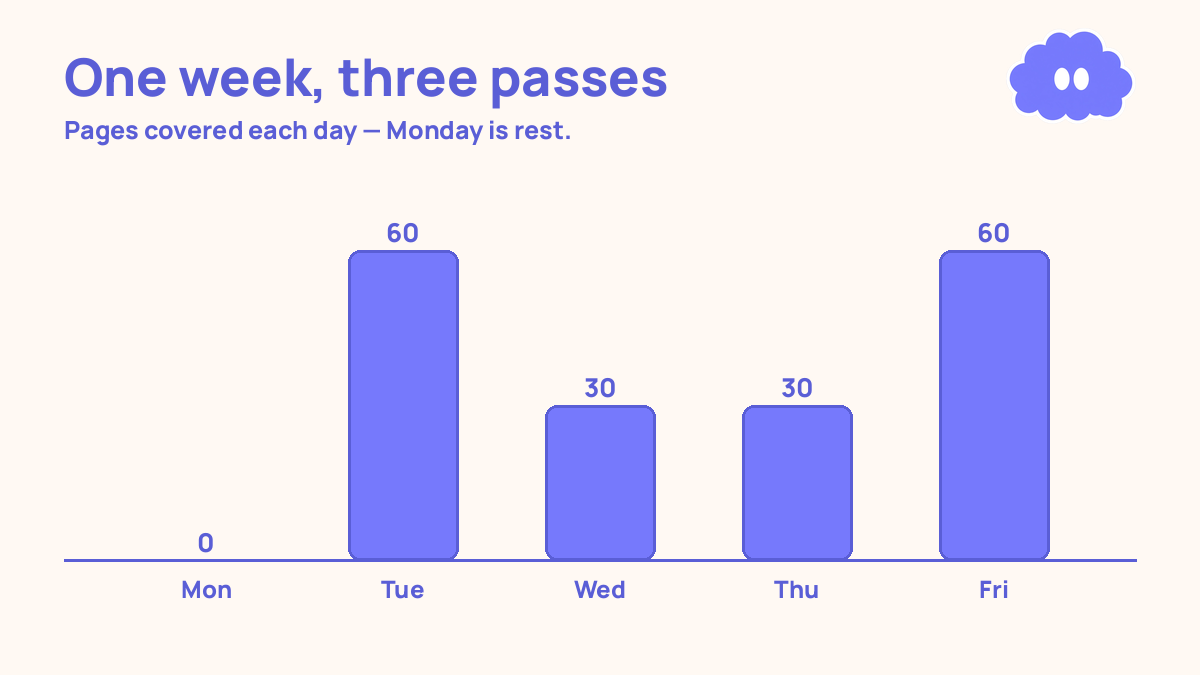
Tuesday is the structure pass. Three 50-minute blocks, with real breaks between them — a practical timer, not a prescription. The 25-minute Pomodoro length was Francesco Cirillo’s practical choice, not a number from cognitive science. Read the whole thesis once, looking only at structure.
Wednesday and Thursday are the sentence pass. Three blocks each day, half the thesis per day. One idea per paragraph, cut the throat-clearing, split the long sentences. Mark the typos you notice, but do not stop to fix them. They belong to Friday.
Friday is the proofreading pass. Two blocks, reading aloud, start to finish. Check the numbers three ways, check every reference, check the contents page against the headings. Then stop.
When it goes wrong
You edit everything at once. You start at page one, fixing the argument, the sentences, and the commas in one read. Split the work into three passes, each with one job. A pass that looks for everything finds nothing well.
You proofread a chapter you are still rewriting. You fix typos in paragraphs you later cut. Proofread last, when the structure and the sentences are settled. A typo fixed in a deleted paragraph is time you will never get back.
You skip the gap and edit the day you finish writing. You read what you meant instead of what is on the page. Leave the draft alone for at least a day. A chapter read after a gap is a chapter you actually see.
You keep polishing and never stop. The third pass finds big problems, so you do a fourth, then a fifth. Go back to pass one. Big problems on the third pass mean the structure pass did not do its job. Fix the structure, then run the passes again.
Weekly review checklist
Copy this list and use it each week while you edit:
- Has the draft rested for at least a day since I last wrote in it?
- Does each chapter do its job, in the right order, with nothing missing?
- Does each paragraph hold one idea, with the first sentences telling the chapter’s story?
- Are the numbers identical in the table, the text, and the methodology?
- Is every reference in the text and in the list, spelled the same way in both?
Downloadable infographic spec: one vertical image, title “Edit in three passes”, with the three passes — structure, sentences, proofreading — plus the rule “one pass, one job, with a day’s gap before you start”, in Thynq cream, Cloud Purple, Dark Purple and pink, with the cloud mascot. Text taken word-for-word from this article.
What this system is not
It is not a promise that three passes will make a thesis perfect, and it is not a substitute for a supervisor’s reading. It is a way to make sure the structure, the sentences, and the typos each get a proper look, in the right order, without wasted work. A well-edited thesis reads clearly. It cannot make weak results strong or a missing argument appear.
Sources
- Cepeda, N. J., et al. (2006). Psychological Bulletin, 132(3), 354-380. Spaced practice beat massed practice, and the optimal gap grows with how long you need to remember the material.
- Diekelmann, S., & Born, J. (2010). Nature Reviews Neuroscience, 11(2), 114-126. Sleep improves the consolidation of what was learned.
- Rowland, C. A. (2014). Psychological Bulletin, 140(6), 1432-1463. Testing beat restudying (g = 0.50); with feedback the effect was larger (g = 0.73) than without it (g = 0.39).
- Gollwitzer, P. M., & Sheeran, P. (2006). Advances in Experimental Social Psychology, 38, 69-119. If-then plans raised goal attainment (d = 0.65) across 94 studies.
- Cirillo, F. — Pomodoro Technique, late 1980s. The 25-minute length was Cirillo’s practical choice, not a number derived from cognitive science.
For the whole thesis, start with the thesis writing system that keeps moving. For the chapter this pass finishes, see how to write a thesis conclusion.
Questions
How many editing passes does a thesis need?
At least three, done separately: a structure pass, a sentence pass, and a proofreading pass. Each pass looks for one kind of problem. A single pass that tries to catch everything catches nothing well.
Should I edit on screen or on paper?
On paper for the structure pass, if you can print it. Paper shows the shape of the thesis in a way a screen does not. Sentences and proofreading work fine on screen, but read the whole chapter aloud either way.
What order should I edit the chapters in?
In thesis order, but do the structure pass on all chapters before the sentence pass on any of them. Fixing a sentence in a paragraph you later cut is wasted work. Structure first, sentences second, typos last.
When do I stop editing?
When a full pass finds only tiny changes, and the changes you make are smaller than the ones before. A thesis is never perfect. It is finished when the remaining problems are small and you can name them.