
The direct answer
How to write a coursework essay, on one to two hours a day, is to decode the brief, set a word budget, make a rough plan, research to a freeze date, draft the body first in timed blocks, then edit in separate passes. Capture references as you go, leave a gap before proofreading, and submit early.
Most guides on how to write a university essay list the same stages: analyse, research, plan, draft, edit. They leave out the calendar, the stopping rules, and the daily shape.
This system is for coursework only: days or weeks, sources open, references required. If your essay is timed and closed book, use the essay exam system instead. The essay writing process is not a straight line. You will loop back as your argument sharpens.
The system in short
- Decode the brief and set the word budget.
- Make a rough plan before you research.
- Research with a stop rule.
- Make the second plan, paragraph by paragraph.
- Draft the body first, in timed blocks.
- Edit in passes, check references, proofread last.
The steps below give each one a time and a stopping rule.
Step 1: Decode the brief and set the word budget
Copy the question out. Underline the command word, the topic, and any limits, such as a date range or a word count. Rewrite the question in your own words to check you understand it.
The command word tells you what kind of answer to give: discuss means weigh sides, then say where you stand; evaluate means weigh strengths and weaknesses and judge; to what extent means say how far you agree; compare means show similarities and differences; analyse means break the topic into parts.
Read the full brief first: word count, deadline, marking criteria, reference style, and submission format. Ask your tutor early if anything is unclear.
Set the word budget before any research. The 10% rule for essays gives about 10% to the introduction, 80% to the body, and 10% to the conclusion. It is a starting point. If your handbook gives a different split, follow that instead.
| Essay length | Introduction (10%) | Body (80%) | Conclusion (10%) |
|---|---|---|---|
| 1,500 words | 150 | 1,200 | 150 |
| 2,000 words | 200 | 1,600 | 200 |
Divide the body total by your paragraph count: four paragraphs give 300 words each. Write the targets on your plan.
Set your AI rule here, in one line. Check your course rules first, never submit AI-written text as your own work, and never cite a reference supplied by AI until you have checked it yourself. Keep a one-line log of any AI help. For the full rules, see how to use AI tools for study without cheating.
Step 2: Make a rough plan before you research
Spend 10 to 15 minutes. Keep the plan to half a page to a page, in bullet points. Write only your main argument in full.
Gather ideas for five minutes. Write down what you already know, then circle the ideas that answer the question best. If a list stalls you, try a mind mapping system.
Write one sentence that answers the question. Every paragraph must back it up. If you cannot write it yet, think more before you plan. Then pick three or four main points, plus the other side. Each point becomes one paragraph. Note the objection and your reply for the other side. Mark every point that still needs evidence. Those marks are your research list.
This is how to write an essay plan for coursework, and how to plan an essay without planning for too long. If you are writing full paragraphs, you have started the essay. To lay the sections out, put this plan into the essay outline planner.
Step 3: Research with a stop rule
Research only to fill the gaps on your rough plan. Start with your reading list and lecture references. Skim first, using the contents page and index. Then read closely in bursts of 15 to 20 minutes. After each burst, ask: how is this relevant, and what more do I need?
Use split-page notes: evidence on the left, your comments on the right. For every useful source, capture author, year, page, and one paraphrase as you read. Record full details immediately, while the source is open. Mark clearly when notes copy the author’s words.
Write for 5 to 10 minutes in each session, in short rough paragraphs. You will not start the draft blank, and you will find weak points early.
Set a freeze date now. For a 14 day plan, freeze on day 6. Stop when all three checks pass: every paragraph has evidence, the other side is covered, and every source has details and a paraphrase. After the freeze, allow only one targeted search for a named gap. If it fails in 20 minutes, leave the point out.
If your coursework grows into a longer project, the literature review system covers that larger job. Book the freeze date now.
Step 4: Make the second plan, paragraph by paragraph
After research, write a second plan. Check the question again and cut any paragraph that does not answer it, however interesting it is. For each paragraph, write the topic sentence, evidence with a page reference, your explanation, and the word target from Step 1. Give the other side its own paragraph, with your reply in one line. Put your strongest point first.
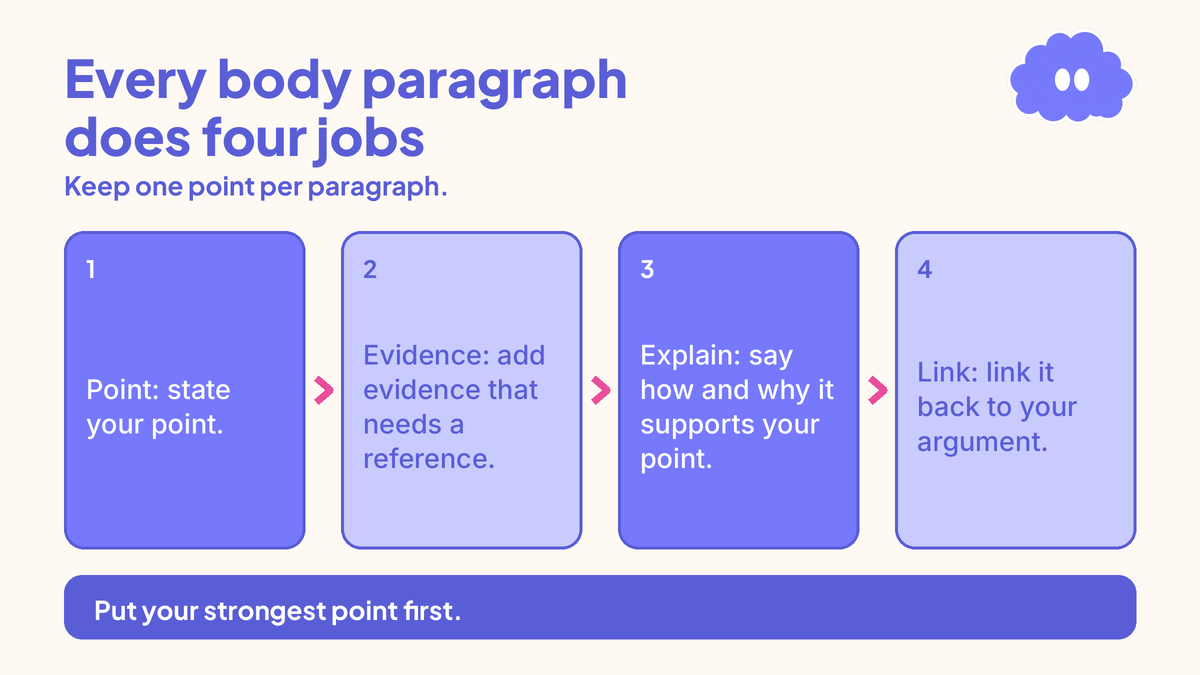
Each body paragraph follows the same PEEL shape. Point: state your point. Evidence: add evidence that needs a reference. Explain: say how and why it supports your point. Link: link it back to your argument. Keep one point per paragraph.
That gives you the coursework essay structure: introduction, body, and conclusion, with the argument stated, developed, and answered. Read the topic sentences in order. They should summarise the argument. If they do not, reorder now, while reordering costs nothing.
Step 5: Draft the body first, in timed blocks
Write the body first, starting with the section you feel clearest about. Write the introduction after the body. Write the conclusion last.
Work in 50-minute blocks, with a 10-minute break between them. Aim for one paragraph per block, at your word target. Write quickly, in short sentences. Do not polish yet. Build the reference list as you draft, adding each source when you cite it.
Then write the introduction: topic, argument, context, and signposts. Then the conclusion: answer the question, summarise, and reinforce your argument. Do not add new points or evidence in the conclusion.
One hour a day means one 50-minute block plus setup. On a busy day, keep a floor of one 25-minute block. If your house is noisy, agree one quiet hour, keep a library bag packed, put your phone in another room, and keep a capture pad beside you.
Step 6: Edit in passes, check references, proofread last
Leave the draft alone for at least one night. Then edit in three passes, one job per pass.
In the structure pass, check the order and the argument: does each paragraph do its planned job, and does the essay answer every part of the question? Cut or move whole paragraphs, not single words. In the sentence pass, check clarity and word count. Cut repetition. If over, cut whole repeated sentences. If under, add evidence or explanation, not padding.
In the proofreading pass, check one kind of error at a time. Read slowly, and read every word. Read aloud, so you hear how the words sound together. Do not rely only on a spelling checker.
Ask for feedback before the final pass, if time allows. Ask where the reader lost the argument, which paragraph felt thinnest, and whether the conclusion answered the question. Fix what you can first.
Finish with the reference check. Every citation must have a matching list entry, and every list entry must be cited. Check that author names match, and that the list follows the style in your brief. For a longer project, the system for managing references for a thesis scales this check up. Check the word count and submission steps.
A worked example: how to write a coursework essay in 14 days
Your situation: second-year sociology student, shared house, part-time job on Saturday afternoons. A 1,500 word essay, due at 5:00pm on Monday 30 November. Question: Evaluate the claim that flexible working improves work-life balance for parents. Study time: 7:00am to 8:00am on weekdays, 10:00am to 12:00 noon at weekends. Total: 18 hours.
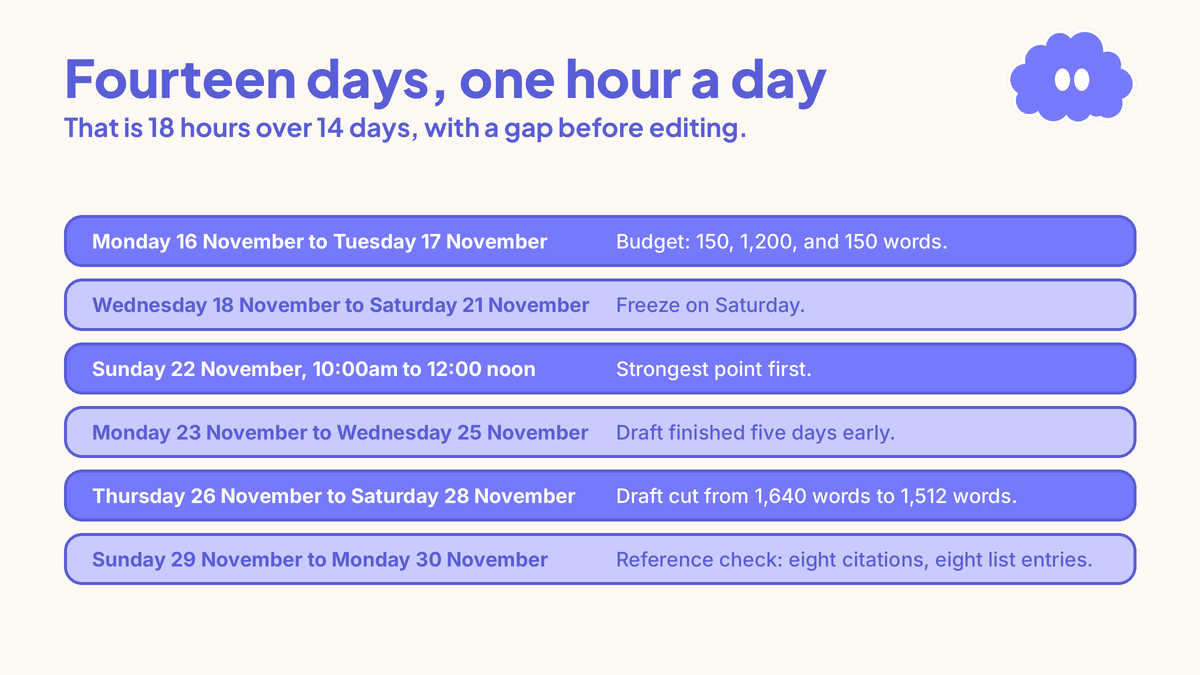
- Monday 16 November to Tuesday 17 November: decode the brief. Budget: 150, 1,200, and 150 words. Four paragraphs at 300 words each. Rough plan in 15 minutes. Freeze date: Saturday 21 November.
- Wednesday 18 November to Saturday 21 November: research bursts, one hour on weekdays, two hours on Saturday morning. Skim by contents and index, read in 15 to 20 minute bursts, capture author, year, page, and paraphrase. Freeze on Saturday.
- Sunday 22 November, 10:00am to 12:00 noon: second plan. Topic sentence, evidence, and word target per paragraph. Strongest point first. One weak point cut.
- Monday 23 November to Wednesday 25 November: draft the body, one paragraph per day, clearest first. Reference list grows with the draft. Introduction and conclusion on Wednesday. Draft finished five days early.
- Thursday 26 November to Saturday 28 November: gap day Thursday, draft sent to a classmate. Structure pass Friday, sentence pass Saturday. Draft cut from 1,640 words to 1,512 words.
- Sunday 29 November to Monday 30 November: proofreading pass on Sunday, read aloud, one error type at a time. Reference check: eight citations, eight list entries. Submit on Monday morning, eight hours before the deadline.
That is 18 hours over 14 days, with a gap before editing.
When it goes wrong
You start with only 48 hours left. Compress, do not skip the system. Day one: one hour on the brief, budget, and rough plan, then three hours of research, then freeze. Draft the body in 50-minute blocks. Leave the draft overnight if you can, then run one pass of each kind.
You keep researching and never start drafting. Check the three freeze tests: every paragraph has evidence, the other side is covered, and every source has details and a paraphrase. If all three pass, draft. If one fails, do one 20-minute search for that gap, then draft.
Your draft is 400 words over the limit. Cut whole sentences first: repetition, off-topic examples, and paragraphs that do not answer the question. Do not cut the other side. Cut the weakest main point instead.
Your draft is 300 words short. Add evidence or explanation, not padding. Pick the thinnest paragraph and add one more piece of evidence, plus two sentences on why it matters. Check the other side: a missing reply often accounts for 200 to 300 words.
You miss two days in a row. Do not double the next day. Do the next block as normal, and shrink the plan to fit the days left. Cut the weakest point, keep the other side, and move the freeze date earlier if research is still open.
Your house is noisy and you have a shift. Use the floor: one 25-minute block in the morning, phone in another room, capture pad beside you. Use the quiet hour for drafting. One paragraph a day still finishes the body in four days.
Weekly review checklist
At the end of week one, and again after you submit, answer these in writing:
- Did I keep the daily study time, and what broke it?
- Is every paragraph doing the job set in the second plan?
- Does every in-text citation match a reference list entry?
- What one step will I change for the next essay?
Change one step only. If research ran long, bring the freeze date forward. If references caused a scramble, capture details as you read.
Downloadable infographic spec: one vertical image, title “How to write a coursework essay”, with the six steps from “The system in short” and the four weekly review questions, in Thynq cream, Cloud Purple, Dark Purple and pink, with the Cloud mascot. Text taken word-for-word from this article.
What this system is not
It is not exam technique. Timed essays need memory, speed, and a five-minute plan, not research and references. It is not a thesis system either. A dissertation needs a larger plan, more sources, and supervisor input.
It is not a promise of grades. It is a way to do steady, checkable work on a real timetable. Your brief and course rules always win where they differ.
Sources
- Prospects. How to write an essay. Published 2 September 2026. Supports the question breakdown, paragraph shape, editing in layers, and AI rules.
- Students Union UCL. Academic Writing Guide. Supports the 10% guideline, PEEL paragraphs, and proofreading one error type at a time.
- Queen Margaret University, Effective Learning Service. Planning and Writing Essays. Supports two plans, body-first drafting, and a draft 5 to 7 days early.
- HLPER. How to write an essay plan. Updated 30 October 2026. Supports the five planning stages, the 10% word split, and the 10 to 15 minute coursework plan.
- UNSW Sydney. How to write a university essay. Supports two plans, split-page notes, and writing 5 to 10 minutes per session.
For the full system behind this method, start with how to build a study system that fits your life.
Questions
How is a coursework essay different from an exam essay?
A coursework essay is written over days or weeks with sources open and references required. An exam essay is written in minutes from memory, with no research and no reference list. This system is for coursework only, so if your essay is timed, use a timed exam system instead.
What is the 10% rule for essays?
The 10% rule is a starting point for splitting your word count: about 10% for the introduction, 80% for the body, and 10% for the conclusion. For a 1,500 word essay, that is 150 words, 1,200 words, and 150 words. If your handbook or brief gives a different split, follow that instead.
How do I know when to stop researching?
Stop on your research freeze date when every paragraph in your second plan has evidence, the other side is covered, and every source has full details and a paraphrase. After the freeze, allow only one targeted search for a named gap. If the search does not fill the gap in 20 minutes, leave the point out or argue it from evidence you already have.
Can I use AI to help with essay writing?
Check your course rules first, because what is allowed varies by course and by assignment. Never submit AI-written text as your own work, and never cite a reference supplied by AI until you have opened and checked it yourself. Keep a one-line log of any AI help you use, so you can declare it honestly if your course asks you to.