
The direct answer
To track your past paper scores and find weak topics, log every paper the same day you mark it, turn each score into a percentage, and write down the topics that cost marks with the marks lost. After three or four papers, rank the topics by marks lost, counting recent papers more, and revise the topic at the top first.
Most students sit past papers and remember only the last score. That wastes the papers. Learning how to track your past paper scores to find weak topics starts with keeping a log instead: a single score tells you how one paper went, while a log of four papers tells you whether you are moving and which topics keep costing marks. This article gives you a system for keeping that log, and shows you how the past paper tracker does the ranking for you.
The system in short
- Log every paper the same day you mark it: subject, paper, date, score and weak topics.
- Turn every score into a percentage.
- Write down the topics that cost marks, with the marks lost.
- Read the trend line, not the last score: three or four papers show whether you are moving.
- Revise the topic at the top of the weak-topic ranking first.
- Sit another paper, log it, and watch the topic drop.
Step 1: Log every paper the same day you mark it
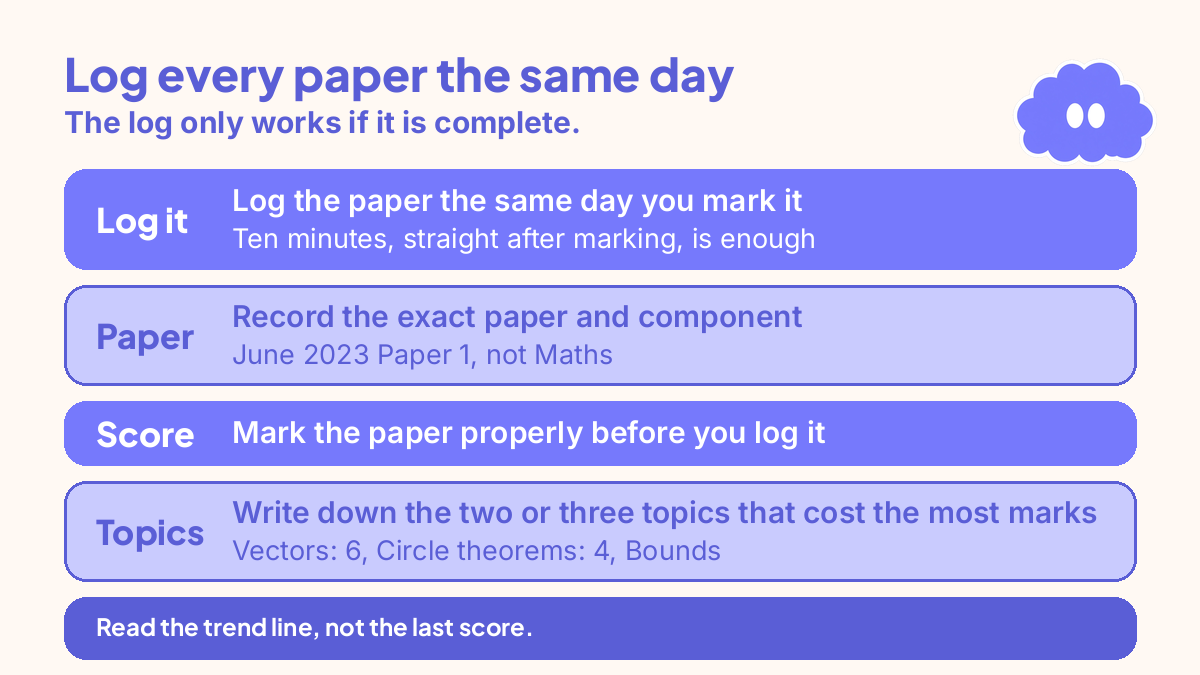
The log only works if it is complete. Log the paper the same day you mark it, while the mistakes are still fresh in your mind. Ten minutes, straight after marking, is enough.
Each entry needs five things: the subject, the paper name, the date you sat it, your score, and the weak topics. Record the exact paper and component, not just the subject name: “June 2023 Paper 1”, not “Maths”.
Mark the paper properly before you log it. A generous mark, or a paper done halfway with the textbook open, does not belong on the same line as a timed, closed-book attempt. If you use AI to check your answers, Use AI to mark your past paper answers shows how to do it honestly, with the mark scheme deciding the score.
The tracker keeps the log in your browser, on your device, and nothing is sent anywhere. You can edit or delete any paper, print the log, or export it as a CSV file. Start with an empty log and add papers as you sit them. Do not backfill old papers from memory: a half-remembered score is worse than a gap.
Step 2: Turn every score into a percentage
Raw marks do not compare. A score of 30 out of 40 is 75%, while 45 out of 100 is 45%. Their mean percentage is 60%, but their combined raw-mark percentage is 75 out of 140, which is about 54%. Neither is an official grade. What matters is that you compare like with like, and percentages are how you do it.
Convert every score the moment you log it: score divided by the total, times 100. A paper out of 80 and a paper out of 100 then sit on the same line. The tracker does this for you and draws one line per subject.
Compare only similar papers. Comparing different boards, tiers or subjects produces a misleading trend. Keep one line per subject, and within a subject, compare papers of the same type. Paper timing matters too: an untimed attempt with hints is not equivalent to an exam attempt, so do not read a jump in the line as progress when the conditions changed.
Step 3: Write down the topics that cost marks
The score tells you whether you are moving. The topics tell you where to go next. After marking, go through the paper and write down the two or three topics that cost the most marks. Not every topic you got wrong, just the expensive ones.
Write each topic with the marks it cost, after a colon: Vectors: 6, Circle theorems: 4, Bounds. The marks make the ranking sharp, because a topic that cost 9 marks matters more than one that cost 2. If you do not know the marks lost for a topic, just write the topic name. In the tracker, a topic with no marks noted counts as 3 marks lost, about one short question. Add the marks later if you work them out.
Use the same topic names every time: “Vectors” on one paper and “vector questions” on the next will count as two topics. Pick one spelling and stick to it.
The log records what cost marks. Deciding what to do about it comes in Step 5, and Past-paper system for exams shows how to build the practice around the topics the log finds.
Step 4: Read the trend line, not the last score
One score is a result. Three or four scores are a direction. After three or four papers in one subject, look at the line, not the latest point. A line going up by a few points each paper means the revision is working, even if the latest score still feels low. A flat line means the revision is not landing, even if the latest score was your best. A line going down means something changed.
The tracker shows one line per subject, with the latest score, the change since the previous paper, and the best score so far. Read all three. The latest score says where you are, the change says whether you moved, and the best score says what you can do.
Do not over-read small moves. A change of one or two points between papers is noise: a harder paper, a tired day, a lucky guess. Look for a move of five points or more, or the same direction three papers in a row, before you change your plan. And do not compare your line with anyone else’s. The log is a record of your papers, not a ranking of your ability.
Step 5: Revise the topic at the top of the ranking first
The tracker ranks your weak topics by marks lost, weighted by recency. Each topic scores the marks it cost you, and recent papers count more: four weeks ago counts half as much as today, eight weeks ago a quarter. Topics you have since fixed drift down the list, because their marks fade. Topics that keep costing marks stay at the top, because fresh marks keep arriving.
Revise the topic at the top first. That is the whole rule. Not the topic you like, not the topic that is easiest to revise, and not all of them at once. One topic, until you can do it, then the next.
Give the top topic a proper session. Work through the method, then do practice questions on that topic only, without the worked answer, until you can complete one cleanly. Then sit another paper that includes the topic and log it. That is the loop: revise, test, log, and watch the topic drop down the ranking. If it does not drop after two more papers, change how you revise it: a different explanation, worked examples first, or a teacher’s help. How to use mock exams to prepare covers how to sit those test papers under proper conditions, and How to retake an exam: a study system for students who have to sit it again shows how to rebuild after a disappointing result.
Step 6: Sit another paper and log it, then repeat
The system only works if the loop keeps turning. A log with four papers and no fifth paper is a snapshot, not a system. Sit another paper, mark it, log it the same day, and check whether the trend line moved and whether the topic you revised dropped down the ranking. If it dropped, the revision worked. If it stayed at the top, revise it differently.
Keep the rhythm steady. One paper a week per subject, in the month before the exam, gives you four papers and a real trend.
When the exam is over, keep the log until results day. If a result surprises you, the log shows what your papers actually said, subject by subject. How to handle a bad exam result covers what to do next if the result is not what you hoped for.
A worked example: four maths papers in four weeks
Your situation: Sara is a GCSE student with a maths exam in five weeks. She sits one past paper a week and logs it the same evening.
Paper 1, 21 October: 41 out of 80, 51%. Weak topics: Vectors: 7, Circle theorems: 6, Bounds with no marks noted, which counts as 3. One paper is a single result, so Sara changes nothing yet.
Paper 2, 28 October: 47 out of 80, 59%. Weak topics: Circle theorems: 5, Vectors: 4, Histograms: 3. The line is up 8 points.
Paper 3, 4 November: 52 out of 80, 65%. Weak topics: Vectors: 5, Algebraic proof: 4. The line is up 6 more points. Vectors has appeared in all three papers.
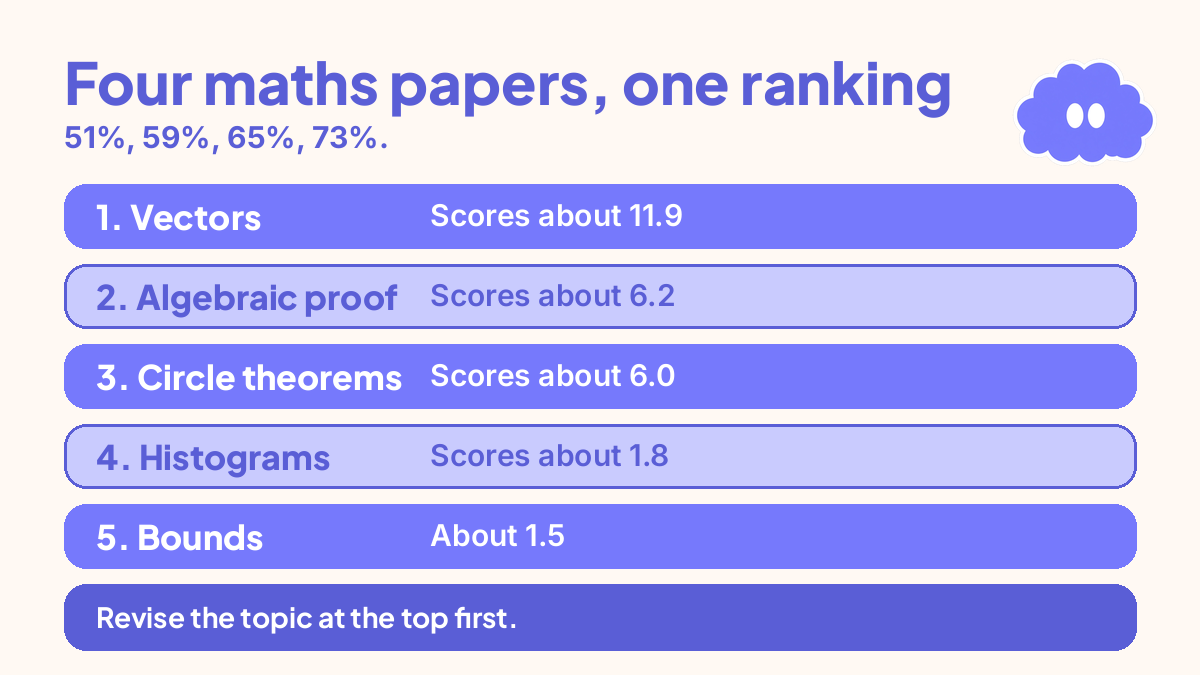
Paper 4, 11 November: 58 out of 80, 73%. Weak topics: Algebraic proof: 4, Vectors: 3. The line is up 8 more points: 51%, 59%, 65%, 73%. The ranking decides what happens next.
The ranking. The tracker weights marks lost by recency, with a four-week-old paper counting half as much as today’s. Vectors scores about 11.9: 7 marks from four weeks ago at half weight, plus 4, 5 and 3 marks from more recent papers. Algebraic proof scores about 6.2, from 4 marks two weeks ago and 4 marks last week. Circle theorems scores about 6.0, from 6 marks four weeks ago and 5 marks three weeks ago. Histograms scores about 1.8 and Bounds about 1.5.
Algebraic proof sits above Circle theorems even though it cost fewer marks in total, 8 against 11, because its marks are recent. Circle theorems is a problem Sara is fixing, and Algebraic proof is a problem she still has. So Sara revises Vectors first, then Algebraic proof, and leaves Circle theorems alone until the next paper. She gives Vectors a full session: the method, then practice questions on Vectors only, without the worked answer. How to revise maths for exams covers how to structure that session.
When it goes wrong
You log the score but not the topics. The trend line looks healthy and you have no idea what to revise. Fix it by going back through the last marked paper now and writing down the topics that cost the most marks, then doing it the same day for every paper after.
You compare papers that are not comparable. A foundation paper and a higher paper sit on the same line, and the line jumps for no reason. Fix it by comparing only papers of the same type.
You change your plan after one paper. One bad score, and the whole revision plan gets rewritten. Fix it by waiting for three papers before you change anything. One paper is a result, not a pattern.
You revise the topic you like, not the one at the top. The ranking says Vectors, and you revise algebra because it feels better. Fix it by following the ranking for one full session, then checking the next paper.
You stop logging when the scores improve. The line is going up, so the log feels finished. Fix it by keeping the rhythm: one paper a week until the exam.
You treat the line as a grade prediction. The tracker says 73% and you assume that is your exam result. Fix it by remembering what the tool will not do: it will not mark your paper, predict your grade, or know your exam board’s grade boundaries. A rising line is encouraging, not a guarantee.
Weekly review checklist
- Did you log every paper you marked this week, the same day, with the weak topics?
- Is the trend line for each subject moving up, flat, or down?
- Which topic is at the top of the weak-topic ranking, and did you revise it this week?
- Did the topic you revised last week drop down the ranking on the next paper?
- Are your topic names spelled the same way on every paper?
- When is the next paper in each subject, and is it in your plan?
Downloadable infographic spec: one vertical image, title “How to track your past paper scores to find weak topics”, with the six steps from “The system in short” and the six review questions above, in Thynq cream, Cloud Purple, Dark Purple and pink, with the Cloud mascot. Text taken word-for-word from this article.
What this system is not
This system is not a grade predictor. A rising line is encouraging, not a guarantee, and the tracker does not know your exam board’s grade boundaries. It is not a substitute for marking properly: a score from a paper you marked generously, or sat with the textbook open, will flatter the line and hide the topics that need work. It does not tell you how to revise a topic, only which topic to revise first. And it cannot help if the log has holes in it. Four papers logged properly beat ten papers half remembered.
Sources
- Thynq past paper tracker. The tool page on thynq.org, read 18 November 2026. Supports the tool description in this article: the log fields, the trend line, recency weighting, the 3-mark default, browser saving, print and CSV export.
- Match Your Tutor. Past Paper Practice Tracker. Read 18 November 2026. Supports the advice to record the exact paper and component, to compare only similar papers, and to treat the result as a starting point, not a grade.
For the full system behind this method, start with how to build a study system that fits your life.
Questions
How do I track my past paper scores?
Log the subject, paper, date, score and weak topics the same day you mark each paper. Turn every score into a percentage so papers out of different totals compare. After three or four papers in one subject, the trend line and the weak-topic ranking show what to revise next.
How many past papers do I need before the pattern is clear?
Three or four papers in one subject. One paper is a single result, two is a comparison, and three or four show a trend and a topic repeating. Fewer than three papers in a subject gives you a list, not a pattern, so sit another paper before you change your revision plan.
What should I write for weak topics if I do not know the marks lost?
Just the topic name. In the tracker, a topic with no marks noted counts as 3 marks lost, about one short question. Add the marks after a colon, like Vectors: 6, when you have them, and the ranking becomes sharper.
Why do recent papers count more than old ones?
Because a topic you lost marks on four weeks ago may be fixed by now. The tracker weights marks lost by recency: a paper from four weeks ago counts half as much as one from today, so topics you have since fixed drift down the ranking and current problems stay at the top.