The direct answer
To take notes in lectures, prepare for 10 minutes, capture only the structure and the key points in your own words while you listen, and finish and test the notes the same evening. This is how to take notes in lectures you attend in person, where you cannot pause, rewind, or ask the lecturer to slow down.
Most lecture notes fail because you try to write down everything, fall behind, and end with pages you cannot revise from. Taking notes in lectures is choosing, while you listen, what you will need later.
You arrive with questions, capture anchors, decide what the slides are for, and finish the same evening. If your lesson is a video you can pause, use the system for notes from online courses instead. This one is for the live hour only.
The system in short
- Prepare for 10 minutes: skim the slides or headings, reread the last page of notes, and write two questions.
- Capture anchors in your own words, and decide what to do with the slides before you start writing.
- When the lecturer speeds up, drop to anchors, mark each gap, and keep listening.
- Choose pen or laptop by the paraphrase rule: whichever helps you put ideas in your own words, with distractions closed.
- Finish the notes the same evening: fill the gaps, write questions, answer them cold, and book the next two reviews.
Step 1: Prepare in 10 minutes
Prep gives your notes a frame, so you hear structure instead of a stream of sentences.
- Minutes 1 to 3: skim the slides, handout, or chapter headings, and note the headings in order for your page.
- Minutes 4 to 6: reread the last page of notes, and note one idea you still do not understand.
- Minutes 7 to 8: write two questions the lecture should answer, from the headings and that gap. Two questions are enough.
- Minutes 9 to 10: set up the page: date, lecture title, headings, a blank line between each heading, and a wide margin for marks and questions.
Use short forms you already know: def for definition, ex for example, an arrow for leads to, and a star for anything the lecturer flags as important. Write them at the top of the page.
If you have only two minutes, reread the last page and write one question.
Step 2: Take notes live, in your own words
Listen for structure first, then detail. Lecturers signal what matters: numbered lists, definitions, repetition, and signposts such as “There are three causes” or “To sum up”. Note what goes on the board and what the lecturer returns to twice.
Write the heading, then two or three anchors under it. An anchor is one key word or short phrase that lets you rebuild the idea later. Write in phrases, not sentences. Keep technical terms exact, and put the explanation in your own words. That choice is how to take lecture notes live.
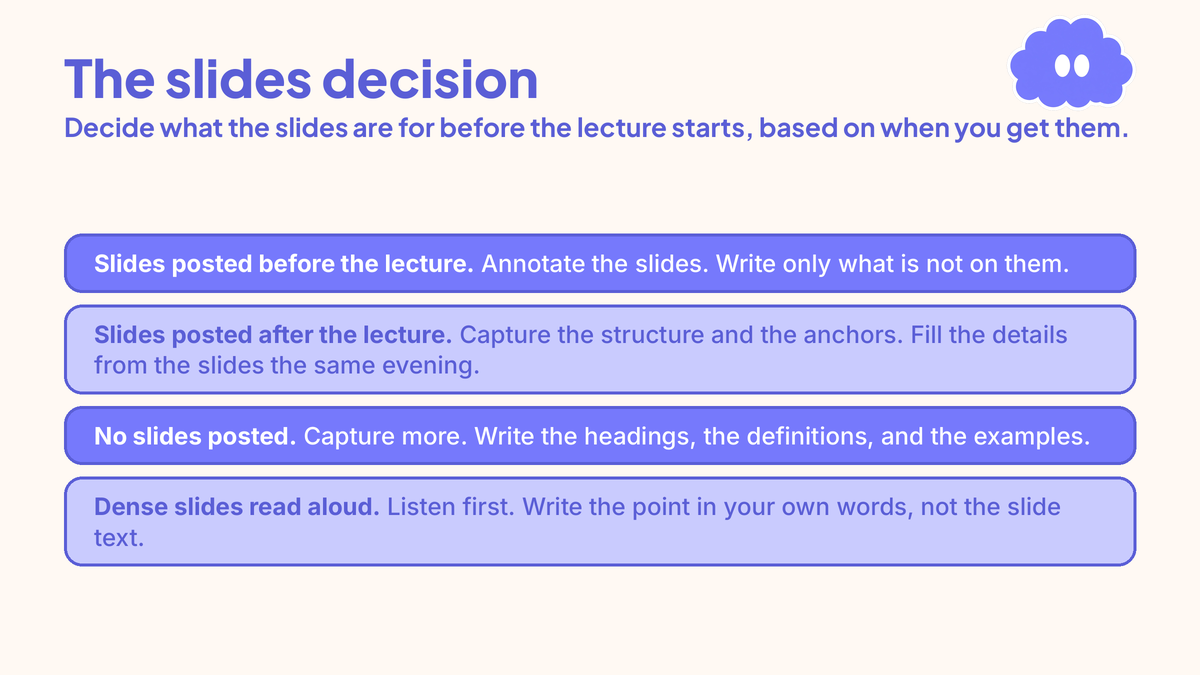
Decide what the slides are for before the lecture starts, based on when you get them.
Slides posted before the lecture. Download or print them before you arrive. Annotate the slides. Write only what is not on them.
Slides posted after the lecture. You cannot annotate what you do not have yet. Capture the structure and the anchors. Fill the details from the slides the same evening.
No slides posted. Your notes carry more weight, because there is no backup copy. Capture more. Write the headings, the definitions, and the examples.
Dense slides read aloud. Stop copying the slide. The slide already holds the text. Listen first. Write the point in your own words, not the slide text. Note the slide number and one example.
Choose the format that fits the lecture in front of you. No single format fits every lecture. Use an outline for a structured lecture, a table for a comparison lecture, with one column per item and one row per feature, and sentence capture for a fast or unstructured lecture, one idea per line, sorted the same evening. For a lecture built around one central idea, a mind map can hold the shape better than a list.
One useful layout is the Cornell notes system. You take notes in the main space during the lecture, then add questions and a short summary after the lecture, and test yourself from the questions later. Use it for lectures with clear headings. The full layout and review routine live on that page.
Step 3: Cope when the lecturer speeds up
Good lecture note taking under speed pressure is triage, not speed writing. The rule for notes during a lecture at full speed is simple: write less, mark the gap, keep listening.
- Drop to anchors. Write one key word or short phrase per idea, under the right heading, and keep terms exact.
- Mark the gap. Use the same symbol every time, such as two question marks in the margin, leave a blank line, and add the slide number.
- Keep listening. Do not chase the sentence you missed. Return to the live point and trust the mark to hold the gap.
- Rebuild the same evening. Fill each gap from the slides first, then the set reading, then one classmate. Ask for the gaps you could not fill, not for a full copy of their notes.
When a diagram goes up, sketch the shape and label the parts. Mark the part you did not follow, and redraw it the same evening, from memory first, then check it.
When a worked problem starts, watch the first step before you write, then write each step with the reason for it in your own words. If you fall behind, write the starting point and the final answer, leave space, and fill the middle steps the same evening.
If the lecture is in your second language, capture exact terms in the room and paraphrase the same evening.
Step 4: Choose pen or laptop honestly
The device matters less than paraphrasing in your own words and keeping distractions closed. Choose the device that helps you do both.
Handwriting forces you to choose, because you cannot copy everything, and pen and paper are faster for diagrams and worked problems. The costs are real too: handwriting is harder to search and reorganise. Typing captures more and is easy to tidy the same evening, but it tempts you to copy word for word, and notifications and other tabs sit one click away.
- Choose pen if the lecture has diagrams or worked problems, or if you know you will open other tabs on a laptop.
- Choose a laptop if you write slowly by hand, need searchable notes, or the lecture is mostly text and fast.
- Mixed setup: laptop for text, paper beside it for diagrams.
If you type, keep one document open, turn notifications off, and put the phone away. After each section, glance at what you wrote: if it matches the slide word for word, rewrite the next point in your own words. If the phone is the leak, the study without your phone routine works for the lecture hour too.
Step 5: Finish and test the same evening
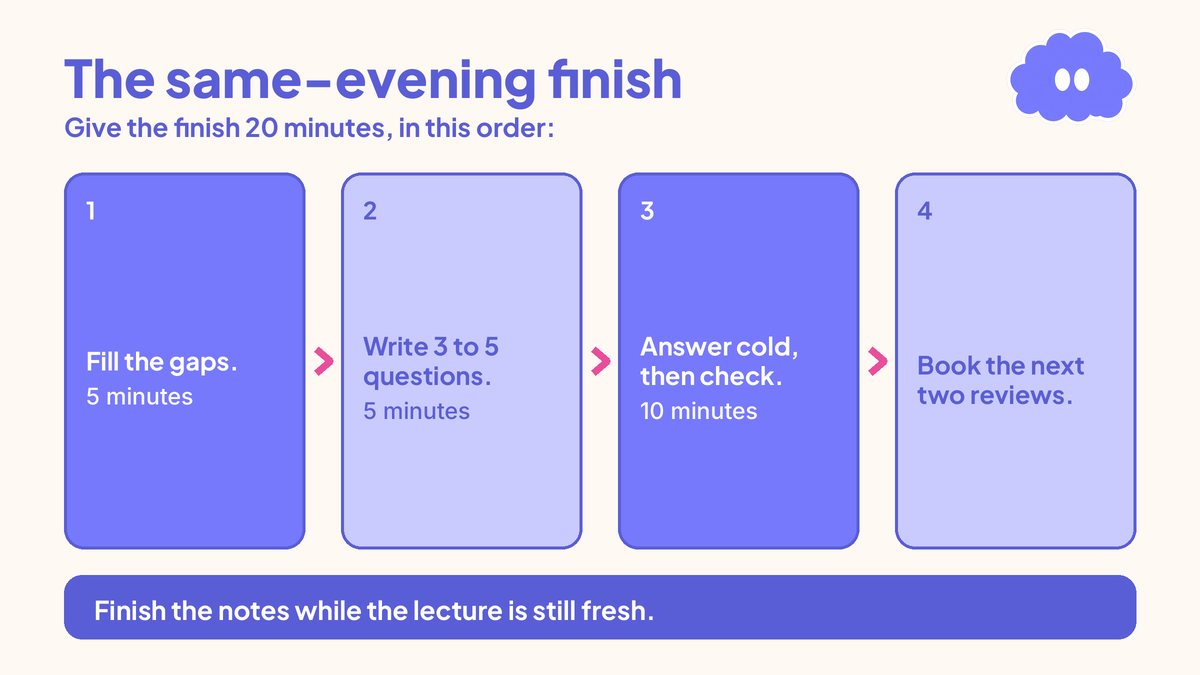
Finish the notes while the lecture is still fresh. Give the finish 20 minutes, in this order:
- Fill the gaps. Spend 5 minutes filling every marked gap from the slides, the set reading, or a classmate. Turn fragments into short sentences only where needed.
- Write 3 to 5 questions. Spend 5 minutes writing questions the notes should answer, one per heading where you can, in the margin or at the end of the page. A good question has a short answer you can check.
- Answer cold, then check. Spend 10 minutes answering with your notes covered, then check each answer and mark the questions you got wrong. Those questions are the next review.
- Book the next two reviews. Put two short re-tests in your plan, after a gap, using a spaced repetition system.
This evening finish sits inside a wider notes system you can actually review, which covers notes from every source. This page covers only the live lecture and the evening after it.
Testing yourself is the step that earns its place. In a 2013 review, Dunlosky and colleagues rated practice testing and distributed practice as the only two high-utility techniques out of ten. Roediger and Karpicke (2006) found students who recalled a passage remembered more a week later than students who restudied it. Cepeda and colleagues (2006) found spaced practice beat massed practice.
Stop after 20 minutes. If gaps remain, write them as questions for the next lecture, and move on.
A worked example: a Tuesday morning biology lecture
Your situation: second-year biology, Tuesday 10:00 lecture on cell respiration, slides posted the night before, laptop for text and paper for diagrams.
- 9:50 to 10:00, prep: skim the 18 slides, copy the four headings onto the page, and reread the last page on photosynthesis. Write two questions: “What are the three stages of cell respiration, in order?” and “Why does the electron transport chain need oxygen?”
- 10:00 to 10:50, lecture: use an outline, with anchors under each heading, and annotate the slides with the examples the lecturer adds. Mark two gaps with two question marks. Sketch the electron transport chain on paper, labels only.
- 10:50, end of lecture: two pages of anchors, one page of slide annotations, two marked gaps, one half-finished diagram.
- 18:30 to 18:50, finish: fill the two gaps from the slides. Redraw the diagram from memory, then check it. Write five questions, answer them cold, get three right, and mark the two wrong answers for the next review. Book the next two reviews.
The notes are short: four headings, short phrases, two filled gaps, one redrawn diagram, five questions.
When it goes wrong
You miss the lecture. Act the same day: get the slides, borrow notes from one classmate, and list the headings you missed. Give recovery 30 minutes. If you missed the lecture entirely, start from the recording with the method to turn lecture recordings into notes.
You arrive late. Sit where you can hear, write the time and heading you join at, and leave the opening blank. Fill it from the slides the same evening.
You zone out for five minutes. Mark the gap with the time and heading, and return at the next heading. Fill it the same evening. If it happens in every lecture, check your seat, sleep, and prep before you blame the notes.
No slides are posted. Capture more: headings, definitions, and examples, with a blank line after each idea. Ask the lecturer afterwards whether slides will be posted, so next week starts with the right plan.
The lecturer reads dense slides aloud. Stop copying. Listen for the point, write it in your own words, and note the slide number and one example.
The lecturer jumps around with no clear structure. Use sentence capture, one idea per line, and star ideas the lecturer returns to. Sort the lines into headings the same evening.
Your notes are a transcript. Next lecture, write only after the lecturer finishes a point, in your own words. If you already have transcript notes, turn them into questions the same evening and test yourself from the questions.
You rely on the recording instead of taking notes. Check the syllabus and ask the lecturer before you record. If recording is needed as an accommodation, arrange it through your university disability service. Take notes in the room, and use the recording only for marked gaps.
Weekly review checklist
Once a week, answer these in writing:
- Did I prepare for 10 minutes before each lecture this week?
- Are my notes in my own words, or did I copy the slides?
- Did I mark every gap and fill it the same evening?
- Did I answer my questions cold before I checked the answers?
- Which lecture needs a different format next week, and what will I change?
If one question keeps getting a no, change one step next week: the format, the prep, or the evening finish, not all three at once.
Downloadable infographic spec: one vertical image, title “How to take notes in lectures”, with the five steps from “The system in short”, the same-evening finish rule, and the five weekly review questions, in Thynq cream, Cloud Purple, Dark Purple and pink, with the Cloud mascot. Text taken word-for-word from this article.
What this system is not
It is not a transcript service. Your notes are not a transcript. They are a scaffold you rebuild from the same evening.
It is not a promise of grades. No system can guarantee a result. It is a way to leave each lecture with notes you can revise from, and to know, the same evening, what you do not yet understand.
It is not a replacement for attending, or the system for video lessons you can pause. It assumes you are in the room, listening and choosing, and it asks you to choose in the room and rebuild the same evening.
Sources
- Dunlosky, J., et al. (2013). Improving students’ learning with effective learning techniques. Psychological Science in the Public Interest, 14(1), 4-58. Only practice testing and distributed practice received a high utility rating; summarisation was rated low.
- Roediger, H. L. & Karpicke, J. D. (2006). Test-enhanced learning. Psychological Science, 17(3), 249-255. Students who recalled a passage remembered more a week later than students who restudied it.
- Cepeda, N. J., et al. (2006). Distributed practice in verbal recall tasks. Psychological Bulletin, 132(3), 354-380. Spaced practice beat massed practice; the best gap grows with how long the material must be remembered.
For the full system behind this method, start with how to build a study system that fits your life.
Questions
Should I take notes by hand or on a laptop?
Use whichever helps you put ideas in your own words, with distractions closed. Handwriting forces you to choose, while typing captures more but tempts you to copy word for word. For diagrams and worked problems, pen and paper are usually faster.
How do you take notes when the lecturer speaks too fast?
Drop to anchors: one key word or short phrase per idea, under the right heading. Mark every gap with the same symbol, keep listening, and rebuild the missing parts the same evening from the slides, the set reading, or a classmate. Do not chase a sentence you missed.
Is it better to record lectures or take notes?
Take notes in the room, and treat a recording as a backup for filling gaps, not a replacement for notes. Check the syllabus and ask the lecturer before you record, and if recording is needed as an accommodation, arrange it through your university disability service. A recording you never revisit helps no one.
How soon after a lecture should I review my notes?
Finish them the same evening, while the lecture is still fresh and gaps are cheap to fill. Spend 20 minutes filling gaps, writing three to five questions, and answering them with your notes covered, then check your answers. After that, test the material again after a gap, rather than re-reading the notes.