The direct answer
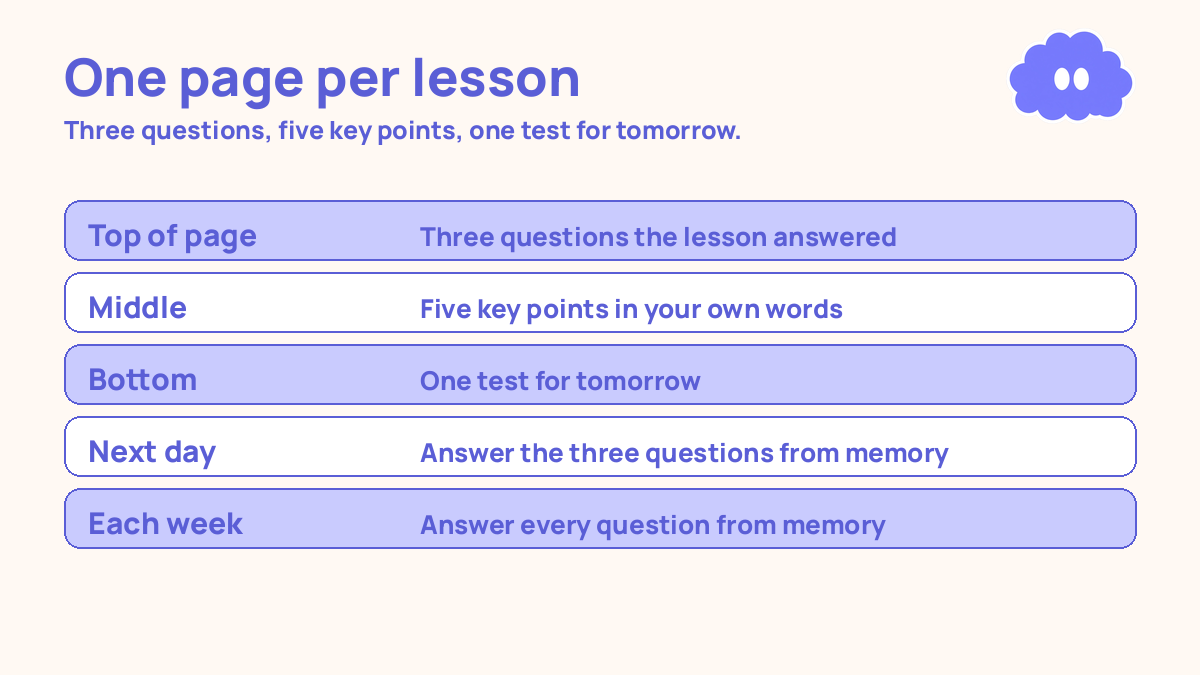
Take notes from an online course by pausing the lesson, writing in your own words, and turning each lesson into questions you can test yourself on. One page per lesson: three questions the lesson answered, five key points, and one thing to test tomorrow. That is the whole system. Notes are what you can review in five minutes and test yourself from.
You finish a course with 40 pages of notes, and you never open them again. They are long, neat, and useless — a copy of the course, not a record of what you understood.
The problem is that most course notes are written the wrong way round. You write while the video plays, so you copy sentences to keep up. Copying feels like working, and it is mostly not. In a 2013 review, Dunlosky and colleagues rated ten common study techniques, and only two received a high utility rating: practice testing and distributed practice. Summarisation and highlighting were rated low. Notes you only re-read are the same low-utility habit in a neater format.
This system is for a student taking an online course, alone, with no teacher. It needs one notebook and a pause button. For the general notes system, read the notes system that you can actually review. For watching the lessons themselves, the video lectures guide shows how to watch them properly. This article is only about the notes.
The system in short
- Before the lesson, write one question the lesson must answer.
- Watch in short parts: watch 10 minutes, pause, then write.
- One page per lesson: three questions, five key points in your own words, one test for tomorrow.
- Turn key points into questions you can answer from memory.
- The next day, test yourself from the page before you start the new lesson.
- Once a week, review the week’s pages: answer every question from memory, and rewrite the ones you miss.
Step 1: One question before the lesson starts
Write one question in your notebook before you press play. “What does this lesson teach me to do?” “What are the three steps of this method?” One question, in plain words. The question tells you what to listen for. Without it, everything sounds equally important, and you write down everything.
If the course gives you a lesson outline, use it. Turn each heading into a question before you watch. A heading that says “Sorting data” becomes “How do I sort data, and when do I use each method?” Questions you wrote yourself are questions you will want to answer. Headings you copied are headings you will ignore.
Decide the cue and the action in advance: “When I open the course, I will write the question first, then press play.” That is an if-then plan, and across 94 studies, if-then plans raised goal attainment by a medium-to-large amount (d = 0.65) over holding the goal alone (Gollwitzer and Sheeran, 2006). A plan decided before the video starts is a session that starts without a debate.
Step 2: Pause, then write in your own words
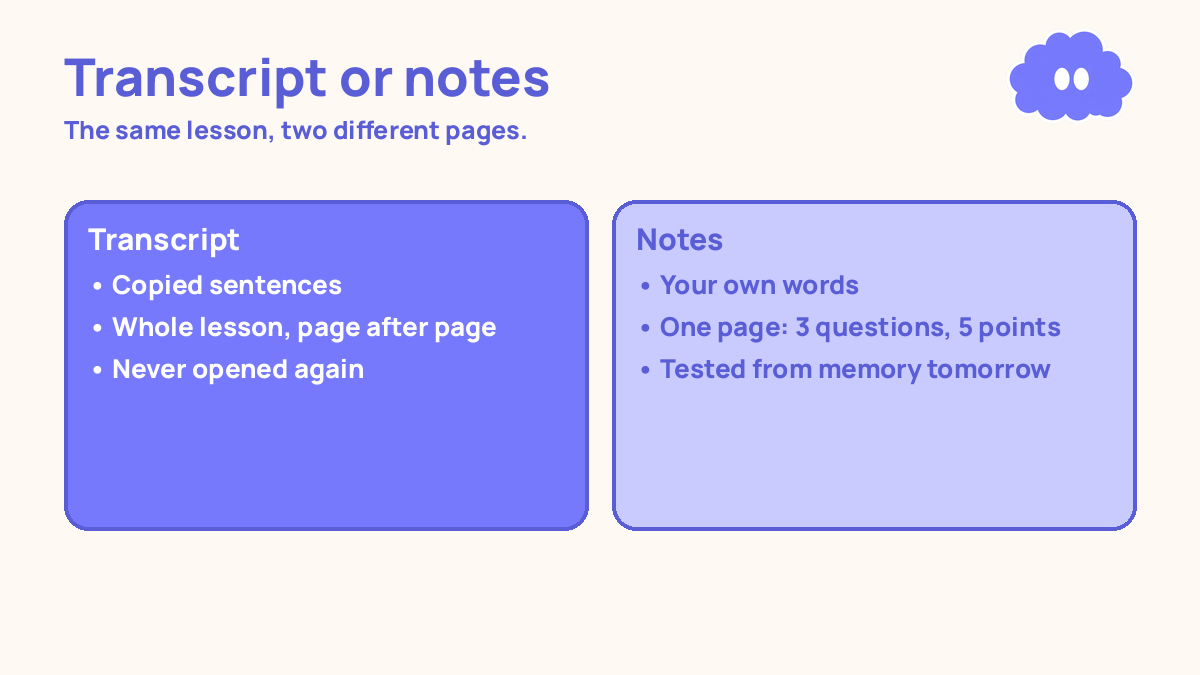
Watch 10 minutes, then pause. Write what those 10 minutes taught you, in your own words, in two or three lines. Then watch the next 10 minutes. A lesson watched in parts, with notes after each part, becomes notes you understand. A lesson watched straight through, with notes taken while it plays, becomes a transcript.
Write in your own words, not the teacher’s. Explaining why each step works, in your own words, is a moderate-utility technique (Dunlosky, 2013), and a 2018 meta-analysis found prompting self-explanation produced a moderate average benefit (Bisra and colleagues, 2018). The original study was only 8 students, so say so.
Do not write everything. Write five key points per lesson, no more. If you have written 20 lines, you are copying, not choosing. Choosing is the work: deciding what matters is how you learn what matters. The five points you choose are the five points you will test yourself on tomorrow.
If the teacher shows a diagram or a table, draw a small version of it yourself. Do not screenshot it and move on. A diagram you drew, even badly, is a diagram you thought about.
Step 3: Turn key points into questions
After the lesson, turn each key point into a question you can answer from memory. “The three steps are X, Y, Z” becomes “What are the three steps, and what does each one do?” Write the question on the left of the page and the answer on the right, or the question on one page and the answer on the back. The point is the same: the page must be able to test you, not just tell you.
Write three questions the lesson answered at the top of the page. These are the questions you will answer tomorrow, from memory, before the new lesson. If you cannot write three questions, you did not understand the lesson yet. Watch the hard part again, in a short part, and write the questions after.
Add one thing to test tomorrow, at the bottom of the page: one question, one problem, one example to do from memory. Tomorrow’s test starts here, not in a separate revision session. A page with a test built in is a page that gets used.
Step 4: Test yourself from the page, after a gap
The next day, before the new lesson, open yesterday’s page and answer its three questions from memory. Cover the answers, write what you remember, and check. Testing yourself beats restudying: Roediger and Karpicke (2006) found students who recalled a passage remembered more a week later than students who restudied it, even though the restudiers felt more confident straight after studying. Feeling fluent right after re-reading your notes is not the same as remembering a week later.
Come back to the page after a gap: tomorrow, in three days, in seven days. That 1–3–7 schedule is a practical starting point, not a rule from the research. The research says the best gap grows with how long you need to remember the material (Cepeda and colleagues, 2006). Feedback matters too: Rowland (2014) found testing beat restudying, and the benefit was larger with feedback (g = 0.73) than without it (g = 0.39). Always check your answers against the page.
If you miss a question, rewrite it in your own words, and put it on tomorrow’s test list. Do not just re-read the right answer.
Once a week, take the week’s pages and answer every question from memory, in one sitting. The questions you miss tell you which lessons to re-watch, in short parts, next week. The questions you get right tell you the system is working.
A worked example: a Monday lesson on spreadsheets
You are taking an online course on spreadsheets. Today’s lesson is about sorting data. Study time is 6:00 to 7:00pm.
6:00–6:05pm — Question. Write at the top of a fresh page: “How do I sort data, and when do I use each method?” Press play.
6:05–6:15pm — Part 1. Watch 10 minutes. Pause. Write two lines in your own words: “Sort A to Z puts text in order. Sort by number puts the smallest first.”
6:15–6:25pm — Part 2. Watch 10 minutes. Pause. Draw the small table from the video yourself, and label it in your own words.
6:25–6:35pm — Part 3. Watch the last 10 minutes. Pause. Write three more lines: the three sorting methods, and when to use each one.
6:35–6:50pm — Turn it into questions. Write three questions at the top of the page: the three methods, and when to use each. Write one test at the bottom: “Sort this list of 10 names and numbers from memory.”
6:50–7:00pm — Close. Put the page in the notebook. Write tomorrow’s first task: “Answer the three sorting questions from memory before the new lesson.”
Tuesday 6:00pm — Test first. Answer the three questions from memory. You get two right. Rewrite the one you missed in your own words, and put it on Wednesday’s test list.
One page, three questions, one test. That is a lesson you can review in five minutes, any time, without re-watching the video.
When it goes wrong
Your notes are a transcript of the whole lesson. You are writing while the video plays. Stop. Watch in 10-minute parts, pause, and then write. If the page is longer than one page, you wrote too much. Cut it to five key points and three questions. A page you can review in five minutes beats 10 pages you never open.
You never look at your notes again. The notes have no test built in. Add one: three questions at the top, one test at the bottom, and a rule that tomorrow starts with answering them. Notes without a test are a diary. Notes with a test are a study tool. The test is what brings you back to the page.
You take notes on a live lesson and cannot keep up. Do not try. Listen to the live lesson, write down only the questions that come to mind, and take proper notes from the recording afterwards, in short parts. Live lessons are for listening and asking. Recordings are for notes. Trying to do both at once does neither well.
You miss a question three times in a row. The question is too big, or the lesson was too hard. Split the question into two smaller ones. If that does not work, re-watch the hard part in a short part, and write the answer in your own words again. Missing the same question three times is information, not failure: it tells you exactly where the gap is.
Weekly review checklist
Copy this list for each Sunday:
- How many lessons did I finish this week, and how many have a one-page note?
- How many of the week’s questions can I answer from memory right now?
- Which pages did I never test myself from, and why?
- What one change will I make next week: shorter parts, fewer key points, or a stricter test-first rule?
Downloadable infographic spec: one vertical image, title “One page per lesson”, with the page layout — three questions, five key points, one test for tomorrow — and the rule “pause, then write in your own words”, in Thynq cream, Cloud Purple, Dark Purple and pink, with the cloud mascot.
What this system is not
It is not a claim that notes alone will teach you a course, and it is not a promise that one page per lesson is enough for every subject. It is a practical notes system for a student taking an online course alone. If a lesson needs a full worked example, add a second page for the example. The shape stays the same: pause, write in your own words, turn it into questions, and test after a gap.
Sources
- Dunlosky, J., et al. (2013). Improving students’ learning with effective learning techniques. Psychological Science in the Public Interest, 14(1), 4-58. Only practice testing and distributed practice received a high utility rating; summarisation and highlighting were rated low.
- Roediger, H. L. & Karpicke, J. D. (2006). Test-enhanced learning. Science, 311, 1535-1539. Students who recalled a passage remembered more a week later than students who restudied it.
- Cepeda, N. J., et al. (2006). Distributed practice in verbal recall tasks. Psychological Bulletin, 132(3), 354-380. Spaced practice beat massed practice, and the best gap grows with how long you need to remember the material.
- Rowland, C. A. (2014). The effect of testing versus restudy on retention. Psychological Bulletin, 140(6), 1432-1463. Testing beat restudying, and the benefit was larger with feedback (g = 0.73) than without it (g = 0.39).
- Gollwitzer, P. M. & Sheeran, P. (2006). Implementation intentions and goal achievement: a meta-analysis. Advances in Experimental Social Psychology, 38, 69-119. Across 94 studies, if-then plans raised goal attainment by a medium-to-large amount (d = 0.65).
- Bisra, K., et al. (2018). Inducing self-explanation: a meta-analysis. Educational Psychology Review, 30(3), 703-725. Prompting self-explanation produced a moderate average benefit (g = 0.55).
For the general notes system, read the notes system that you can actually review, and for watching the lessons, the video lectures guide.
Questions
Should I take notes while watching an online course?
Yes, but pause first. Watch a short part, pause, then write what it taught you in your own words. Notes written while the video plays are usually copied sentences, not understanding.
How do I take notes from a video I cannot pause?
Take them after. Watch the whole lesson once, then watch it again in short parts and write notes on the second pass. Live lessons are for listening; the recording is for notes.
What is the best format for online course notes?
One page per lesson: three questions the lesson answered, five key points in your own words, and one thing to test yourself on tomorrow. The same format every time, so review takes minutes, not hours.
How do I review notes from an online course?
Test yourself from them, do not re-read them. Cover the key points, answer the three questions from memory, and check. Come back the next day, in three days, and in seven days.