The direct answer
How to study without your phone: put it in another room, set a timer for 25 minutes, and study one task until the timer rings. Keep a paper pad beside you: every time you want to check something, write it on the pad instead of picking the phone up. When the timer rings, take a 5-minute break, and only then check the phone if you need to. That is the whole system: distance, a timer, and a pad.
You know the pattern. You sit down, open your notes, and before you have read a page your hand is on your phone. Ten minutes go.
The problem is not laziness. The phone is the easiest thing in the room to pick up, and it is designed to be picked up. This system does not ask for willpower. It changes the room.
One honest note. A 2017 study by Ward and colleagues found that people whose phone was in another room did better on tests of memory and focus than people whose phone was on the desk, even when the phone was off. A later replication in 2022 found no difference. The evidence is mixed, so this is a practical system, not a proven fact.
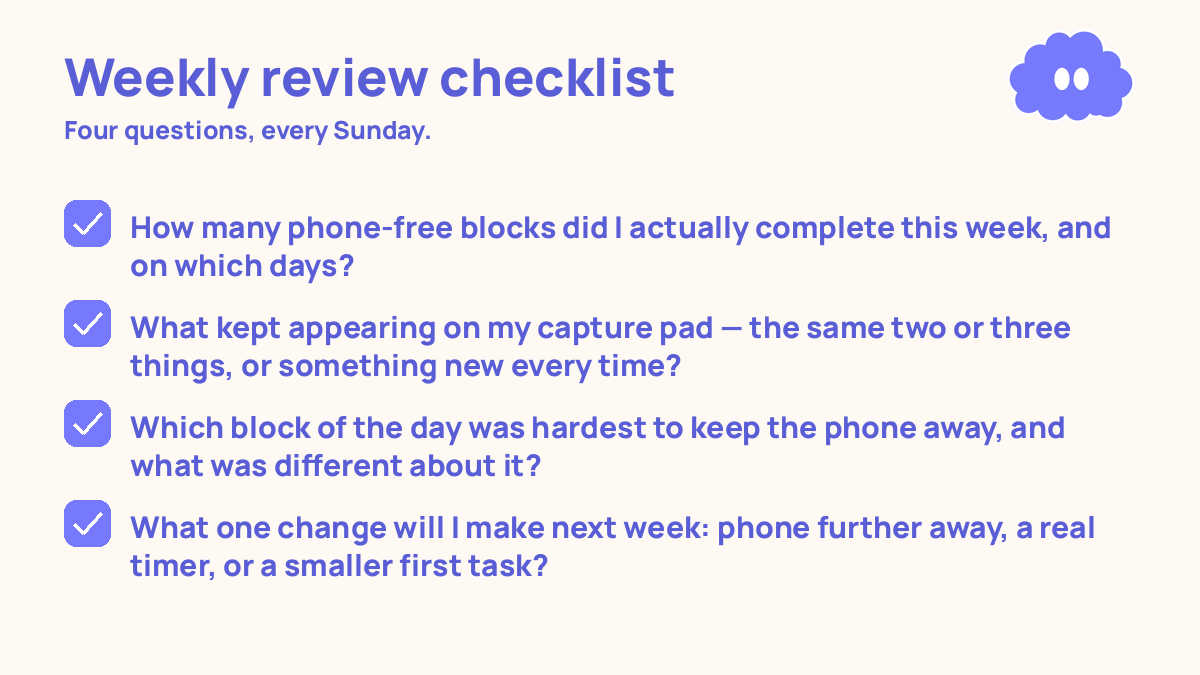
How to study without your phone: the system in short
- Decide what you will study in the next 25 minutes and write it in one line.
- Put your phone in another room, on silent, face down. One room? Put it in a bag on the far side of the room.
- Put a paper pad and a pen beside you. This is your capture pad.
- Set a timer for 25 minutes — a kitchen timer, a watch, or your laptop, not the phone.
- Study one task until the timer rings. When you want to check something, write it on the pad.
- Take a 5-minute break. Check the phone now if you must, then put it away and start the next block.
Step 1: Write the task in one line before you move the phone
Never start by moving the phone and then wondering what to study. That gap is exactly when you pick it up again. Decide the task first, while the phone is still on the desk, and write it on paper in one line.
“Revise biology” is not a task. “Answer the 8 questions on photosynthesis from memory” is a task. If you cannot write it in one line, it is too big. Split it.
This one line tells you what to do when the timer starts, and tells you at the end whether the block actually happened.
Step 2: Move the phone out of the room
Pick the phone up, silence it, and put it in another room. A drawer beats a pocket. A bag on the far side of the room is the fallback if you live in one room.
Do this before you sit down, not after. Make it part of the starting ritual: task written, phone moved, timer set, sit down. If you share a room, tell the other person: “I am studying until 7, my phone is in my bag, knock if it is urgent.”
For the one-time setup, see the phone setup for focus.
Step 3: Keep a paper capture pad beside you
This is the step most students skip, and it is the one that makes the system hold. You will want to check things: a name, a message, a fact for the essay. The urge is real, and fighting it with willpower for 25 minutes is tiring.
So give the urge somewhere to go. When it comes, write the thing down in three words — “text Maya about notes”, “check due date” — and go back to the task. Writing it down stops the thought looping, and guarantees you will not forget it, which is the real reason you wanted to check it now.
At the break, look at the pad. Most of it will already feel unimportant. Cross it out. After a week, the pad will have fewer entries.
Step 4: Use a timer that is not the phone
The timer has to live on something that is not the phone, or the phone comes back to the desk. A kitchen timer costs almost nothing. A watch works. Your laptop has a timer, and the laptop is already open for study. Pick one and keep it in the same place every day, so setting it becomes automatic.
Set 25 minutes. That is the Pomodoro length from Francesco Cirillo’s technique in the late 1980s, and one thing to know honestly: 25 minutes was Cirillo’s practical choice, not a number derived from cognitive science. If a task needs a longer run, use 50-minute blocks — see the Pomodoro technique for students.
The timer gives you a start you cannot negotiate with and a stop you can trust. You do not decide when to start or stop. The timer decides.
Step 5: One task until the timer rings
During the 25 minutes, you do the one task you wrote down. If another task pops into your head, write it on the capture pad and keep going. Do not switch. Switching costs time every time: in four experiments, Rubinstein, Meyer and Evans (2001) found people lost between 614 and 1,096 milliseconds on every switch between tasks, and lost more as the tasks got more complex. Each switch also breaks the thread of what you were thinking.
If someone interrupts you, the block is broken. Note where you stopped, deal with it, and start a fresh 25 minutes. A broken block was not 25 minutes of focus, and counting it as one lies to you about how much you actually did.
Step 6: Take the break, then check the phone once
When the timer rings, stop. Take a 5-minute break away from your desk if you can. Stand up, get water, look out of a window. Then, if you need to, check the phone once. Answer the message that matters, cross the pad items off, and put the phone back in the other room before the next block starts.
Do not check the phone during the break and then carry it back to the desk “just for the next block”. The phone goes back first, the timer starts second.
After four blocks, take a longer break of 15 to 30 minutes. Eat, walk, rest properly. That is when you deal with the phone properly.
A worked example: an evening after classes
You get home at 5pm, with two and a half hours before dinner.
5:00 — set up. Write the first task: “Answer the 8 photosynthesis questions from memory.” Phone to the kitchen, on silent, face down. Pad and pen on the desk. Timer set for 25 minutes.
5:00–5:25 — block 1. Answer the 8 questions from memory, then check against your notes. Pad gets two entries: “text Maya about notes” and “check essay due date”.
5:25–5:30 — break. Water, cross out “text Maya” — it can wait. The due date stays.
5:30–5:55 — block 2. Work through the 6 mole-calculation problems on page 42. Pad gets one entry: “look up osmosis diagram”.
5:55–6:00 — break. Check the phone once. One message from Maya, nothing urgent. Reply in one line. Phone back to the kitchen.
6:00–6:25 — block 3. Draft one essay paragraph, using the osmosis diagram from the break. Pad stays empty.
6:25 — stop. Three blocks, three finished pieces of work, phone in another room throughout. Dinner at 6:30, phone back, nothing urgent missed.
| Time | What happens | Phone |
|---|---|---|
| 5:00 | Write task, move phone, set timer | Kitchen, silent |
| 5:00–5:25 | Block 1: 8 questions | Kitchen |
| 5:25–5:30 | Break: water, check pad | Kitchen |
| 5:30–5:55 | Block 2: 6 mole problems | Kitchen |
| 5:55–6:00 | Break: check phone once, one reply | Kitchen, then back |
| 6:00–6:25 | Block 3: draft one paragraph | Kitchen |
| 6:30 | Dinner, phone back | With you |
The phone focus system for distracted students is the wider version: the same rule, plus a session plan and a distraction log to track whether your focus is improving week by week.
When it goes wrong
You keep “just checking one thing” and the phone stays in your hand. The phone is not in another room, so the system has not started. Move it before you sit down, every time, even when you are sure you will not check it. The system is the distance, not the intention.
The capture pad fills up and you spend the break doing the pad, not resting. The pad is for capturing, not for doing. Cross out what no longer matters and leave the rest for the long break. If the pad has more than five entries after one block, your task was too vague. Write it smaller and start again.
You need the phone for a genuine study job, like a timer or a calculator, and it creeps back. Move the job, not the phone. A kitchen timer, a watch, a laptop timer, a real calculator. Every job you keep on the phone is a reason to pick it up. If there is truly no other way — an app only your course uses — open it, use it, and put the phone back before you start reading.
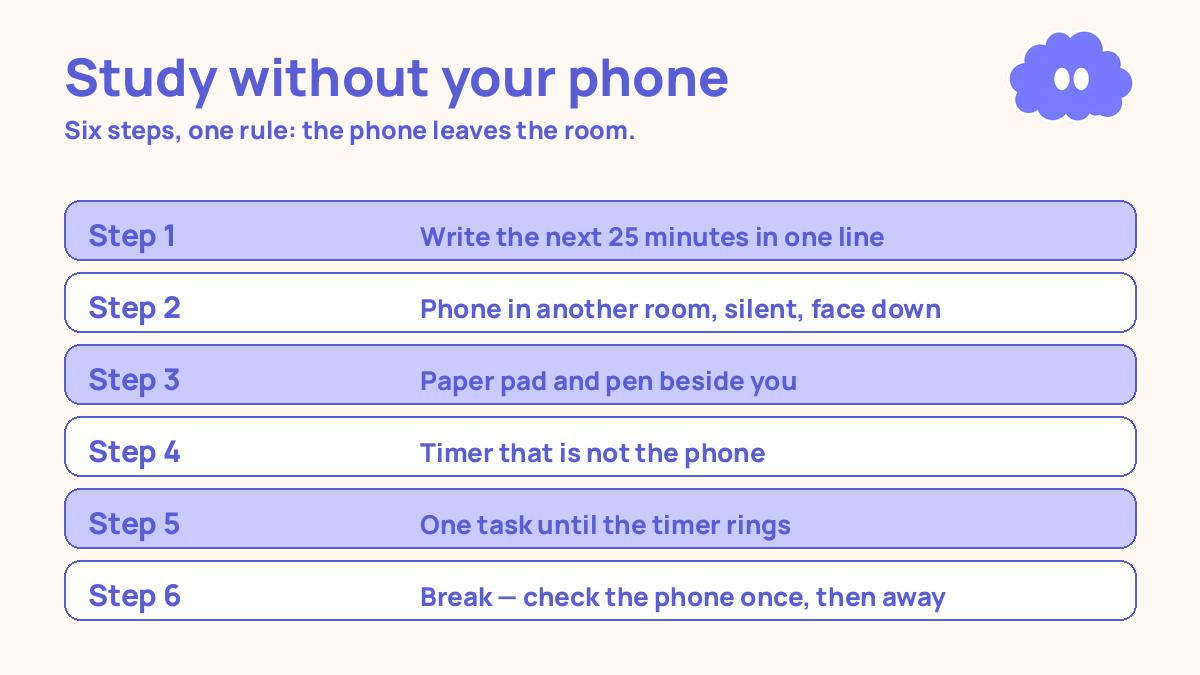
Weekly review checklist
Copy this list and use it each week:
- How many phone-free blocks did I actually complete this week, and on which days?
- What kept appearing on my capture pad — the same two or three things, or something new every time?
- Which block of the day was hardest to keep the phone away, and what was different about it?
- What one change will I make next week: phone further away, a real timer, or a smaller first task?
Downloadable infographic spec: one vertical image, title “Study without your phone”, with the six steps — write the task, phone in another room, capture pad beside you, timer that is not the phone, one task until it rings, check the phone once at the break — in Thynq cream, Cloud Purple, Dark Purple and pink, with the cloud mascot. Text taken word-for-word from this article.
What this system is not
It is not a claim that phones damage your brain, and it is not a promise that removing the phone will raise your grades. The evidence on phone proximity and focus is mixed: one study found an effect, a later replication did not. This system is a practical way to make the easiest distraction harder to reach, so that the 25 minutes you planned actually happen. If your course needs the phone, adapt it: shorter blocks and phone face down at the far end of the desk.
Sources
- Ward, A. F., Duke, K., Gneezy, A. & Bos, M. W. (2017). “Brain drain”, Journal of the Association for Consumer Research 2(2). People whose phone was in another room did better on tests of memory and focus than people whose phone was on the desk, even when the phone was off.
- Ruiz Pardo & Minda (2022). A pre-registered replication that found no significant difference by phone proximity. The evidence is mixed, so phone-in-another-room is presented here as a practical system, not a proven fact.
- Rubinstein, J. S., Meyer, D. E. & Evans, J. E. (2001). Journal of Experimental Psychology: Human Perception and Performance 27(4), 763–797. Mean switch costs were 614 to 1,096 milliseconds per switch.
- Cirillo, F. — Pomodoro Technique, late 1980s. Classic cycle: 25 minutes work, 5 minutes break, longer break after four. The 25-minute length was Cirillo’s practical choice, not a science-derived number.
Questions
Do I have to put my phone in another room?
That is the version that works best: out of sight and out of reach. If you live in one room, put it in a bag on the far side of the room, face down, on silent. The point is that picking it up takes effort.
What if I need my phone for study, like a timer or a dictionary?
Use something else for the job. A kitchen timer, a watch, or your laptop timer replaces the phone timer. A paper dictionary or a laptop tab replaces the phone dictionary. Every job you keep on the phone is a reason to pick it up.
What if someone needs to reach me urgently?
Tell one person you are studying until a set time and to knock if it is urgent. Real emergencies are rare, and most messages can wait 25 minutes. If you are genuinely on call, use shorter blocks and check the phone between them.
Will I still reach for my phone out of habit?
Yes, for the first week or so. That is why the system uses a paper capture pad: when the urge comes, you write the thing down instead of opening the phone. The urge passes in a minute or two.