
The direct answer
How to study when your shifts clash with your lectures: sort every lecture into must-attend live, catch-up from the recording, or notes-only. Every missed lecture gets a catch-up slot within 48 hours, never a vague later. That slot is the whole system.
A clash is not one problem. It is three problems wearing the same clothes: the lecture you miss, the notes you never take, and the gap that opens up three weeks later when the exam assumes you were there. Most students handle only the first one, by asking for a swap or skipping the lecture, and the gap opens anyway. The system below maps every clash for the term, sorts the lectures, and gives each missed lecture a fixed catch-up slot.
The system in short
- Map the clash: every lecture against every shift for the whole term, in one calendar.
- Sort every lecture into must-attend live, catch-up from the recording, or notes-only.
- Book a 48-hour catch-up slot for every missed lecture: recording, notes, and practice, fixed in the calendar.
- Ask for the swap first, with dates and a swap offered, using the words in Step 4.
- Close the gap with a classmate’s notes and the lecturer’s office hours, with two questions ready.
- Review on Sunday for 15 minutes: how many lectures clashed, how many catch-ups ran, and what to ask for next week.
Step 1: Map the clash for the whole term
Start with one calendar that holds both your timetable and your rota. Put every lecture, lab, seminar, and deadline on it first, then add every shift. The clashes will show themselves: Tuesday 9.00 lecture against a Tuesday 8.00 to 12.00 shift, every week. Thursday lab against a Thursday closing shift, twice a month. A map for one week is not enough, because a clash that happens once is an accident and a clash that happens every week is a pattern, and patterns need a different fix.
Count the clashes by kind: how many clash every week, how many clash once or twice, and how many are labs or assessed seminars, where missing them costs marks? Three weekly clashes need a rota conversation. One clash in a term needs a single catch-up slot.
If your rota changes every week, the map changes with it. Re-map when the new rota lands, using the re-plan in How to study when your rota changes.
Step 2: Sort every lecture into must-attend, catch-up, or notes-only
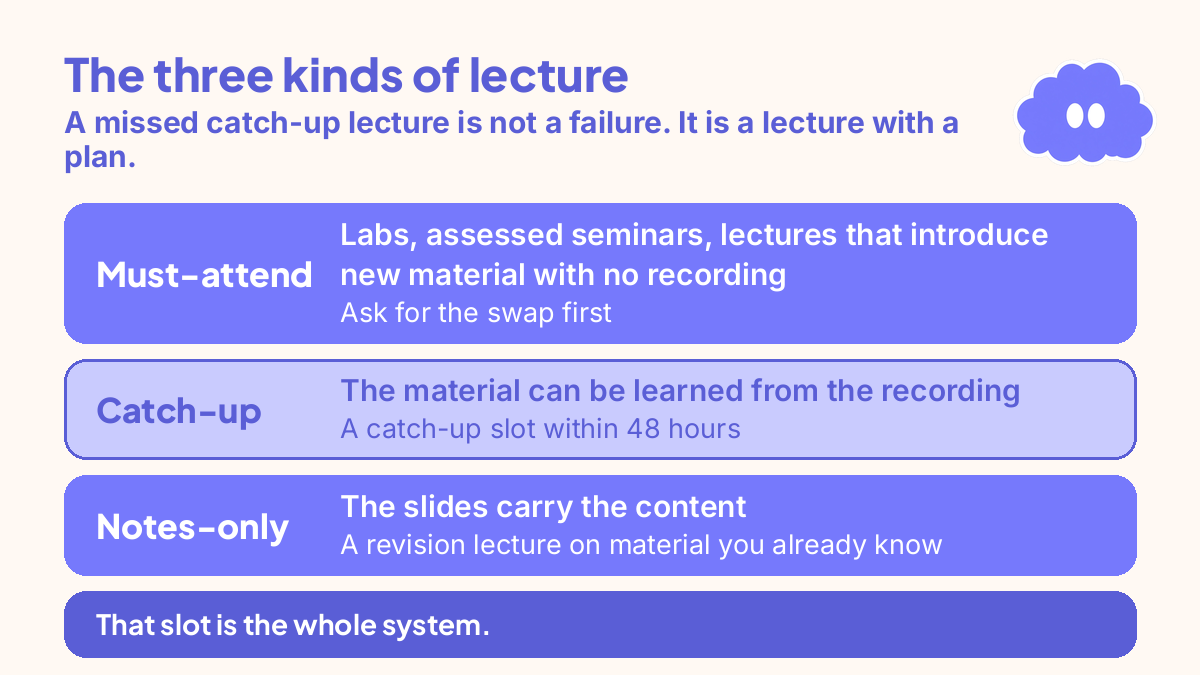
Not every lecture needs you in the room. Sort each one into three kinds. Must-attend means the lecture cannot be caught up: labs, assessed seminars, lectures that introduce new material with no recording, and any session where attendance is marked. Catch-up means the lecture is recorded and the material can be learned from the recording: most standard lectures. Notes-only means the lecture adds little beyond the slides: a revision lecture on material you already know, or a guest talk with notes provided.
Ask two questions for each lecture: is it recorded, and does it introduce new material or assess you? If it is not recorded and it introduces new material, it is must-attend. If it is recorded, it is catch-up. If the slides carry the content, it is notes-only. Write the kind next to each lecture in the calendar, so a clash on Tuesday morning already has its answer before the week starts.
This sort is what stops the guilt. A missed catch-up lecture is not a failure. It is a lecture with a plan. A missed must-attend lecture is the one to fight for. For lectures you do attend, the system in How to take notes in lectures makes the notes worth catching up from.
Step 3: Book a 48-hour catch-up slot for every missed lecture
A missed lecture without a catch-up slot is a gap that grows. The rule is 48 hours: within two days of the missed lecture, sit down for one hour and do three things. First, watch the recording at normal speed and take notes as if you were there, pausing to write, not to rewind endlessly. Second, compare your notes with a classmate’s notes and fill the holes. Third, test yourself from memory on the three main points of the lecture, then check.
Book the slot in the calendar the moment you know you will miss the lecture. Tuesday 9.00 lecture missed, catch-up slot Wednesday 7.00 to 8.00. The slot is fixed, like a shift. If the lecture is not recorded, the slot becomes a notes-and-questions session: read the slides, borrow notes, write down the three things you do not understand, and take them to office hours.
One hour per missed lecture is enough if you do it within 48 hours. After a week, the same catch-up takes two hours, because you have forgotten the context and the course has moved on. For recorded lectures, the method in How to study video lectures properly covers how to watch without drifting.
Step 4: Ask for the swap first, with dates and a swap offered
Before you accept a clash, ask for a swap. The ask has four parts: the dates, the lecture, the reason, and the swap you offer. “My Tuesday 9.00 lecture clashes with my Tuesday shift for the next six weeks. The lecture introduces new material and is not recorded. Could I swap my Tuesday shift for a Thursday shift? I can work Thursday 8.00 to 12.00 instead.” That is a request a manager can say yes to, because it solves their problem as well as yours.
Ask at least a week before the rota is written, and ask in person or by message, not in the middle of a busy shift. If the swap is refused, ask for the next best thing: a later start on that day, so you catch the second half of the lecture, or a different day for the same shift. If you need the words for the wider conversation, How to ask your boss for study time has a script for exactly this, including what to say when the answer is no.
Keep a note of every ask and every answer. A swap refused in week two, asked again in week six with exam dates attached, sometimes lands differently. If the clash is with a must-attend lecture every week, tell your tutor.
Step 5: Close the gap with notes and office hours
A catch-up slot on your own closes most of the gap, but not all of it. The rest closes with two things: a classmate’s notes and the lecturer’s office hours. Find one classmate in each course who takes good notes and ask to compare notes after any lecture you miss. Offer the same in return when they miss one. Compare, do not copy: read their notes, mark the three things yours missed, and add them in your own words. Copying notes you do not understand is not catching up.
Then take two questions to office hours. Not “I missed the lecture, can you explain it”, which asks the lecturer to repeat an hour in 10 minutes, but two specific questions from your catch-up: “In the Tuesday lecture, why does the second stage need a catalyst?” or “I got the first two steps of the problem, but the third step does not match the slides. Where did I go wrong?” Specific questions get specific answers, and they show the lecturer you did the work. Most lecturers are far more helpful to a student who missed a lecture and did the catch-up than to one who missed it and did nothing.
If the gap is still open after the catch-up and office hours, say so in the Sunday review and move the topic into the next week’s hard task.
Step 6: Review on Sunday for 15 minutes
On Sunday, or on your first free evening after the week ends, spend 15 minutes on three questions. First, how many lectures clashed this week, and of which kind? Second, did every missed lecture get its 48-hour catch-up, and did the catch-ups actually run? Third, what must next week protect: one must-attend lecture, one swap ask, one office-hours visit?
If the same lecture clashes every week and the swap keeps being refused, the review is where you decide to escalate: a conversation with your tutor, a different shift pattern, or a timetable change. For weeks when one hour a day is all you have, How to study in one hour a day shows how to fit the catch-up into a single hour.
A worked example: a Tuesday lecture that clashes every week
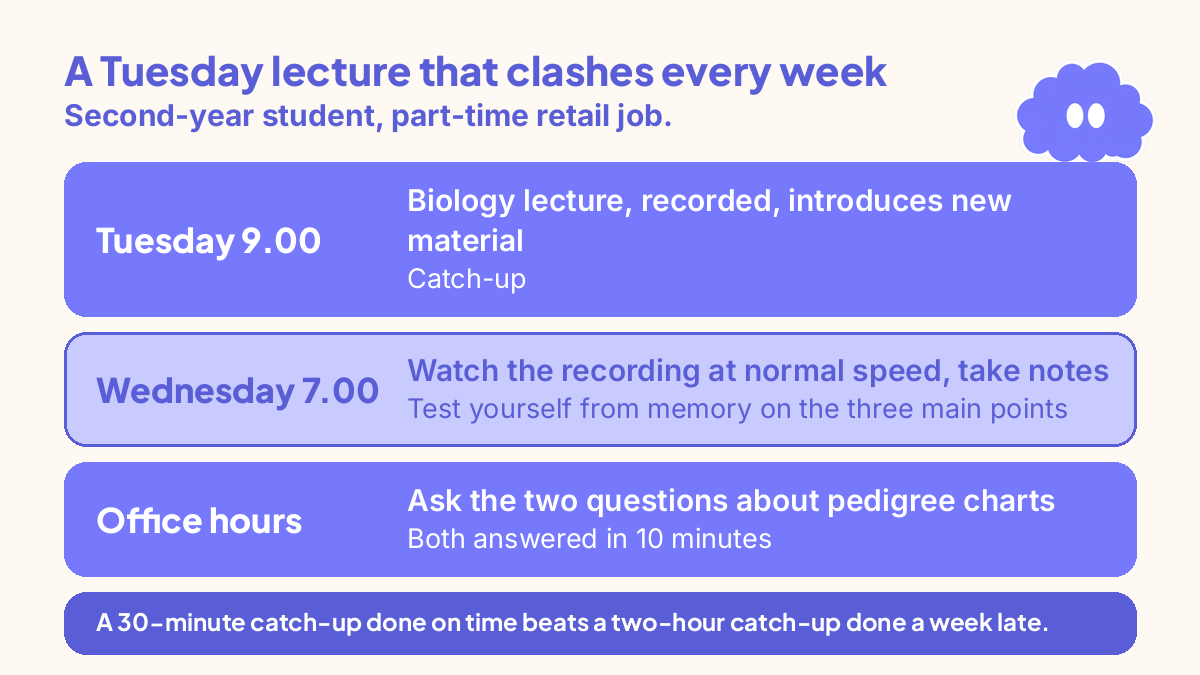
Your situation: Second-year student, part-time retail job. Tuesday shift 8.00 to 12.00 clashes with the Tuesday 9.00 biology lecture, every week. Thursday 2.00 lab is must-attend and never clashes. Exam in six weeks, weakest topic is genetics, and the Tuesday lectures cover genetics for the next four weeks.
- Week one, map and sort: Tuesday 9.00 biology lecture, recorded, introduces new material: catch-up. Thursday 2.00 lab: must-attend. Ask for the swap on Monday: Tuesday shift for Thursday morning shift. Manager says no this week, but will try next week.
- Tuesday, missed lecture: Lecture missed for the shift. Catch-up slot booked: Wednesday 7.00 to 8.00. Borrow notes from a classmate on Tuesday evening.
- Wednesday, catch-up slot: Watch the recording at normal speed, take notes, compare with the classmate’s notes, fill two holes. Test yourself from memory on the three main points: dominant and recessive alleles, Punnett squares, and pedigree charts. Two questions written down for office hours.
- Thursday, lab and office hours: Lab 2.00 to 4.00, attended. Office hours 4.30: ask the two questions about pedigree charts. Both answered in 10 minutes.
- Week two, ask again: Swap asked again on Monday, with the exam date attached. Manager agrees to swap the Tuesday shift for a Thursday shift in weeks three and four.
- Weeks three and four: Tuesday lectures attended live. The catch-up slots become practice slots: past paper questions on genetics, marked and reviewed.
- Sunday review, week four: Four Tuesday lectures, two missed, two attended. Both missed lectures caught up within 48 hours. The genetics gap is closed.
When it goes wrong
You miss a must-attend lecture and there is no recording. Go to the lecturer before the next lecture, not after. Say you missed it for work, say what you have done so far, and ask for the two things you need: the key points and one practice question. Lecturers help students who show the work. Do not wait until the exam to admit the gap.
The catch-up slots keep slipping past 48 hours. Shorten them. A 30-minute catch-up done on time beats a two-hour catch-up done a week late. Watch the recording at normal speed, take notes, test the three main points, stop. If the slot keeps slipping, move it to the morning before your next shift, when nothing can take it.
Your manager refuses every swap and the same lecture clashes every week. Tell your tutor. They have seen this before, and they may know of an evening group, a recorded alternative, or a timetable change. If nothing changes, the catch-up system still works, but it needs the full hour every week, and the exam plan should give that topic extra practice.
You miss a lecture, catch up, and still feel behind. That is normal for one week. If it does not fade after three weeks, the problem is the topic, and the topic needs a hard task on a day off.
You fail an exam on a topic you missed for work. Do not write the topic off. A failed exam can often be retaken, and a retake with a catch-up system is a different exam from the first attempt. The system in How to retake an exam: a study system for students who have to sit it again covers how to rebuild after a failed attempt.
Weekly review checklist
- How many lectures clashed this week, and of which kind: must-attend, catch-up, or notes-only?
- Did every missed lecture get its 48-hour catch-up, and did the catch-ups actually run?
- Did the swap asks go in on time, and what were the answers?
- Did office hours happen, and did the two questions get answered?
- Which topics still have a gap, and what will close it next week?
- What will change next week: a new swap ask, a different catch-up time, or a conversation with a tutor?
Downloadable infographic spec: one vertical image, title “How to study when your shifts clash with your lectures”, with the six steps from “The system in short” and the six review questions above, in Thynq cream, Cloud Purple, Dark Purple and pink, with the Cloud mascot. Text taken word-for-word from this article.
What this system is not
It is not a promise that shifts and lectures stop clashing. They will clash, and some weeks the clash will win. It is not a way to attend every lecture while working every shift, and it will not work if you miss lectures without a catch-up slot and then blame the job when the gap opens. What it does is smaller: it sorts the lectures, protects the ones that matter, and gives every missed lecture a fixed hour to come back.
Sources
- Dunlosky, J., et al. (2013). Improving students’ learning with effective learning techniques. Psychological Science in the Public Interest, 14(1), 4-58. Practice testing and distributed practice rated high; rereading rated low.
- Cepeda, N. J., et al. (2006). Distributed practice in verbal recall tasks. Psychological Bulletin, 132(3), 354-380. Spaced practice beat massed practice.
- Roediger, H. L., & Karpicke, J. D. (2006). Test-enhanced learning. Psychological Science, 17(3), 249-255. Recallers remembered more a week later than restudiers.
For the wider working-student system behind this one, start with How to build a study system that fits your life.
Questions
What should I do when my work shifts clash with my lectures?
Sort every lecture into must-attend live, catch-up from the recording, or notes-only. Ask for a shift swap for the must-attend ones first. Give every missed lecture a catch-up slot within 48 hours, with the recording, notes, and practice questions.
Is it okay to miss lectures because of work?
Sometimes, but only for lectures you can genuinely catch up on. Labs, assessed seminars, and lectures that introduce new material are must-attend. A recorded lecture with good notes can be caught up. Missing a must-attend lecture without a plan is how gaps open up.
How do I catch up on a lecture I missed for work?
Watch the recording within 48 hours, take notes as if you were there, then test yourself from memory on the three main points. Borrow a classmate’s notes and compare them with yours. Take two questions to the lecturer’s office hours.
How do I ask my boss to change a shift that clashes with a lecture?
Ask with the dates and a swap offered, at least a week before the rota is written. Say which lecture clashes and why it cannot be missed, and offer a shift you can work instead. One specific ask with a swap attached is far easier to say yes to than a general complaint.