
The direct answer
When your rota changes, do not rebuild your whole study plan. Spend five minutes on the day the new rota lands, move your study blocks into the free gaps the new rota leaves, and keep one floating block that can land on any day of the week.
A fixed weekly timetable only works when the week repeats. For a student on a changing rota, the week never repeats, so the plan has to be rebuilt every time the rota arrives. That sounds like extra work, but it takes five minutes once you have the routine, and it is the difference between a week where study happens and a week where it quietly disappears. The system below gives you that routine, a minimum week for the worst rotas, and a way to ask for what you need from work.
The system in short
- When the new rota lands, spend five minutes re-planning: mark work, sleep, and classes, then place study blocks in the gaps.
- Keep two fixed blocks and one floating block: the fixed blocks sit in the gaps that appear most weeks, the floating block lands wherever the rota leaves room.
- Give every block one task before you start, written in the plan, so a 30-minute gap is never spent deciding what to do.
- Run the minimum week when the rota is brutal: two 30-minute test sessions and one 20-minute review, all from memory.
- Ask for the rota earlier and for one protected hour around exams, using the words in Step 5.
- Review on Sunday for 15 minutes: what the rota did to the week, what to change next time, and what the next rota must protect.
Step 1: Re-plan for five minutes the day the rota lands
The re-plan starts the moment you see the new rota, not on Monday morning. Open your calendar and mark three things first: work shifts, sleep, and fixed classes or deadlines. What is left is your real free time, and it will look different every week. Then place your study blocks. Look for the two longest free gaps first and put your hardest task in the longer one. A 90-minute gap before an evening shift is worth more than three 30-minute gaps scattered across the week, because hard tasks need an unbroken stretch. Fill the smaller gaps with short tasks: flashcards, a practice question, or reading one page of notes and testing yourself on it.
Write the plan down, on paper or in your phone, with a time and a task for each block. A block that says “study” gets skipped. A block that says “Tuesday 7.00 to 7.45, test myself on cell division from memory” gets done, because you know exactly what to do when the time comes. If you use a revision timetable that works, build it from the new rota each week instead of copying last week’s version.
Step 2: Keep two fixed blocks and one floating block
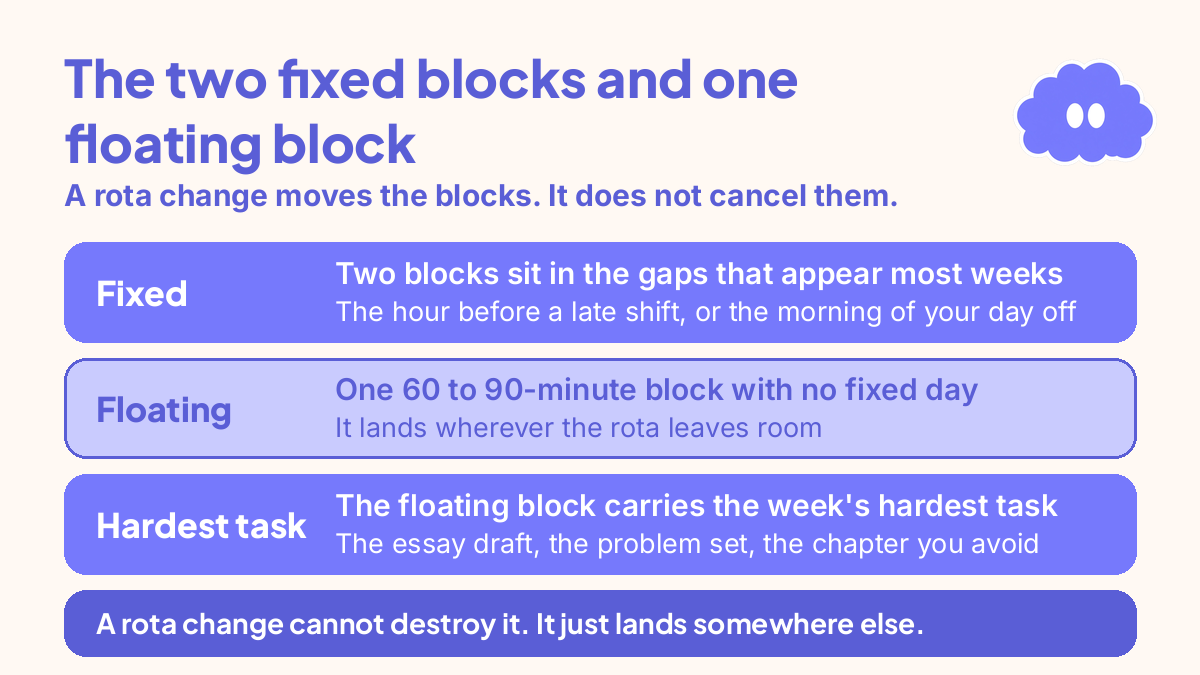
Two blocks stay roughly where they are most weeks, and one block floats. The fixed blocks sit in the gaps your rota usually leaves: the hour before a late shift, the morning of your regular day off, the lunch break on a short day. They are fixed in the sense that you defend them, not in the sense that they never move. When the rota moves them, you move them, in the five-minute re-plan.
The floating block is the part most students miss. It is one 60 to 90-minute block with no fixed day. Each week, when the rota lands, you look at where the biggest free gap fell and you put the floating block there. It carries the week’s hardest task: the essay draft, the problem set, the chapter you have been avoiding. Because it has no fixed day, a rota change cannot destroy it. It just lands somewhere else.
Step 3: Give every block one task before you start
A study block fails most often in its first two minutes, when you sit down and have to decide what to do. With a changing rota, that decision is harder, because the block is at a different time and you are in a different mood. So decide in the re-plan, not in the block.
Each block gets one task, one subject, and one finish line. “Revise biology” is not a task. “Write the stages of mitosis from memory, check against notes, re-write the two I missed” is a task, and you know when it is done. Short blocks get short tasks: ten flashcards, three practice questions, one diagram from memory. Long blocks get one hard task, not three medium ones, because switching tasks inside a block wastes the time you fought the rota to win.
Step 4: Run the minimum week when the rota is brutal
Some rotas leave almost nothing. A week of late shifts, an early start, and a weekend shift can wipe out every block you planned. That is when the minimum week matters, because it is the difference between a bad week and a lost week.
The minimum week is 80 minutes, in three sessions. Two 30-minute sessions, testing yourself from memory on the most important topic, and one 20-minute review of what you got wrong. Do them wherever they fit: before a shift, on a break, on the bus. They are short on purpose. A tired student after a long shift will do 30 minutes of testing from memory, but will not do two hours of reading, and 30 minutes of testing beats two hours of reading anyway.
If even the minimum week does not fit, do one 10-minute test a day for five days. Ten minutes, one topic, from memory, then check. It keeps the habit alive and the material warm, and it stops the week from becoming a zero. The rule is simple: a rota can shrink the week, but it cannot cancel it. For the evenings when you are too tired to start at all, use the system in How to study when you are tired after work.
Step 5: Ask for the rota earlier and protect one hour around exams
You cannot control the rota, but you can often get it sooner, and sooner is worth a lot. When the rota lands late, you plan late, and late planning means the first two days of the week are already gone. Ask your manager when the rota is usually ready and whether you can have it a day earlier, or at least know the day it will appear. Say why in one sentence: you have exams and assignment dates that do not move, and you plan your study around the rota. Most managers would rather give you the rota a day early than have you ask for a shift swap at the last minute.
Around exams, ask for something specific. Not “less work”, which is vague and easy to refuse, but one protected thing: no closing shift the night before the exam, or the exam morning off, or no rota change in exam week. One specific ask, made two weeks early, with the date named, has a far better chance than a general complaint made the day before. If you need the words, How to ask your boss for study time has a script for exactly this conversation, including what to say when the answer is no.
If the answer is no and the rota stays late and changeable, the system still works. It just leans harder on the floating block and the minimum week. That is what they are for.
Step 6: Review on Sunday for 15 minutes
On Sunday, or on your first free evening after the week ends, spend 15 minutes on three questions. First, what did the rota do to the week? Which blocks survived, which ones moved, which ones vanished? Second, what will you change next time the same pattern appears? If late shifts always eat the evening block, stop planning evening blocks in late-shift weeks and plan morning blocks instead. Third, what must the next rota protect? One exam, one deadline, one long block for the hardest task.
Write the answers in two or three lines. That note is what makes the system improve instead of repeating. If your job is the kind where shifts change every week by design, the system in Study system for shift-work students covers the longer patterns behind the weekly changes.
A worked example: a rota that changes on Wednesday
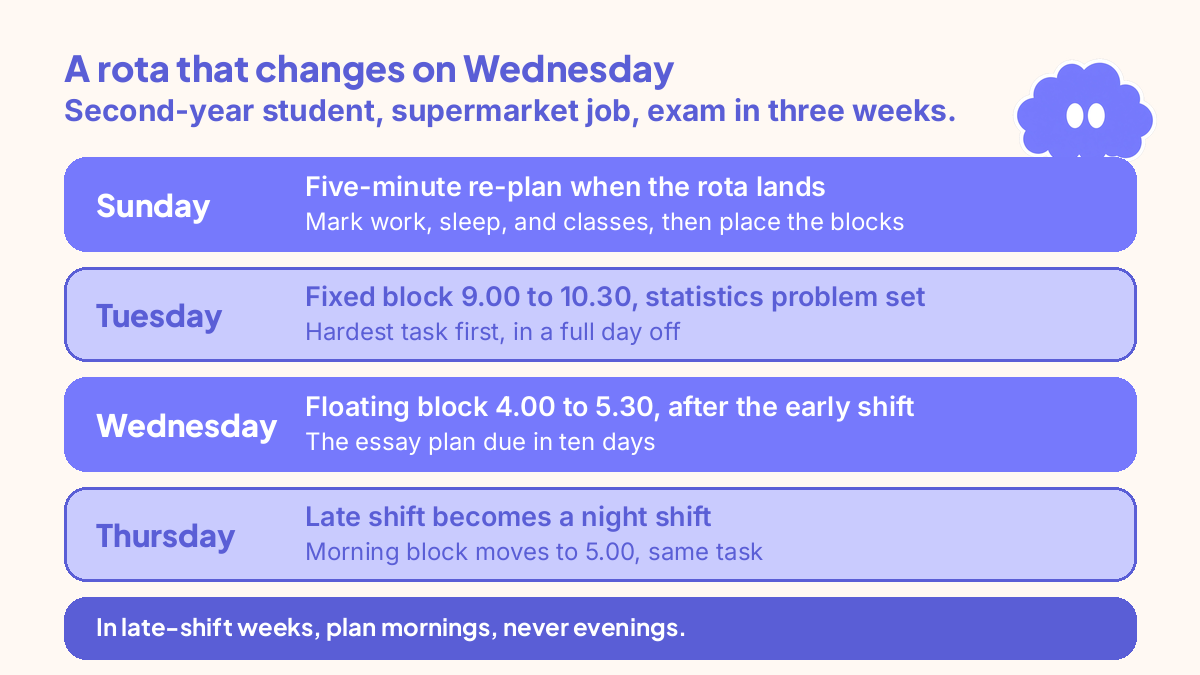
Your situation: Second-year student, part-time job in a supermarket. Rota for next week lands on Sunday evening: Monday late shift 2.00 to 10.00, Tuesday day off, Wednesday early shift 7.00 to 3.00, Thursday late shift 2.00 to 10.00, Friday day off, Saturday shift 10.00 to 6.00, Sunday day off. Exam in three weeks, weakest topic is statistics, and last week’s rota was completely different.
- Sunday evening, five-minute re-plan: Mark work and sleep. Free gaps: Tuesday all day, Wednesday evening after 3.00, Friday all day, Sunday all day, Monday morning before 2.00, Thursday morning before 2.00, Saturday evening after 6.00.
- Fixed blocks: Tuesday 9.00 to 10.30, statistics problem set, hardest task first. Friday 9.00 to 10.30, test the whole statistics chapter from memory. These sit in the two full days off, the gaps that appear most weeks.
- Floating block: Wednesday 4.00 to 5.30, after the early shift, for the essay plan that is due in ten days. It lands on Wednesday because that is where the longest midweek gap fell.
- Short blocks: Monday 11.00 to 11.30, ten flashcards before the late shift. Thursday 11.00 to 11.30, three practice questions. Saturday 7.00 to 7.30, review the week’s mistakes.
- Wednesday change: On Wednesday morning the manager swaps your Thursday late shift to a night shift, 10.00 to 6.00. Thursday morning block moves to Thursday evening after sleep, 5.00 to 5.30, same task, three practice questions. Nothing else changes, because the floating block already landed and the fixed blocks sit on days off.
- Sunday review: Late shifts ate no blocks this week because the blocks sat in mornings and days off. Note for next time: in late-shift weeks, plan mornings, never evenings. Next rota must protect Tuesday morning, the statistics block before the exam.
When it goes wrong
The rota lands late, on Tuesday, and Monday is already gone. Do not try to rescue Monday. Start the re-plan from Tuesday and run the minimum week for the days that are left. A late rota costs you one day, not the week, unless you spend the week angry about Monday.
Your manager changes a shift after you planned around it. Move the affected block, not the whole plan. Find the next free gap of the same size, move the block and its task there, and leave everything else alone. If no gap fits, split the task into two short sessions and do the minimum week for that subject.
You keep planning evening blocks and late shifts keep eating them. Stop planning evenings in late-shift weeks. The pattern is telling you something. Plan mornings before late shifts and full blocks on days off, and let evenings be for rest or a 10-minute test. A plan that keeps failing in the same place is not a discipline problem. It is a planning problem.
You skip the Sunday review because the week was messy. That is the week the review matters most. Fifteen minutes, three questions, two lines of notes. The review is what turns a messy week into a lesson instead of a repeat.
Weekly review checklist
- Did the re-plan happen on the day the rota landed, or did planning slip to midweek?
- Which blocks survived the rota, and which ones moved or vanished?
- Did the floating block land, and did it carry the hardest task?
- Did every block have one task written down before it started?
- Did the minimum week run, and was 80 minutes enough to keep the material warm?
- What pattern in the rota keeps breaking the plan, and what will change next time?
Downloadable infographic spec: one vertical image, title “How to study when your rota changes”, with the six steps from “The system in short” and the six review questions above, in Thynq cream, Cloud Purple, Dark Purple and pink, with the Cloud mascot. Text taken word-for-word from this article.
What this system is not
It is not a promise that a changing rota stops being hard. Some weeks will still be short on time, and some rotas will still land late. It is not a fixed timetable, and it will not work if you copy last week’s plan and hope the rota matches. What it does is smaller and more useful: it gives you a five-minute routine that turns whatever rota arrives into a week where study still happens.
Sources
- Dunlosky, J., et al. (2013). Improving students’ learning with effective learning techniques. Psychological Science in the Public Interest, 14(1), 4-58. Only practice testing and distributed practice rated high; rereading and highlighting rated low.
- Cepeda, N. J., et al. (2006). Distributed practice in verbal recall tasks. Psychological Bulletin, 132(3), 354-380. Spaced practice beat massed practice; the optimal gap grows with how long you need to remember.
- Roediger, H. L., & Karpicke, J. D. (2006). Test-enhanced learning. Psychological Science, 17(3), 249-255. Recallers remembered more a week later than restudiers, though restudiers felt more confident immediately.
For the lunch-break blocks this system relies on, read How to study on your lunch break. For the wider working-student system behind it, start with How to study with a part-time job.
Questions
How do I study when my work rota changes every week?
Re-plan on the day the new rota lands, not on Monday. Spend five minutes marking your new free blocks, move your study blocks into them, and keep one floating block that can land on any day. A fixed weekly timetable breaks when the rota changes; a re-plan routine does not.
What if my new rota wipes out all my study time?
Drop to the minimum week: two 30-minute test sessions and one 20-minute review, all from memory, using the gaps you still have. That is 80 minutes, and it keeps the material warm. Then use your next day off for one longer session to catch up on the new material you missed.
Should I ask my boss for my rota earlier?
Yes, if your course has fixed deadlines. Ask for the rota as early as the rota allows, and say why: you need to book study time around exams and assignment dates. If the rota still comes late, the five-minute re-plan in this system is what saves the week.
How do I keep a study habit when no two weeks look the same?
Keep the habit small and tied to something that happens every day, not to a time of day. Test yourself for 10 minutes after your evening meal, or review flashcards on the bus. The time changes with the rota; the trigger stays the same, so the habit survives.