The direct answer
Ask your boss for one specific thing, at the right time, with something to offer in return — and get the answer written down before you leave the room. The specific thing might be a fixed finish time two nights a week, a shift swap on one day, or two leave days in exam week. The trade might be covering a colleague’s shift, or finishing a piece of work early. The written note is what turns a friendly yes into a plan you can actually study around.
You need one clear ask, one honest reason, one offer in return, and a short message afterwards that records what was agreed.
Why most students never ask
Most working students never ask their boss for study time at all. They fit study around whatever hours they are given, and when the hours get in the way, they study less and blame themselves.
There are two reasons for that. The first is fear: asking feels like admitting you cannot cope, or like asking for special treatment. The second is vagueness: “I need more time to study” is not something a boss can say yes to, because it has no shape. It does not say which hours, which days, or for how long.
The system in short
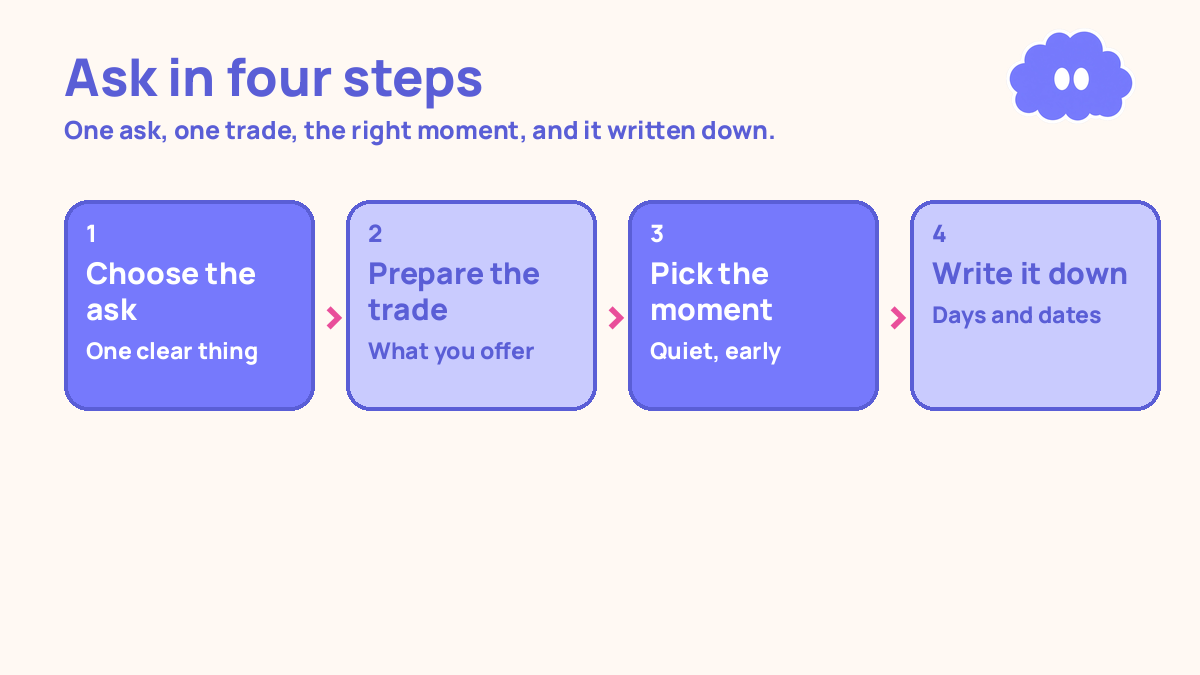
- Choose one specific ask: a fixed finish time two nights a week, a shift swap, or leave days in exam week.
- Prepare the trade: what you will offer in return, in the same conversation.
- Pick the moment: early in the week, in a quiet moment, at least two weeks before you need it.
- Say it in plain words: one sentence for the ask, one for the reason, one for the trade.
- Write it down afterwards: a short message with the days, times, and dates — agreed by both of you.
If the boss says yes, fit the agreed hours into the Study system for students with a full-time job so they do not drift.
Step 1: Choose one specific ask
A boss can say yes to a specific ask. A boss cannot say yes to “I need more study time”. So pick one thing, and make it concrete enough to fit on a rota.
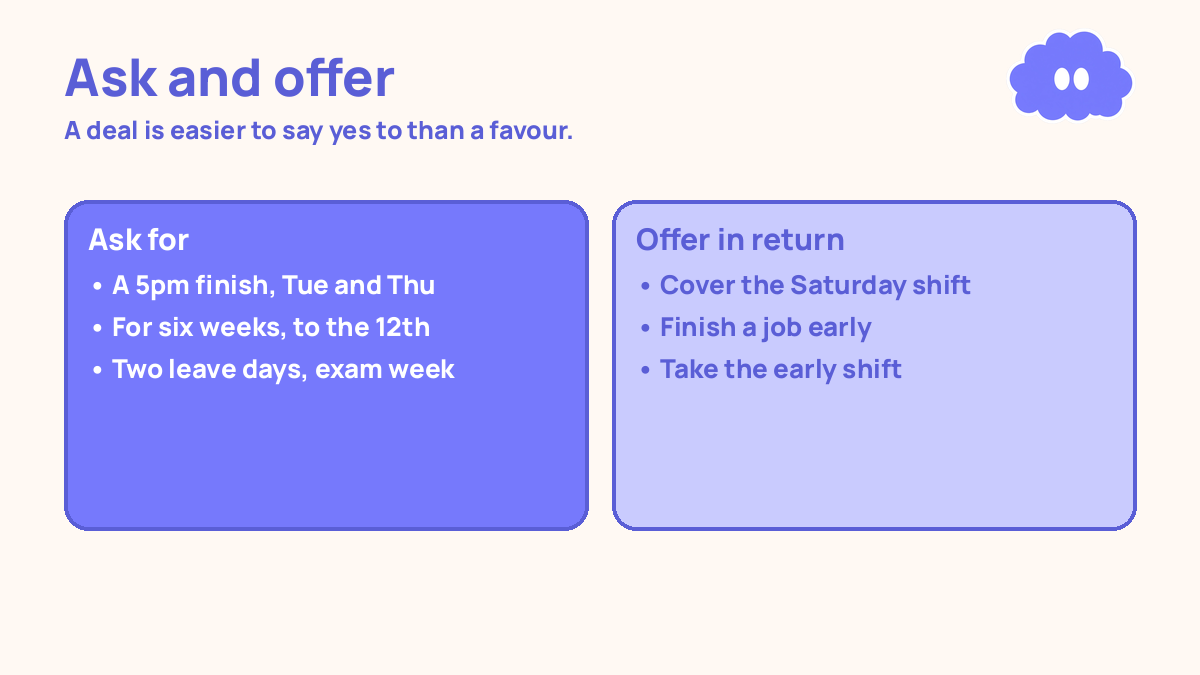
There are three asks that work for most working students. The first is a fixed finish time: “Can I finish at 5pm on Tuesdays and Thursdays for the next six weeks?” The second is a shift swap: “Can I swap my Saturday shift for a weekday shift until the exam?” The third is leave: “Can I take two days off in exam week, on the 12th and 13th?”
“For the next six weeks” is easier to agree to than “from now on”.
Step 2: Prepare the trade
An ask with nothing in return is a favour. An ask with a trade is a deal, and deals are easier to say yes to. Before the conversation, decide what you will offer.
The trade should cost you something real but not your study time. Covering a colleague’s Saturday shift once a month. Finishing a piece of work early before the exam week. Taking the early shift on a day when nobody else wants it. The point is not to pay for the time — it is to show that you have thought about the team’s side, not only your own.
Write the trade down before you ask, in one line, next to the ask. If you cannot think of a trade, ask yourself what your boss worries about most: cover on a busy day, a deadline, a shift nobody wants.
Step 3: Pick the moment
Ask early in the week, in a quiet moment, and at least two weeks before you need the time. Those three rules decide whether the conversation works. Early in the week, because rotas are usually set then and changes are still possible. A quiet moment, because a boss in the middle of a crisis cannot think about your rota. At least two weeks before you need it, because a boss who has time to plan can say yes, and a boss asked on the day cannot.
Never ask on the day you need the time. “Can I leave early tonight?” is an emergency, not a plan, and it will be remembered as one. Never ask in front of colleagues, either. A public ask puts the boss on the spot, and people on the spot say no.
If your boss is always busy, ask for two minutes at a time that suits them: “Do you have two minutes on Tuesday morning? I want to ask about my hours.”
Step 4: Say it in plain words
Here is the whole conversation, in four short sentences. “I am studying for an exam in six weeks. Could I finish at 5pm on Tuesdays and Thursdays until then, so I can study in the evenings? In return, I can cover the Saturday shift once a month. Would that work?”
That is it. One sentence for the situation, one for the ask, one for the trade, one question at the end. No long explanation, no apology, no story about how hard it is. A short ask respects the boss’s time, and it is easier to answer.
Say it once, then stop talking. The hardest part is the silence after the question. Fill it and you will start negotiating against yourself — offering more, asking for less, apologising for asking at all. Ask the question, then wait.
If the boss says yes, thank them and move to Step 5 at once. If the boss says “let me think about it”, agree a time to come back: “Shall I check back on Thursday?”
Step 5: Write it down
After the conversation, send a short message the same day: “Thanks for agreeing — just to confirm, I will finish at 5pm on Tuesdays and Thursdays from next week until the 12th, and I will cover the Saturday shift on the 20th. Let me know if I have that wrong.”
That message does three things. It records what was agreed, so nobody forgets. It gives the boss a chance to correct you if you misunderstood. And it shows you are serious — a student who writes it down is a student who will keep their side of it.
A worked example: the conversation and the week after
You work in a shop, full time, and you have an exam in six weeks. Your normal finish is 6pm, and by the time you get home and eat, your two-hour study session starts at 8pm and you are too tired to use it. You need two evenings a week finishing at 5pm.
Monday morning — you ask: You catch your manager after the morning handover, when the shop is quiet. “I am studying for an exam in six weeks. Could I finish at 5pm on Tuesdays and Thursdays until then, so I can study in the evenings? In return, I can cover the Saturday shift on the 20th. Would that work?” She says yes, and you agree to check the rota together on Thursday.
Monday afternoon — you write it down: You send a message the same day. “Thanks for agreeing — just to confirm, I will finish at 5pm on Tuesdays and Thursdays from next week until the 12th, and I will cover the Saturday shift on the 20th. Let me know if I have that wrong.” She replies: “That is right.”
Tuesday, 5:00–7:00pm — study: You finish at 5pm, home by 5:30, and study 6:00–7:00pm, then a second hour 7:15–8:15pm — finished by 8:15, and you are not exhausted because you started an hour earlier.
Thursday, 5:00–7:00pm — study: The same. Two evenings, four hours of study a week, in the part of the evening when you still have energy.
Saturday the 20th — the trade: You cover the Saturday shift, as agreed. Four hours a week for six weeks is 24 hours of study you did not have before — and the only cost was one Saturday shift and one short conversation.
When it goes wrong
The boss says no outright. Do not argue, and do not apologise. Ask one question: “What would make it possible?” The answer tells you what the real problem is — cover on a certain day, a busy period, a rule you did not know about. Then offer a smaller version: one night instead of two, or a later start date. A no to the big ask is often a yes to the small one.
The boss says “we’ll see” and nothing happens. “We’ll see” is not a yes. It is a no that nobody has to say out loud. Give it one week, then go back with a specific question: “I asked about finishing at 5pm on Tuesdays — is that possible from next week?” If the answer is still vague, assume it is a no and try a different ask.
You ask at the wrong time and get a sharp no. You asked on a Friday afternoon, or in the middle of a busy day, and the boss snapped. Do not take that no as final. It was a no to the moment, not to the ask. Wait a week, pick a quiet morning, and ask again, briefly.
The agreement is forgotten the first busy week. The rota changes, your 5pm finish disappears, and nobody mentions it. This is why Step 5 exists. Show the message, politely: “We agreed I would finish at 5pm on Tuesdays until the 12th — is that still possible this week?” A written agreement is easy to point to. A spoken one is easy to forget.
Weekly review checklist
Copy this list and use it each week while the agreement runs:
- Did I get the hours I asked for this week — both days?
- Did I use those hours for study, or did something else take them?
- Did I keep my side of the trade — the shift, the early finish, the deadline?
- Is the agreement still working, or does it need a new conversation?
- What one thing will I do differently next week: ask earlier, write it down sooner, or protect the hours better?
Downloadable infographic spec: one vertical image, title “Ask your boss for study time”, with the four sentences — one for the situation, one for the ask, one for the trade, one question at the end — and the three rules: one specific ask, at least two weeks ahead, written down the same day, in Thynq cream, Cloud Purple, Dark Purple and pink, with the cloud mascot. Text taken word-for-word from this article.
What this system is not
It is not a trick for getting time off, and it is not a way to avoid work. The trade matters because the deal has to be fair — your boss has a rota to run, and your study time comes from somewhere. It is also not a promise that every boss will say yes. Some will not, and some workplaces cannot change hours at all. This system gives you the best chance of a yes: a specific ask, a fair trade, the right moment, and a written record.
Sources
- Gollwitzer, P. M. & Sheeran, P. (2006). Implementation intentions and goal achievement: a meta-analysis of effects and processes. Advances in Experimental Social Psychology, 38, 69–119. If-then plans raised goal attainment (d = 0.65) over holding the goal alone. Decide the cue and the action in advance — “when my manager is free on Tuesday morning, I will ask” — instead of deciding again every day.
- Lally, P., et al. (2010). How are habits formed: modelling habit formation in the real world. European Journal of Social Psychology, 40(6), 998–1009. Median time for a behaviour to feel automatic was 66 days, range 18–254; missing one day did not measurably hurt the process.
For the full system this fits inside, start with the two-hour study system for working students.
Questions
What exactly should I ask my boss for?
One specific thing, not study time in general. A fixed finish time two nights a week, a shift swap on one day, or two leave days in exam week. A specific ask is easy to say yes to; a vague ask is easy to put off.
When is the best time to ask?
After you have done good work, not in the middle of a crisis. Ask early in the week, in a quiet moment, and at least two weeks before you need the time. Never ask on the day you need it.
What if my boss says no?
Ask what would make it possible, and when to ask again. A no to one ask is not a no to every ask. Offer a smaller version — one night instead of two — and put a date in the diary to ask again.
Should I put the agreement in writing?
Yes. A short message after the conversation — the days, the times, and the dates it starts and ends — protects both of you. If it is not written down, it will be forgotten the first time the rota gets busy.