The direct answer
How to study during a placement year is a system for a student who works full time and studies at the same time, for a year. Set three placement goals before you start, build a weekly rhythm around the working day, keep a theory-to-practice log, run a monthly portfolio routine, manage two supervisors, and plan the return to final year.
A placement year is a structured period of full-time work experience built into a university degree, usually between the second and final year. It is also called a sandwich year or an industrial placement. It typically lasts 9 to 12 months, and it is usually assessed, often by a reflective portfolio, and worth a full year of credits.
The system in short
- Set three placement goals before you start: one skill to build, one piece of evidence to collect, and one link to your final year.
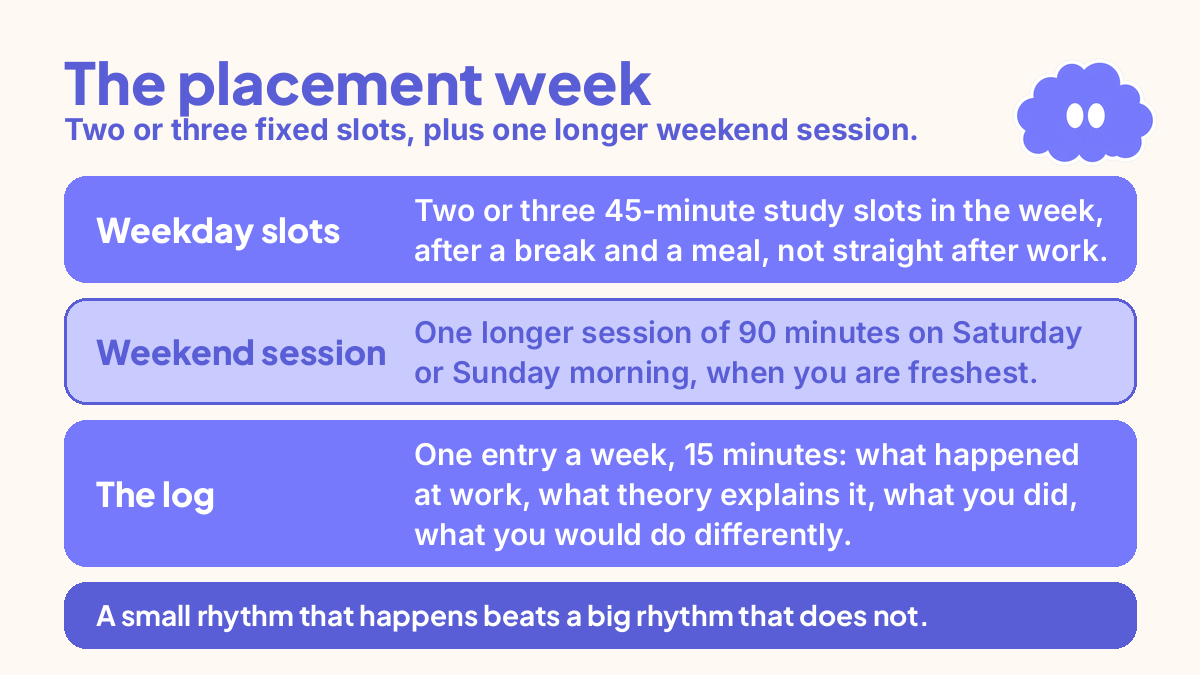
- Build a weekly rhythm around full-time work: two or three fixed 45-minute study slots in the week, plus one longer weekend session.
- Keep a theory-to-practice log: one entry a week linking something at work to something from your course.
- Run the reflective portfolio routine: one monthly entry, written from the log, with evidence collected as you go.
- Manage two supervisors: a work supervisor and a university tutor, with a check-in each month and a question ready for each one.
- Plan the return to final year in the last month: re-test second-year topics, read the final year outlines, and choose a dissertation topic from the placement.
Step 1: Set three placement goals before you start
Do not start the placement without goals. A year without goals becomes a year of work that teaches you things you cannot name, and a portfolio you cannot write. Set three goals before the first day, and write them on one page.
Goal one is a skill to build: one skill the placement can teach you that the degree cannot. It might be a technical skill, such as a software tool or a lab method. It might be a professional skill, such as running a meeting, writing a report for a client, or managing a small project. Name the skill, name how you will practise it, and name how you will know you have it: a project you completed, a task you can now do alone, or a piece of feedback from your supervisor.
Goal two is a piece of evidence to collect: one project, one report, or one piece of work you can describe in the portfolio and use in job applications. It should be real work, with your name on it, that shows what you did and what changed because of it.
Goal three is a link to your final year: one question, topic, or problem from the placement that you want to carry into your final year, as a dissertation topic, a final-year project, or a module choice. The placement is the best source of a final-year topic you will ever have, because it is a real problem you have actually seen.
Check the goals with your university tutor in the first month. If a goal does not fit the assessment, change it now, not in month ten. The system for planning your final year at university shows how the placement goals feed into the final-year plan.
Step 2: Build a weekly rhythm around full-time work
Full-time work leaves less study time than a term at university, and the study that does happen must be short, fixed, and protected. Build the rhythm before the placement starts, and treat the study slots like work meetings: they happen at the same time each week, and they do not move for anything less than an emergency.
The rhythm is: two or three 45-minute study slots in the week, plus one longer session of 90 minutes at the weekend. The weekday slots go in the evening, after a break and a meal, not straight after work.
Protect your sleep and your rest. A placement year is tiring in a way university is not: eight hours of work, every day, with a commute. The one-hour study system for working students and the two-hour study system for working students use the same short-slot logic, and the weekend study plan for working students covers the weekend session in full.
Step 3: Keep a theory-to-practice log, one entry a week
The theory-to-practice log is the heart of the placement year. It is one entry a week, 15 minutes, linking something at work to something from your course. It is the raw material for the portfolio, the final-year project, and the job interview after graduation.
Each entry has four lines. What happened at work this week: one specific event, task, or problem. What theory from your course explains it, or fails to explain it. What you did, and what happened next. What you would do differently, and what you want to learn. Four lines, 15 minutes, once a week, in the first weekday study slot.
The log works because it forces the connection between work and study while both are fresh. A student who writes the log weekly has 40 entries by the end of the year, and the portfolio almost writes itself.
Step 4: Run the reflective portfolio routine, one entry a month
Most placements are assessed by a reflective portfolio, and most portfolios are written in the last week, from memory, in a panic. The routine below writes it in monthly entries, from the log, so the last week is for editing, not for remembering.
Once a month, in the weekend session, write one portfolio entry of 400 to 600 words. The entry has three parts. First, what you did that month, with specific examples and dates. Second, what you learned, in skills and in understanding, with one example that shows it. Third, how it connects to your course theory, with one reference to a concept, a model, or a reading from your degree.
Collect the evidence as you go. Keep a folder, physical or digital, for the evidence: a project report with your name on it, a piece of feedback from your supervisor, a screenshot of a tool you built, a photo of a prototype, a thank-you email from a client.
Check the portfolio criteria in the first month, and check them again every three months. The criteria decide the structure, the length, and the weighting, and writing to the wrong criteria wastes a month. The system for writing a reflective essay uses the same reflection habit, and the working student study planner tool can hold the weekly rhythm.
Step 5: Manage two supervisors, with a check-in each month
A placement year has two supervisors, and they have different jobs. Your work supervisor manages your day-to-day work, your tasks, and your performance. Your university tutor manages your learning, your assessment, and your return to final year. The system works when both know what you need from them, and when you check in with each monthly.
The work supervisor check-in is a 15-minute conversation, once a month, with one question ready: “What should I focus on next month, and what would good look like?” Ask for feedback on one specific piece of work, not on your performance in general.
The university tutor check-in is also monthly, and it has a different question: “Is my portfolio on track, and is my final-year plan realistic?” Bring the log and the latest portfolio entry, so the tutor can see the work, not just hear about it. If the tutor cannot see you in person, send the entry by email and ask for written feedback. A monthly email with the entry attached is enough to keep the relationship alive and the assessment on track.
Step 6: Plan the return to final year in the last month
The return to final year is the part of the placement year students plan least, and it is the part that costs the most marks. A year away from lectures means a year away from the material, and the first month of final year is hard if you arrive cold. Plan the return in the last month of placement, while you still have the weekly rhythm.
In the last month, use the study slots for re-testing, not for new placement work. Re-test the key topics from your second year in short sessions: close the notes, write or say what you remember, then check. Roediger and Karpicke (2006) showed students who recalled material remembered more a week later than students who restudied it, and the re-testing works in 25-minute slots as well as in long sessions.
Read your final year module outlines in the last month, and choose your modules with the placement in mind. And choose a dissertation topic that uses what you learned on placement: a real problem, with real data, that you have actually seen. The system for choosing a thesis topic covers the choice, and the placement gives you the best starting point for it.
Return to study gradually. The first week of final year runs at three quarters of your normal hours, with the weekly rhythm from the placement year kept intact: the same study slots, the same weekend session, the same review.
A worked example: twelve months on placement, 9:00am to 5:00pm
Your situation: Second-year engineering student, 12-month placement at a manufacturing company, September to August. Assessed by a reflective portfolio, 3,000 words, due in August. Final year starts in September.
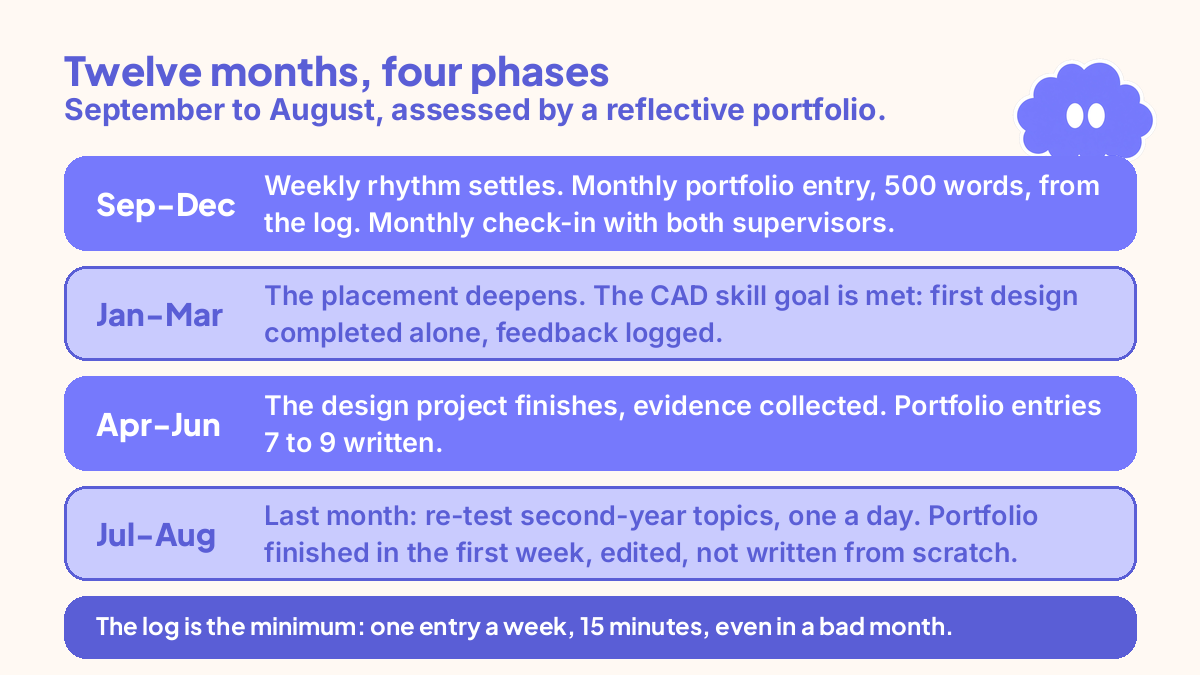
- September, before the placement: set the three goals. Skill: learn the company’s CAD software well enough to complete a design alone. Evidence: one design project, with your name on the drawings. Final-year link: a dissertation on design for manufacture, using a real problem from the placement. Write the goals on one page, check them with the university tutor.
- October to December: weekly rhythm settles. Tuesday and Thursday, 7:00-7:45pm: theory-to-practice log and portfolio reading. Saturday, 9:00-10:30am: longer session, project work and research.
- January to March: the placement deepens. The CAD skill goal is met: first design completed alone, feedback from the supervisor logged. The log shows a pattern: the theory of tolerances explains most of the design problems, and the gaps are in materials.
- April to June: the design project finishes, evidence collected: drawings, feedback, a thank-you email from the production team. Portfolio entries 7 to 9 written.
- July: last month. Study slots move to re-testing: second-year topics, one a day, 25 minutes, close the notes and write from memory.
- August: portfolio finished in the first week, from the monthly entries, edited, not written from scratch. Submitted on time.
When it goes wrong
The placement is boring, and the log is empty. Tell your work supervisor in the first month, with a specific ask: a new task, a new project, or a rotation. If nothing changes in a month, tell your university tutor. A placement that teaches nothing is a placement the university needs to know about.
You stop studying after month two. The rhythm is too big. Cut it to two 45-minute slots a week and one monthly portfolio entry, and protect those. A small rhythm that happens beats a big rhythm that does not. The log is the minimum: one entry a week, 15 minutes, even in a bad month.
The portfolio is due in a week and you have nothing. Write it from the log, not from memory. If there is no log, write it from your calendar, your emails, and your supervisor’s feedback: what you did each month, with dates. It will be thinner than a portfolio built monthly, but it will be honest, and honest beats invented. Then, for final year, keep a log from week one.
Weekly review checklist
Use this checklist at the end of each placement month, in writing, in 20 minutes.
- Did the study slots happen at their planned times this month?
- Is the theory-to-practice log up to date, with one entry per week?
- Is the monthly portfolio entry written, and does it have evidence attached?
- Have I checked in with both supervisors this month, and what did they say?
- Are my three placement goals still on track, or does one need changing?
- What one change will I make to next month’s rhythm, and what stays the same?
Downloadable infographic spec: one vertical image, title “How to study during a placement year”, with the six steps from “The system in short” and the six review questions above, in Thynq cream, Cloud Purple, Dark Purple and pink, with the Cloud mascot. Text taken word-for-word from this article.
What this system is not
This system is not a way to do a full-time degree in the evenings while you work full time. It does not promise grades, and it does not replace the university’s placement support. It turns a year of work into assessed learning, a portfolio, and a final year that starts warm instead of cold.
Sources
- Roediger, H. L., & Karpicke, J. D. (2006). Test-enhanced learning. Psychological Science, 17(3), 249-255. Retrieval practice beat restudying after a delay; the return-to-study re-testing in the last month uses this method.
- Dunlosky, J., et al. (2013). Improving students’ learning with effective learning techniques. Psychological Science in the Public Interest, 14(1), 4-58. Only practice testing and distributed practice rated high utility; the short, spaced study slots in this system follow that finding.
For the full system behind this method, start with how to build a study system that fits your life.
Questions
What is a placement year?
A placement year is a structured period of full-time work experience built into a university degree, usually between the second and final year. It is also called a sandwich year or an industrial placement. It typically lasts 9 to 12 months, and it is usually assessed, often by a reflective portfolio.
How do I study while working full time on placement?
Study in short fixed slots around the working day, not in long evening sessions. Two or three 45-minute slots a week, plus one longer weekend session, is enough for the placement assessments and the theory log. Protect the slots like work meetings, and stop on time.
What should I write in a placement reflective portfolio?
Write about what you did, what it taught you, and how it connects to your course theory, with specific examples and dates. Collect the evidence as you go: a project you worked on, a skill you learned, a problem you solved. A portfolio built in monthly entries beats one written in the last week.
How do I prepare for final year after a placement year?
In the last month of placement, re-test the key topics from your second year in short sessions, read your final year module outlines, and choose a dissertation topic that uses what you learned on placement. Return to study gradually, with a fixed weekly rhythm from week one.