The direct answer
How to write a reflective essay is a sequence, not a mood: choose one incident, pick one model, draft the middle before the introduction, keep description and feelings under 30% of the words, link one piece of theory to what happened, and finish with a concrete action plan.
A reflective essay differs from a coursework essay. It asks what happened, how you felt, what it means, and what you will do differently. The marker checks whether you can look at your own work honestly and learn from it. An essay that only describes an event scores badly, and one that only talks about feelings scores badly too. The marks sit in the analysis.
This system takes five days for a 1,500 word essay, at about one hour a day.
The system in short
- Decode the brief in 20 minutes and choose your model: Gibbs, Kolb, or Driscoll.
- Choose one incident you can describe in five lines, and reject the rest.
- Gather your evidence in 30 minutes: notes, feedback, and one piece of theory.
- Draft in order, middle first, with a word budget for each section.
- Link theory to what happened, one claim at a time, with the theory doing real work.
- Edit in three passes: cut description, check the feelings, and test the action plan.
Step 1: Decode the brief and choose your model
Read the brief twice before you write a word. Most reflective essays fail before drafting because the student answered the wrong question. Circle four things: the word count, the model named, the incident type, and the marking criteria. If the brief names a model, use it.
Gibbs’ Reflective Cycle (1988) has six stages: Description, Feelings, Evaluation, Analysis, Conclusion, Action Plan. Use it for one incident in depth. Kolb (1984) has four stages: Concrete Experience, Reflective Observation, Abstract Conceptualisation, Active Experimentation, and suits repeated practice. Driscoll’s model is shorter still: What, So What, Now What, for short reflections.
Write the model at the top of your plan. Do not switch models halfway through: a marker who expects six stages will look for all six. Check the marking criteria: most schemes give the most weight to analysis and the action plan, so your word budget should match that.
Step 2: Choose one incident you can describe in five lines
A reflective essay needs one incident, not three. Students who try to cover a whole placement write a summary, and summaries have nothing to analyse. Pick the incident that taught you something, not the one that sounds most impressive.
Use the five-line test: what happened, where, who was involved, what you did, and what the result was. If you need more than five lines, the incident is too big. Cut it down to one moment inside it: one difficult conversation, not a whole placement.
Reject incidents that fail any of these three tests. First, you must remember it clearly enough to describe what you actually did, not what you wish you had done. Second, something must have gone wrong, or surprised you, or forced a choice: an incident where everything went smoothly gives you nothing to analyse. Third, you must be able to link it to theory from your module. Write the chosen incident at the top of a fresh page, in five lines, and keep it there.
Step 3: Gather your evidence in 30 minutes
Reflection without evidence is opinion. Before you draft, collect three things: your own notes, feedback from someone else, and one piece of theory. Set a timer for 30 minutes and stop when it rings.
Your own notes come first. Find the notes, journal entries, or lecture notes from the day of the incident. Copy out the facts you need: dates, times, names, what was said, what you did. Do not copy your feelings from the day yet. Feelings belong in the essay, but they need to be the feelings you can stand behind now, not only the ones you felt at the time.
Feedback comes second. If a tutor, mentor, or peer commented on the incident, find that comment. One line is enough: “You spoke too fast and the group stopped listening.” Feedback gives you something to agree or disagree with, and disagreement is good material for analysis. Theory comes third. Pick one piece of theory from your module that explains what happened, and read the original source, not a summary. Write it in two sentences of your own, and note the page or chapter so you can cite it. Put the three pieces of evidence on one page: facts, feedback, theory.
Step 4: Draft in order, middle first, with a word budget
Draft the middle first. The introduction and conclusion are easier once the analysis exists. Work through the model stages in order, and give each stage a word budget before you write it.
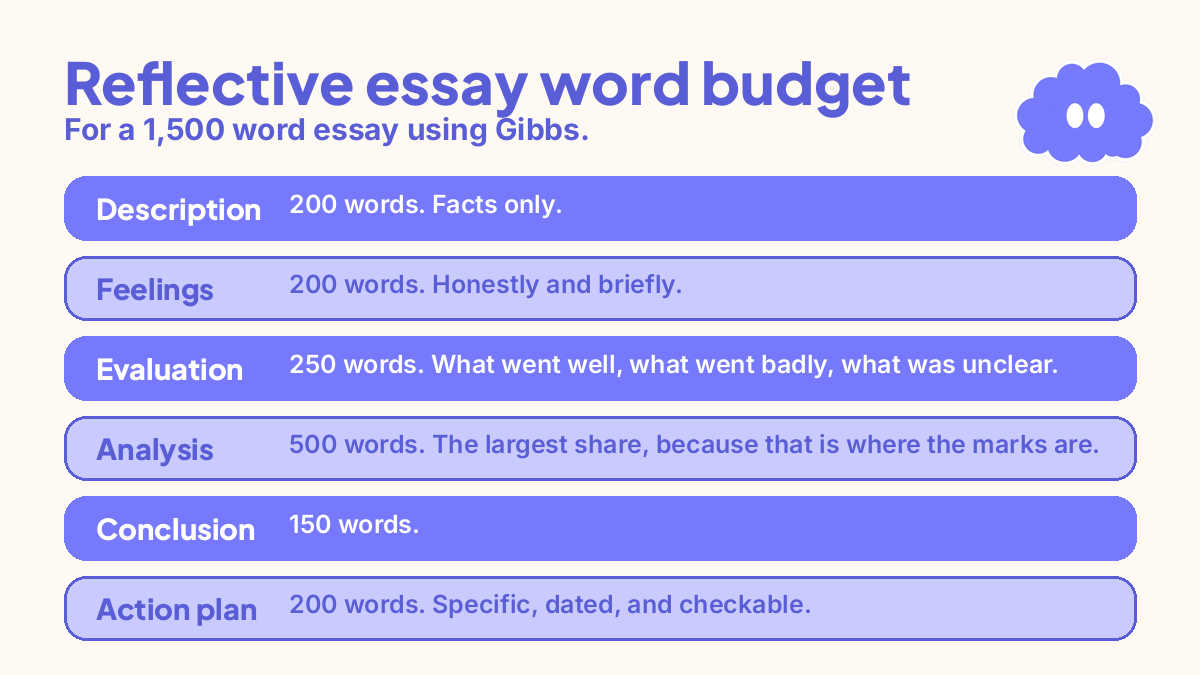
For a 1,500 word essay using Gibbs, use this split. Description: 200 words. Feelings: 200 words. Evaluation: 250 words. Analysis: 500 words. Conclusion: 150 words. Action plan: 200 words. Description and feelings together come to 400 words, 27% of the total, inside the 30% limit. Analysis gets the largest share, because that is where the marks are.
Write the description as facts only. “I arrived at 9:00am. The patient asked for pain relief. I said I would check with the nurse. I did not return for 40 minutes.” That is description. “It was a terrible morning and I felt awful” is not, and it does not belong here. Write the feelings next, honestly and briefly: “I felt confident at the start and embarrassed by the end” is useful, while “I felt a range of emotions” says nothing. Write the evaluation as a short judgement: what went well, what went badly, and what was unclear. Then write the analysis, the longest section, which answers why it went that way and what the theory says about it.
Write the conclusion as one paragraph: what you learned, in one or two sentences. Then write the action plan as specific steps with dates. “I will practise” is not an action plan. “I will rehearse the first two minutes of my next presentation out loud, twice, the evening before, and ask one classmate to time me” is one. Draft fast and do not edit as you go. Write the introduction last, in 15 minutes.
Step 5: Link theory to what happened, one claim at a time
Theory in a reflective essay must do real work. A paragraph that describes a theory and then never mentions the incident again is decoration, and markers ignore it. Link theory to the incident one claim at a time, in this pattern: what happened, what the theory says, what that means for your incident.
Start with your strongest claim, not your longest theory summary. For example: “I spoke for eight of the ten minutes, and nobody else contributed. Group role theory suggests that one person dominating the discussion shuts down the others, which matches what happened here.” The theory explains the incident instead of sitting beside it.
Use one theory well rather than three theories badly. Pick the one that explains the most of what happened, and mention the others only if they change the conclusion. Cite Gibbs (1988) and Kolb (1984) by name and year, and follow your department’s referencing style. If your essay also needs a literature review, the literature review system shows how to organise sources by theme instead of listing them one by one. Check each theory paragraph with one question: if I deleted the theory, would the paragraph still say the same thing? If yes, the theory is decoration. Rewrite it so the theory changes the conclusion, or cut it.
Step 6: Edit in three passes, then submit early
Edit in three separate passes, one job per pass. Editing everything at once is how description survives and the action plan stays vague.
Pass one: cut description. Read the description and feelings sections and cut every sentence that repeats a fact, adds background the marker does not need, or belongs in the analysis. Count the words in description and feelings together, and cut until they are under 30%. Most first drafts are 40% description.
Pass two: check the feelings. Ask whether each feeling is honest and specific. Cut phrases like “I felt a range of emotions” and replace them with the actual feeling and the moment it changed. Then check that the feelings match the analysis: if you say you felt confident but the analysis says you were unprepared, one of them is wrong.
Pass three: test the action plan. Read each action and ask three questions: is it specific, does it have a date, and could someone check whether I did it? If an action fails any of the three, rewrite it. Then read the whole essay aloud, or record yourself explaining it and listen back. Check the word count, the model stages, and the references, then submit a day early if you can.
A worked example: a reflective essay on one failed group presentation, written over five days
Your situation: second-year business student, 1,500 word reflective essay using Gibbs, due Friday. The incident is a group presentation on Tuesday 4 November when you spoke for eight of the ten minutes, two group members said nothing, and the tutor’s feedback was that the group sounded like one person presenting.
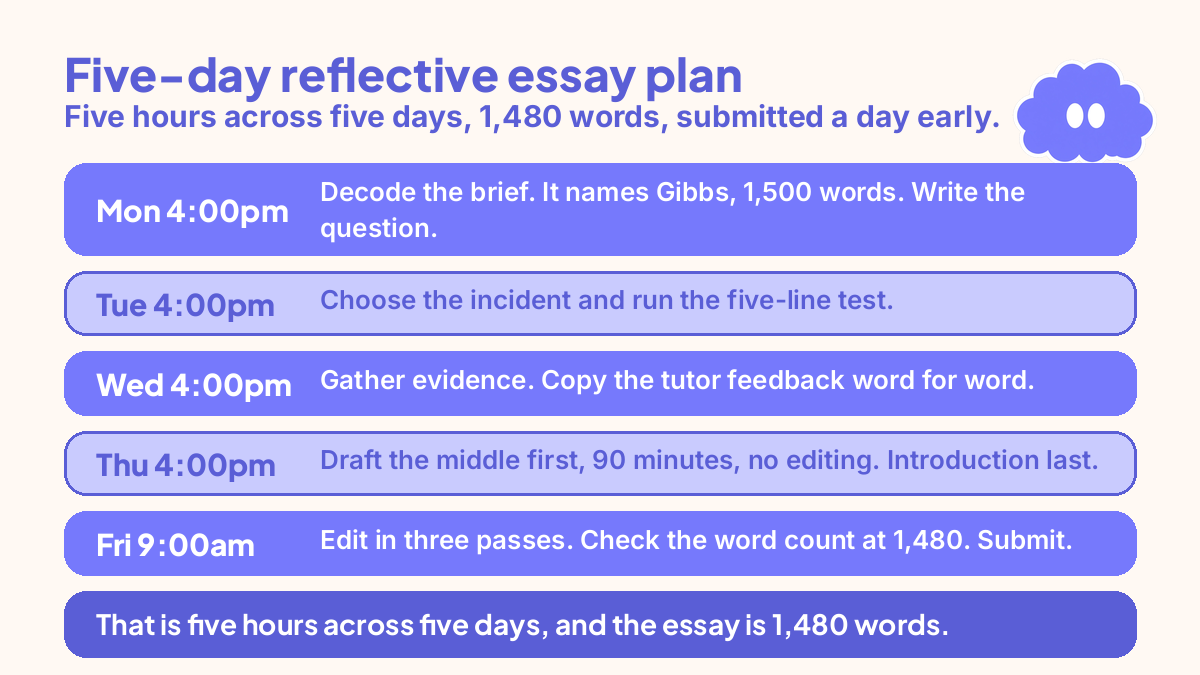
- Monday, 4:00-5:00pm: decode the brief. It names Gibbs, 1,500 words with 10% tolerance, weight on analysis and action plan. Write the one-sentence question for the essay.
- Tuesday, 4:00-4:45pm: choose the incident and run the five-line test. Reject the whole module as too big and the earlier seminar as too smooth to analyse.
- Wednesday, 4:00-4:30pm: gather evidence. Copy the tutor’s feedback word for word, ask one group member what they noticed, and write the group roles theory in two sentences of your own.
- Thursday, 4:00-5:30pm: draft the middle first, 90 minutes, no editing. Description 200 words, feelings 200, evaluation 250, analysis 500, conclusion 150, action plan 200. Write the introduction last, in 15 minutes.
- Friday, 9:00-10:00am: edit in three passes. Pass one cuts 120 words of description. Pass two fixes the feelings. Pass three rewrites the action plan with dates. Read the essay aloud, check the word count at 1,480, and submit at 10:00am, a day early.
That is five hours across five days, and the essay is 1,480 words with description and feelings at 26%.
When it goes wrong
Your essay is all description. Cut the description to its word budget and move the cut words into analysis. Ask why after every descriptive sentence.
Your essay is all feeling and no analysis. Keep the feelings section short and move the extra feeling sentences into the analysis as evidence. “I felt embarrassed” becomes “I felt embarrassed because I had prepared the slides alone and nobody else had seen them, which meant the group had no reason to speak.” Feelings are the data. Analysis is what you do with the data.
You cannot link theory to the incident. You may have chosen the wrong theory, or the wrong incident. Re-read the theory in two sentences of your own. If it explains nothing that happened, pick a different theory, or a different incident. Do not force a theory onto an incident it does not fit.
You miss a day in the five-day plan. Do the next step as planned, with no doubling up. The weekly study review system covers the same rule: one missed day is a bad day, not a failed system.
Weekly review checklist
Use this checklist at the end of the week you submit the essay, in writing.
- Did description and feelings together stay under 30% of the word count?
- Does each theory paragraph change the conclusion, or only decorate it?
- Is the action plan specific, dated, and checkable by someone else?
- Did the model stages appear in order, with none missing?
- What one part of the drafting order will you keep for the next reflective essay?
- What one mistake from this essay will you avoid next time?
Downloadable infographic spec: one vertical image, title “How to write a reflective essay”, with the six steps from “The system in short” and the six review questions above, in Thynq cream, Cloud Purple, Dark Purple and pink, with the Cloud mascot. Text taken word-for-word from this article.
What this system is not
This system does not turn a weak incident into a strong essay. If nothing went wrong and nothing surprised you, no amount of drafting will create analysis. It does not promise grades, and it does not replace your brief: if your department wants a different model, a different word count, or third person throughout, follow the brief.
It is not a coursework essay system. A coursework essay argues a case from sources. A reflective essay examines your own experience with the help of theory. The two are marked differently, so keep them separate. If you have never written reflectively before, start with one Gibbs reflection of 300 words on a single seminar.
Sources
- Gibbs, G. (1988). Learning by Doing: A Guide to Teaching and Learning Methods. Oxford: Further Education Unit, Oxford Polytechnic. The six-stage reflective cycle used in this system.
- Kolb, D. A. (1984). Experiential Learning: Experience as the Source of Learning and Development. Prentice Hall. The four-stage learning cycle, an alternative model.
- Dunlosky, J., et al. (2013). Improving students’ learning with effective learning techniques. Psychological Science in the Public Interest, 14(1), 4-58. Practice testing and self-explanation were rated higher than re-reading.
Questions
How do I start a reflective essay?
Start with the incident, not with the introduction. Pick one specific moment you can describe in five lines, then choose your model and write the description and feelings first. The introduction is easier once the middle exists, and most students who start at the top write a vague opening they later delete.
How much of a reflective essay should be description?
Keep description and feelings together under 30% of the word count. The rest goes to evaluation, analysis, and the action plan. If description passes half the essay, the marker sees a diary entry, not a reflection, so cut the retelling and add one more paragraph that explains why it happened.
Should a reflective essay be written in the first person?
Yes, in most cases. Reflection is about your experience, so first person is expected in the descriptive and reflective parts. Check your brief first, because some departments want third person for the theory sections. When in doubt, use first person for what happened and third person for the theory you link to it.
Which reflective model should I use?
Use the model your brief names. If it names none, Gibbs works well for a single incident because it walks you through description, feelings, evaluation, analysis, conclusion, and action plan in order. Kolb suits learning from repeated practice, and Driscoll suits short reflections. Pick one model and use it all the way through.